Zhu Ye Qing: Bamboo Leaves from the Mountain Where Monkeys Pick Tea
As an Amazon Associate, I earn from qualifying purchases.
The first time I went to Mount Emei, I was thirty-one and already a decade into my tea habit. I’d drunk Longjing in Hangzhou, Tieguanyin in Anxi, pu’er in Menghai. I thought I knew Chinese tea. Then the bus dropped me at the halfway point — about 1,200 meters up — and I watched a Tibetan macaque steal a tourist’s bag of Lay’s potato chips while the mist rolled in from Golden Summit and erased everything below us.
The tea gardens started appearing around 800 meters, tucked into terraces so narrow you could touch both edges with outstretched arms. The leaves were the color of fresh bamboo — not the dark, waxy green of mature growth, but the pale, translucent green of new shoots in April. An elderly woman was working a row, her bamboo basket strapped to her back, her fingers moving with the same precision I’d later see in the monastery kitchens below.
“These are picked before Qingming,” she said when I stopped to watch. “After that, they’re just leaves.”
She held one up: a single bud, flat and pointed, the exact shape of a bamboo leaf. I’d been drinking tea for ten years and had never seen anything quite like it.
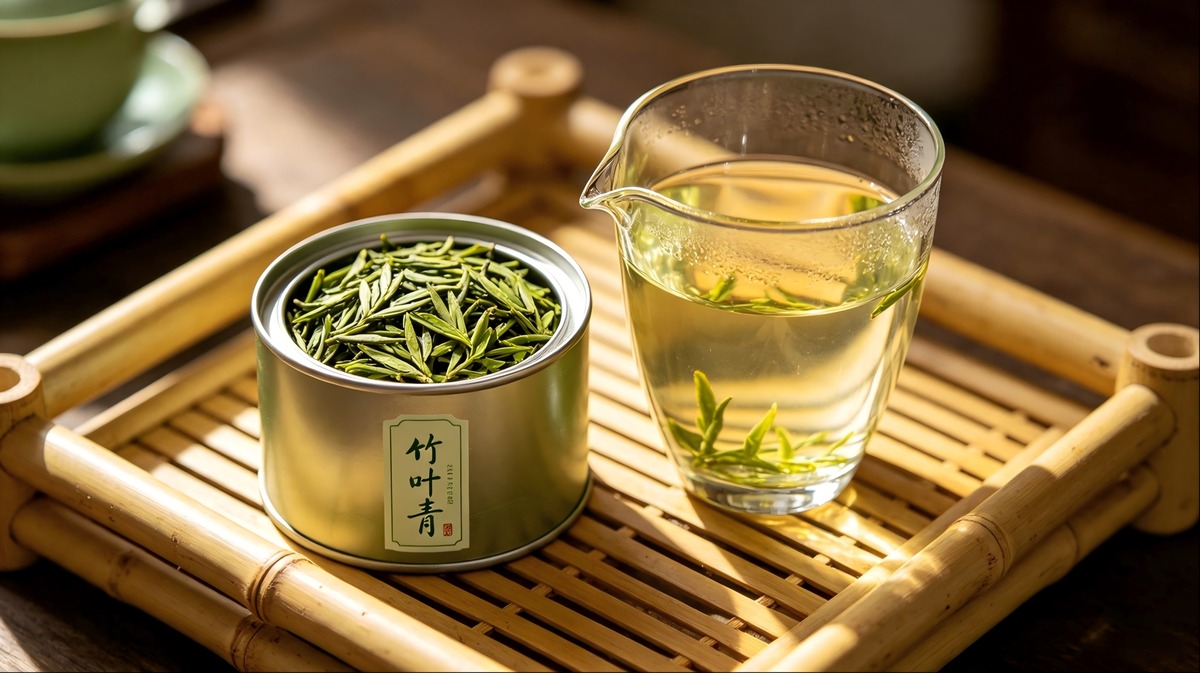
Zhu Ye Qing. Bamboo Leaf Green. A tea named after what it looks like — and a mountain that has been growing it for more than a thousand years.
Altitude in a Cup
Zhu Ye Qing (竹叶青) is a premium green tea grown exclusively on Mount Emei (峨眉山) in Sichuan province. The mountain sits at the western edge of the Sichuan Basin, rising sharply from the plain to 3,099 meters at its Golden Summit. The tea gardens occupy the middle band — roughly 800 to 1,500 meters — where the temperature stays cool year-round and the mountain’s famous sea of clouds provides natural shade and humidity.
The name is purely descriptive. The processed leaves are flat, smooth, and tapered at both ends — the silhouette of a bamboo leaf. No poetry. No emperor’s blessing. Just a tea that looks exactly like what it’s named after.
What makes Zhu Ye Qing different from other Chinese green teas starts with the plucking standard. Only the single bud is picked — no accompanying leaf, no stem. The buds are plucked in early spring, before the Qingming Festival in early April, when the plant’s energy is concentrated in the newest growth. A single kilogram of finished tea requires roughly 50,000 to 60,000 hand-plucked buds. That’s about five hours of continuous picking by an experienced hand.
The processing is deceptively simple. After plucking, the buds are spread and allowed to wither slightly in the mountain air — a step called tan liang (摊晾) that reduces moisture and begins concentrating the leaf’s amino acids. Then comes the kill-green step (sha qing, 杀青): the buds are tossed in a hot wok at roughly 180-200°C to deactivate the enzymes that would otherwise oxidize the leaf. This is where the tea maker’s skill matters most — too hot and the buds scorch; too cool and the grassy notes persist. After fixation, the buds are shaped — rolled and pressed by hand to achieve their signature flat, blade-like form. The final step is drying, done at a lower temperature to preserve the delicate flavor compounds built up during the mountain’s slow spring growth.
The altitude is the secret weapon. Tea grown above 800 meters develops more slowly, which means more time for amino acids — particularly theanine — to accumulate in the leaves. Theanine is the compound responsible for the sweet, brothy umami that defines high-end green teas. Combine that with Mount Emei’s near-constant mist — the mountain gets over 200 foggy days per year — and you get leaves that are naturally shaded, pushing amino acid levels even higher. It’s the same principle that makes Japanese gyokuro so intensely savory, but achieved through geography rather than deliberate shade-cloth farming.
What does it actually taste like? The dry leaves smell like roasted chestnuts and fresh-cut grass — similar to Longjing, but lighter. The liquor is pale jade-green, almost translucent. First sip: vegetal and clean, like snap peas in spring. Then a chestnut sweetness emerges, soft and round. The finish is where Zhu Ye Qing distinguishes itself — it’s long and cool, with a subtle returning sweetness (hui gan, 回甘) that starts at the back of your throat and spreads forward. It tastes like the mountain it came from: clean, a little austere, and far quieter than it has any right to be.
The Monks Knew First
Mount Emei is one of China’s Four Sacred Buddhist Mountains. The first Buddhist temple in China was built here in the 1st century CE. By the Tang Dynasty, there were more than a hundred temples scattered across its slopes, and the monks had already figured out that the mountain’s climate was perfect for growing tea.
The relationship between Buddhism and tea on Mount Emei is not decorative — it’s functional. Monks meditate for hours. Tea keeps you awake without making you jittery. Over centuries, the monasteries developed their own tea gardens, their own processing techniques, their own rituals. Drinking Zhu Ye Qing on Mount Emei is not a tourist activity. It is a thousand-year-old practice of staying present. There’s a local saying: “峨眉天下秀” — Emei is the most beautiful mountain under heaven. The tea, in its own quiet way, agrees.
How to Brew It Without Ruining It
Zhu Ye Qing is a delicate green tea. Treat it like one. Water temperature: 80-85°C (176-185°F). If you don’t have a variable-temperature kettle, bring water to a boil and let it sit for two minutes before pouring. Boiling water will scald the buds and turn the liquor yellow and bitter. A temperature-controlled kettle removes the guesswork — it’s the single piece of equipment I recommend to every new tea drinker, regardless of what they’re brewing.
Vessel: A tall, clear glass is ideal. Zhu Ye Qing is a visual tea — the buds sink slowly, then stand upright at the bottom of the glass like tiny bamboo forests. You lose half the experience if you can’t watch it happen. Dosage: 2-3 grams per 200ml of water. Green tea is not oolong — don’t pack the vessel. Steeping: Pour water along the side of the glass, not directly onto the leaves, to keep the temperature gentle. First infusion: 1-2 minutes. Second and third: 30-60 seconds each. You’ll get three solid infusions before the flavor fades. The second pour is usually the best — the buds have fully opened by then.
Want to learn the gongfu brewing method that works for any Chinese tea? Start with the gaiwan guide — three fingers, one lid, and the most versatile brewing vessel in the world.
Where to start: Authentic Mount Emei Zhu Ye Qing is still relatively hard to find on Western-facing platforms. Specialty tea shops that source directly from Sichuan are your best bet. If you’re buying online, look for terms like “pre-Qingming” (明前), “single bud” (独芽), and “Emei” (峨眉) as quality indicators. Good Zhu Ye Qing should have buds that are uniform in size, pale green with a slight silver sheen, and unbroken. If the bag smells more like hay than chestnuts, it’s stale.
Next: Anji Baicha — the albino tea that isn’t actually a white tea, and why its pale leaves make everything you think you know about green tea wrong.