Tieguanyin: The Iron Goddess in Your Cup
As an Amazon Associate, I earn from qualifying purchases.
The first time I smelled real Tieguanyin, I wasn’t drinking it. I was sitting in a concrete farmhouse in Anxi County, Fujian, watching a tea maker named Mr. Lin sift through a bamboo tray of dark green pellets the size of peppercorns. The room was warm — early October, no air conditioning, windows open to the terraced hills outside — and the air was thick with something I couldn’t place. Not jasmine. Not osmanthus. Something cooler. Wilder. It got into my sinuses and stayed there.
“Orchids,” Mr. Lin said, before I could ask. “The leaves do that themselves. No flowers anywhere. No added fragrance. Just the tea.”
He was right. There were no flowers in the room. No perfume. No essential oils. Just a fifty-year-old man, a bamboo tray, and a kilogram of tea leaves that smelled like a florist’s shop in April.
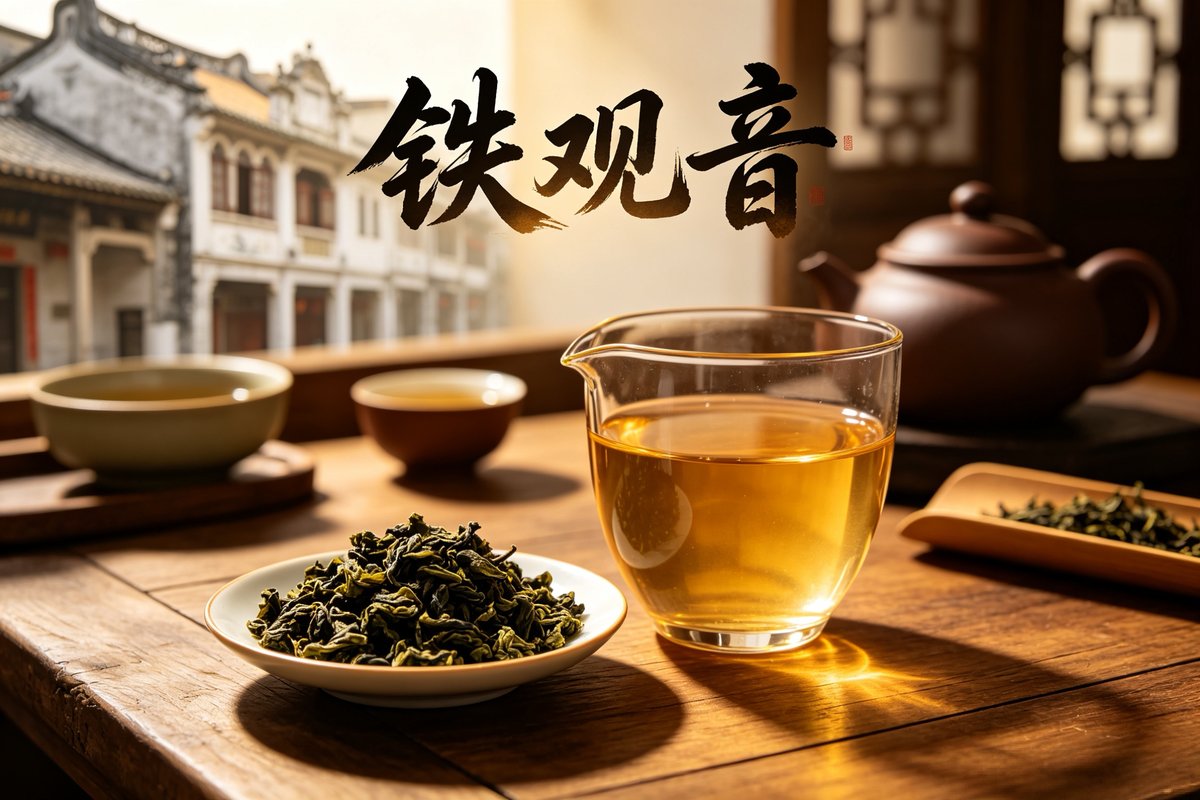
That’s Tieguanyin (铁观音). It’s an oolong tea from the hills of southern Fujian, and its calling card is an orchid fragrance so vivid that first-timers assume it must be artificial. It’s not. It’s chemistry — the result of a production process so precise it borders on obsessive. And the tea doesn’t just smell like orchids. Pour it six times from the same leaves, and each cup tastes different. No other tea transforms itself so completely across a single session.
The Bruise That Becomes a Flower
Tieguanyin sits in the oolong family — partially oxidized, somewhere between green and black. Modern “green-style” Tieguanyin is oxidized maybe 15-20%, barely more than a green tea. Traditional Tieguanyin, the way it was made for centuries before vacuum packing and refrigeration, goes to 40-50%. Both produce the orchid note. They just get there differently.
The process hinges on a step called yao qing (摇青) — “shaking the green.” After picking (one bud, two or three leaves, always by hand), the leaves are spread on bamboo trays to wither under the Fujian sun. Then comes the shaking: the leaves are tossed in rotating bamboo drums, again and again, bruising their edges. Each bruise breaks cell walls. Enzymes meet oxygen. Oxidation starts — but only at the margins, where the leaf is wounded.
The tea maker repeats this cycle for hours. Shake, rest, shake, rest. Each round deepens the oxidation at the leaf edges while the center stays green. The bruised edges are where the orchid fragrance lives. The bruising releases lipids and glycosides that, during the subsequent firing step, transform into linalool, geraniol, and indole — the exact same aromatic compounds that give real orchid flowers their scent. The tea didn’t borrow the fragrance from somewhere else. It synthesized it from its own biochemistry.
After shaking, the leaves are pan-fired to stop oxidation, then rolled — not once, but in multiple passes — into tight pellets. This shape, unique to Fujian and Taiwanese oolongs, preserves freshness. Drop the pellets into hot water and they don’t just open. They explode, unfurling from peppercorn to full leaf in the space of a single steep.
The whole process — withering, shaking, firing, rolling, drying — takes about thirty-six hours. It’s the kind of pipeline where you can’t fix mistakes. If the shaking goes too long, the orchid note goes flat and grassy. If the firing is too hot, you get roast and no flower. Mr. Lin told me he ruined his first two years of batches. “The tea teaches you,” he said. “But it doesn’t tell you what you did wrong. You have to figure that out yourself.”
What Tieguanyin Actually Tastes Like
Let me be honest about something most tea guides won’t tell you: there are two completely different Tieguanyins, and they taste nothing alike.
Green-style Tieguanyin — the modern version, roughly 80% of what you’ll find on the market — is pale gold in the cup. It smells like someone crushed a handful of orchid petals into hot water. The taste is light, floral, almost creamy — a clean sweetness that runs through the front of your mouth and vanishes quickly. It’s refreshing in the way a cold glass of sparkling water is refreshing. No weight. No roast. Just flowers and clarity.
Traditional Tieguanyin is amber-brown in the cup and smells like roasted orchids — flowers baked into toast. The taste is heavier, rounder, with a mineral depth that lingers long after you swallow. There’s honey. There’s stone fruit — apricot, maybe peach. And there’s hui gan (回甘), the “returning sweetness” that rises in your throat a full thirty seconds after the tea is gone. It’s like the finish of a good wine, except instead of oak and tannin you get a slow wave of sweetness you didn’t see coming.
If green-style is a pop song, traditional is a symphony. I prefer the traditional version. So does Mr. Lin. “The young people want green,” he told me, shrugging. “They think traditional is for old men. They are wrong, but the market is the market.”
The good news is you don’t have to choose. Start with green-style — it’s easier to find, cheaper, and the orchid fragrance will tell you immediately why this tea is famous. Then, when you’re ready, hunt down a traditional roast from a village like Gande or Xiping. The distance between the two is the best tea education you’ll ever get, and it costs less than a single bottle of mediocre wine.
The Goddess and the Farmer
The name Tieguanyin means “Iron Guanyin” — Guanyin being the Buddhist bodhisattva of compassion, the one who hears the suffering of the world. “Iron” refers to the weight of the finished leaves, which are so dense they clink when dropped onto porcelain.
The origin story, told in Anxi for generations, goes like this: a poor farmer named Wei Yin walked past a crumbling temple to Guanyin every day on his way to his tea fields. The statue inside was covered in dust. Wei couldn’t afford to restore the temple, so he did what he could — swept the floor, burned incense, tidied the altar. He did this for years. No one asked him to. No one was watching.
One night, Guanyin appeared to him in a dream and told him to look behind the temple. He found a single tea plant growing in the rocks — a plant nobody had seen before. He propagated it, pressed the leaves into tight pellets, brewed the tea. The fragrance was unlike anything in Anxi. When he shared it with neighbors, they asked what it was called. “Iron Guanyin,” he said — heavy as iron, given by the Goddess.
I like this story because it’s not about wealth or reward. Wei didn’t ask for anything. He just swept a temple floor because it seemed like the right thing to do. The tea was a gift, not a transaction. It’s the kind of story that makes you want to sit down with a cup and think about what you’ve been doing with your hands lately.
How to Brew Tieguanyin (The Gongfu Way)
You can brew Tieguanyin in a mug like any other tea. But if you do, you’re missing the entire point. This tea was designed for gongfu cha (工夫茶) — the Chinese method of brewing tea with a high leaf-to-water ratio and multiple short steeps in a small vessel. The vessel is traditionally a gaiwan — a lidded porcelain bowl that fits in your palm.
Here’s the routine:
Fill the gaiwan one-third full with dry leaves. Yes, that much. The pellets will expand enormously — a single teaspoon of dry Tieguanyin can fill a gaiwan once it opens up.
Water at 90-95°C. Hotter than green tea, cooler than black. Let boiling water sit for thirty seconds before you pour. A temperature-controlled kettle makes this effortless, but you can also just wait.
First steep: rinse and discard. Pour hot water over the leaves and pour it out immediately — don’t drink this. It wakes the leaves and washes off dust. This is standard gongfu protocol for all ball-rolled oolongs.
Second steep: 20-30 seconds. This is where the orchid fragrance peaks. The leaves will have just started to open. The liquor will be pale gold. Sip slowly. Pay attention. This steep is fleeting, and it won’t taste the same in five minutes.
Third steep: 30-40 seconds. The leaves are fully open now. The floral notes start giving ground to honey and minerals. Many people — me included — think this is the best pour in the sequence.
Fourth through eighth steeps: Add 15 seconds each time. The tea will keep giving — softer, sweeter, like a conversation that’s moved past introductions into something more comfortable. By the seventh steep the orchid is mostly gone, but the mineral sweetness remains. By the eighth, it’s a memory of tea. Drink it anyway.
Pour along the inside edge of the gaiwan, not directly onto the leaves. Aggressive pouring bruises the leaves further and releases bitterness. The whole ritual takes maybe twenty minutes. It’s not fast. That’s the point.
Where to Start
If you’ve never had Tieguanyin, start with a green-style version from Anxi . The orchid fragrance is unmistakable, and a decent grade costs $15-30 for 100g — about the price of two cocktails in a city bar. (Traditional charcoal-roasted Tieguanyin — the amber-liquor version I described above — is surprisingly hard to find on Amazon. If you come across it in a specialty tea shop, buy it. In the meantime, here's a worthy detour:) If you're curious about more distinctive Tieguanyin variations, try osmanthus oolong — the floral sweetness of Tieguanyin meets the perfume of osmanthus blossoms, a completely different sensory experience.
Buy from a vendor who lists the harvest season and the specific village in Anxi — Gande, Xiping, and Xianghua are the well-known growing areas. If the label just says “Fujian” with no further detail, move on. The terroir differences between these villages are real. Gande Tieguanyin tends lighter and more floral; Xiping produces a heavier, more mineral cup. The village name on the package is the difference between drinking a wine that says “France” and one that says “Chablis Premier Cru.”
Next in the tea series: Ripe Pu’er — the dark tea fermented in piles for months until it tastes like old libraries and rain-wet earth. Same leaf, completely different universe.