The Tea Horse Road: China's Other Silk Road, Paved in Tea and Sweat
As an Amazon Associate, I earn from qualifying purchases.
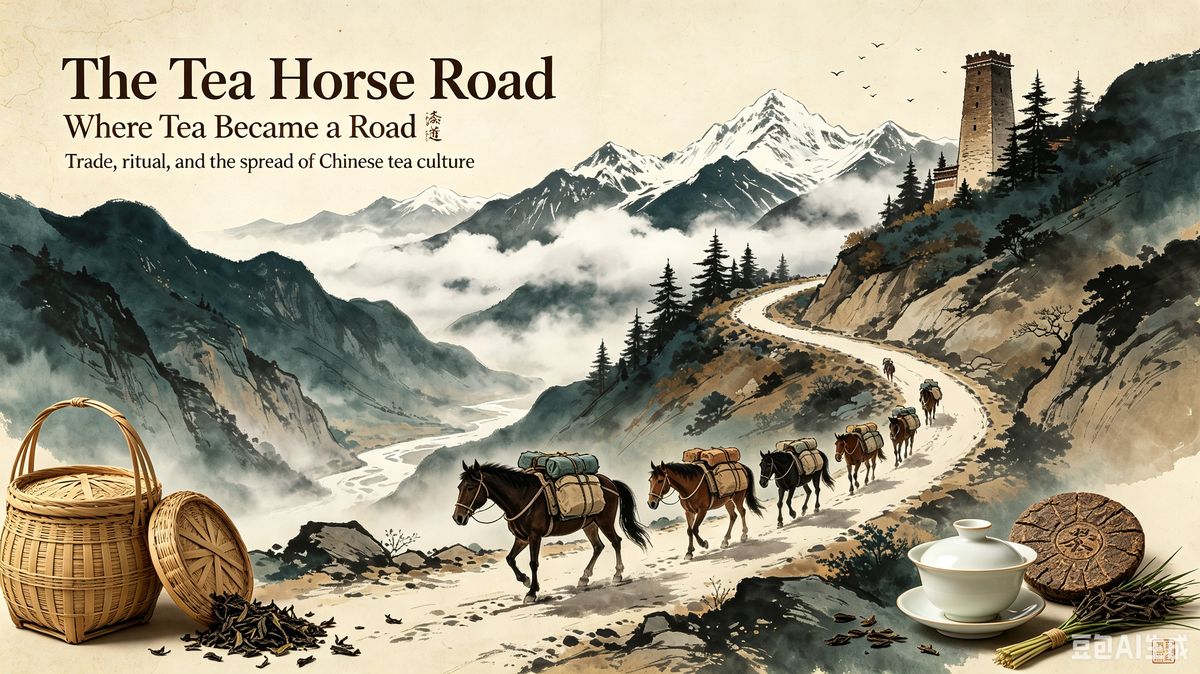
The horse was smaller than I expected. Not the tall, broad-shouldered warhorses you see in European paintings — this was a Yunnan pony, compact and muscular, the kind of animal that can carry twice its body weight up a mountain pass at four thousand meters without complaint. For a thousand years, these ponies carried China’s tea from the jungles of Xishuangbanna to the monasteries of Tibet, to the markets of Nepal, to the caravans that would eventually reach Persia and beyond. They carried bricks of pu’er tea compressed so tightly you could use them as doorstops. And the men who walked beside them carried something heavier: the weight of a trade route that killed roughly one in three of the people who walked it.
I learned this standing in a museum in Pu’er city, staring at a photograph from 1923. The photo showed a caravan of twenty ponies and six men, crossing a snow pass somewhere between Lijiang and Zhongdian. The men were wearing straw sandals. In the snow. One of them was smiling.
The Tea Horse Road was not a single road. It was a web of trails stretching over four thousand kilometers across what is now Yunnan, Sichuan, and Tibet, reaching into Myanmar, Nepal, and India. It predates the Silk Road by centuries — while the Silk Road was carrying jade and brocade to Rome, the Tea Horse Road was already carrying tea leaves up into the Himalayas. And while the Silk Road has been romanticized into a thousand books and documentaries, the Tea Horse Road remains mostly unknown outside China. Which is strange, because it arguably shaped the world more.
A Road Built by Addiction
Here is what most tea drinkers do not know: pu’er tea exists because of a logistical problem.
Yunnan grows some of the world’s oldest tea trees — some over a thousand years old, their trunks thick enough that it takes two people to wrap their arms around them. The tea from these trees, particularly from the Six Famous Tea Mountains of Xishuangbanna, was exceptional. But Yunnan is in the far south of China. The major population centers — and the major consumers of tea — were in the north and west.
Getting fresh loose leaf tea from Yunnan to Beijing overland took months. By the time it arrived, it was stale. So the tea makers of Yunnan invented a solution: they steamed the leaves and pressed them into dense bricks, wrapped them in bamboo, and let them ferment slowly over the months-long journey. By the time the bricks arrived at their destination, the tea had transformed. It was darker, earthier, more complex. Accidental fermentation had created something entirely new. Pu’er tea was not invented by a tea master in a laboratory. It was invented by distance.
But the real engine of the Tea Horse Road was not tea heading north — it was horses heading south. Tibet needed tea. The Tibetan diet was heavy on yak butter, barley, and dried meat — almost entirely lacking in vegetables. Tea provided vitamins and helped digest the fat. Tibetans began boiling bricks of pu’er with yak butter and salt to make what is now called butter tea, a drink that is somewhere between soup and a survival mechanism at high altitude. A single Tibetan might consume five kilograms of tea per year. Multiply that by a population of several million, living on a plateau where nothing resembling a tea plant could possibly grow, and you have the economic engine of an empire.
China, meanwhile, needed warhorses. The Song Dynasty was locked in a perpetual conflict with nomadic empires to the north, and China’s grasslands were not sufficient to breed the cavalry it needed. Tibet had horses. China had tea. The math was simple. At the height of the trade, a single brick of pu’er could buy a horse. Not a pony — a warhorse. The exchange rate was set by imperial decree and enforced at border markets where Chinese tea merchants and Tibetan horse traders met under the watch of armed guards. Tea was currency. Tea was military strategy. Tea was, for several centuries, literally the most valuable thing the Chinese empire produced.
The Two Main Routes — and the Tea That Built Them
The Tea Horse Road was not a single path. It was two great arteries, each carrying a different kind of tea, each serving a different half of the Himalayan world.
The Sichuan-Tibet route (川藏线) was the workhorse. Starting from Ya’an in western Sichuan, it carried the highest volume of tea of any route on the road. The tea that traveled this path was not the delicate green tea of the eastern provinces — it was nanlubiancha (南路边茶), or Tibetan tea, a fermented dark tea pressed into dense bricks called Kangzhuan (康砖) and Jinjian (金尖). The leaves were coarse, the stems thick, the fermentation deep. This was not tea for sipping contemplatively from a gaiwan. This was tea boiled with yak butter and salt into a thick, caloric slurry that kept Tibetan herders alive at four thousand meters above sea level. A single Tibetan might consume five kilograms of it per year. Multiply by millions, over centuries, and you begin to understand the scale of this trade.
The dark tea bricks had three advantages that made them uniquely suited to the road. First, they were impervious to the journey. A brick of Kangzhuan could be dropped in a river, dried in the sun, and still brew a decent cup. Loose leaf green tea would have been dust by the first mountain pass. Second, they served the Tibetan diet perfectly. A meal of yak meat, barley flour, and butter is heavy — dark tea cuts through the fat, aids digestion, and provides vitamins that are otherwise absent from a high-altitude pastoral diet. Third, the bricks themselves became currency. In the markets of Lhasa and Shigatse, a single Kangzhuan brick could buy salt, wool, or a month’s supply of barley. Tea was money. Tea was nutrition. Tea was, for much of Tibetan history, the difference between surviving the winter and not.
From Lhasa, the bricks traveled further — through the Chumbi Valley into Sikkim and Bhutan, over the Nathu La pass into India, through the mountain markets of Nepal. A Tibetan trader might start his journey in Ya’an with a caravan of forty horses loaded with tea bricks. By the time he reached Kathmandu, he would have traded those bricks for wool, salt, turquoise, and silver — and then turned around and walked back. The round trip took over a year.
There was also the smaller xilubiancha (西路边茶) route heading northwest from Sichuan into Qinghai and Gansu, serving Tibetan communities on the northeastern edge of the plateau. Its volume was far lower than the southern route, but it fed the trade networks that reached into Central Asia.
The Yunnan-Tibet route (滇藏线) carried pu’er. Starting from the tea mountains of Xishuangbanna and Pu’er city, this southern artery wound northwest through Dali, Lijiang, and Shangri-La before climbing into Tibet. The tea on this road was different: Yunnan’s large-leaf varietal, sun-dried, steamed, and pressed into cakes. The most famous forms were the Seven Sons cake (七子饼, a 357-gram disc), the bowl-shaped tuocha (沱茶), and the mushroom-shaped jincha (紧茶) — all raw pu’er, which would slowly ferment over the months-long journey through the mountains.
This route split at Dali. The northern fork went to Tibet and Nepal. The southern fork went through Xishuangbanna into Burma, then into India’s Assam region and further into Thailand and Laos. Pu’er from these southern branches fed the tea habits of Southeast Asia for centuries. The compression of the cakes was not aesthetic — it was engineering. A mule could carry loose leaf tea, but a mule could carry far more tea if that tea was pressed into dense discs and stacked. When you are crossing the Hengduan Mountains at four thousand meters, where a misstep means a thousand-meter fall, every gram of load matters. The tea cake was the most efficient form of tea ever invented for transport by animal.
The Men Who Walked It
I keep coming back to that photograph. The straw sandals in the snow. The smiling man.
The porters on the Tea Horse Road were mostly from Yunnan and Sichuan — poor farmers who could not afford horses of their own. They carried loads of sixty to ninety kilograms on their backs, suspended from a band across their foreheads. They walked in teams of ten to twenty, singing work chants to keep rhythm. A round trip from Pu’er to Lhasa and back took over a year. Some of them made the journey once and never returned — landslide, altitude sickness, bandits, or simply the exhaustion of carrying a human weight up a mountain at four thousand meters above sea level.
The tea they carried was stamped with the name of the mountain it came from. Menghai. Yiwu. Nannuo. Bulang. These names became brands, hundreds of years before anyone used the word brand. A brick stamped “Yiwu” commanded a higher price in Lhasa than one stamped with an unknown mountain. The reputation of a tea followed it across a continent. If that sounds like modern luxury marketing, it is because it is exactly that — terroir-based branding, executed at altitude, on foot, in the twelfth century.
What Remains
The Tea Horse Road died in the 1960s. Highways were built through the mountains. Trucks replaced ponies. The border markets closed. The last of the old porters passed away, taking their songs with them.
But you can still walk parts of the road today. The section between Shaxi and Shigu in Yunnan is a well-preserved cobblestone trail that winds through pine forests and terraced fields, the stones polished smooth by a thousand years of hooves and feet. In the villages along the route, old men still press pu’er into bricks by hand, using stone molds that their grandfathers used, that their grandfathers’ grandfathers used.
And the tea itself — pu’er from the Six Famous Tea Mountains — is now among the most expensive tea in the world. A single cake of vintage raw pu’er from a named ancient tree can sell for more than a car. The road is gone. The value it created is not.
If you want to taste what the Tea Horse Road tasted like, start with a ripe pu’er from Menghai — the region that produced the bricks that bought warhorses. A temperature-controlled kettle is non-negotiable (pu’er demands boiling water, 100°C, no exceptions). A plain white gaiwan lets you watch the liquor darken from pale amber to the color of strong coffee over five, six, eight steeps. And the tea itself? Start with a classic Menghai 7572 ripe pu’er cake — the benchmark for what tea from this region should taste like — or try an aged tangerine pu’er for a citrus-inflected variation that has become wildly popular in the last decade. That darkness is the taste of a thousand years of trade, compressed into a cup.
As an Amazon Associate, I earn from qualifying purchases.
Next: we leave the trade routes behind and go into the mountains themselves. The ancient tea trees of Yunnan — some older than the Ming Dynasty — and what a tea tastes like when the tree it came from has been alive for eight hundred years.