Sitting Still With Tea: What a Chengdu Tea House Taught Me About Chan Buddhism
As an Amazon Associate, I earn from qualifying purchases.
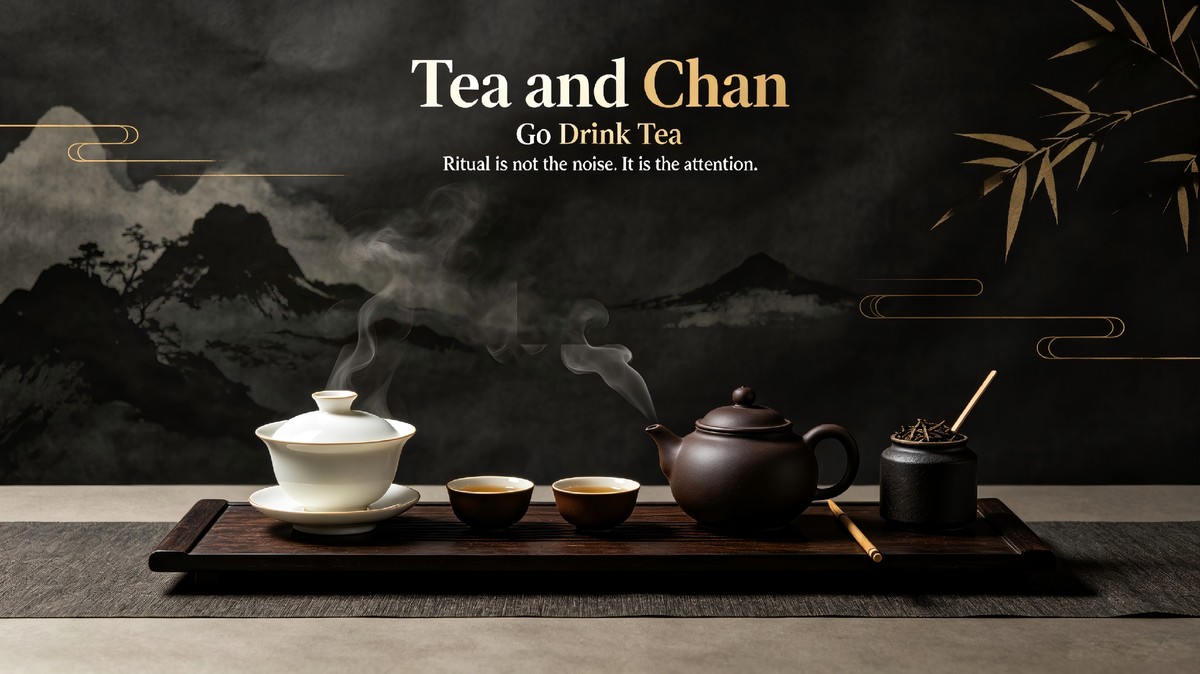
The tea master never looked at me. Not once in two hours. She poured from a long-spout copper kettle in a single continuous arc — a motion she had performed, by my rough calculation, somewhere north of three hundred thousand times. Her eyes stayed on the water, on the cup, on the leaves unfurling in the bottom of the gaiwan. I was the only customer at 3pm on a Tuesday, sitting on a bamboo stool in a Chengdu tea house that smelled of roasted Tieguanyin and old wood. And she was teaching me something without saying a word.
I had come to Chengdu for the tea. I left understanding something about attention.
This is the part where most people expect me to explain what Chan Buddhism is. I am not going to do that. Partly because I am a programmer who builds distributed systems, not a monk. But mostly because the thing that hit me in that tea house was not a concept you can explain. It was a state you can only enter — and tea, as it turns out, is one of the oldest and most reliable doors into it.
The Monk Who Said Three Words
In the 9th century, a monk named Zhaozhou ran a small temple in northern China. One day, a young monk arrived, having walked for weeks to study under him.
“I have just arrived at this temple,” the young monk said. “Please teach me.”
Zhaozhou looked at him. “Have you eaten your rice porridge?”
“Yes, I have.”
“Then go wash your bowl.”
The young monk bowed and left. Later, another monk — one who had been at the temple for years — asked the same question: “Please teach me.”
Zhaozhou asked him: “Have you eaten your rice porridge?”
“Yes.”
“Then go wash your bowl.”
The senior monk stood there, confused. “Master, I have been washing my bowl every day for five years. I am asking you for the deeper teaching.”
Zhaozhou looked at him for a long moment. Then he said three words that have echoed through Chinese tea culture for over a thousand years:
Chi cha qu. Go drink tea.
Not as a dismissal. As the entire teaching, compressed into three syllables. The point was never the tea. The point was the attention you bring to it. Wash your bowl. Drink your tea. The rest is noise.
The Space Between Steeps
I think about this story a lot when I brew oolong in a gaiwan. If you have ever brewed gongfu-style, you know the rhythm. Pour. Wait twenty seconds. Pour out. Drink. Pour again. Wait twenty-five seconds. Pour out. Drink. Seven, eight, ten steeps, each one slightly different from the last, the tea softening and deepening as the leaves give up everything they have.
And between each steep, a gap. Ten seconds of nothing. Maybe twenty. You cannot check your phone — your hands are occupied with a gaiwan that is exactly the temperature of boiling water. You cannot plan your next meeting. You cannot debug the build failure from earlier. You are pinned to the present by a piece of porcelain and some leaves.
This gap, I have come to believe, is the point. Not the tea. The gap.
I spent thirteen years in big tech — Microsoft, Google, NVIDIA. I built systems designed to process information faster. Lower latency. Higher throughput. I was very good at reducing the gap between input and output. And at some point, without noticing it, I reduced the gap between living and thinking about living to zero. There was no space left between a moment and my reaction to it.
Tea puts the gap back. It is not a productivity hack. It is a slowness hack. And the Chan monks figured this out a thousand years before Slack notifications existed.
Chan Buddhism and tea grew up together in China for a reason. Monks discovered that the caffeine in tea kept them awake during long hours of meditation — but they also discovered something subtler. The act of preparing and drinking tea was itself a form of meditation. Grinding the leaves. Heating the water. Watching the steam rise. The entire sequence demanded the same quality of attention that sitting on a cushion did. But for people like me, who cannot sit still on a cushion for more than eight minutes without wanting to check a terminal, tea was the back door into the same room.
How to Drink Tea Like a Chan Monk
You do not need a temple. You do not need robes. You need three things: a gaiwan, some loose leaf tea, and the willingness to be bored for twenty minutes.
One: brew gongfu-style. Not because it is traditional. Because it is slow in a way that demands attention. Western-style brewing — one big pot, steeped for three minutes, poured into a mug — is efficient. Gongfu-style is deliberately inefficient. You cannot rush it. The leaves will not let you.
Two: do nothing between steeps. This is the hard part. The gap. Do not check your phone. Do not think about what you are going to do after. Watch the steam. Watch the leaves. Watch your own restlessness rise and fall like the water level in the gaiwan. If you cannot do ten seconds, do five. Build from there.
Three: drink it like it is the first cup you have ever tasted. Most of us drink tea the way we read email — scanning for the important parts, discarding the rest. Try drinking it the way a sommelier tastes wine. Let it sit in your mouth. Notice how the flavor changes as it cools. Notice that the third steep tastes nothing like the first. The tea is giving you a different version of itself every time. Pay attention.
I keep a plain white porcelain gaiwan on my desk now, next to a ThinkPad and a half-eaten bag of sunflower seeds. It is the cheapest thing on my desk and the most valuable. It does not beep. It does not have a dark mode. It just sits there, waiting for me to notice that I have not noticed anything all day.
As an Amazon Associate, I earn from qualifying purchases.
Next in the tea series: we leave the temple and enter the mountains. Phase 2 begins with the tea that monks drank to stay awake during meditation — and why its descendants now sell for more than gold by weight.