Rou Gui: Cinnamon Fire of the Wuyi Cliffs
As an Amazon Associate, I earn from qualifying purchases.
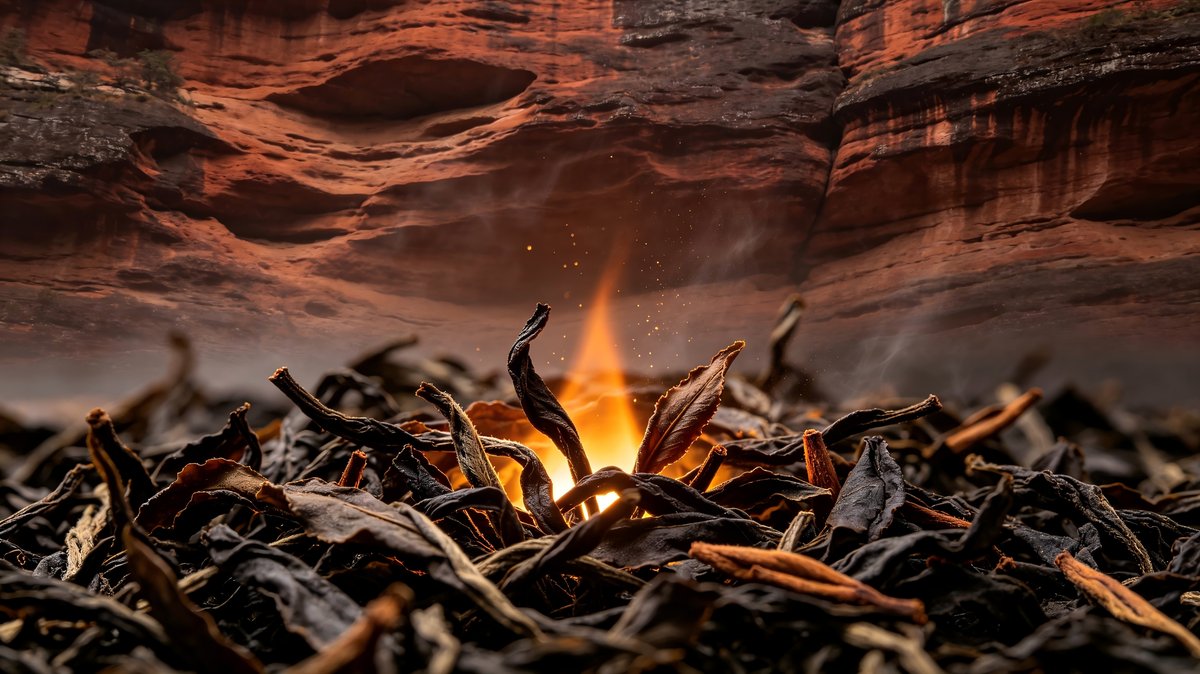
The tea master at Wuyi Shan had poured me seven teas in two hours. I was starting to think I understood rock tea — the mineral backbone, the honey-lift of Shui Xian, the charcoal authority of Da Hong Pao. Then he dropped a handful of dry leaves into a gaiwan and the entire room changed. The aroma hit before the water did: sharp, warm, ecclesiastical. My notes from that moment, scrawled in a notebook now stained with tea rings, read "smells like a Catholic church during Mass — sandalwood and something burning that isn't supposed to burn." The tea was Rou Gui (肉桂), which translates literally to "cinnamon." This is the first thing you need to understand about Rou Gui because Rou Gui does not taste like cinnamon. Not even a little. What Rou Gui actually is: the most aggressive, unapologetic rock tea in Wuyi. It doesn't introduce itself. It walks into the room and takes the chair at the head of the table.
The Cinnamon That Isn't
Rou Gui is a relatively young varietal by Wuyi standards. While Da Hong Pao traces its lineage back centuries, Rou Gui as a named cultivar emerged in the 1980s from a wild bush discovered in Wuyi's rocky, mineral-heavy soil. It spread fast. Today Rou Gui accounts for roughly thirty percent of Wuyi's rock tea acreage — second only to Shui Xian — and commands prices at auction that sometimes exceed Da Hong Pao. At the annual Wuyi Rock Tea Competition, the Rou Gui categories draw the most entries and the fiercest arguments. Growers treat it like a sport.
The "cinnamon" moniker comes from the aroma of the dry leaf — spicy, warm, woody — not the taste. Think of it like a Belgian tripel: all clove and banana on the nose, none of it in the mouth. The compound responsible is cinnamaldehyde, the same molecule that gives cinnamon bark its smell, present in trace amounts in Rou Gui leaves and amplified dramatically by the high-temperature charcoal roast. Rou Gui is the most heavily fired of the major Wuyi oolongs, typically roasted hotter and longer than either Da Hong Pao or Shui Xian. Oxidation runs fifty to sixty percent. The leaves come off the charcoal nearly black, and they snap when you bend them.
Processing follows the standard Wuyi oolong path — wither, bruise, oxidize, pan-fire, roll, charcoal-bake — but the roast is the entire story. Too light and you get a thin, vegetal tea with none of Rou Gui's signature power. Too heavy and you've burnt the spice notes into ash and bitterness. A properly roasted Rou Gui balances on a razor's edge. I spent thirteen years debugging distributed systems where the hardest bugs weren't the ones that crashed — they were the ones that almost worked, that produced correct results ninety-nine percent of the time and quietly corrupted data the other one percent. Rou Gui is the tea equivalent of a race condition: everything has to line up or the result is wrong in ways you can taste but can't quite name.
What you actually taste: pour boiling water on those dark, twisted leaves and the room fills with a fragrance I can only describe as liturgical — sandalwood, clove, old books, cooled incense. The first sip doesn't arrive gently. Where Shui Xian opens with honey and the promise of a long gentle afternoon, Rou Gui kicks the door down. The body is full, heavy, coating. Flavor starts with roasted grain and dark caramel, then the spice hits — not sweet baking cinnamon, but something closer to cassia bark, the rougher, more medicinal cousin. Behind that: wet stone, mineral water, the yán yùn backbone that every Wuyi tea carries. But in Rou Gui the rock note isn't a supporting player. It's the lead riff, distorted and loud.
The finish is what separates good Rou Gui from great. After you swallow, a cooling sensation rises in the throat — the Chinese call this hóu yùn (喉韵, "throat rhythm"). It's minty, almost mentholated, and it lingers like you just breathed cold air through a eucalyptus grove. This cooling throat finish is the signature of high-quality Rou Gui. If your Rou Gui doesn't have it, the roast was too heavy or the leaf too young. Through five or six steeps, the spice gradually burns off and the mineral character takes over. By steep seven you're tasting Wuyi sandstone filtered through charcoal — pure, dry, ancient. Rou Gui doesn't age into gentleness the way some oolongs do. It goes out swinging.
Domineering
In Chinese tea culture, there is a word that gets attached to Rou Gui more than any other: bà qì (霸气). It translates roughly to "domineering" — the quality of something that refuses to be subtle, that announces itself and owns the space it occupies. In Wuyi, this is not an insult. Bà qì is a compliment of the highest order, applied to teas that have presence so strong you can't ignore them. Rou Gui has bà qì the way a V8 engine at a red light has bà qì — everyone knows what it is and nobody is pretending otherwise.
Among Wuyi rock teas, Da Hong Pao is the legacy, Shui Xian is the workhorse, and Rou Gui is the one that swaggers. Tea farmers will tell you that if a man walks into a tea room and orders Rou Gui, he's either a beginner who heard the name and got curious, or an expert who knows exactly what he's asking for. There is no middle. The tea competition circuit has only amplified this reputation. Winning lots of Rou Gui sell for prices that make Bordeaux look reasonable — a single kilogram of competition-grade Rou Gui can run into the thousands of dollars, which is why growers roast harder and select leaves more ruthlessly every year. The chase for bà qì is self-reinforcing: the teas that win are the most extreme, so the next year's entries are even more extreme. Rou Gui is a feedback loop with a charcoal fire.
How to Brew Rou Gui
Three things you need to know before you brew Rou Gui at home.
First: boiling water, no exceptions. Rou Gui is the hardest rock tea to extract properly. If your water is ninety-five degrees instead of one hundred, you get warm cinnamon water with the structural integrity of a wet paper towel. It must be boiling. A variable-temperature kettle set to "boil and hold" removes the guesswork — Rou Gui's thick leaves demand sustained heat across all six to eight steeps.
Second: short steeps, zero forgiveness. Flash rinse the leaves, then first steep at ten seconds, second at fifteen, add five seconds per round. If you hit thirty seconds, you've gone too far and the astringency will grab your tongue like a fist. Six to eight steeps is a normal session. The cooling throat finish should arrive by steep three — if it never shows up, the tea isn't good Rou Gui. A plain porcelain gaiwan is your best tool here — it gives the leaves room to unfurl and won't interfere with the flavor the way a seasoned Yixing pot can.
Third: skip the Yixing pot for your first session. Use a porcelain gaiwan. You need to taste the tea, not the pot's accumulated memory. Yixing is for when you've committed to a specific Rou Gui and plan to drink it regularly. For exploration, gaiwan first — the porcelain won't lie to you.
Where to Start
If you want to try Rou Gui yourself, this Wuyi Rou Gui from YAN CHA is a solid entry point — traditional medium-heavy charcoal roast, the sandalwood-spice profile intact, the cooling throat finish present by steep three. Good dry Rou Gui smells like sandalwood and warm spice, not charcoal. If the dry leaf smells like a barbecue grill, the roast was overdone and the volatile aromatics are dead. If it smells like nothing at all, the tea is stale. The leaves should be long, dark brown to near-black, loosely twisted — not broken, not dusty, not compressed. When brewing, look for the liquor to pour amber-dark with an oily sheen on the surface. That sheen is a good sign — it means the leaf oils survived the roast intact.
Next: Fenghuang Dancong (凤凰单丛, Phoenix Single Bush) from Guangdong — the oolong that actually smells like what it's named after. Unlike Rou Gui's bait-and-switch with cinnamon, Dancong delivers honey-orchid perfume straight up with no tricks. Same oolong family, completely different philosophy.