Ripe Pu'er: Old Libraries, Rain-Wet Earth
As an Amazon Associate, I earn from qualifying purchases.
The first time I walked into a pu'er fermentation room, I thought something had gone wrong. It was July in Menghai County, Yunnan — already 35°C outside — and inside the warehouse it was hotter. Steam rose from mounds of dark leaves piled waist-high on the concrete floor. The air was thick, humid, alive. It smelled like a forest floor after three days of rain. Like old books in a library that hadn't been opened in decades. Like earth, but not dirty earth — the kind of rich, dark soil that gardeners pay money for. A worker handed me a handful of leaves. They were warm. Not sun-warm. Body-warm. As if something inside them was still breathing.
“They've been piled for thirty-eight days,” he said. “Another week and they're done.”
I brought the leaves to my nose. The smell was deep. Damp. Alive. It was the smell of time — compressed, accelerated, bottled. That's shou pu'er (熟普洱) — ripe pu'er — the dark tea that ferments in piles for six weeks until it tastes like centuries. It's the strangest tea in the world. And once you understand how it's made, you'll never look at a teacup the same way again.
The Pile
In 1973, engineers at the Kunming Tea Factory faced a problem. Raw pu'er — the traditional version, sheng pu'er — takes decades to age. Fifteen years for something decent. Thirty for something special. The demand for aged pu'er was growing, driven by Hong Kong's tea houses, but nobody wanted to wait a generation for inventory.
So they asked a question that sounds insane: what if we could make tea age faster by making it rot — carefully?
The answer was wò duī (渥堆) — wet-piling. Here's how it works. Freshly sun-dried tea leaves from Yunnan's broad-leaf varietal (Camellia sinensis var. assamica — bigger, tougher, and more chemically complex than the small-leaf plants used for green tea) are piled into mounds, sometimes a meter high, sometimes several tons. Water is sprayed over the pile. A cloth is thrown over the top. And then you wait.
Inside the pile, something extraordinary happens. The moisture and trapped heat — temperatures can reach 60°C at the core — create a perfect environment for microbial fermentation. Bacteria, yeasts, and molds that naturally live on the leaves multiply and transform the tea's chemistry. Polyphenols oxidize. Catechins — the compounds that make young tea bitter and astringent — break down into simpler, smoother molecules. The tea doesn't just change. It becomes a different substance entirely.
I spent thirteen years debugging distributed systems, and let me tell you: a pu'er fermentation pile is a better distributed system than most of what I built at Microsoft. Each pile is its own miniature ecosystem. The outside dries faster than the core. The bottom compresses differently than the top. Workers have to turn the pile every few days — redistributing moisture, evening out temperature, making sure no single spot ferments too fast or too slow. Miss a turn by twelve hours and you get a sour patch. Let the core overheat and the whole pile turns to compost. It's chaos engineering, but with tea.
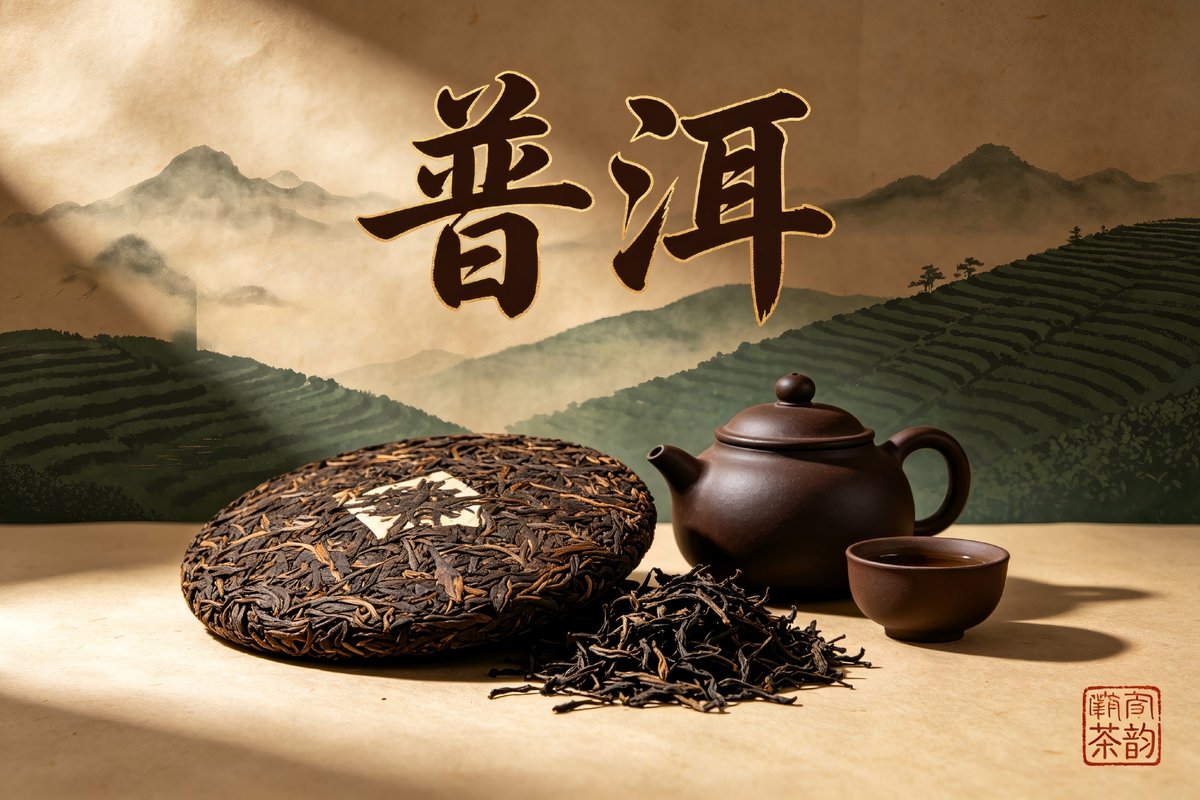
After forty-five to seventy days, the pile is broken apart. The leaves are now dark brown, almost black. They're dried, sorted, and usually pressed into cakes — bǐng chá (饼茶) — discs the size of a dessert plate, wrapped in paper. The smell is unmistakable: wet earth, old wood, a hint of camphor. If raw pu'er is a teenager with potential, ripe pu'er is a fifty-year-old who's seen things. It's smooth. It's deep. It doesn't need to prove anything.
What Ripe Pu'er Actually Tastes Like
Let me warn you about something before your first sip: cheap ripe pu'er can taste like a fishing dock at low tide. If your first impression is fishy, muddy, or vaguely reminiscent of an aquarium that hasn't been cleaned — you bought the wrong tea. Put it down. Try again with something better.
Good ripe pu'er tastes like none of those things. The first steep hits you with earth — not dirt, but forest floor, the dark loam under old trees. There's woodiness, like the smell of an antique desk drawer. There's a faint sweetness, like dried dates or molasses, hiding underneath. And there's texture — ripe pu'er is thick. Creamy, almost. It coats your mouth the way a stout beer does, leaving a velvet film on your tongue.
The second and third steeps bring out the complexity. A camphor coolness, like menthol without the burn. A mineral note, like licking a smooth river stone. And then — about thirty seconds after you swallow — the huí gān (回甘) arrives: a returning sweetness that rises from the back of your throat, like the finish of a good wine. Except instead of oak and tannin, you get a slow wave of honeyed warmth you genuinely didn't see coming.
The fermentation produces a compound called theabrownin — the same pigment that gives black tea its color, but concentrated to a much higher degree. It's what makes the liquor opaque, almost black in the first few steeps, gradually lightening to amber by the eighth or ninth pour. Theabrownin is also why ripe pu'er is famously gentle on the stomach. In China, people drink it after heavy meals the way other cultures drink digestifs. It cuts through oil. It settles. It warms.
By the tenth steep, the tea is pale and soft — a memory of the first cup. Drink it anyway. The last pour of a pu'er session is always the gentlest, and that's the one you'll remember.
The Tea That Traveled
Pu'er isn't just a tea. It's a geographical designation. By Chinese law, only tea from Yunnan province — specifically from a set of designated mountains in Xishuangbanna, Pu'er City, and Lincang — can be called pu'er. The same way Champagne can only come from Champagne. The same way Scotch can only come from Scotland.
For centuries, pu'er was the tea that traveled. Compressed into cakes and wrapped in bamboo, it was loaded onto mules and carried north along the Tea Horse Road (茶马古道, chá mǎ gǔ dào) — a network of mountain trails linking Yunnan to Tibet, Sichuan, and beyond. The journey took months. Along the way, the cakes aged naturally in the mountain air, fermenting slowly under the alternating humidity of river valleys and the thin, cold atmosphere of high passes. By the time they reached Lhasa or Chengdu, the tea was worth ten times what it cost at the source.
That's the origin of aged pu'er as a concept — it wasn't deliberate. It was a side effect of logistics. The tea changed during transit, and people liked the changed version better. So they started aging it on purpose, treating cakes like investments, storing them in climate-controlled rooms for decades. A 1950s Red Mark cake sold at auction in 2019 for the equivalent of $350,000. For tea.
Ripe pu'er, invented in 1973, was a shortcut to that taste — a way to produce the smooth, earthy depth of a thirty-year-old raw cake in forty-five days. Purists will tell you it's not the same. They're right. But it's also not meant to be the same. It's meant to be accessible. It's meant to let you taste what time does to tea without waiting for your grandchildren to be born.
How to Brew Ripe Pu'er
Ripe pu'er is the most forgiving tea to brew and the easiest to ruin. Forgiving because it's almost impossible to over-steep into bitterness — the fermentation has already broken down most of the catechins responsible for astringency. Easy to ruin because rushed brewing produces a flat, muddy cup that tastes like nothing.
Here's the routine.
Use boiling water. Not near-boiling. Actually boiling. 100°C. Ripe pu'er laughs at lower temperatures. You're trying to extract compounds produced by six weeks of microbial transformation — 85°C water doesn't stand a chance. A temperature-controlled kettle set to boil is ideal, but any kettle will work.
Rinse twice. Pour boiling water over the leaves, let it sit five to ten seconds, pour it out. Do it again. Ripe pu'er is made in piles on warehouse floors. It needs a rinse. It needs two. Don't skip this step. The first rinse wakes the leaves. The second washes off the accumulated dust of fermentation. By the third pour, the tea is ready.
Steep short and count. Start with ten to fifteen seconds for the first real steep. Add five to ten seconds each pour. A good ripe pu'er will give you ten to fifteen steeps from the same leaves. The first few will be dark — nearly black — with a thick, creamy body. Later steeps lighten to amber and bring out the sweetness. By the last steep, the tea is pale gold and tastes like warm water with a memory of earth. Drink it anyway.
Use a gaiwan or a small clay pot. A porcelain gaiwan — the lidded bowl that fits in your palm — is the simplest way to brew pu'er gongfu style. A Yixing teapot made from zisha clay is traditional; the porous clay absorbs oils from the tea over time and seasons the pot. But a gaiwan costs a tenth as much and works perfectly. Start there.
Pour along the inside edge of the vessel, not directly onto the leaves. The whole session — ten steeps, maybe twenty minutes — is deliberately slow. That's the point. Ripe pu'er doesn't reward impatience. It rewards sitting still.
Where to Start
For your first ripe pu'er, start with a cake from the Menghai Tea Factory — also labeled as Dayi (大益). Menghai is the most reliable name in ripe pu'er. They literally helped develop wet-pile fermentation at the Kunming Tea Factory in 1973, and their recipes — numbered blends like 7572 — have been produced consistently for decades. A Menghai 7572 ripe pu'er cake is the baseline. If you only ever try one ripe pu'er, make it this one. A 357-gram cake costs $20-40 and will last you months of daily drinking.
If you want something a little more surprising, try a Xinhui chenpi pu'er — ripe pu'er stuffed into a hollowed-out mandarin orange peel from Xinhui, Guangdong, then dried whole. It looks like a dried tangerine someone forgot about, and it brews like nothing else: the dark, earthy depth of ripe pu'er wrapped in a bright, citrusy, almost medicinal sweetness from the aged peel. Crack one open, drop it in a gaiwan, and you get two teas for the price of one — the pu'er, and the peel. It's the most photogenic tea in your cupboard and the one your guests will keep asking about.
Buy from a vendor who lists the factory, the recipe number if applicable, and the harvest year. If the label just says “Yunnan Pu'er” with no further detail, move on. The gap between a generic ripe pu'er and a factory-identified cake is the gap between a wine that says “Red Wine” and one that says “Châteauneuf-du-Pape.” You don't need the most expensive one. You just need the one where the maker was willing to sign their name.
Next in the tea series: The Gaiwan Guide — how to brew any Chinese tea with a $10 porcelain bowl, three fingers, and zero specialized equipment. Once you learn this, you'll never use a tea bag again.