Huangshan Maofeng: Tea From the Mountain Where Clouds Are Born
As an Amazon Associate, I earn from qualifying purchases.
The first time I went to Huangshan, I made the mistake every first-timer makes: I checked the weather forecast. Sunny, 22°C, zero percent chance of rain. Perfect, I thought. Three hours later I was standing in a cloud so thick I couldn’t see my own feet. The famous granite peaks — the ones that appear in every Chinese ink painting ever made — had vanished. The pines that grow sideways out of vertical rock faces were just dark smudges twenty feet away. And somewhere in that fog, tea was growing.
I found the tea gardens on the way down, around 800 meters, where the cloud thinned into mist and the mist settled into something the growers call wu (雾) — the permanent haze that feeds these mountains. An old farmer named Uncle Cheng was working a small plot, his hands moving through the bushes the way a pianist’s hands move across keys: fast, sure, each touch deliberate. “The mist,” he said without looking up, “is why this tea tastes like water that remembers where it came from.”
Clouds and Sparrow Tongues
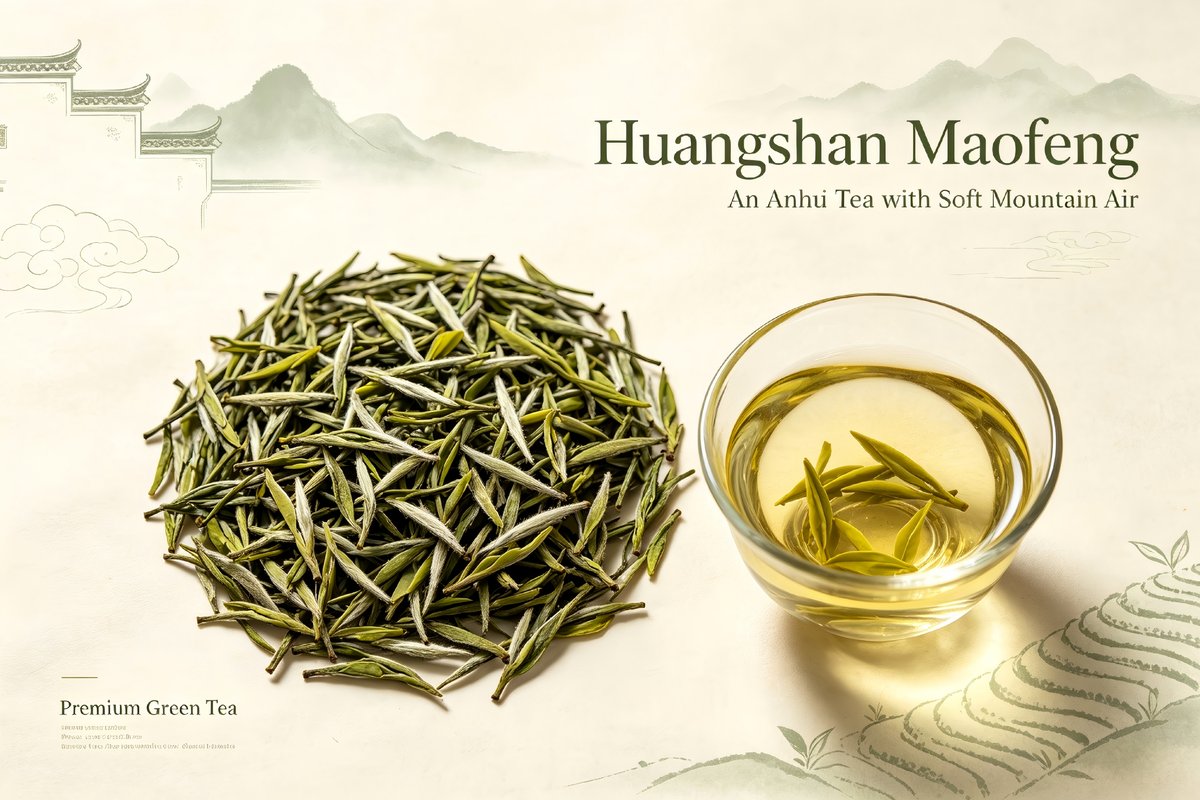
Huangshan Maofeng (黄山毛峰, Yellow Mountain Fur Peak) is one of China’s ten famous teas, grown on the slopes of Huangshan in southern Anhui province. The name is literal: mao (毛) refers to the fine silver-white down covering every bud, and feng (峰) describes the peak-like shape of the processed leaves. Together they mean “furry peaks” — a tea that looks like the mountain it comes from.
The tea grows between 700 and 1,200 meters, where the Yellow Mountain’s famous sea of clouds rolls through daily. This isn’t just scenery. The perpetual mist diffuses sunlight into a soft, even glow, forcing the tea bushes to grow slower and develop more amino acids — specifically L-theanine, the compound that gives high-quality green tea its silky body and lingering sweetness. Less direct sun also means fewer catechins, which is why Huangshan Maofeng has almost none of the astringent bitterness you get from lower-altitude greens. I spent thirteen years debugging complex systems at Microsoft and Google, and the way mist-altitude-sweetness interact in this tea is a reminder that the best systems aren’t the ones you design — they’re the ones that evolved over a thousand years before you showed up.
The picking standard is famously strict: one bud plus one or two unfurled leaves, harvested before Qingming in early April. The buds should be covered in white down and shaped like sparrow tongues — què shé (雀舌). If the bud has opened even slightly, it’s already too late. After picking, the leaves go through a kill-green step in a hot wok, but unlike Longjing’s aggressive palm-pressing or Biluochun’s tight spiral rolling, Maofeng is handled with an almost shocking gentleness. The tea maker’s movements are more like lifting and shaking than pressing — shai (筛) and dou (抖), sifting and flicking, keeping the leaves airborne in the wok so they cook without crushing. The goal isn’t to reshape the leaf. It’s to stop oxidation while preserving the natural form. The resulting dry leaf keeps its mountain silhouette: flat at the base, tapering to a point, the down still white against the dark green.
What you actually taste: the liquor is a pale ivory-green, not the bright jade of other Chinese greens. First steep carries a clean, high-altitude floral note — orchid, sometimes described as “orchid in an empty valley.” Then chestnut. Then a sweetness that rises from the back of your throat and stays there, the kind of hui gan that makes you pause mid-sentence — like the finish of a good wine, but quieter, more patient. The mouthfeel is where Maofeng really separates itself: soft as spring water, no bite, no edge. You’re not drinking flavor so much as drinking texture. It’s the tea equivalent of a room that goes quiet after a loud party, and suddenly you notice the sound of your own breathing.
The Immortals’ Laughter
Huangshan Maofeng as a named style is relatively young — late Qing Dynasty, around 1875, when a tea merchant named Xie Zheng’an from She County began processing tea from the high-altitude gardens above 800 meters and selling it under the name “Huangshan Maofeng.” But tea has been growing on these mountains since the Tang Dynasty. The poet Li Bai — the same Li Bai who wrote about drinking alone under the moon — climbed Huangshan and wrote that the mountain’s springs “taste like the laughter of immortals.” He was almost certainly drinking the predecessor to this tea.
In Chinese tea culture, Huangshan occupies a specific niche. It’s not as famous abroad as Longjing, not as romantic as Biluochun’s fruit-tree story. But among serious Chinese drinkers, Maofeng is the tea you graduate to — the one that teaches you subtlety after you’ve burned out on big, loud flavors. When someone in a tea house orders Maofeng, it says: I know what I’m doing, and I don’t need to prove it.
How to Brew Huangshan Maofeng (and How Not to Ruin It)
Three rules. Break any of them and you might as well be drinking something else.
First: 80°C water, no higher. This tea’s magic is all in its amino acids, and amino acids denature fast. Boiling water will cook the sweetness right out and leave you with something that tastes like hot grass clippings. If you don’t have a variable-temperature kettle, this affordable glass kettle or this gooseneck with ±1°F precision pays for itself the first time you taste Maofeng at the right temperature vs. the wrong one.
Second: glass cup, top-drop method. Put the leaves in first, pour water gently along the side of the glass. Watch the buds sink slowly, releasing tiny streams of pale green into the water like ink blooming in reverse — it’s half the reason to drink this tea. A straight-walled glass pitcher like this lets you see what the tea is doing. Don’t cover the cup. Don’t use a gaiwan unless you really know what you’re doing — the leaves need room to stretch, and a gaiwan doesn’t give them that.
Third: drink it within six months of opening. Huangshan Maofeng loses its high notes faster than almost any other green tea. The orchid vanishes first, then the chestnut, then all you’re left with is a polite memory of what it used to be. Store it cold, sealed, away from light. If someone offers you last year’s Maofeng, smile and ask for water instead.
Where to Start
Huangshan Maofeng is harder to find on Amazon than Longjing or Biluochun, but it’s out there. Look for leaves that are dark green with visible silver down, individually distinct (not broken into dust), and priced above the suspiciously cheap tier — real high-mountain Maofeng can’t be produced for supermarket prices. A solid entry point is this Huangshan Maofeng from FullChea, which carries the right bud-down profile and floral character. If you can find it from a specialty tea shop — even better. The best Maofeng never makes it to Amazon.
If you’ve only ever had Japanese green tea (steamed, grassy, umami-forward), Huangshan Maofeng will feel like a different species entirely. It’s the tea that made me realize Chinese greens aren’t just variations on a theme — they’re separate languages.
Next: Xinyang Maojian — a green tea from Henan so sharp and mineral it’s been called “the tea that bites back.” Same altitude, same bud-set picking, completely different personality.