Gaiwan: Three Fingers, One Lid, and a Thousand Years of Tea
As an Amazon Associate, I earn from qualifying purchases.
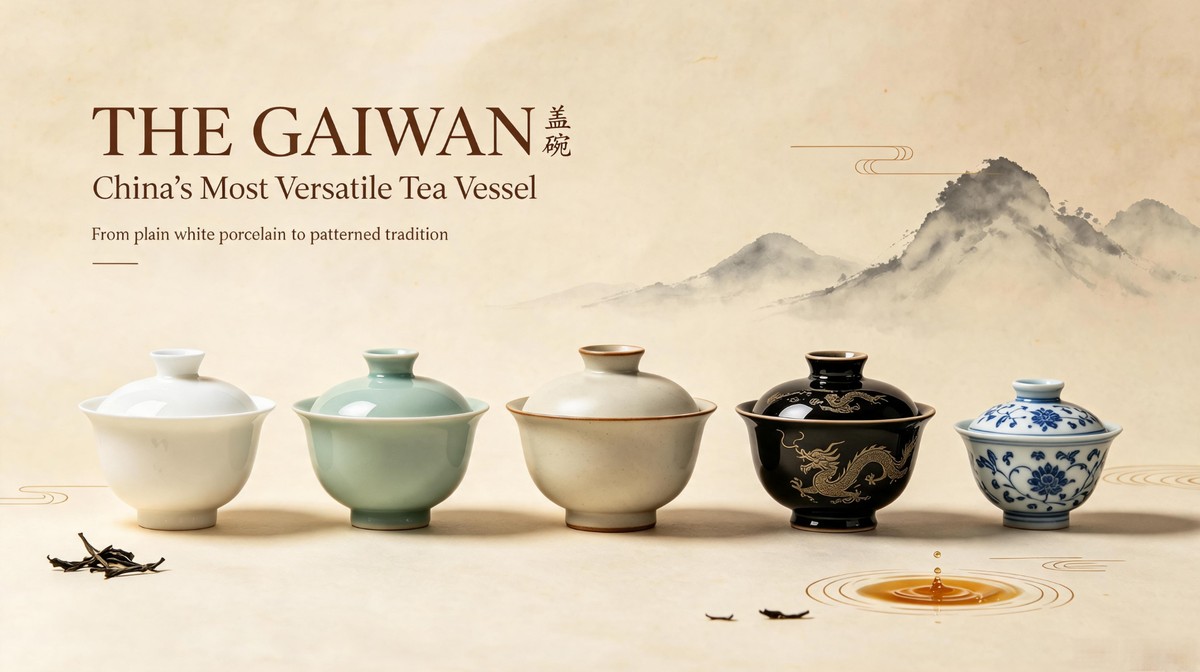
The first time I tried to use a gaiwan, I burned my fingers so badly I dropped the entire thing into the tea tray. Porcelain clattered against bamboo. Tea splashed across the table in a hot amber wave. The old man at the next table in Chengdu’s People’s Park didn’t laugh — but the corner of his mouth moved, just slightly, the way someone who’s seen this a thousand times reacts to the thousand-and-first.
“You’re holding it like a teacup,” he said, in Sichuan dialect so thick I barely caught the words. “It’s not a teacup. It’s a tool.”
He walked over, picked up my gaiwan — white porcelain with a thin blue rim, the same model used in every tea house in Chengdu — and showed me how to hold it. Thumb and middle finger on opposite sides of the rim. Index finger pressing the knob of the lid. Wrist relaxed. Tip forward. The tea streamed out in a clean amber arc, not a single drop on the saucer.
“I’ve been doing this for forty years,” he said. “The first ten, I burned myself too.”
That’s the gaiwan (盖碗). Three pieces of porcelain — bowl, lid, saucer — that together form the most versatile brewing vessel in Chinese tea. It looks like something a museum would put behind glass. In China, people use it every day — in tea houses, in homes, on the backs of motorcycles. The gaiwan is the soul of Chinese tea brewing, and once you learn to hold it without scalding your fingers, you’ll wonder why you ever used anything else.
The Three Pieces
A gaiwan has three parts, and every one of them earns its keep. The bowl (碗, wǎn) holds the leaves and water — wide at the mouth, narrow at the base, designed to give leaves room to unfurl completely. The lid (盖, gài) traps heat and — this is the clever part — doubles as a strainer. Tilt it just slightly and the leaves stay behind while the tea flows through the gap. The saucer (托, tuō) catches drips and gives you something cool to hold when the bowl is too hot to touch. Together, these three pieces do the work of a teapot, a strainer, and a coaster, without any moving parts, without any seams that trap old tea residue, and without anything that can break beyond repair.
The design hasn’t changed much since it emerged in the Ming Dynasty. That’s not because nobody’s had a better idea in 600 years. It’s because the gaiwan is already a solved problem.
Here’s why it works so well. First, the wide mouth. Ball-rolled oolongs can triple in size when they open — a gaiwan gives them space. Longjing leaves need room to dance in hot water — a gaiwan’s wide bowl is a stage, not a cage. Second, you control the pour completely. Tilt the lid half a millimeter and you get a slow trickle. Open it wide and the whole bowl empties in two seconds. This matters because steep time determines the flavor — with a gaiwan, you are the timer. Third, porcelain is neutral. Unlike Yixing clay teapots, which absorb oils and flavors over decades of use, a porcelain gaiwan adds nothing and takes nothing away. Brew oolong in the morning, green tea in the afternoon, and you won’t taste yesterday’s Tieguanyin in today’s Longjing. The gaiwan resets to zero every time you rinse it.
The material also makes a difference in what you can see. White porcelain lets you watch the leaves open. You see the liquor darken from pale straw to amber gold over five, ten, twenty seconds. You know it’s ready not by a timer but by your eyes. I spent thirteen years debugging code — staring at terminal output, waiting for the pattern to emerge from the noise. Brewing tea in a gaiwan feels similar. You watch. You wait. You learn to read the signals. The leaves tell you when they’re done. You just have to pay attention.
What does gaiwan-brewed tea actually taste like? Cleaner. Brighter. More transparent. Because porcelain doesn’t muffle anything — unlike unglazed clay, unlike metal strainers, unlike paper tea bags that leach their own flavor into the water — you taste the tea and nothing but the tea. Every flaw shows up. Every virtue shines through. It’s the most honest cup you’ll ever drink.
The Bowl That Democratized Tea
The gaiwan arrived at the right moment. Before the Ming Dynasty, tea brewing was elaborate — powdered tea whisked into green froth in dark-glazed bowls was the standard brought back from Song-era temples. It required specialized equipment and years of training. Then the Hongwu Emperor, the first Ming ruler, banned compressed tea cakes in 1391. Too expensive. Too aristocratic. He ordered the empire to brew loose leaf tea instead.
Loose leaves don’t whisk into froth. They need to steep. The gaiwan solved that problem instantly. And because it was just three porcelain pieces — affordable to produce, nearly indestructible, easy to clean — it spread everywhere. From imperial chambers to roadside tea stalls. It democratized tea in a single generation.
Today, you see gaiwans in every context. In Chengdu tea houses, old men pour boiling water from long-spout copper kettles while playing mahjong, their gaiwans perpetually half-full. In a Fujian tea master’s studio, the gaiwan is the first thing a student learns to hold — before any Yixing pot, before any ceremony. On my kitchen counter in Shanghai, a plain white gaiwan sits next to a ThinkPad and a half-eaten bag of sunflower seeds. The gaiwan doesn’t care about your credentials. It just makes good tea.
How to Brew With a Gaiwan
How to hold it without burning yourself. Place your thumb and middle finger on opposite sides of the rim — the very edge, not the bowl itself, which will be hot. Press your index finger onto the knob of the lid. Your ring and pinky fingers float free, relaxed. Pour from the wrist, not the arm. Practice with cold water first. Everyone burns themselves the first few times. That’s part of learning.
Warm the gaiwan. Pour hot water in, swirl for five seconds, dump it out. This pre-heats the porcelain so your tea doesn’t lose temperature halfway through the first steep. Skipping this step means a lukewarm first pour. Don’t skip it.
How much leaf. For ball-rolled oolongs like Tieguanyin, fill the gaiwan one-third full of dry leaves — they’ll expand enormously once they hit water. For open-leaf teas like Longjing or white tea, about 3-5 grams, enough to just cover the bottom of the bowl.
Water temperature by tea type. Green and yellow teas: 80-85°C. White tea: 85-90°C. Oolong: 90-95°C. Black and dark tea: 95-100°C. If you don’t have a thermometer, the old rule is: boil water, then wait. Two minutes for greens, one minute for oolongs, pour immediately for black teas. A temperature-controlled kettle eliminates the guesswork, but you don’t need one to start.
First steep: rinse and discard. Pour hot water over the leaves and pour it out within five seconds. Don’t drink this. It wakes the leaves, washes off surface dust, and prepares them for proper extraction. This is standard gongfu protocol for virtually every Chinese tea.
Second through eighth steeps. The first real pour starts at 20-30 seconds. Add 10-15 seconds for each subsequent steep. Pour along the inside edge of the bowl, not directly onto the leaves — direct pouring agitates them and draws out bitterness. By steep six, the tea is softer and sweeter, like a conversation past introductions. By steep eight, it’s mostly warm water with a tea memory. Drink it anyway.
Between steeps, leave the lid off. Trapping heat after the pour steams the leaves in their own residual moisture, making later steeps flat and vegetal. Let them breathe.
Where to start. A decent porcelain gaiwan costs $10-20. Look for plain white Dehua porcelain — the same kilns that have produced China’s finest ceramics since the Song Dynasty. It’s neutral, durable, and you can see the color of the liquor clearly through the walls. Start with a plain white porcelain gaiwan — neutral, $10-15, and you can see the color of the liquor clearly through the walls. If you want something with more personality, the dragon-pattern Sancai gaiwan brings a touch of traditional Chinese ceramic art to the table — same function, more character. Either way, a porcelain gaiwan is the only teaware investment you actually need. Everything else — Yixing pots, fairness pitchers, aroma cups — is optional. The gaiwan is the foundation.
Next in the tea series: I sit still for two hours in a Chengdu tea house and try to understand what Chan Buddhism has to do with a cup of oolong. Turns out: everything.