Da Hong Pao: Red Robe, Black Rock, and the Origin of All Oolong
As an Amazon Associate, I earn from qualifying purchases.
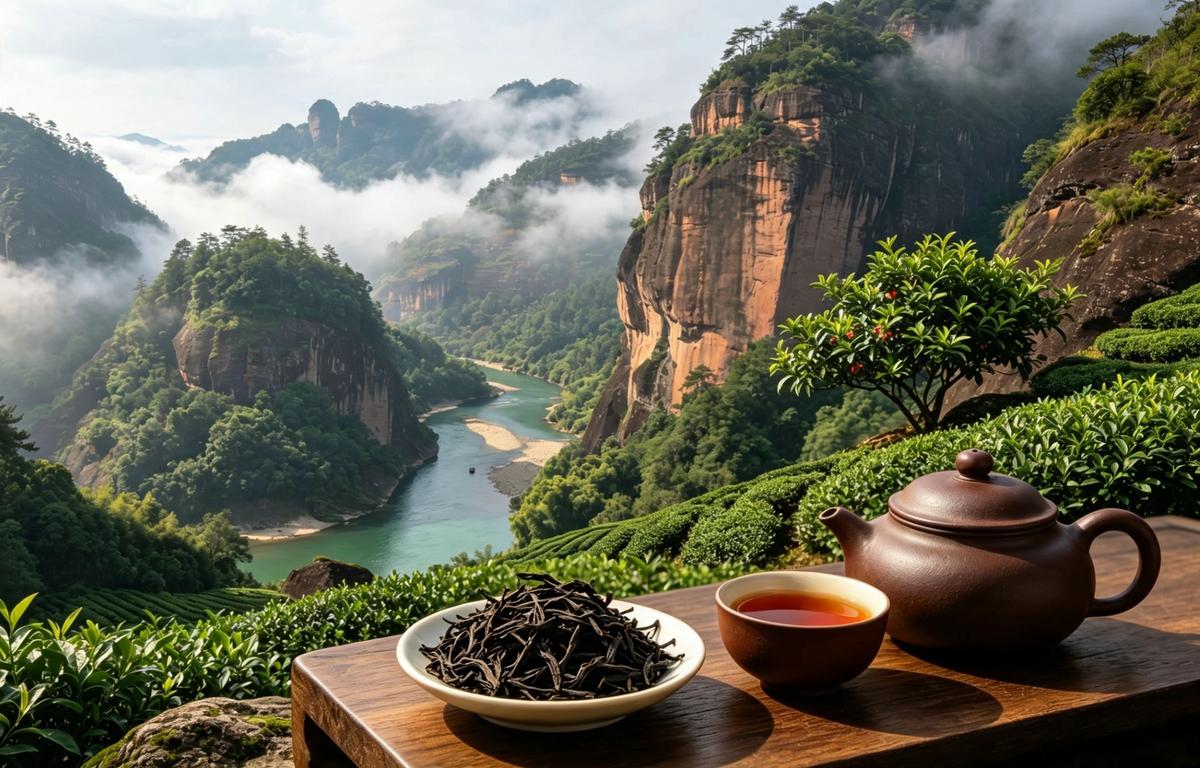
The shifu handed me a cup no bigger than a thimble and said, "Smell the lid first." I lifted the gaiwan lid — a small porcelain saucer, still hot from the pour — and brought it to my face. What hit me wasn't tea. It was charcoal smoke and wet stone and something darkly sweet, like molasses that had been left too close to a campfire. "Now taste," he said. The liquid was the color of brandy. It coated the inside of my mouth the way a peated whisky does — not just flavor, but presence, a kind of geological weight that seemed to bypass taste entirely and go straight to memory. I was in a small tea room in Wuyi Shan, Fujian province, sitting across from a man who'd been roasting this tea for forty years, and I had just met the origin of all oolong.
The tea was Da Hong Pao (大红袍, Big Red Robe), the king of Wuyi rock teas and — depending on whom you ask — either a legend wrapped in charcoal or a religion disguised as a beverage. It grows on near-vertical cliffs above the Nine Bend River, where the sun only hits the valley floor for a few hours a day and the roots of the tea bushes thread straight into bare sandstone. What you taste in Da Hong Pao is not just leaves and processing. You taste the rock itself. And once you've tasted it, every other oolong becomes a footnote.
The Rock and the Fire
Da Hong Pao sits at the far end of the oolong spectrum — a heavy, heavily-oxidized, heavily-roasted tea that pushes oolong closer to black tea than green. Where Tieguanyin is floral and delicate, Da Hong Pao is dark and mineral. Where Dong Ding is toasty, Da Hong Pao is a controlled burn. The leaves are picked much later than green tea — one bud plus three or four full leaves — then withered, tossed and bruised to initiate oxidation, pan-fired at 60-70% oxidation to fix the leaf, rolled into tight dark twists, and then — this is the part that separates Da Hong Pao from everything else — roasted over charcoal. Not once. Multiple times. Sometimes across an entire year.
The roasting technique is called tàn bèi (炭焙), charcoal baking, and it's the soul of this tea. The charcoal is made from lychee wood, burned down to embers in a pit, then transferred into a deep ash bed where a bamboo basket of tea leaves sits above it for eight to twelve hours. Each roast pulls moisture out of the leaves and drives the smoke deep into their structure. Between roasts, the tea rests for weeks or even months — letting the char settle, letting the flavors marry. A single batch might be roasted three, four, five times. The roast master — almost always an older man who's done this since his teens — judges doneness by smell alone. Staring at the basket. Waiting. No thermometer. I spent thirteen years at Microsoft and Google debugging software where the output was deterministic: same input, same output, every time. Tàn bèi is the opposite. The weather on roast day, the humidity, the exact moisture content of that particular batch of charcoal — every variable shifts the result. If your brain runs on logic and reproducibility, this tea will break it. And then rebuild it.
The other half of Da Hong Pao's identity is terroir. The Wuyi Mountains are made of sandstone and volcanic rock, mineral-dense and sharp-edged. The tea bushes don't grow in soil the way you imagine soil — soft, dark, earthy. They grow in rock crevices where centuries of mineral runoff have deposited just enough grit for roots to anchor. Some roots reach meters deep into the cliff face, pulling dissolved minerals directly from the stone. This comes through in the cup as what Chinese drinkers call yán yùn (岩韵), "rock rhythm" or "cliff melody." It's not a flavor. It's a sensation — a cool, mineral structure that coats your tongue and throat and persists through every steep. If Longjing tastes like the spring water that flows over smooth river stones, Da Hong Pao tastes like the stone itself.
What you actually taste: the dry leaf smells like dark chocolate and ash and something that reminds me of old bookstores. First steep — flash rinse, pour in and pour out — hits with roasted nuts and charcoal, almost aggressive. Give it ten seconds for the real first infusion and the mineral body arrives: cool stone, a metallic edge that's not unpleasant, like licking a clean river rock. By the third steep, the smoke pulls back and fruit surfaces — dried longan, dates, maybe overripe stone fruit, a sweetness that's earthy rather than bright. The aftertaste, the huí gān, is what separates Da Hong Pao from every other tea I've ever had. It doesn't just linger. It changes. Three seconds after you swallow, the roast is dominant. Ten seconds later, a cool sweetness rises from the back of your throat. Thirty seconds later, you're tasting mineral again. It's like the tea has a plot structure. Good Da Hong Pao will give you eight to twelve steeps, each dramatically different from the last — first smoke and rock, then fruit, then honeyed sweetness, then something like wet wood at dawn. Not a tea you finish. A tea you experience.
The Scholar and the Robe
The origin story of Da Hong Pao is the kind of legend so perfectly shaped you almost don't want to fact-check it. In the Ming Dynasty, a young scholar named Ding Xian was traveling through Wuyi Shan on his way to Beijing to sit for the imperial examinations — the civil service test that determined your entire station in life. He fell gravely ill. A monk at Tianxin Temple brewed him tea from some scraggly bushes growing on a nearby cliff. Ding Xian recovered, continued to Beijing, and placed first in the examinations — zhuàngyuán, the highest honor available to any scholar in imperial China. On his return journey, he stopped at the temple and draped his official red robe — the crimson garment that marked him as the top scholar — over the tea bushes as an offering of gratitude. Big Red Robe. The name has stuck for six centuries.
The six original mother bushes still grow on a cliff called Jiǔlóngkē (九龙窠, Nine Dragon Nest), over 350 years old. They are guarded like museum pieces, roped off, monitored. The last harvest from those original bushes was in 2005 — twenty grams of tea leaves, sold at auction for ¥208,000, roughly $28,000. That was the end. No more harvesting. The mother bushes are now officially retired, living monuments to a tea that outgrew its own biology. Every Da Hong Pao you can actually buy today comes from cuttings of those original plants, propagated across the Wuyi region for decades. The genetics are the same. Only the location is different — and in Wuyi rock tea, location is everything.
To understand what Da Hong Pao means in Chinese tea culture, you have to understand that Wuyi Shan is the origin point of all oolong tea. Every Tieguanyin from Anxi, every Dong Ding from Taiwan, every Phoenix Dan Cong from Guangdong — they all trace their methodology back to these cliffs. The Wuyi Mountains are to oolong what Bordeaux is to wine, and Da Hong Pao is its Pétrus. When a Chinese tea drinker orders Da Hong Pao, it carries the same weight as a Frenchman ordering a first-growth Bordeaux. It says: I am not here to dabble.
How to Brew Da Hong Pao (Seriously, Don't Use a Mug)
Four rules. Da Hong Pao is not a forgiving tea.
First: gaiwan or Yixing pot. You need a vessel that holds heat and gives the leaves room to expand — these are full-size leaves, not tight little balls. A Western mug with a basket infuser will produce something that tastes like an ashtray. If you don't have a gaiwan, this porcelain gaiwan is the standard entry point — cheap, functional, identical to what tea masters use in Wuyi. A small Yixing pot like this is better if you plan to drink rock tea regularly, but dedicate one pot to oolong — the clay absorbs flavor over time.
Second: boiling water. Yes, boiling. 100°C, straight off the fire. This is not green tea. Anything less than boiling and you're leaving most of the flavor behind. If your kettle doesn't hit a full rolling boil reliably, this variable-temperature kettle removes the guesswork.
Third: flash rinse, then short steeps. Pour boiling water over the leaves, count to three, pour it out immediately. This wakes up the leaves and washes off any charcoal dust. Then steep: 15 seconds for the first real infusion, adding 5-10 seconds for each subsequent pour. You should get eight to twelve steeps. If you're getting harsh bitterness in the first steep, your water may be too hard — soft water lets the mineral notes through without the astringent edge. If you're not getting any bitterness at all, the tea is too light and you've probably bought a cheap blend.
Fourth: pay attention. Da Hong Pao changes more across ten steeps than most teas do across their entire existence. Drink each pour separately. Compare them. The first is smoke and rock; the fifth is fruit and honey; the tenth is wood and memory. If you're scrolling your phone while drinking this tea, you're wasting it.
Where to Start
Da Hong Pao is not a beginner tea. If you've never had oolong before, start with Tieguanyin or a lighter Wuyi tea like Shui Xian — Da Hong Pao will just taste like a campfire to you and you'll wonder what all the fuss is about. But if you've put in some tea miles and you're ready for the deep end, a solid entry point is this Da Hong Pao from Teavivre, which carries the right dark-roast profile and mineral structure. Look for leaves that are long, twisted, and dark — nearly black — with a faint oily sheen. If the dry leaf doesn't smell like roasted nuts and charcoal, you've bought something else wearing the name. Real yán yùn doesn't come cheap; if the price looks like supermarket tea, the flavor will too.
I came to Wuyi Shan looking for a tea and left with a new category of experience. Da Hong Pao doesn't just taste like something. It tastes like somewhere. And that somewhere — a maze of sandstone cliffs where the river cuts through and the sun only visits for a few hours — is still there, still growing tea in the cracks between the rocks, still producing leaves that carry the weight of the stone they came from.
Next: Shui Xian (水仙, Water Sprite) — Da Hong Pao's quieter sibling from the same cliffs. Less famous, less expensive, and in some ways better. Same rock rhythm, half the legend, all the complexity.