Biluochun: The Green Snail That Frightens the Fragrance
As an Amazon Associate, I earn from qualifying purchases.
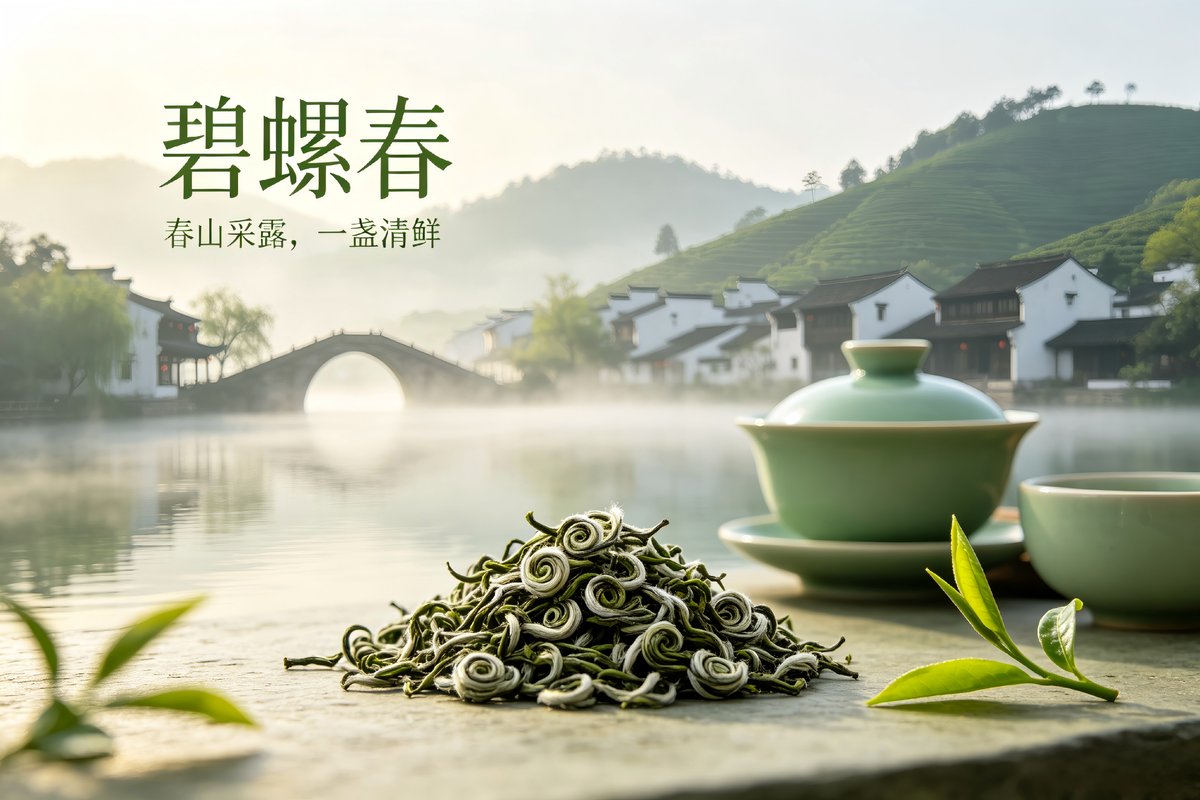
I was twenty-seven and standing in a tea processing room on Dongting Mountain — not the Hunan one, the Suzhou one — when a woman named Auntie Shen poured hot water over a glass that already had dry tea leaves waiting at the bottom. Before the water hit the halfway mark, the room filled with a smell so vivid it stopped the conversation. Peach. Apricot. Something floral underneath, like osmanthus in September. The white down from the leaves had lifted into the steam and was spinning upward in the morning light like a cloud of silver dust.
“You smell that?” Auntie Shen said, not really asking. “In the old days, before the emperor got involved, they called this tea Scary Fragrance.”
She wasn’t exaggerating. The Chinese was xià shà rén xiāng (吓煞人香) — literally, “a fragrance so intense it frightens people.” And standing there with the steam still rising, I understood why. This tea didn’t just smell good. It smelled like it was trying to prove something.
Fruit Trees and Snail Shells
Biluochun (碧螺春, Green Snail Spring) comes from Dongting Mountain, a peninsula-and-island formation that sits inside Taihu Lake near Suzhou, Jiangsu province. It’s one of China’s ten famous teas, and alongside Longjing, it’s the other green tea that every Chinese tea drinker knows by name. But where Longjing is flat-pressed and toasty, Biluochun is rolled into tight spirals the size of peppercorns — each one a tiny green snail shell, hence the name.
The thing that makes Biluochun genuinely unlike any other green tea is where it grows. The tea bushes on Dongting Mountain aren’t planted in rows on open terraces. They’re scattered under fruit trees — loquat, peach, plum, apricot, waxberry. The tea plants absorb the volatile aromatic compounds from the fruit blossoms and the soil around the fruit tree roots. This isn’t a marketing story. It’s terroir in the literal sense: the same plant grown thirty meters away from a fruit tree produces a recognizably different tea. The loquat trees give a stone-fruit sweetness. The peach trees contribute a floral top note. The effect is cumulative and impossible to fake.
Processing Biluochun is labor-intensive in a way that borders on unreasonable. The leaves are picked before Qingming — usually late March to early April — one bud and one tiny unfurled leaf per pick. It takes roughly sixty thousand buds to make a single jin (500 grams) of finished tea. After picking, the leaves go through kill-green in a hot wok, then the tea maker hand-rolls them into spirals while they’re still hot. The rolling motion isn’t mechanical; it’s palms pressing and twisting in a rhythm that looks like kneading bread dough, except the dough is two hundred degrees Celsius. The spirals tighten as they dry, and the white down — the fine silver hairs that covered the bud — stays intact on the surface of each curl.
I spent thirteen years debugging distributed systems at Microsoft and Google, and I can tell you with some authority: the process window for Biluochun is narrower than most production deploys I’ve run. Over-roll and you crush the leaf cells, releasing bitterness. Under-roll and the spiral won’t hold its shape. The right outcome is a tea that looks like gunpowder but smells like an orchard.
The Emperor Who Renamed It
The Kangxi Emperor visited Suzhou in the late 1600s and was served this tea by a local official. He loved it. He hated the name. “Scary Fragrance” was a farmers’ name — vivid but unworthy of a tribute tea destined for the Forbidden City. So Kangxi renamed it Biluochun: bi (碧, jade-green) for the color, luo (螺, spiral shell) for the shape, and chun (春, spring) for the harvest season. The name stuck. The tea became an imperial tribute item, and Dongting Mountain’s tea farmers have been sending their best spring pick to Beijing — in one form or another — for three centuries.
For Suzhou locals, Biluochun isn’t a luxury good. It’s a seasonal marker. When the first batch appears in the tea shops along Shiquan Street in late March, spring has officially arrived, regardless of what the calendar says. Old men will sit outside their houses with a glass of Biluochun, watching the Taihu Lake mist roll in, and they won’t say anything for an hour. This isn’t rudeness. It’s the Jiangnan version of a religious practice.
How to Brew It — Backwards
Biluochun breaks the usual tea-brewing sequence. With most teas, you put the leaves in first and pour water over them. With Biluochun, you pour the water first, then add the leaves. This is called the “downward pouring” method (下投法), and there’s a reason for it.
The dry leaves are so light — all that white down acts like a feather coating — that if you pour water over them, they float on the surface and the fragrance escapes into the air instead of steeping into the liquid. When you drop them into water that’s already in the glass, they sink slowly, unfurling as they go, and the aroma stays trapped in the cup. Watch closely: each spiral opens like a tiny green flower, and the white hairs detach and drift in the water like snow in a glass paperweight.
Three rules for Biluochun:
Water temperature: 80°C (175°F). This is lower than Longjing. Biluochun is all bud, no mature leaf — it scalds easily. If you don’t have a temperature-controlled kettle, let boiling water sit for three minutes before pouring.
Glass, not gaiwan. You want to see the leaves. A tall, clear glass (roughly 250ml) is the traditional vessel. The visual performance — spirals opening, down drifting, the water turning pale jade — is half the experience. If you brew this in a gaiwan, you’re hiding the best part.
Don’t cover it. Never put a lid on Biluochun. The trapped steam will stew the buds and turn the liquor yellow and bitter within sixty seconds. Brew it open. Drink it while it’s pale green. When the color shifts to amber, the leaves are exhausted and you should start a new cup.
You should get three good infusions from a single pinch of leaves. The first steep is all fragrance — fruit and flowers. The second brings the sweetness forward. The third is softer, more mineral, like the memory of the first two. By the fourth, you’re drinking lightly flavored water. That’s fine. Pour it out and start again.
Where to Start
Real Dongting Mountain Biluochun — the stuff grown on the actual island in Taihu Lake — is expensive and hard to verify. Most of what’s sold as “Biluochun” online is grown elsewhere in Jiangsu or Zhejiang using the same cultivar and processing method. That doesn’t mean it’s bad tea — the spiral-rolling technique travels well — but don’t pay Dongting Mountain prices without Dongting Mountain provenance.
For your first Biluochun, look for a Suzhou-style Biluochun from a vendor who lists the harvest date. Pre-Qingming (before April 5th) is the premium pick. If the vendor just says “spring harvest” without a date, you’re probably getting later-picked leaves — still good, but less fragrant. Expect to pay $15-35 for 50g of decent quality, which will make roughly twenty sessions. A single teaspoon of dry Biluochun is enough for a 250ml glass — these spirals are dense and the flavor-to-weight ratio is surprisingly high.
Next: Huangshan Maofeng — the tea that grows above the clouds on one of China’s most sacred mountains, where the fog rolls in at noon and the leaves taste like orchid and fresh snow.