The Switch Nobody Dated: How Shaojiu Took China From Huangjiu
December in Shanghai, and the windows of a small 本帮菜 restaurant on Jianguo Road are fogged from the inside. At the next table a woman is pouring warm huangjiu out of a tin pot into three small cups, slowly, the way you pour tea for guests. On my side of the room two men in padded jackets are working through a bottle of 53 percent baijiu with a plate of braised pork. Neither table finds the other strange.
That is the strange part. Two drinks, both from grain, both Chinese, four metres apart, and they belong to different centuries. The amber one in the tin pot is 黄酒 (huangjiu), fermented, 14 to 20 percent, drunk warm. It was the drink of the Chinese table for something like two thousand years: the wine in the poems, the wine in the ancestor rites, the wine 李白 was drunk on. The clear one is 白酒 (baijiu), distilled, 50 percent and up, and it is what the country actually drinks now.
At some point China changed its national drink. Nobody wrote down the year.
Why fermentation stops
Yeast is a factory that poisons itself. It eats sugar and produces alcohol, and when the alcohol around it reaches about 15 percent, its own waste shuts the whole operation down. Nobody passed that rule. It is chemistry, and it applies to Bordeaux, to sake and to Shaoxing huangjiu alike. Brewers push toward 18 or 20 percent with cool ferments and careful feeding, and they do get there, but the wall does not move for anyone.
Distillation is how you climb over it. Heat the finished mash, catch the vapour, cool it back down. Alcohol boils at 78°C and water at 100, so what comes off the pot is richer than what went in. One pass on a 10 percent wash lands near 35 percent. Two passes and you are at 60 or 70. Nothing here needs modern equipment — a pot, a lid and something cold will do.
The Chinese had all three of those things for a very long time. So why did the country keep drinking 15 percent for another thousand years?
The still the Chinese built
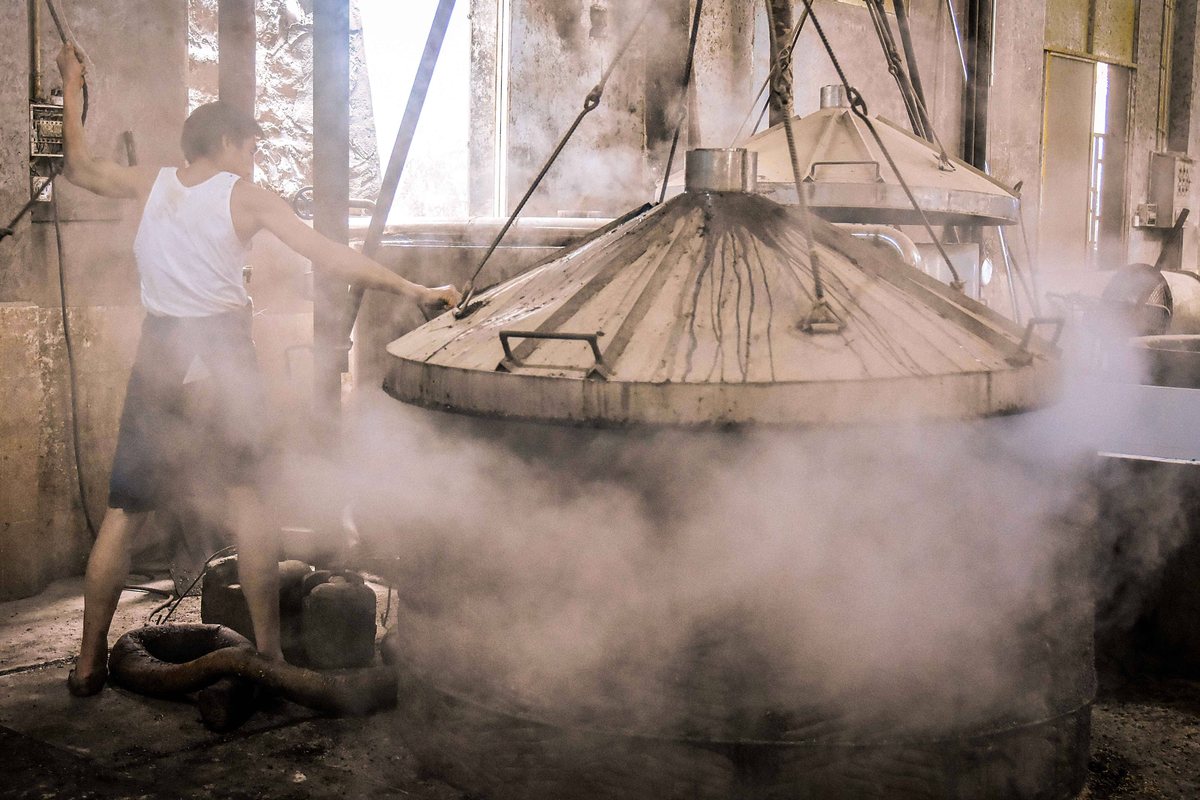
Chinese distillers did not copy a European pot still, and the difference tells you what the drink is. A Scottish still boils a clear fermented liquid. A Chinese 甑桶 (zeng tong) takes the whole batch — steamed sorghum, spent mash, husks and all — and drives steam up through that solid bed from below while a shallow pan of cold water, the 天锅 (tian guo, sky pot), sits on top. Vapour hits the cold underside, condenses, and runs into a gutter around the rim.
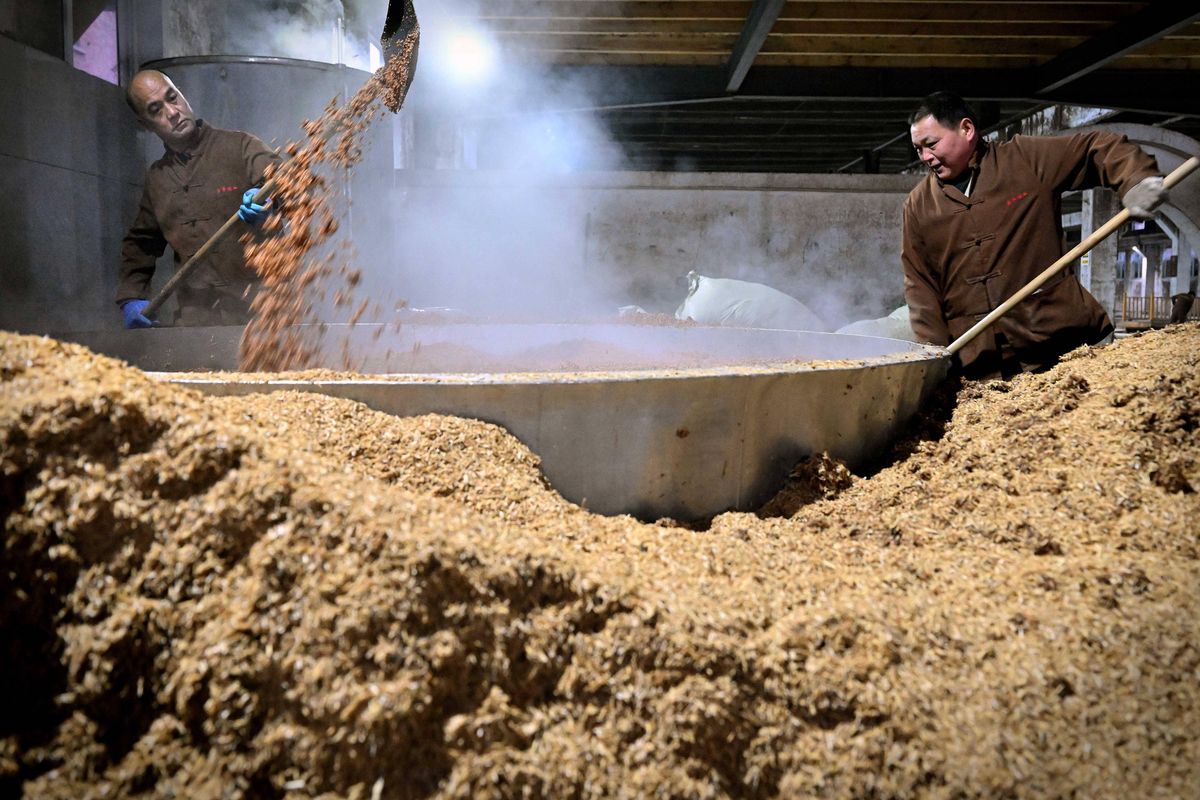
There is no pump and no clear liquid anywhere in the process. The grain bed is the column, and every pass leaves flavour in it, which is why baijiu tastes of the grain it came from while whisky tastes of the barrel it slept in. It also explains the smell of a Chinese distillery: wet grain, hot husks, yeast, and something sour underneath. A bakery that got out of hand.
The date nobody agrees on
The most quoted answer comes from 李时珍, the pharmacologist, in 本草纲目 (1578): 「烧酒非古法也,自元时始创其法」 — burned wine is not an ancient method; the technique was first created in the Yuan. The name backs him up. 忽思慧's 饮膳正要, written for the Yuan court in 1330, lists 阿剌吉酒 — araq, the Arabic word for distilled spirit, carried east along the same routes as the still itself. A loanword is a fingerprint.
Earlier texts are traps. 白居易, around 820, writes 「烧酒初开琥珀香」: the shaojiu, just opened, smells of amber. Amber is the problem — a distillate is clear. What Bai Juyi drank was almost certainly warm yellow wine, and his 烧酒 means heated wine, not burnt wine. A good share of the "the Tang had baijiu" case rests on lines like that one.
Then there is the object in the Shanghai Museum: a bronze distillation vessel from the Eastern Han, roughly 1,700 years old, which 马承源 ran experiments on in the 1980s and got spirit of about 20 percent out of. The apparatus existed in China before the Western Roman Empire fell.
Which means the interesting question is not when the still arrived. A technology can sit in a workshop for a thousand years and change nothing, because existing and being worth the fuel are different problems. I spent thirteen years shipping software before I started writing about this, and the lesson keeps repeating: the invention is never the event. The economics are.
The crop that decided it
Here is the argument I find convincing, and almost none of it is about taste.
Huangjiu is made from rice, glutinous rice, grown on the best irrigated land in the country. Every jar of it competes with dinner. Baijiu's workhorse grain is 高粱, sorghum, which grows on marginal ground, survives drought and waterlogging, and tastes bad enough that nobody fights you for it — tannins make it unpleasant as food. It is a crop with no other buyer.
Distillation gives that crop a market, and it changes the arithmetic of moving goods. A litre of 60 percent spirit carries the alcohol of three litres of 15 percent wine in a third of the volume. Ship by cart or canal boat, pay tax by the jar, and that ratio is the entire business case. Add cold northern houses and the fact that 烧酒 warms you faster, and the geography writes itself: spirit took the north and the west, huangjiu held the wet, rice-growing south.
The population roughly doubled between 1400 and 1600: more mouths, the same fields, and a drink that turns a marginal crop into cash. That is arithmetic, not a change of taste. By the late Ming the practice was ordinary; 宋应星's 天工开物 (1637) describes 烧酒 as workshop routine, not a foreign curiosity. By the 1930s grain spirit dominated by volume across most of the country. Huangjiu never lost a war. It lost the land, and retreated to the one region rich enough to keep drinking it: the Yangtze delta, and Shanghai.
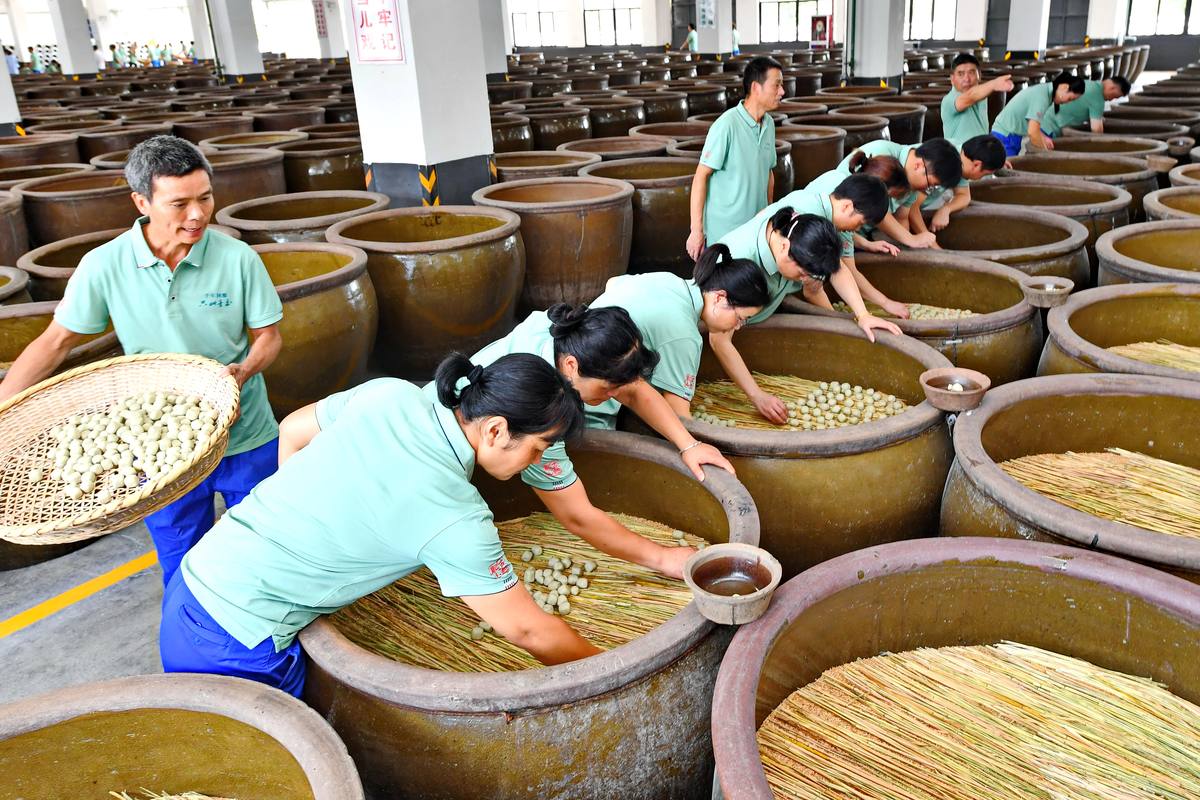
The last time I stood in a Shaoxing brewhouse, the man running the 开耙 — the stirring that controls the ferment — said his grandfather's village made its own wine every winter, and now the village buys it in bottles. Nothing was banned, he said. The rice just got expensive.
Taste the switch in one sitting
Two bottles, one evening, no ceremony. Buy a five-year 花雕, the half-dry type (半干), and the cheapest decent 清香 baijiu you can find; 汾酒's basic bottle is the reference point. Use the same cup for both, and 15ml is enough.
Warm the huangjiu to about 40°C in a water bath. Not 60, and never boiling — above 50 the alcohol lifts off and takes the aroma with it, and you are left with sweet hot water. Four minutes with a thermometer is all it takes.
Then drink them side by side and notice where each one sits. Huangjiu is round and low, grain and dried fruit with a saline edge, and it wants food. Baijiu is a vertical line: it goes up through your nose before you have decided whether you like it. The gap between those glasses is not quality. It is six hundred years of economics, poured twice.
On the labels, three words do most of the work. Huangjiu: 年份 for age, 类型 for dryness, 绍兴 for origin. Baijiu: ignore the price and read the 香型 — 清香, 浓香 or 酱香. You are picking a family, not a brand.
Next: what happens to a bottle after you open it. Why the 53 percent one survives a year of neglect while the 15 percent one is dead by Thursday, and what to do with the last third you cannot finish.