Three Legs and a Spout: The Bronze Cups That Held the Shang Together
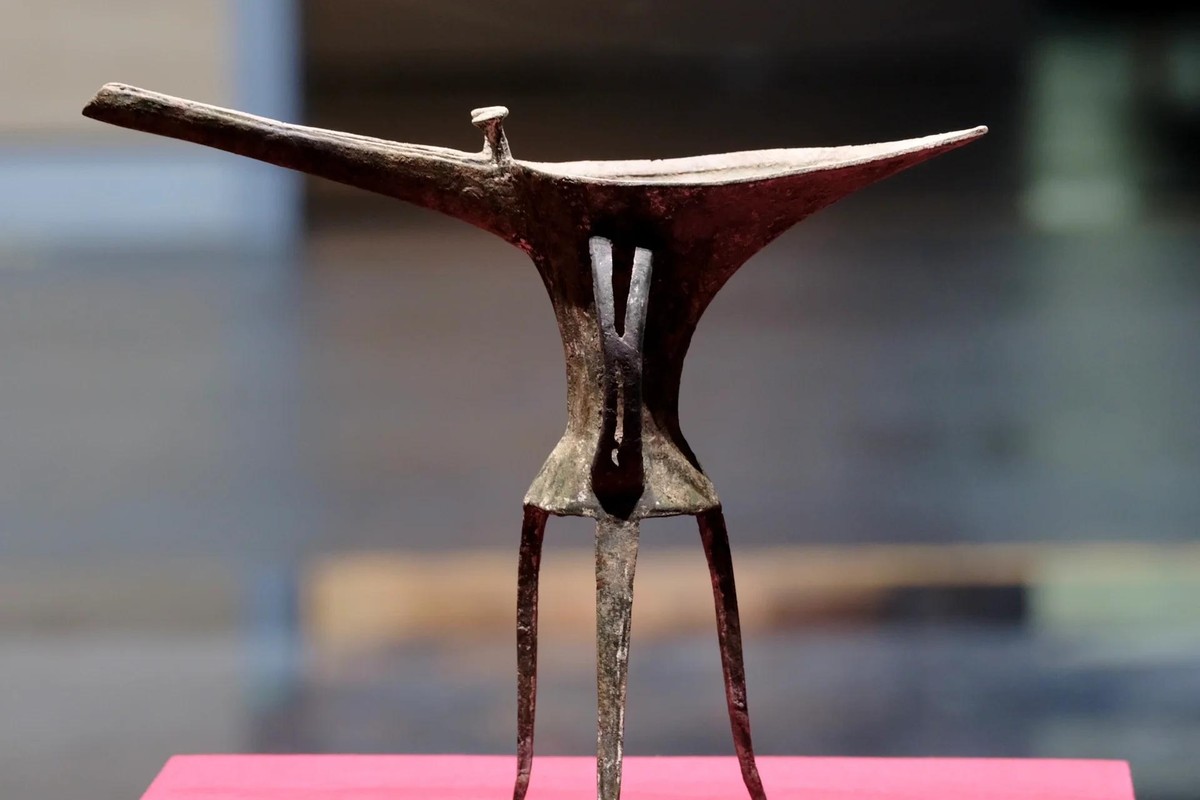
The bronze gallery at the Shanghai Museum is cold in a way the weather has nothing to do with, and on a weekday morning it is nearly empty. I stopped at a case holding four objects the size of coffee cups, each one lit from above so its shadow fell on a pad of red cloth. A jue, said the label. Three legs, a long trough of a spout on one side, a pointed tail on the other, a handle, and two small posts standing up from the rim like antennae. I had walked past it a dozen times as a schoolboy, on trips that always ended at the giant 大克鼎.
Nobody tells you the small things are the interesting ones. That cup is not a cup. It is a machine built to do exactly one thing at a table three thousand years ago, and once you know what the parts are for, the entire political order of the Shang dynasty starts turning up in vitrines.
What each part is for
Begin with the parts, because the parts are the argument. The two posts on the rim of a jue are the most argued-over detail in Chinese bronze studies. One long-standing explanation holds that they carried a strainer, so cloudy millet wine could be poured through the cup rather than around it; others think they were there to be gripped. Nobody disputes that the long spout is for pouring, and that the pointed tail opposite it balances the cup and lets the last drops run out. The three short legs let it stand in hot ash. Warm the wine, pour it through, and the gesture begins.
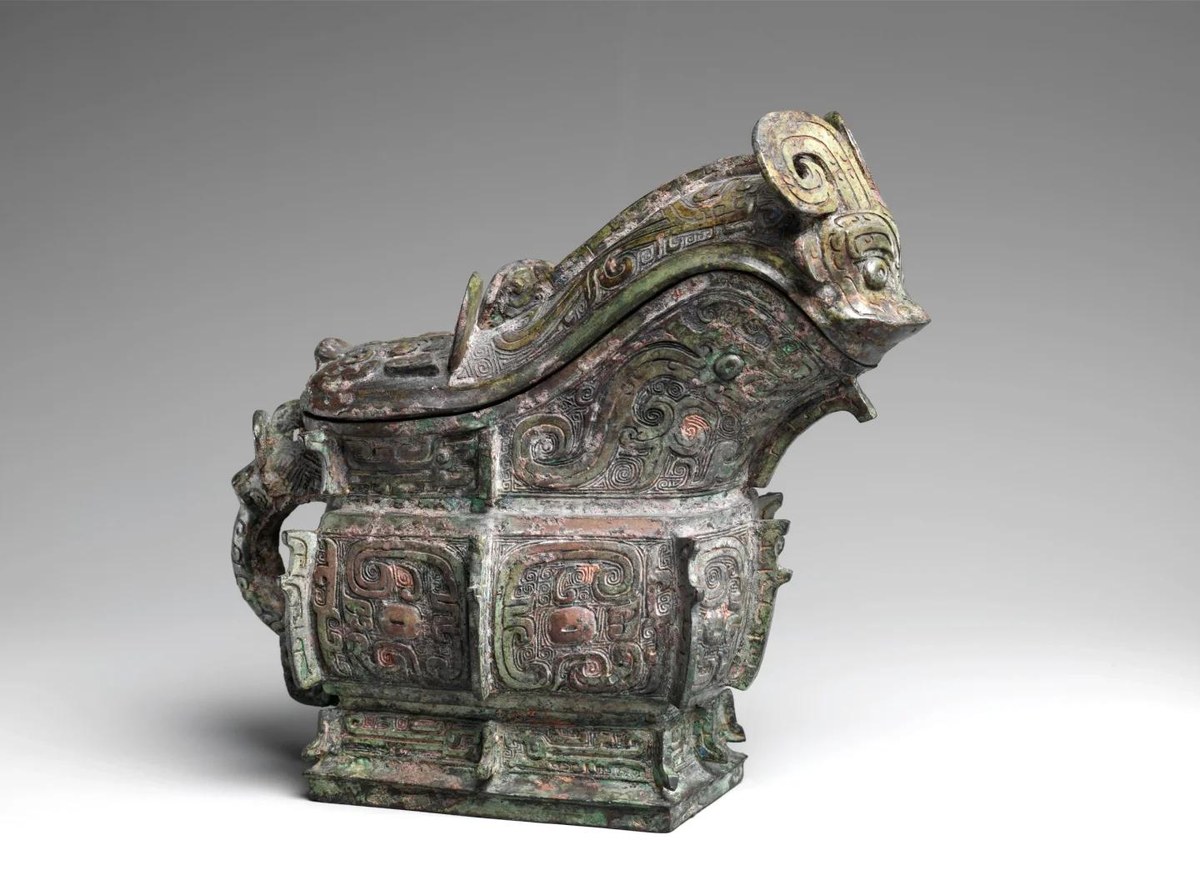
The rest of the family divides by verb, not by style. You warm in a 斝 jia, which has legs for heat. You ladle from a 卣 you, pour from a 觥 gong, the animal-shaped pourer with a lid along its back. You store and display in a 尊 zun, an 彝 yi, a 罍 lei. You drink from a 觚 gu, the tall trumpet beaker, or a 觯 zhi, the lidded cup. Wine is scooped from one vessel, warmed in another, poured from a third and drunk from a fourth, and every function has an object of its own.
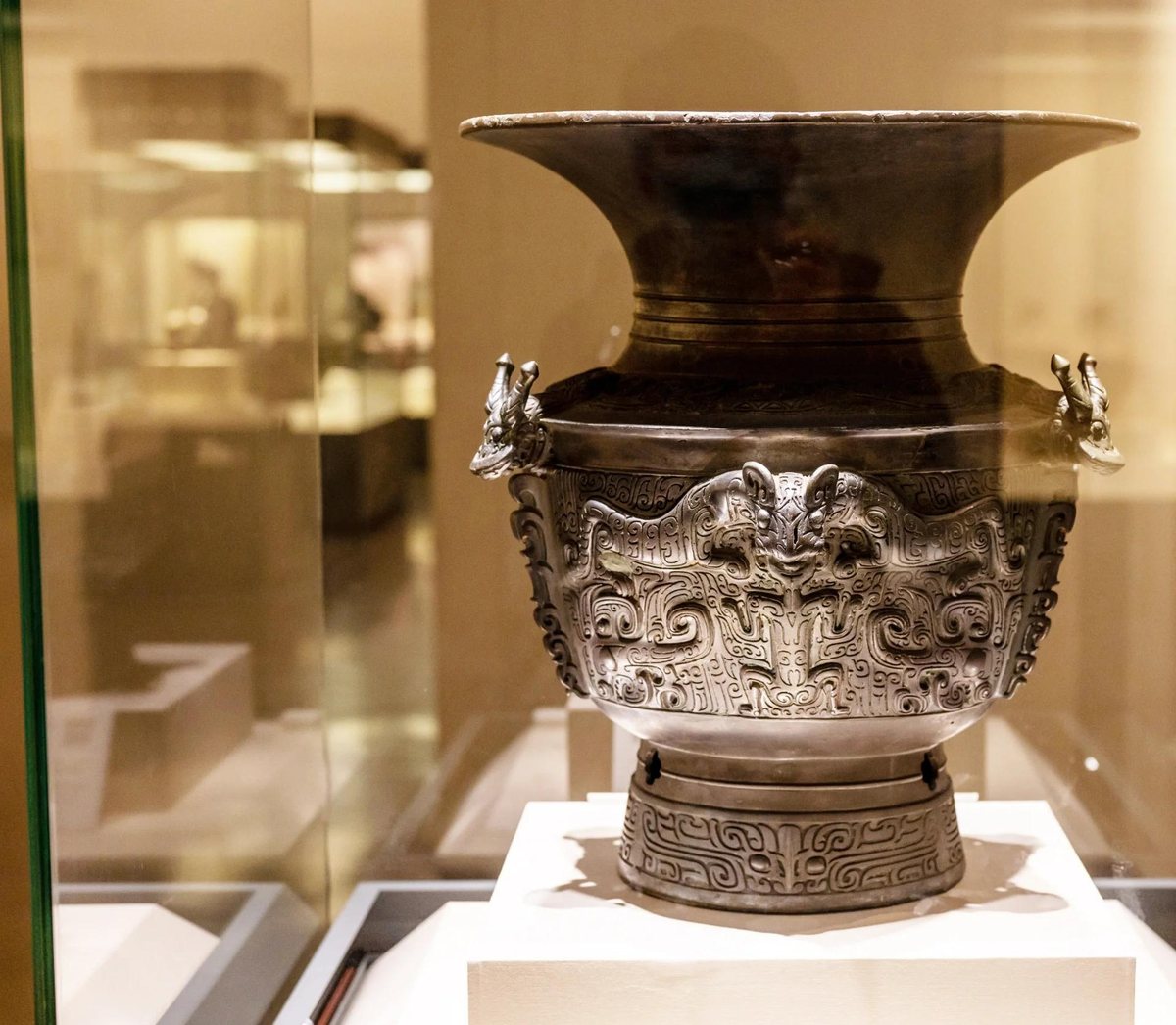
None of it was carved. It was cast, and the method explains why a museum can show you forty cups that look like they came off the same line. A foundry built a clay model, pressed soft clay sections onto it, fired those sections into a mould, then assembled the mould around a core and poured. Every ridge and every spiral of thunder pattern was cut into the mould first. Mediterranean founders mostly used lost wax, one wax model per object; the Chinese assembled a reusable mould, which is why a single tomb can hold a matched set. It was a build system, not a craft fair.
Why the wine vessels outnumber everything else
Walk the gallery and count. Cups, beakers, jars, pourers, warmers. Wine, wine, wine, with a few food vessels standing among them like chaperones. Shang tombs are loaded with drinking equipment, and the number of cups a man took into the ground tracks his rank as reliably as the size of his coffin. Fu Hao, consort of a Shang king, was buried at Anyang in about 1200 BC with hundreds of bronzes; the drinkers outnumber the cooking pots.
Then the Zhou arrive and the ratio flips. Tombs from the centuries after the conquest fill up with food vessels instead, cauldrons called ding and grain basins called gui, graded in sets of nine, seven, five. An archaeologist can date a tomb by that shift alone. The reason is written down, and it is one of the strangest documents to survive the ancient world.
Around 1046 BC the Zhou took the Shang capital. One of the first things the new regime produced was an edict about drinking. The Announcement on Drunkenness, 酒诰, is the Duke of Zhou instructing his brother, freshly posted to govern conquered Shang territory. It does not read like a health pamphlet. It reads like a security memo: wine is fine at sacrifices, in moderation; gather to drink for pleasure and the penalty is not a fine.
群饮,汝勿佚,尽执拘以归于周,予其杀。
If they gather in crowds to drink, do not let them slip away. Seize them all and send them back to Zhou, and I will put them to death.
The Book of Rites, compiled centuries later, turns the same anxiety into choreography: 一献之礼,宾主百拜, in the offering of a single cup, host and guest bow a hundred times, and though they drink all day, they do not get drunk. That sentence is the whole Chinese theory of the banquet, and it is older than anything on your table tonight.
Confucius makes the same point about hardware. In the Analects he looks at a gu that has lost its proportions and says it twice, as if he cannot believe it: 觚不觚,觚哉!觚哉! A gu that is not a gu, call that a gu? Call that a gu? He is not complaining about pottery. A vessel that no longer holds what it was made to hold is a rite that no longer holds, and a rite that no longer holds is a state that no longer holds. The Book of Songs keeps the other side: at the end of the harvest year the farmers of Bin raise the horn cup and shout 称彼兕觥,万寿无疆, ten thousand years without end. The same object could carry a death sentence in one century and a birthday toast in the next.
The lead in the cup
Lead bronze plus warm wine is a chemistry experiment. Wine carries organic acids, the alloy carries lead, and heat finishes the job: the result is lead acetate, which the Chinese called 铅糖, lead sugar, because it tastes sweet. A cup warmed over a fire before every ancestral sacrifice delivered it politely, in small doses, for generations. Researchers have measured elevated lead in Shang bronze and in bones from Anyang, and the popular version of the story has the aristocracy drinking itself into decline. I would not go that far: the measurements are real, the political conclusion is a guess that has been argued over for decades. It does settle one modern question, though. Do not drink from an antiquity. Not out of reverence, out of arithmetic.
How to look at one properly
Count the legs. Three legs and a spout means the owner could heat it; four legs or a flat ring foot means storage. Find the seam: piece-mould casting leaves a faint vertical ridge where two clay sections met, and Shang founders often turned that flaw into a decorative flange, cast rather than welded on. Read the inside of the rim and the floor of the belly, where most inscriptions run three to six characters, a clan sign plus a dedication such as 父乙, for Father Yi; that is the only place the object names itself. Then look at the patina under the light. Three thousand years in the ground produces a crust that sits on the metal in layers, green over blue over brown, and it does not come off on a fingertip. Bright turquoise that looks like paint usually is.
Where to go: the Shanghai Museum for density, the National Museum of China for scale (the 832-kilogram 后母戊鼎 and the 龙虎纹尊 share a building), the Yinxu Museum at Anyang for the ground itself, Baoji in Shaanxi for Western Zhou inscriptions.
One rule if you are ever offered one for sale: don't. The market is full of cast copies with glued patina, and a real piece with no excavation record is either stolen or a fake. Both are someone else's problem becoming yours.
Next: the grain left over from making wine does not get thrown away in China. It gets salted, brined and sold in Shanghai delis as 糟卤, wine lees turned into the most elegant cheap food in the city.