Zongzi: The Dumpling That Has to Be Tied Shut
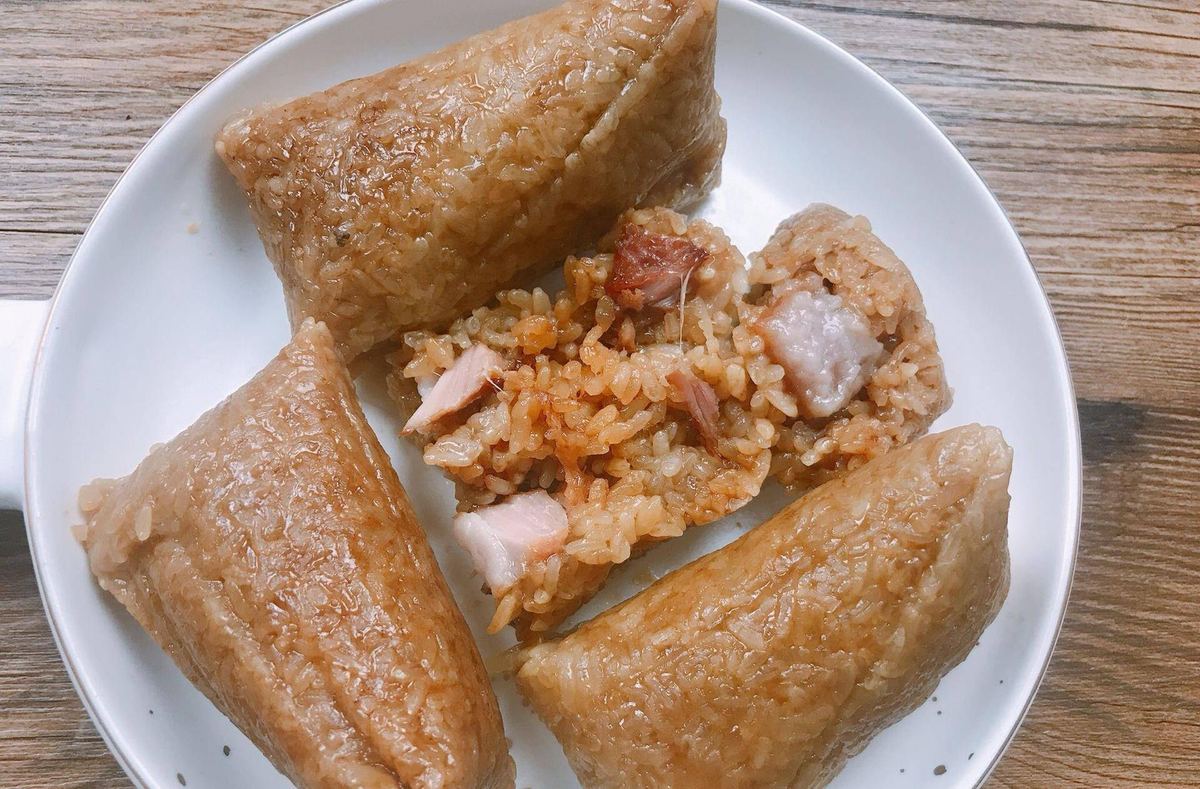
Every June the bathroom of my grandmother's flat stopped being a bathroom. The tub filled with cold water and reed leaves, a plate laid across the top to hold them under, and by morning the whole place smelled green. Not perfume-green. Riverbank green: wet, a little bitter, like the air over a canal at low tide.
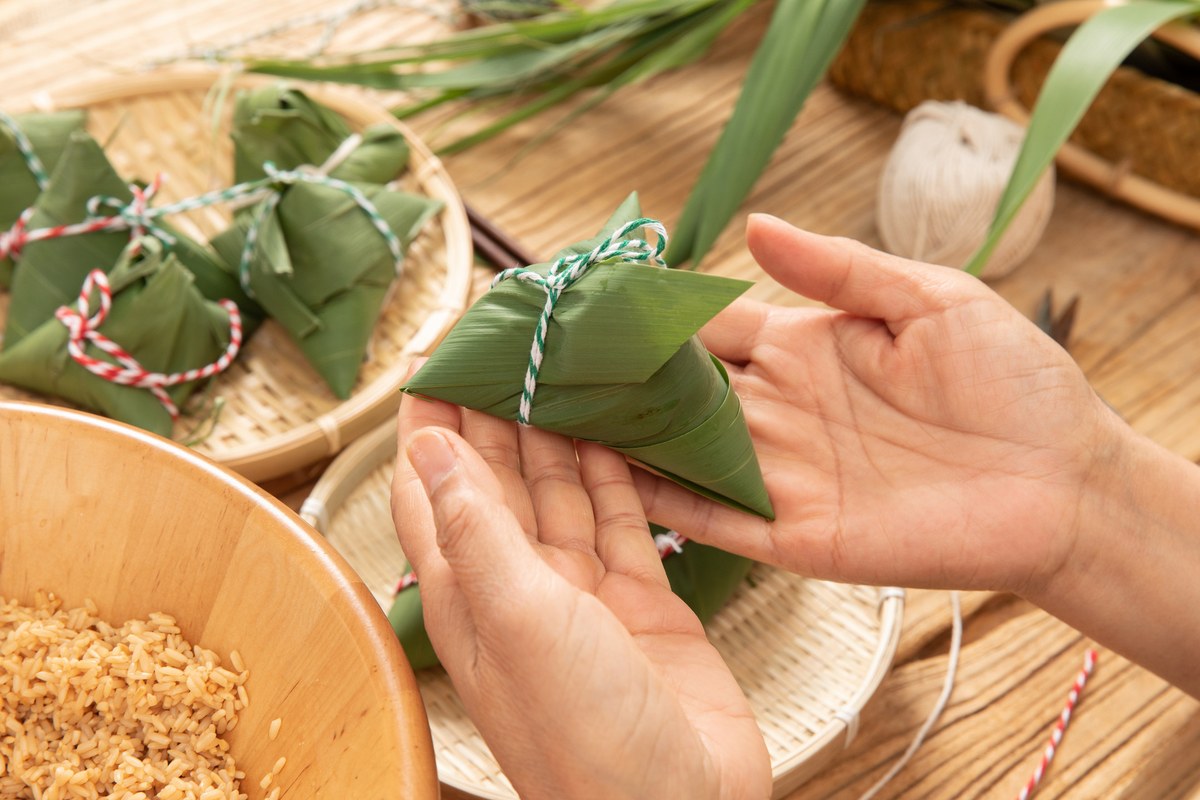
She worked at the kitchen table with a stool pulled up beside her. Bowl of soaked rice on the left, bowl of pork belly darkening in soy on the right, a spool of cotton string hung off the back of a chair. She'd bite off a length, overlap two leaves in her palm, twist her wrist into a cone, pack rice, drop in the pork, cover with rice, fold the long tail over, pinch both corners, wrap the string twice, once through, and pull it with the flat of her thumb. Ten seconds. She did forty in an afternoon and never once looked at her hands.
I was six the first time I tried. My cone had a hole in the bottom. Rice went across the table, onto the floor, into my lap. She laughed at me, not unkindly, and handed me two fresh leaves.
Zongzi (粽子, zòngzi) is glutinous rice packed into a leaf, folded into a pyramid or a brick, tied with string, and boiled for hours. That is the entire recipe. Everything that makes one good or terrible happens in the packing and the tying, which is why no two families' zongzi taste the same and why nobody can teach it to you in a message.
The leaf is doing more than holding
Reed leaves (芦苇叶, lúwěiyè) up here in the Jiangnan delta are narrow, so you use two or three at a time, overlapped, and the seams have to land where the folds will cover them. Further south they use bamboo leaves, wide enough that one will do, more forgiving to fold and a little less perfumed. Either way the leaves get boiled for ten minutes to soften, then soaked overnight, and the water turns the colour of weak tea.
The aroma is the argument for the leaf. Rice boiled in a pot tastes like rice. Rice boiled inside a reed leaf for four hours takes on something grassy and faintly smoky that no sauce can imitate, and it clings hardest to the outer layer of grains, the ones actually touching the leaf. That's why the best bite of a zongzi is always the first one, scraped off the inside of the wrapper.
Fat is the mechanism
Glutinous rice (糯米, nuòmǐ) soaks four hours or overnight, drains, and gets tossed with a little light soy and salt. Season the rice itself, not just the filling, or you end up with a well-flavoured lump of pork in a mouthful of nothing.
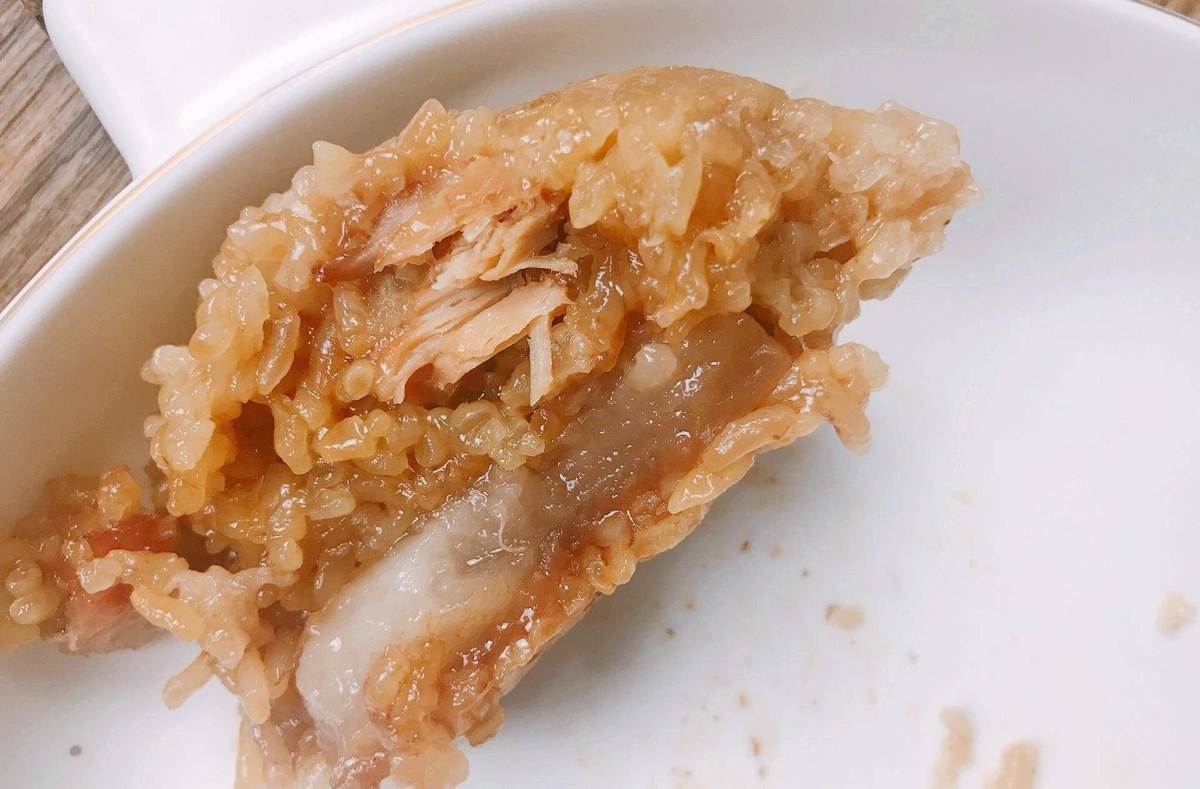
Then the pork: belly (五花肉, wǔhuā ròu), cut into thumb-sized slabs, marinated overnight in light soy, dark soy, Shaoxing wine, a pinch of sugar. Skin on. People leave the skin off and it's the whole point of the cut. Over four hours the fat renders into the surrounding rice, the collagen goes soft enough to cut with a spoon, and the grains packed against the pork turn translucent and savoury. The top of the zongzi and the bottom of the zongzi do not taste the same. That gradient is the dish.
Two millimetres of string
This is where it goes wrong, and it goes wrong quietly. Tie it loose and river water seeps in through the seams while it boils; the rice takes on too much liquid, the grains give up separating, and you unwrap the thing and pour it out. Tie it tight and the rice has nowhere to swell. It comes out dense at the core, the leaf splits along a seam you didn't know was exposed, and the pot fills with rice soup and loose leaves.
The knot is snug, not tight. There is maybe two millimetres between the two, and you learn it in your fingertips after about a hundred failures. My grandmother could not explain it. She'd take my zongzi, squeeze it, hand it back and say 再紧一点, a little tighter. I'd ask how much tighter. She'd say, tighter.
The story behind all this folding is short. In 278 BC a poet and minister named Qu Yuan spent his career telling the king of Chu things the king did not want to hear, was exiled twice for it, and when the capital fell he walked into the Miluo River holding a rock. Fishermen threw rice into the water so the fish would eat that instead of him. Whether they thought to wrap it in leaves first is the sort of detail that gets added later by people who like their history tidy. It doesn't matter much. Every June a country makes the same thing for a man who died twenty-three centuries ago, and almost nobody chews a single bite thinking about him.
The enemy is a vacuum bag
Supermarket zongzi are identical. Same weight, same angle on all four corners, because a machine folded them. The rice has been pressure-steamed into a single block with no grain left in it, closer to mochi than to rice, and there is one slice of pork in the middle, thin as a business card, no skin, no fat worth rendering. The leaf smells of the plastic it was sealed against. It is not a worse zongzi. It is a different food that has been given the same name, the way a rice cake is not a cake.
Worse are the ones sold as health food, with quinoa and chicken breast and no fat at all. That is a grain bowl wearing a leaf as a costume.
The sweet-savoury split is real and I won't pretend otherwise. North of the Yangtze the default is sweet: red bean paste, a dried jujube, sometimes plain rice to be dipped in sugar. In Jiaxing, eighty kilometres from Shanghai, the default is pork. Marriages have survived this disagreement. Dinners have not.
Eat it hot, with your hands
Hot is not negotiable. A cold zongzi is a brick; the rice sets into something with the texture of a doorstop and the fat goes waxy. Straight out of the pot, drained, given two minutes to stop scalding, is the only correct window.
Cut the string, and keep the string. My grandmother washed hers and dried them on the windowsill, a whole year's worth hanging off a nail by the sink, because cotton string is cotton string and why would you buy more. Peel the leaf back like a banana. Steam comes off the rice. It's glossy, and greenish at the surface where it was pressed against the leaf. Eat it with your hands, standing up, over a plate you don't really need. Some people in Jiaxing dip it in light soy. My grandmother would have taken that as a personal remark on her seasoning.
And when you're done, the leaf still smells of the leaf. Hold it up. That smell is where the rice was.
She's in her nineties now and stopped folding three summers ago. The last batch she made, the ties were loose, and the rice came out soft at the edges, and none of us said anything about it. My mother has the spool now. Same spool.
Every June I get the leaves out and fold four before I get one that doesn't leak. Ten seconds, she used to say. It takes me about ninety, and the knot is still the only part of the recipe nobody ever wrote down.
💬 Comments