Yong Tau Foo: The Tofu That Took the Boat to Ampang
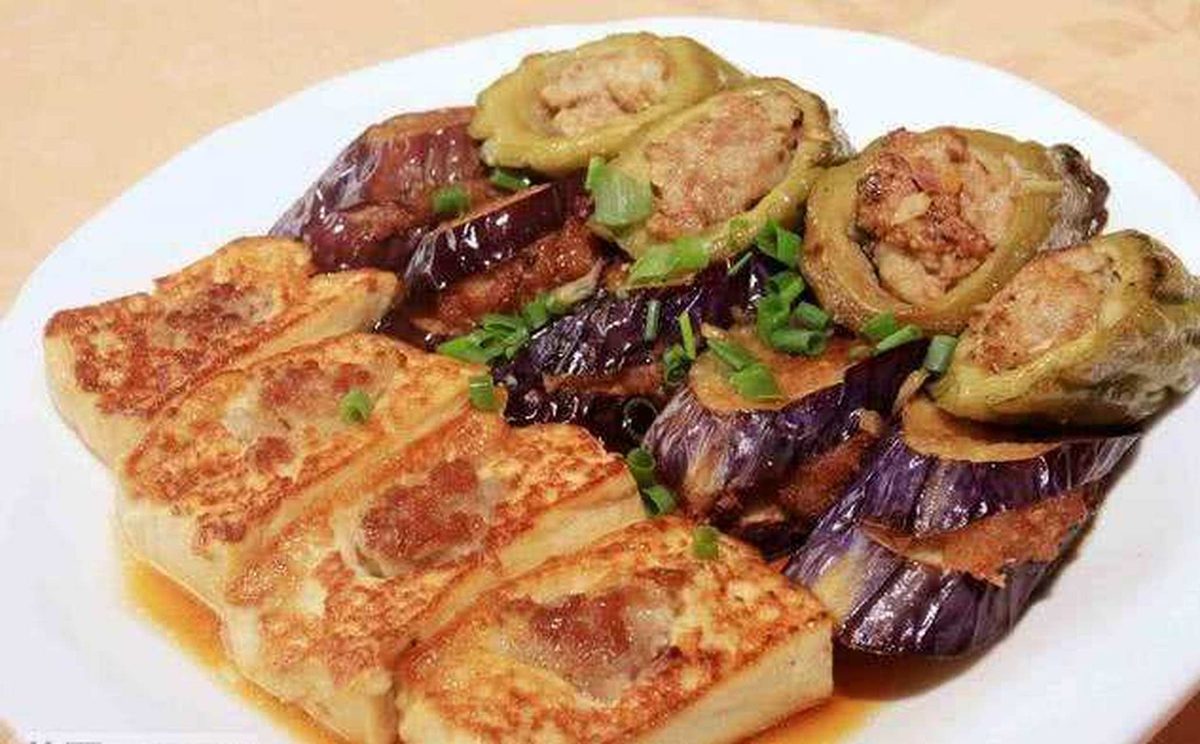
You don't order it by name. You point.
The tray sits at the front of the shop, banked in ice: rings of bitter gourd, okra pods, eggplant cut into fans, squares of fried tofu skin, red chilies with the seeds scraped out — each one plugged with a pale pink dome of fish paste. You take a bowl and a pair of tongs and build your own lunch, one piece at a time, while the woman behind the counter watches to see what kind of person you are.
Then it goes into the back and comes out in a bowl of broth so clear you can count the shallots floating in it. The smell gets to your table first: dried anchovy, white pepper, a slick of fried shallot oil on the surface. The broth is hot enough to fog your glasses. Under it, faintly, is the green smell of just-blanched bitter gourd, which is the point of the whole bowl and the reason half the people at your table will push it to the side.
The first bite is a small argument. The fish paste gives, springs, gives again — a texture the Chinese call tán (弹), bounce, and no amount of starch can imitate it. Then the bitter gourd arrives late, sits on the back of your tongue, and leaves with something sweet behind it. If the gourd has been boiled to olive drab, you get the bitterness without the exit. One bite tells you whether the kitchen knows what it's doing.
I ate this for the first time in 2018, in Ampang, on the eastern edge of Kuala Lumpur, on a work trip I have otherwise forgotten. A colleague drove me there, ordered for me, then watched me eat, which is the most Malaysian thing anyone has ever done to me. Six pieces, nine ringgit. I was back the next morning before my flight, at a different shop, alone, ordering badly because I had to guess the names.
Yong tau foo (酿豆腐, niàng dòufu, "stuffed tofu") is Hakka food that got on a boat. When Hakka families left Meizhou for the Malayan tin mines in the nineteenth century, they brought the pocket, kept the technique, and swapped the pork for fish — fish was cheap and not every customer ate pork. Same trick, new land. In Meizhou it is seared in lard and braised dark. In Ampang it is poached pale in broth and handed to you in a bowl.
The argument nobody is having out loud
In Meizhou, the stuffed face goes down into a hot pan of lard first — that wet crackle, hard and fast — and only then into a clay pot with soy, stock, and a scrap of salted fish. What you are buying is crust: a thin gold shell where the pork met the iron, and a gravy dark enough to stain the rice under it.
Ampang does the opposite, and does it without apology. Nothing touches a hot pan. The items go into simmering anchovy stock (江鱼仔, jiāngyúzǎi) for four or five minutes and come out the colour they went in. No sear, no soy, no crust. The broth is the sauce. Anyone who tells you this is the lesser version is judging a soup by whether it crunches.
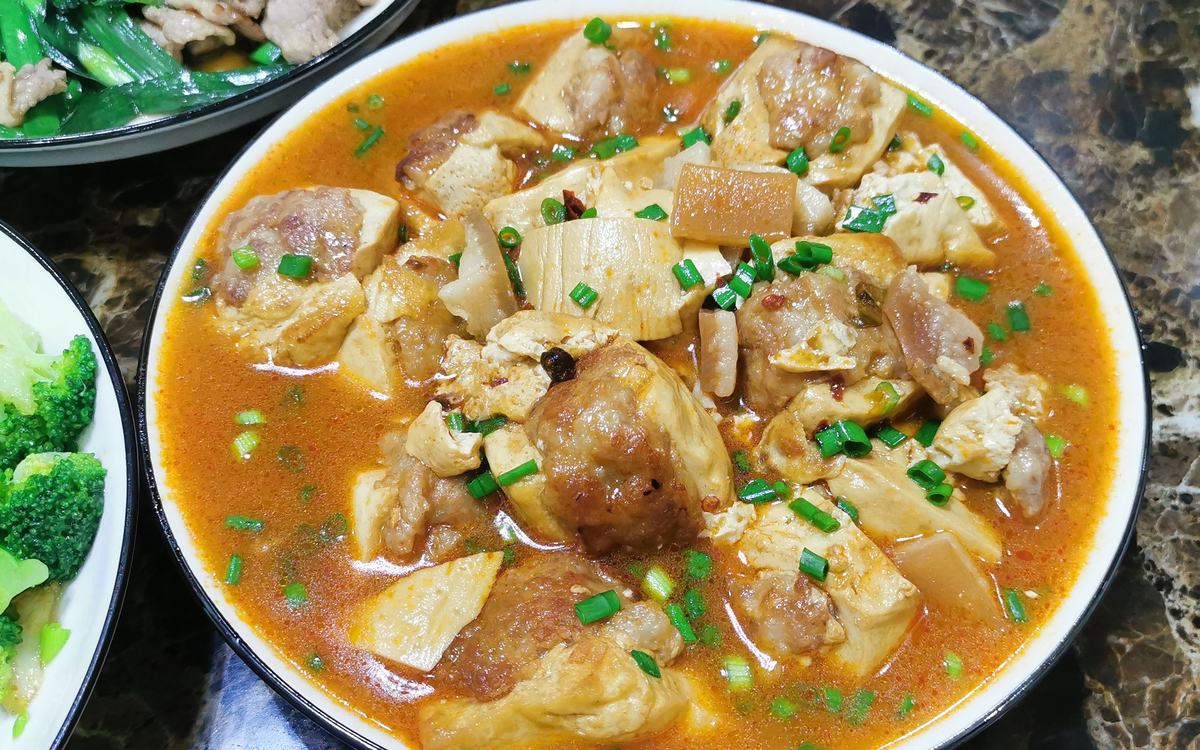
The two bowls are answering different questions. The fried one answers: how do we make this feed a family, with rice, on a wet night. The soup one answers: how do we make this a bowl you can eat at ten in the morning, in a shirt, before work. Both answers are correct. I have eaten more of the fried version, because I grew up closer to it, and I think about the soup version more.
The wrapper got ambitious
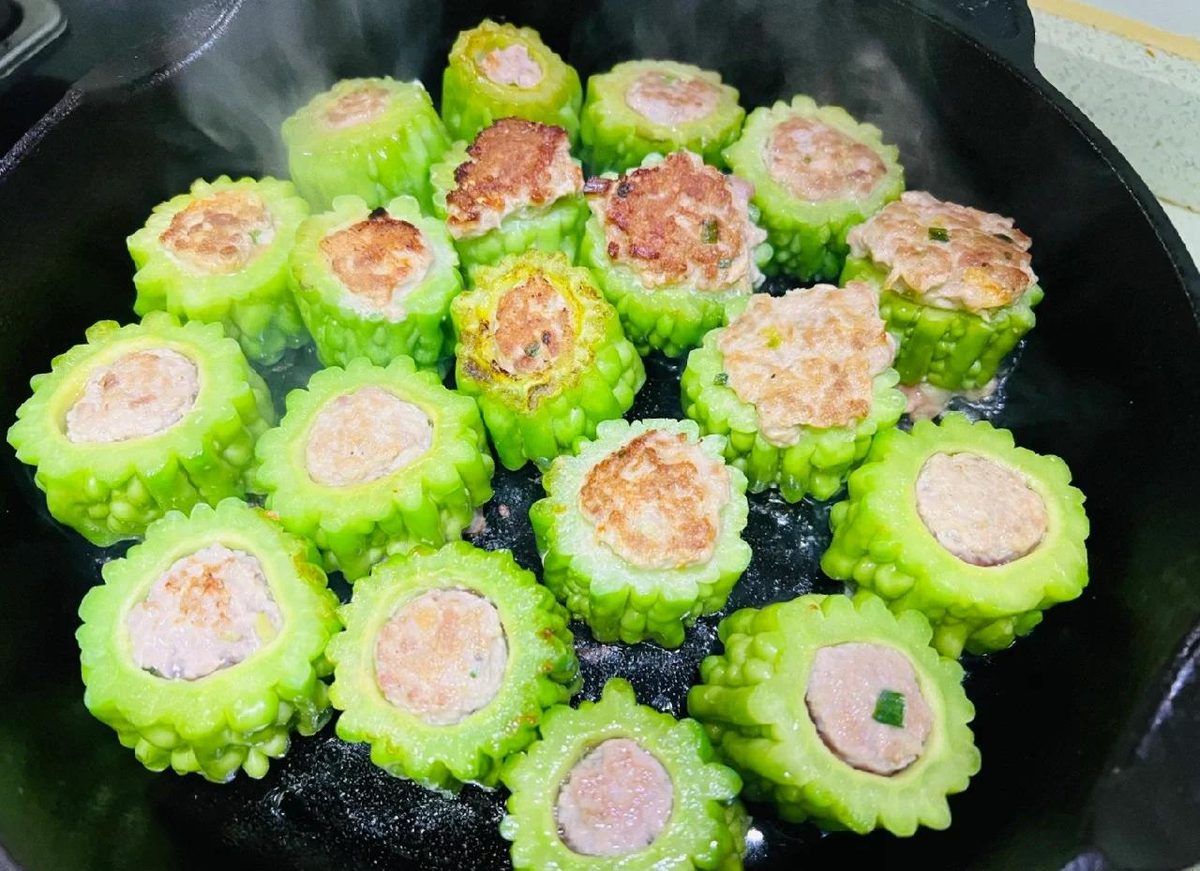
In Meizhou, the wrapper is mostly tofu. In Ampang, the wrapper is whatever will hold fish paste and survive a simmer: bitter gourd (苦瓜, kǔguā), okra, eggplant, chili, fried tofu puffs, tofu skin (腐竹, fǔzhú), a knotted sheet of bean curd. Okra is the one that divides the table. It goes slippery in the broth, and that slipperiness is the reason some people order four of them and other people order none.
The paste itself is the tell. Mackerel or mud carp, salt, ice water, a little starch, whipped hard in one direction until the mass turns tacky and lifts off the bowl in a single piece. Salt first, then cold water — that order is what makes it spring instead of crumble. A good paste tastes of the sea and hardly of anything else, and it should be slightly cooler than room temperature when it goes in.
What goes wrong
The chain-shop bowl is the enemy, and in Kuala Lumpur and Singapore it is everywhere. The fish paste is more than half starch, so it bounces like a rubber eraser and tastes of white pepper and nothing else. The broth has salt and MSG and no anchovy, which you can taste as a flatness behind your front teeth. You finish it and feel like you ate a bowl of hot water with a spoon.
Then there is the dry version, which is fine in principle and ruined in practice: the same items drained and drowned in a sweet, gluey sauce that coats the back of the spoon like paint. If the sauce is holding its shape, the kitchen is hiding a weak stock behind starch. Ask for it in soup instead, or walk.
Three smaller crimes. Bitter gourd boiled until it is grey and limp, so you get all of the medicine and none of the vegetable. And the sweet chili sauce poured directly into the broth — I have watched people do this, and I have said nothing, and I regret it. Dip. The broth is the dish.
In the West you mostly meet a fourth version: three limp fishballs, two leaves of bok choy, and a menu that calls it yong tau foo because nobody there will argue. It is not the same food. It is a fishball soup wearing its clothes.
How to eat a bowl of it
Pick five or six pieces, not twelve. You want one of each texture: something bitter, something slippery, something fried, one chili, and two pieces of plain tofu as your control. Order the soup version (汤) your first time, not the dry. Noodles are optional and usually a mistake on a hot day — bee hoon if you must, but the bowl stands alone.
Drink the broth before you add anything. Then white pepper, nothing else. Work through the pieces in order of aggression: tofu first, chili somewhere in the middle when your mouth still has opinions, bitter gourd last so the bitterness gets the final word and doesn't fight everything before it. Spoon the broth over each piece as you go; the items are bland on their own by design.
Order something cold with it — iced barley, soy milk, anything with ice — because the broth arrives scalding and the contrast is half the pleasure. The other half is the sound: four spoons, one bowl each, no conversation.
You will over-order. Everyone over-orders. The first time I did it I counted my tongs at the counter and paid for fourteen pieces, and I ate eleven and left three and thought about those three on the plane. That's the whole review.
Making this at home turns on one thing — keeping the fish paste cold and whipping it long enough that it springs back instead of crumbling into the broth. It deserves a full walkthrough. Recipe coming soon.
💬 Comments