Yibin Ba Ba Shao: Fifty Skewers, One Fist, No Sauce
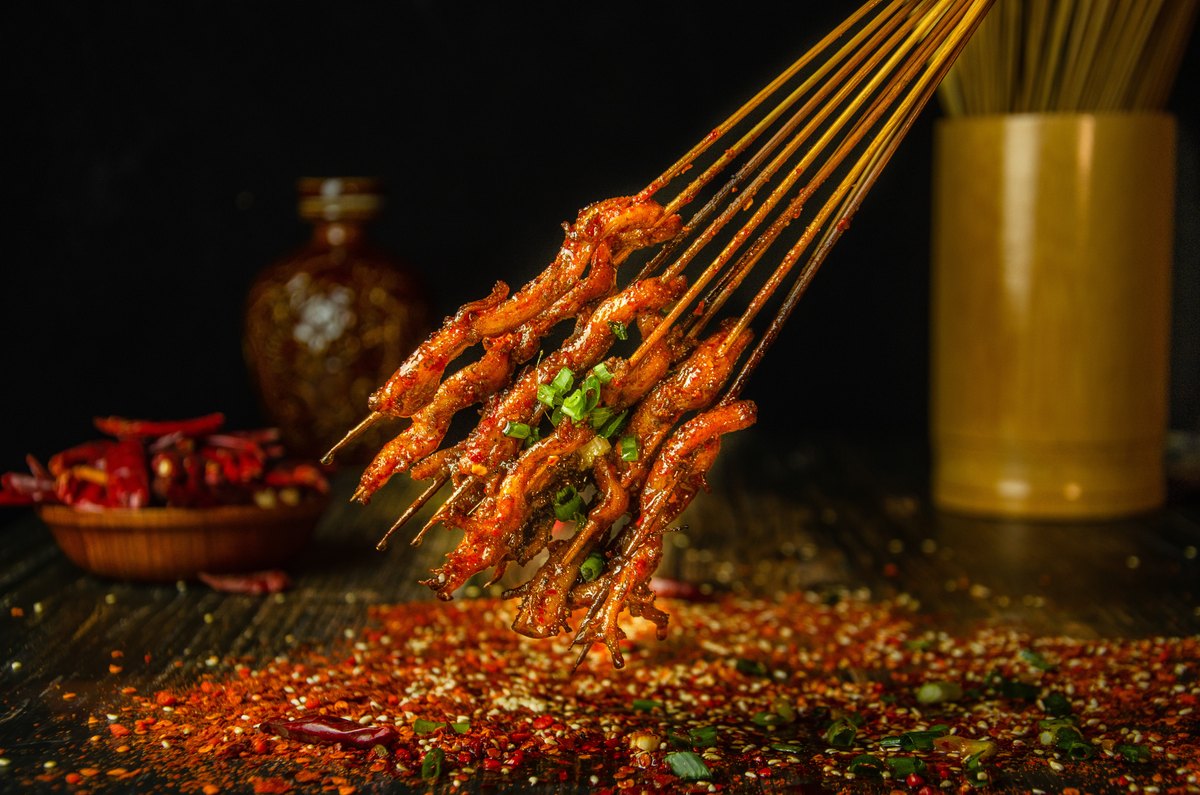
The smell arrives before the light does. Charcoal first, smoke leaning sour at the edges, then cumin, then the fat dropping onto the coals. You turn the corner and find a man squatting over a steel trough of coals no bigger than a bathtub, fanning them with a piece of cardboard torn from a carton. In his left hand he holds what looks like a bundle of twigs. It is fifty skewers, fanned out like a hand of cards, and he flips the whole bundle at once.
This is Yibin barbecue, 把把烧 (bǎ bǎ shāo), and the name is the whole idea. Bǎ is a bundle, a fistful, a bunch of things held together. Nobody here orders six skewers. You order a bundle — fifty at a time, sometimes a hundred — and each stick carries a piece of meat barely a centimetre across. A cube of pork belly. A slip of beef. A knuckle of tendon no wider than your little fingernail.
Small enough to cook in forty seconds. Small enough that the fire reaches all six sides before the inside has time to steam. That is the entire design, and it took me two trips and one very wrong dinner to understand it.
No sauce, ever
I thought I knew Chinese barbecue. I had eaten lamb off a Uyghur cart in Shanghai at two in the morning, chicken frames in Shenyang, the pancake-wrapped thing that made Zibo famous. So when a friend from Chengdu asked whether I had tried 把把烧, I said no, and he looked at me the way you look at someone who claims to have visited Sichuan but never ate lunch.
My first attempt was in Chengdu, at a place with the characters 把把烧 in red neon and a laminated menu. The skewers came out the size of my thumb, glazed, sticky, sweet. They were fine. They were also completely interchangeable with every other grill on the street, and I remember thinking the name must be marketing.
It isn't. It's geography. Yibin sits where the Jinsha and the Minjiang rivers run into each other and become the Yangtze, and for a couple of centuries it was a port town full of men who loaded boats for a living and needed to eat cheap and fast. Small skewers, cheap cuts, a fire you can build in a bucket, a cook who can turn out a hundred sticks while you're still sitting down. The form never changed because it never needed to.
What changed, when I finally got to Yibin, was my understanding of what a skewer is for.
Yibin's grill uses no sauce. No brush, no glaze, no bowl of sweet bean paste on the counter. What goes on the meat is dry: cumin, coarse chili flake, salt, ground Sichuan pepper, a hit of MSG that nobody apologises for. The cook dusts at three separate moments — once on the raw meat, once halfway, once as the bundle comes off the fire — and each dusting does different work. The first seasons. The second builds a crust. The third blooms in the residual heat so the aroma hits your face before the plate reaches the table.
There's no oil baste either, which is why the charcoal matters. Fat from the pork belly renders and drips and comes back up as smoke, and that smoke is the sauce. A gas grill produces heat. It doesn't produce this.
The nose tendon problem
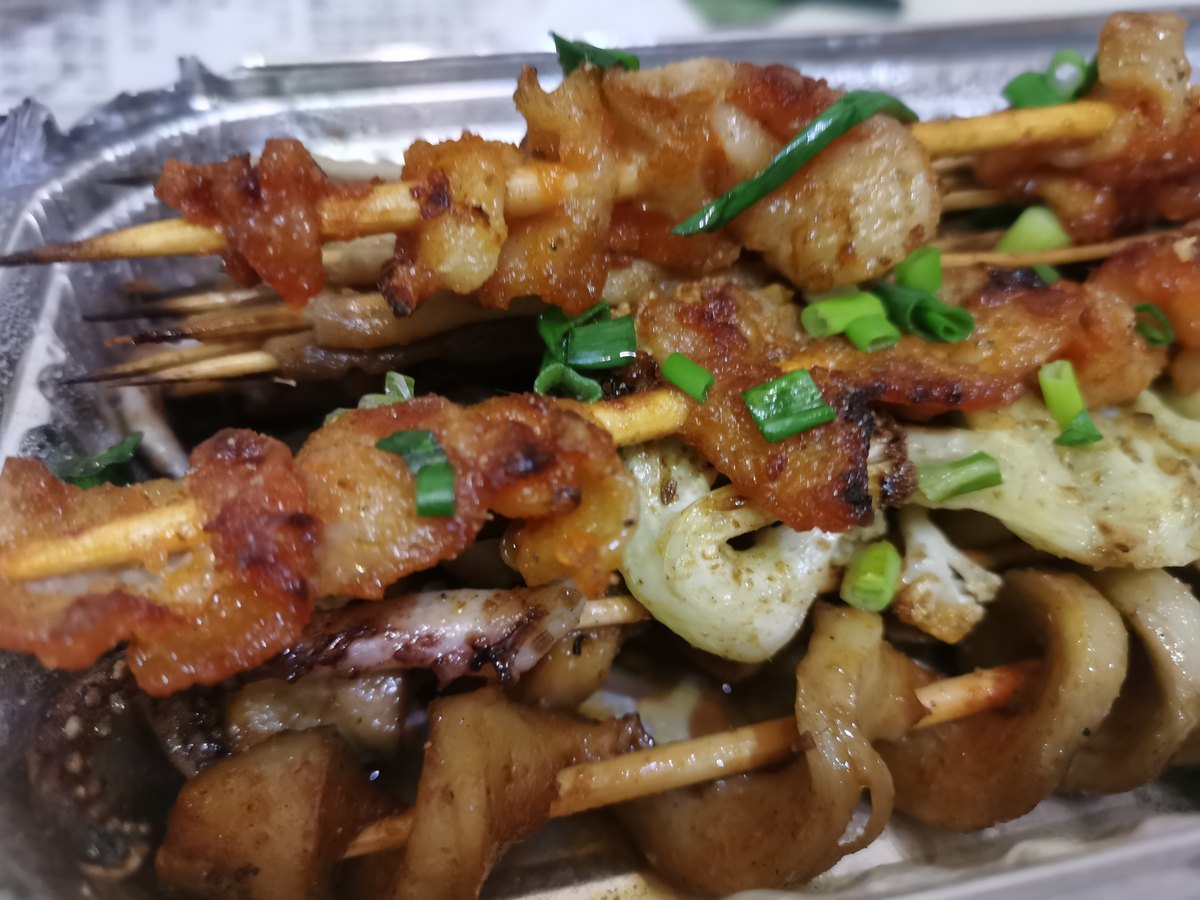
Every region has one cut that outsiders find alarming, and Yibin's is 鼻筋 (bí jīn), the tendon from a pig's snout. It looks like a pale, translucent noodle threaded onto a stick. It has almost no flavour of its own, which is exactly the point: it's there for the chew, a rubbery-crunchy snap that gives way slowly, and it holds dry spice better than any muscle does.
I ordered four. Then eight. Then stopped counting, because counting is a thing you do when you're not enjoying yourself.
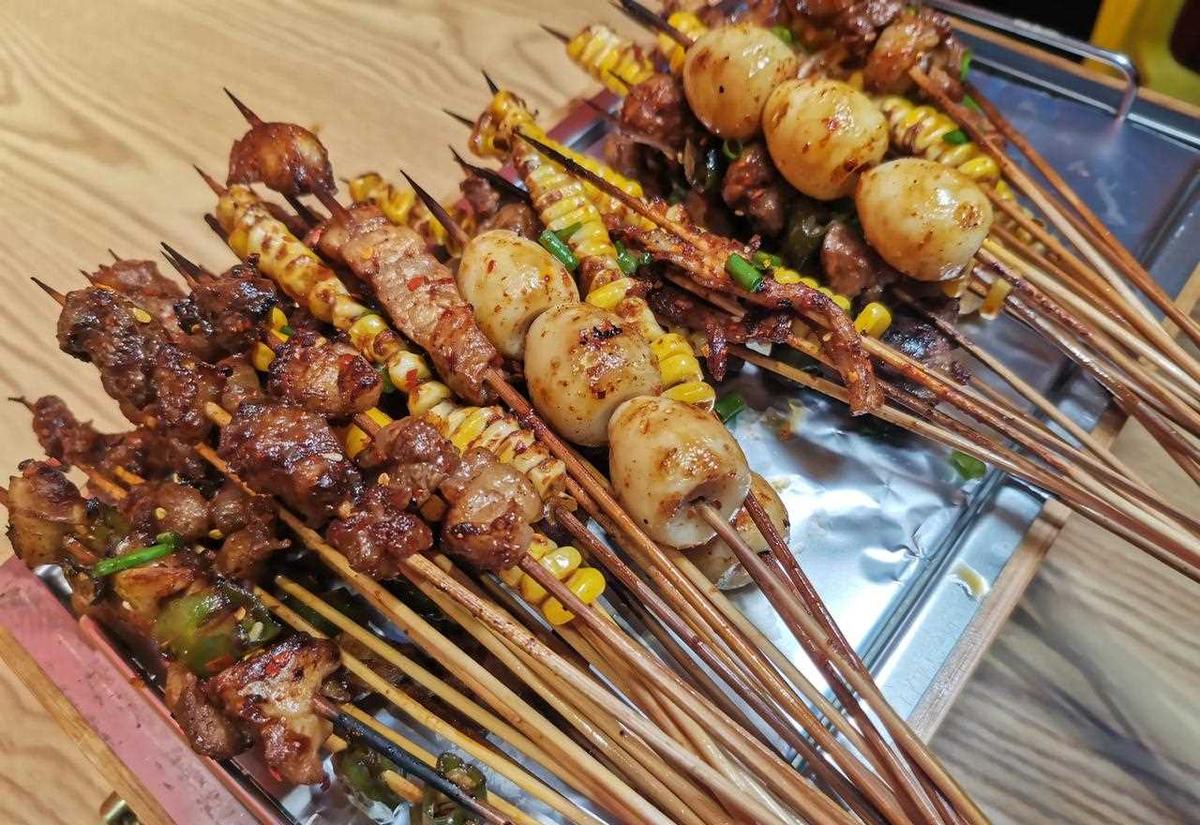
The other staples: pork belly cut thin so the fat renders before the lean dries; 粉肠, a length of small intestine with a soft, mineral interior; beef threaded so tightly the pieces touch; potato sliced into coins, parboiled, then charred until the edges go crisp and the middle stays glassy. Eggplant split open and buried under garlic. And at every table, a small dish of dry dip — chili, salt, ground pepper — that you press each skewer into before eating, like stamping a document.
What ruins it
The glazed version. It's what most of the country outside Sichuan sells as 把把烧 — sweet, lacquered, the meat shiny under a heat lamp. Sugar burns before meat chars, so the cook pulls the skewer early to save the glaze, and you get candy wrapped around something grey. If your fingers are sticky afterwards, you were not eating this.
The jumbo version. Three centimetres of pork on a flat bamboo stick, advertised as "generous." It cannot work. The outside scorches while the middle is still pink, or the cook holds it back until the middle is safe and the outside has gone leathery.
The tray version. Pre-grilled at six in the evening, stacked, reheated to order. Ask yourself why your skewers arrived in four minutes flat when the table next to you is still waiting. Charcoal time is not compressible.
And the white-tablecloth version, in the cities that have discovered Yibin food recently. Same dish, same name, thirty yuan a stick, served on slate. It isn't fraud. It's just that 把把烧 was built for a plastic stool and a case of beer, and something gets lost in translation along with the smoke.
The good version is loud and slightly chaotic. The cook is sweating. The bundle is in his fist, not on a plate. It costs about a yuan and a half per stick and it's in front of you ninety seconds after you point at it.
The forty-second window
Eat standing, or as close to it as the stool allows. Order in waves, not at once — three bundles, then three more. A skewer that has been sitting on the tray for five minutes is a different, worse object: the fat congeals, the crust softens, the cumin goes flat.
Take it straight off the fire, press it into the dry dip, and eat it in two bites. Don't strip the meat with your teeth and put the stick down. The whole point of a centimetre of meat is that it's one mouthful, still spitting hot, and then it's gone and you're reaching for the next one.
Beer, obviously. Something cold enough that you don't taste it. And when the woman with the pad comes to count the sticks, let her count. The bill is the only part of the evening that isn't fast.
I ate fifty-four skewers that night and I would like to say I stopped because I was full. What actually happened is that the charcoal ran low and the cook started banking the fire for the next table, and I understood, watching him, that a bundle of fifty is not a portion size. It's a unit of time. Fifty skewers is however long you get to sit there before the coals make their decision.
The home version is possible but unforgiving: a centimetre of meat dries out in the time it takes to answer your phone, and the dusting schedule matters more than any marinade. That deserves its own post. Recipe coming soon.
💬 Comments