Naan: The Bread That Bakes on a Wall
The oven is not an oven. It is a hole in the ground, waist deep, lined with clay, and the man tending it is lying almost flat on his stomach with one arm buried to the shoulder. From inside the hole comes a low roar, the sound a fire makes when it has air and nothing to prove. When the arm comes back out, the hand is empty and red to the wrist.
He is not pulling bread out. He is putting bread in. The dough goes onto the wall the way you would stick a wet leaf to a window: one flat smack, palm first, fingers following, and then the hand is already out and reaching for the next one. He does this eleven times in a row without standing up.
That is a Xinjiang naan (馈, náng) coming into the world. Not rolled, not proofed in a tin, not brushed with butter at the end. Baked by contact, on a vertical wall of hot clay, by a man who has to put his arm into a fire to make breakfast.
The pit is called a tunur in Uyghur, and you will hear Chinese speakers call it a náng kēng (馈坑) — a naan pit. Mine is a clay cylinder sunk into the pavement, maybe a metre across at the mouth, wider at the belly. The fire burns down at the bottom for an hour or two until the wood has gone to embers and the walls have gone the colour of a dying sunset. Then the ash gets raked out, the floor gets sprinkled with salted water, and the whole thing steams. The steam is the point. Dry heat makes a cracker. Steam makes bread.
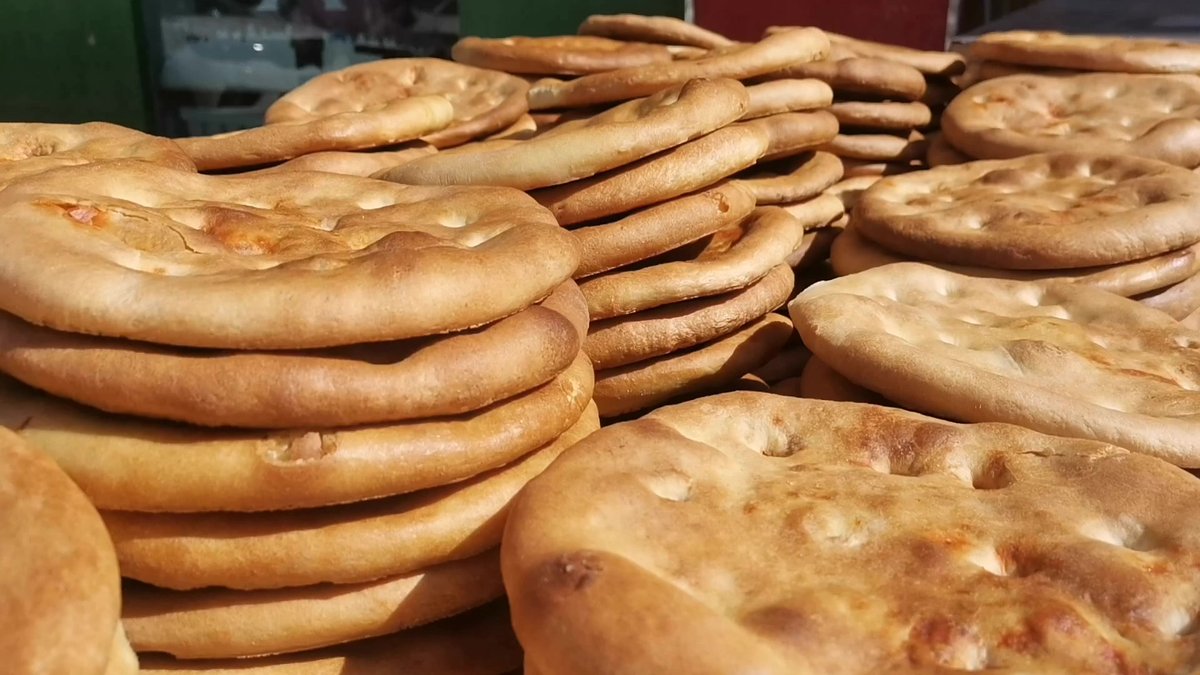
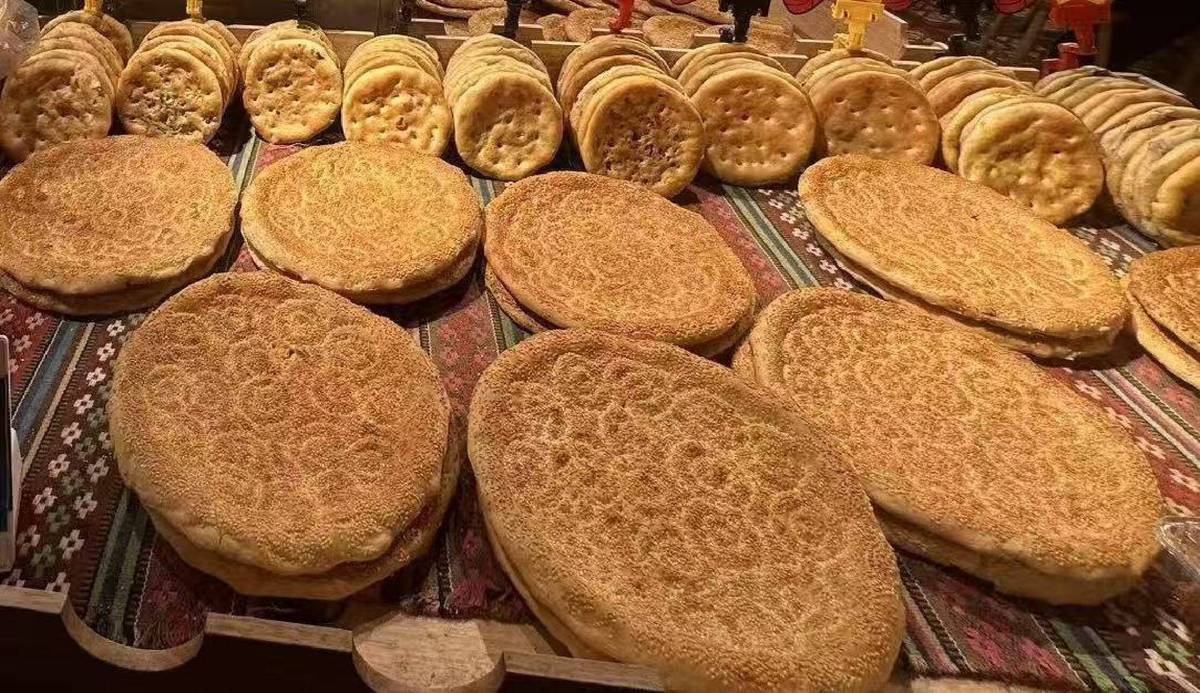
The tool that tells you whether you are watching a real baker or a tourist show is the stamp. A náng chuōzi (馈戳子), or chekich in Uyghur: a block of wood with a handle and a circle of blunt nails driven through it. He presses it into the centre of each round, once, hard, and the dough sighs and dimples. The holes are not decoration. They let the steam out of the middle so the bread stays flat instead of ballooning into a balloon, and they give the hot oil somewhere to sit. Every naan you have ever seen with an even lattice of identical dots was stamped by a machine. His holes are uneven, deeper in the middle, shallower at the rim, because his wrist rolls when he pushes. You can read a baker's forearm in a piece of bread.
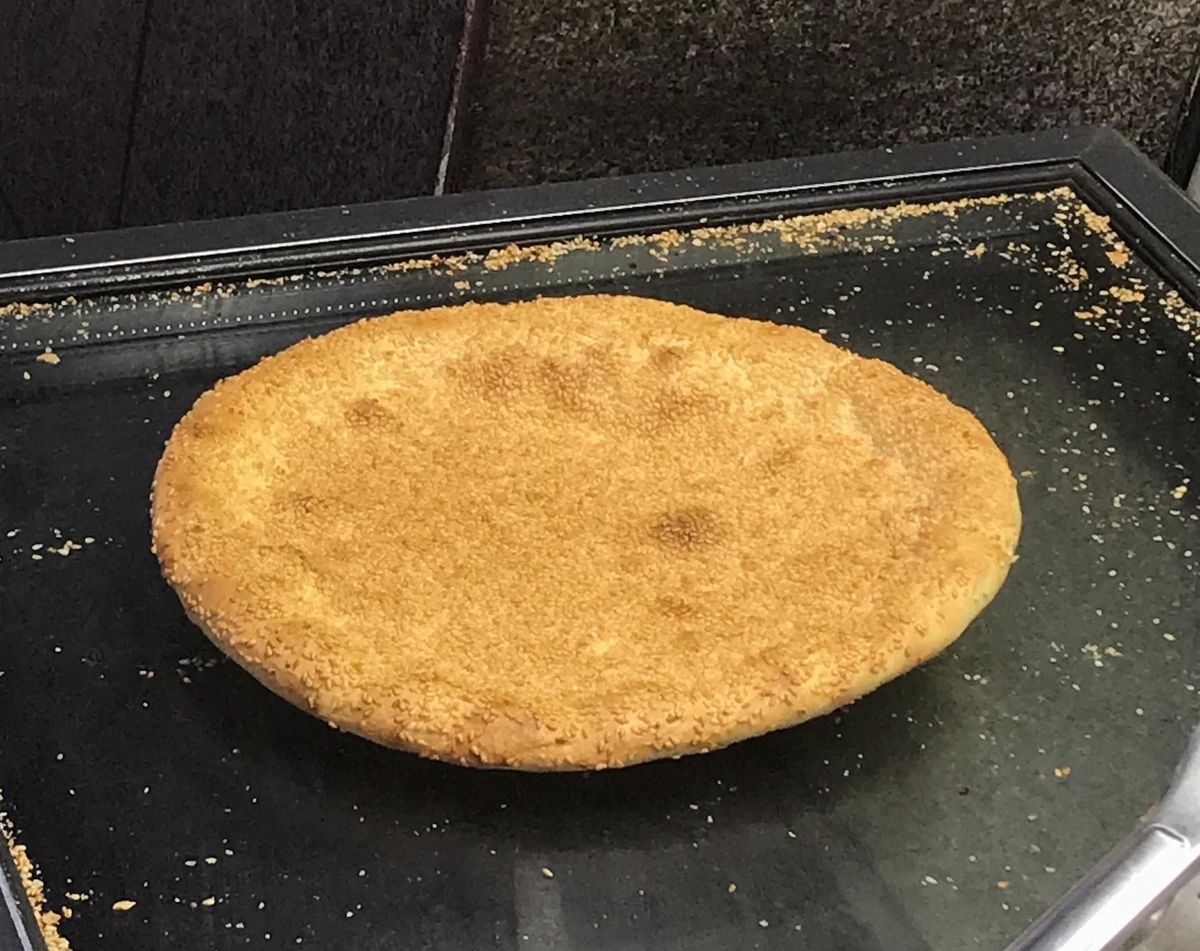
Four to six minutes. He pulls them with a long iron hook, one at a time, and stacks them on a board like plates. What comes out has three zones and you can find all three with your fingers. The outer ring is puffed and pale, soft enough to fold. The middle band is blistered brown, spotted with dark freckles where the dough touched the hottest part of the wall. And the centre, the stamped well, is glossy and slightly chewy, pooled with whatever oil he brushed on before it went in. Tap the ring with a knuckle and you get a hollow tick, like knocking on a door that is not quite shut. The smell arrives before any of that: hot flour, woodsmoke, and — if it is the onion version — sweet fried onion, because he pressed raw chopped scallion and onion into the dough before stamping. Cumin dust, if he's doing the spiced ones. Sesame, if it's a sesame naan, toasted black at the edges.
There are more kinds than a foreigner expects. The big flat dà náng as wide as a steering wheel and thin as a magazine. The dense little wōwo náng with a thumb-deep well in the centre, built for scooping. Sesame. Onion. Sweet. And ròu náng, stuffed with chopped lamb and fat, which is functionally a cousin of the samsa from the same pit. Order the onion one. Always order the onion one.
The word itself is Persian — nān, bread — and it walked west and east along the same routes as everything else. But the reason naan matters isn't etymology, it's shelf life. Baked hard and dry and left to cool, a naan will keep for weeks in a cloth bag, which is why it crossed the Taklamakan a thousand years before anyone wrote down a recipe. Xinjiang has a saying: three days without meat is bearable, one day without naan is not.
The first one I ever ate came off the back of a three-wheeled cart in Shanghai's Putuo district, sometime around 2003. Somebody had welded an oil drum into a tandoor and propped it on the flatbed, and the whole rig smelled like a campfire in the middle of a city that does not allow campfires. The baker charged three kuai. I ate it walking home with lamb fat on my fingers and flour on my sleeve, and I remember being annoyed that I had spent fifteen years of my life not knowing this existed. Six years later I would stand in the same kind of smoke in Urumqi at four in the morning and realise the cart in Putuo had been the real thing all along, just translated.
Which brings me to the enemies. The first is the plastic bag. Supermarket naan with an ingredient list longer than the bread's history — sugar, vegetable oil, cultured wheat flour, calcium propionate, sodium stearoyl lactylate — is a pita that went to business school. It is soft, faintly sweet, and tastes of the bag. The second enemy is the restaurant that bakes at five and serves at nine, then warms your naan in a microwave so you get leather with one hot spot in the middle. A naan has a fifteen-minute window. Inside it, the bread is extraordinary. Outside it, the bread is a plate. There is no middle ground and no rescue. If your naan bends like a slice of sandwich loaf, it was never within shouting distance of a fire.
So eat it the way it is meant to be eaten, which is now. Tear it with your hands, not a knife — the tear gives you a rough edge and a rough edge holds sauce. Eat the ring first while it's still soft, then the blistered band, then save the oily centre for last. Drink salted milk tea with it, the kind with a skin on top. Wrap a skewer of cumin lamb in a torn piece and pull the meat off with your teeth. And if you are lucky enough to be sitting in front of a plate of big-plate chicken, the naan's real job is the bottom of that plate, mopping up the potato-thickened chilli oil that nobody else at the table is brave enough to finish.
When it goes hard — and it will, that's the design — do not throw it out and do not microwave it. Sprinkle water over both sides, wrap it in a towel, and steam it for three minutes, and it comes back soft enough to fold. Or tear it into strips and stir-fry it with lamb and onion, which is what a Xinjiang cook does with yesterday's bread and what you should do with yours.
The pit is still going at four in the morning. Somebody is still lying on his stomach with one arm in the ground, sticking wet dough to a hot wall, pulling it back out blistered and fragrant and slightly lopsided. That's the entire trick. There isn't another one.
💬 Comments