Wonton Noodles: Two Cities, One Bowl, No Agreement
The sound gets you first. Behind a bead curtain in a shop the size of a closet, a man is bouncing on a bamboo pole. The pole is thick as a forearm, clamped at one end, and he rides it with his whole weight, one foot down, one foot on the wood, hopping in a short steady rhythm while a slab of dough flattens underneath. Thump. Thump. Thump. Then the cleaver: a hundred strokes in the time it takes you to blink, and what lands on the bench is a pile of noodles as fine as thread and faintly yellow, cut from a sheet thin enough to read a newspaper through.
That is zhúshēng miàn (竹升面), bamboo-pressed noodles, and it is the reason the bowl in front of you has a bite no machine can fake. The pole does not simply flatten the dough. It compresses it, rolling the strands over each other thousands of times, and that is what builds the spring — the snap when you bite in and the noodle pushes back.
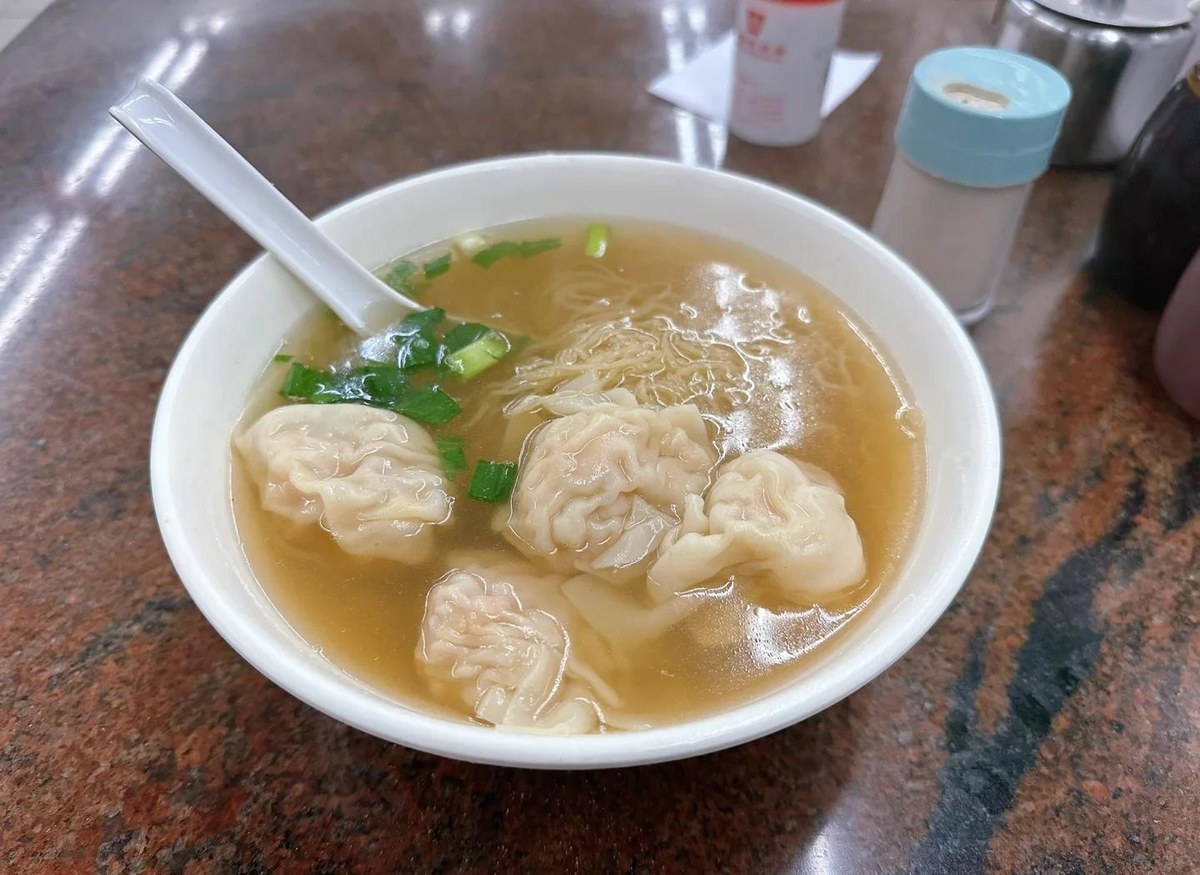
Now look at what is in the bowl, because the bowl is the argument. In Hong Kong, what arrives is small. Deliberately, almost insultingly small, a portion built for a bowl you could hold in one hand, with the noodles sitting in a single neat nest on top of the soup. Nothing else is visible. You will eat half of it before you find the point: the wontons are not floating on top, they are underneath, buried, four or five of them, silver-pink through wrappers thin enough to see your chopsticks through, each trailing a little flattened tail. Jīnyú wěi — goldfish tail (金鱼尾). That is the shape, and the shape is the entire design.
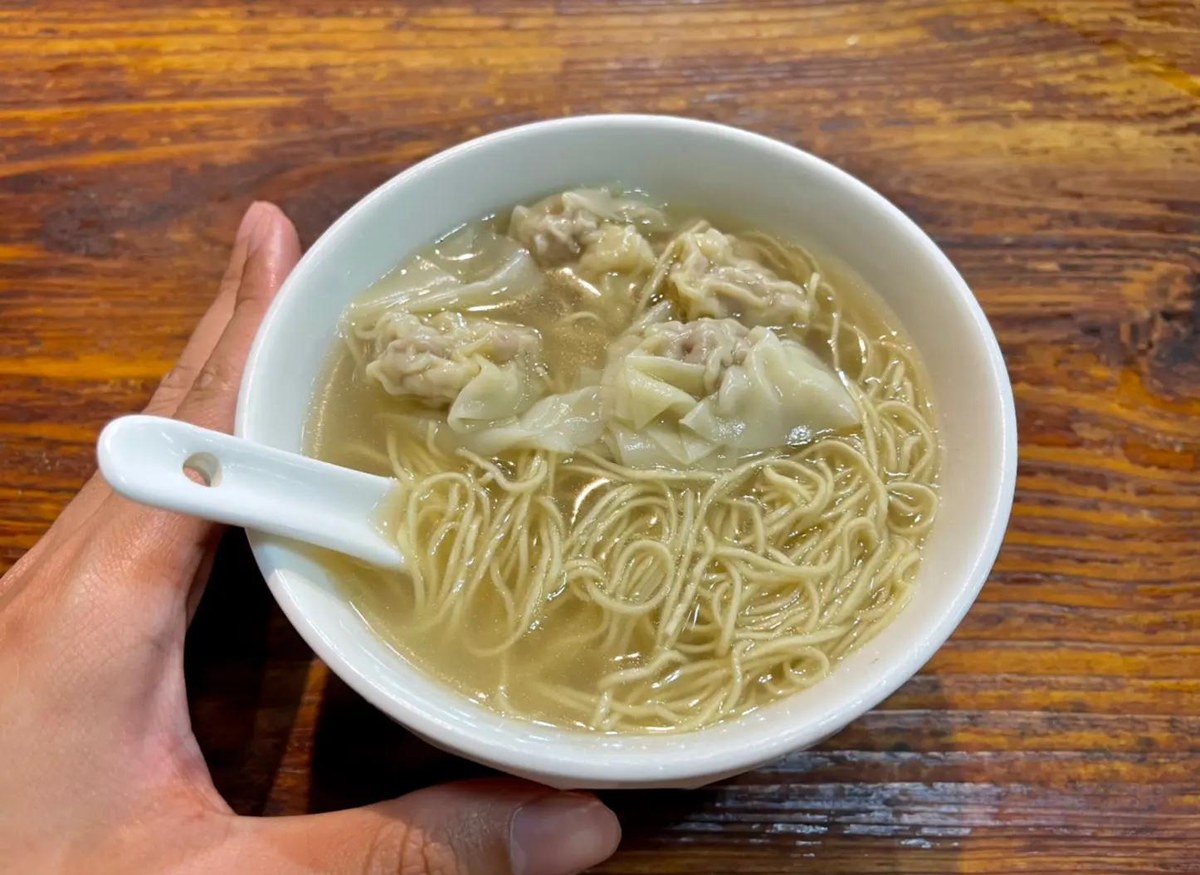
In Guangzhou, forty minutes up the rail line, the same dish arrives in a bowl you could wash your face in. A bigger nest of noodles (dà róng, 大蓉), wontons the size of a thumb joint, a broth that reads darker and meatier, a spoon wide enough for both at once. You eat it at a folding table on the pavement in Xiguan with your knees in the street and you stop when you are full, not when the bowl is empty.
Both cities are certain they are right. This is not one dish that grew a variation. It is one dish with two origin stories and nobody holding a whistle.
Wonton noodles began in Guangzhou, in the Xīguān (西关) district, sometime in the 1860s, carried on shoulder poles by vendors with a stove on one end and bowls on the other, sold cheap and late as a night snack. The trick that made the broth worth walking for was two dried things: dàdì yú (大地鱼), dried flounder, and xiā zǐ (虾子), shrimp roe. Both are the cheap, ugly engine of the whole bowl. A broth built on pork bones alone tastes like a shrug next to one built with them. When the trade moved south to Hong Kong in the mid-twentieth century, the shops got smaller, the portions got smaller, the prices went up, and the recipe turned strict — pork bone, dried flounder, shrimp roe, nothing else.
I grew up in Shanghai, which means I grew up thinking I knew what a wonton was. In Shanghai, wonton means xiǎo húntun (小馄饨), wrappers pinched loosely around a dot of pork, swimming in clear soup with dried shrimp, seaweed, egg shreds, and a spoon of lard. You order them by the liǎng. You eat them at six in the morning, standing up, and the whole bowl costs less than a coffee. It is a lovely thing and it is not wonton noodles, and it took a bowl in Hong Kong to explain the difference to me.
The shop was in Wan Chai, four tables, a queue down the wall and out the door. I got what I assumed was a child's portion and started on the noodles, and twenty seconds in my chopsticks hit something under them and came up with a wonton, then another. I had been eating the wrong half first my entire life. The soup was the colour of weak tea and tasted of the sea in a way that had nothing to do with salt. The noodles squeaked against my teeth. I finished in four minutes and ordered a second bowl immediately, and the woman at the counter did not look surprised, which told me I was not the first person to do that.
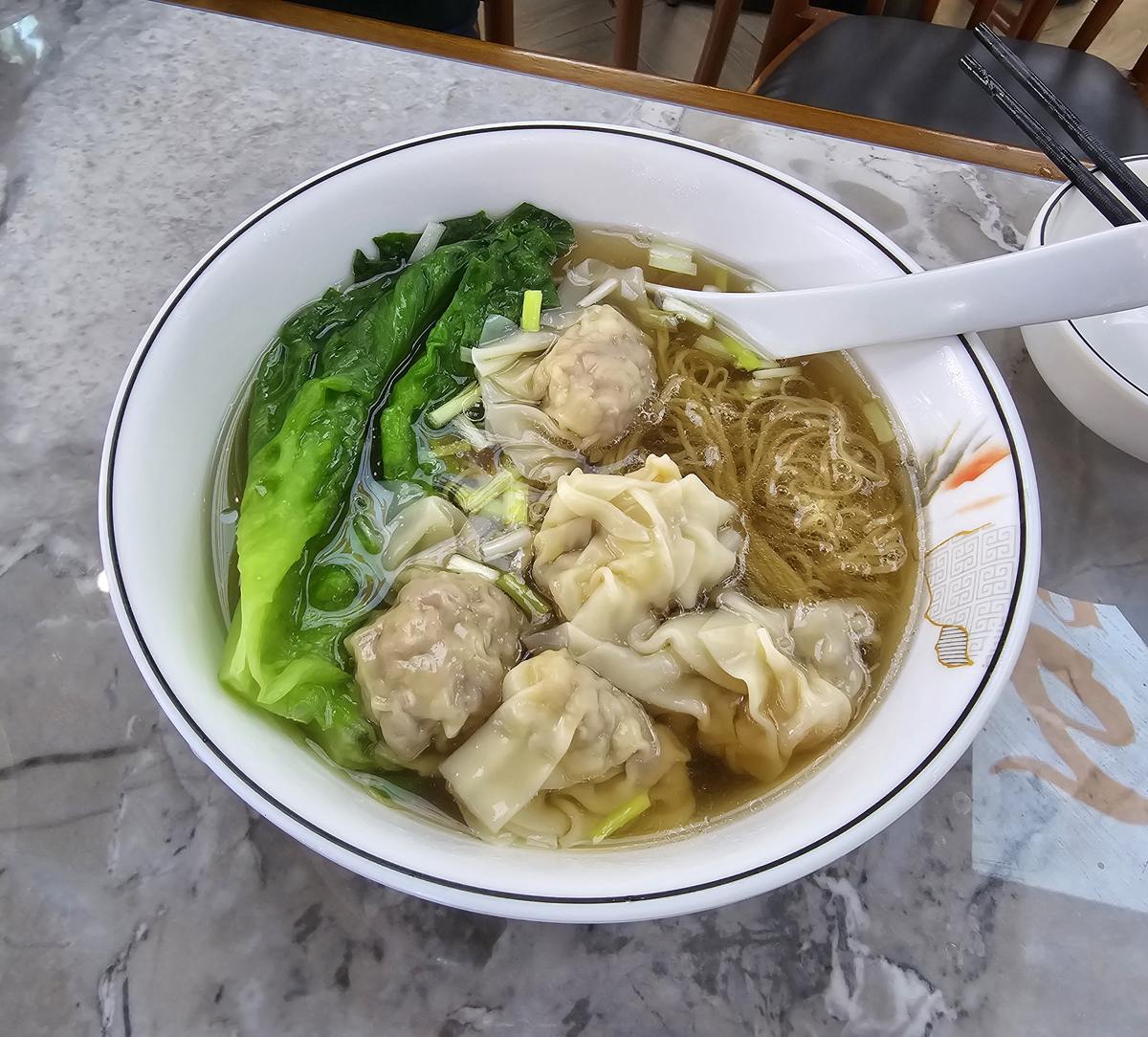
Now the bad version, because you will meet it. The common one is a bowl of yellow noodles drowning in broth with six giant wontons sitting on top, each the size of a golf ball and mostly dough. That is not wonton noodles, that is two separate dishes that fell into the same bowl. A wonton here should be smaller than the noodle portion and thinner than your finger. If the wrapper is thick enough to chew all the way through, you have a dumpling, and a fine dumpling it may be, but it is doing a different job.
The second failure is the noodle itself. Machine-made wonton noodles skip both the alkaline water and the pressing, so they go soft in the bowl inside ninety seconds and taste of nothing but lye. Test it: a properly pressed noodle should still bite back at the bottom of the bowl. If the last strand is mush, the noodles were wrong before they were cooked.
The third is broth that tastes like a bouillon cube. Real broth here has a slightly muddy, oceanic depth and a faint bitterness at the back of the throat that comes off the dried flounder. If it tastes clean and chickeny, somebody cut the fish.
And the fourth, the sad one: wontons left open, tails unsealed, so they split in the water and leak. A wonton that boiled open is a wrapper full of nothing.
How to eat it. Noodles first, in the first ninety seconds, before they soften. Lift, do not stir; you are not trying to coat them, you are trying to get them into your mouth while they still snap. Then the wontons, and here is where the small bowl pays off: the seconds the noodles spent sitting on top kept the wontons from overcooking, so the wrappers are still silky and faintly translucent. Then the soup, from the spoon, at the end, when it has picked up a little of both. Do not reach for chili oil in Hong Kong. In Guangzhou nobody will stop you, and a few drops of red vinegar is the local move anyway. A former colleague from Guangzhou once told me, without a trace of humour, that a small bowl of wonton noodles is "a snack for people with somewhere to be." It is the politest way anyone has ever called me an idiot.
You finish. The bowl is small enough that it is gone before you are ready, the way good bowls are. The broth at the bottom has cooled a degree or two. The last wonton is still there, silver through the wrapper, intact, waiting. You eat it and think about ordering another. In Hong Kong, that thought is how a meal is supposed to end. In Guangzhou, you would only be halfway through.
Out of room for today. Doing this one at home means solving the snap without a bamboo pole, and the broth is a two-hour argument between pork bone, dried flounder, and shrimp roe. That deserves its own post. Recipe coming soon.
💬 Comments