Stinky Mandarin Fish: In Search of the Barrel
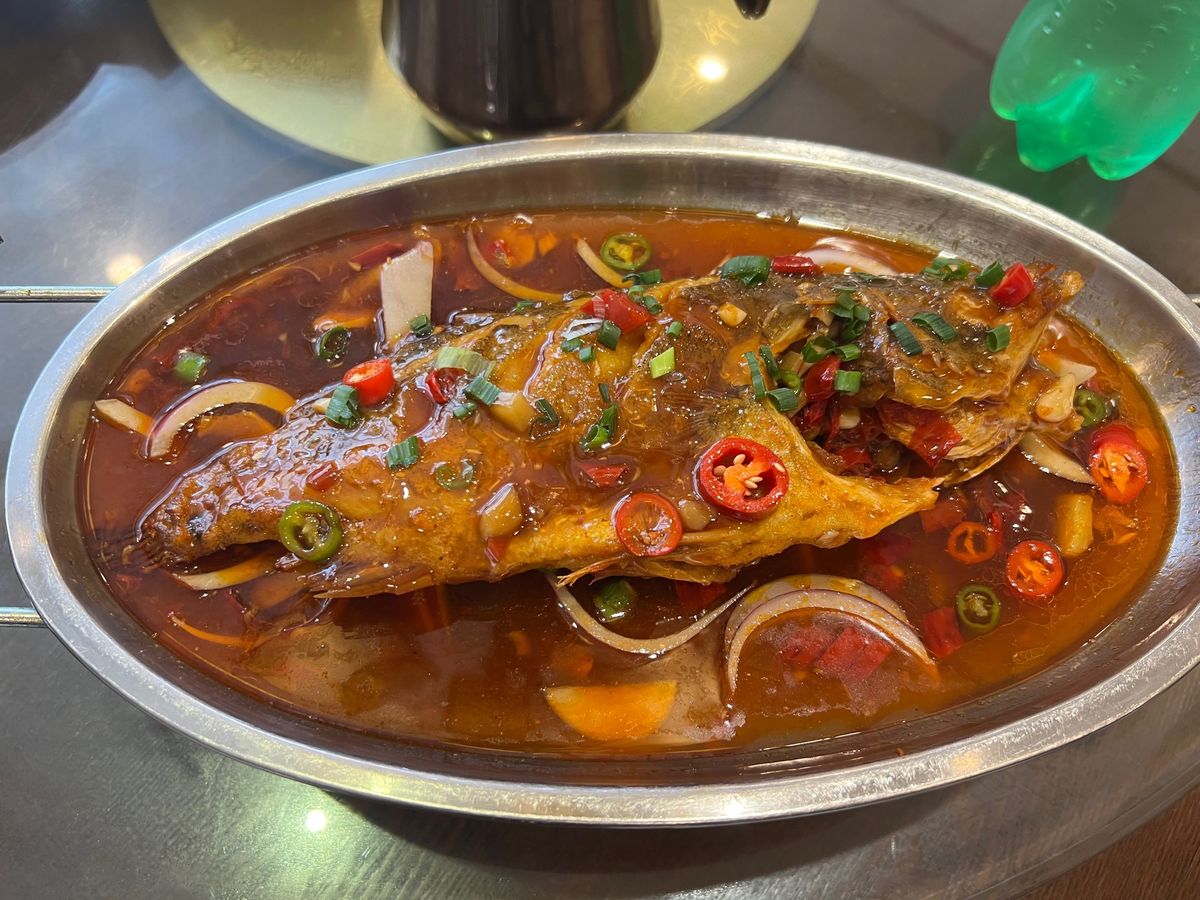
The first one smelled like a hospital floor. Ammonia, flat and chemical, rising off a fish that had been simmered in soy until it looked exactly right — near-black glaze, scallions laid across the back — and then fell apart at the first touch of a chopstick into grey paste. I was in a Shanghai restaurant with a whole page of Anhui dishes, and I had ordered it on the word of a colleague from Hefei who told me, deadpan, that it was the best fish in China. Two bites in I decided he was either lying or his grandmother had ruined him.
It took me seven years to find out he was telling the truth. 臭鳜鱼 (chòu guì yú), which translates as "stinky mandarin fish," is freshwater fish cured in salt and cold until the flesh firms up and the smell turns loud. Made properly it is one of the great fish dishes of China. Made badly, which is most of the time outside Anhui, you get ammonia and mush. That gap is the whole story, and it is why I eventually drove into the hills to work out which one I had eaten.
The Barrel Is the Recipe
Start with the fish. 鳜鱼 (guì yú) — mandarin fish, no relation to the orange — is a freshwater predator from the Yangtze basin: small, expensive, and prized for flesh that is sweet, firm, and almost free of the little bones that make freshwater fish a chore.
Which is how the dish begins. The story Huizhou tells is a merchant's accident: a trader hauling mandarin fish home from the Yangtze in the cold months, packing them into barrels under salt when they started to turn, arriving a week later with fish that smelled wrong and felt stiff under the skin. Fish that expensive does not get thrown away. Somebody cooked one, and the old Huizhou prefecture — the hill country south of Huangshan — has been defending the result ever since.
The barrels are still there. Not in Shanghai, where the dish sits on menus and rarely comes from a barrel at all, but in the market towns south of Huangshan, where the winters are cold enough and the technique never left. I found mine in the back of a wet market in Shexian, in November, which is the season: a row of wooden barrels stained black with use, a stone on each lid to hold the fish down under their own brine.
What the barrel does is simpler than the smell suggests. Salt first: the fish are gutted, rubbed inside and out, and layered with salt so the water leaves the flesh and the wrong bacteria never get a foothold. Then cold, which is the part you cannot fake — between five and ten degrees for three days to a week, depending on size and weather. Under the salt the fish's own enzymes go to work on its protein, breaking it into free amino acids and a little sugar. The flesh tightens. The flavour deepens. It is closer to dry-ageing a steak than to pickling a cucumber.
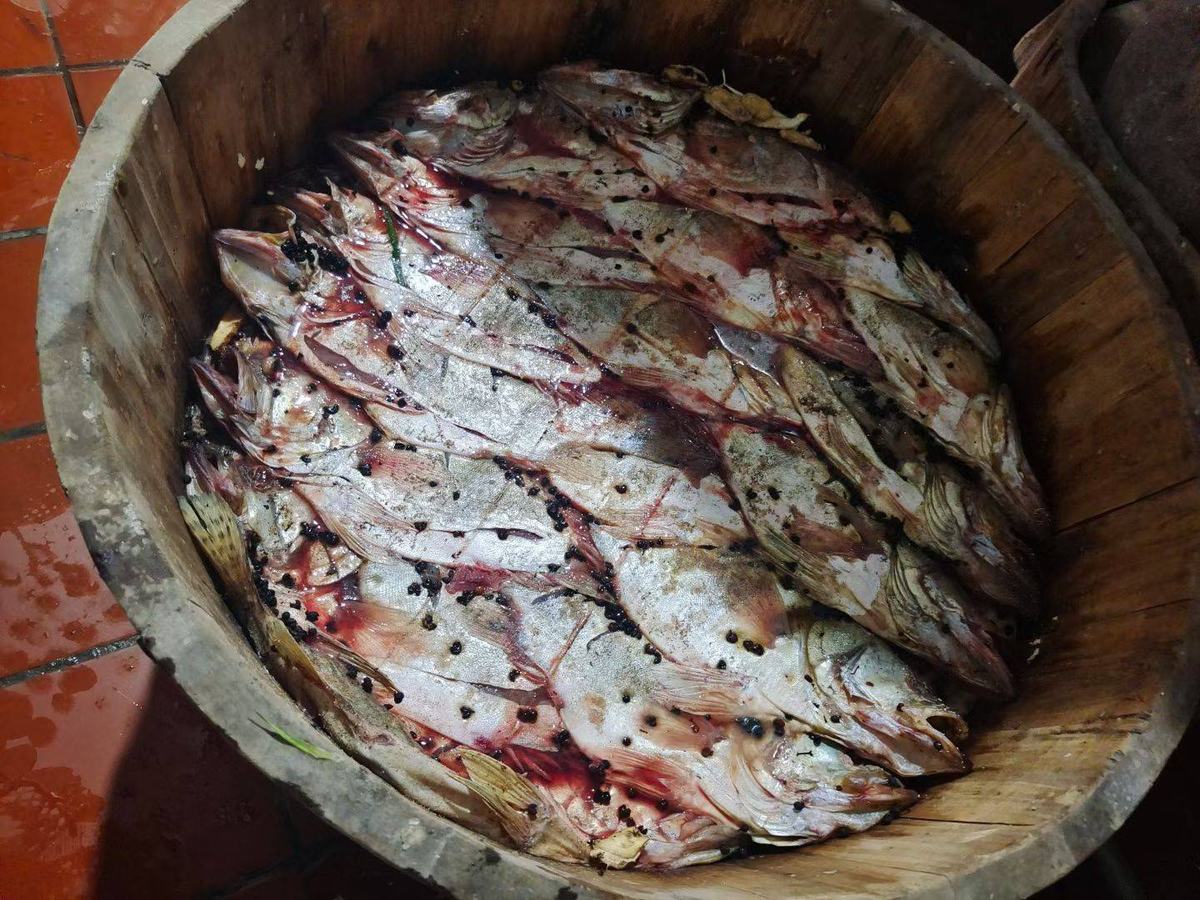
The sign it is ready is texture, not smell. Pull a finished fish apart and the meat separates into neat flakes that hold their shape — 蒜瓣 (suàn bàn), "garlic cloves," the phrase every cook in the region uses. If the flesh smears into paste, it went too long or it started bad. If it springs back like a fresh fillet, it never went anywhere at all, and all you have is an ordinary fish with an unfortunate smell.
The Shortcut Smell
Bad 臭鳜鱼 is easy to find and worth being able to name.
The ammonia shortcut. Fermenting takes a week and a cold room. Ammonia takes an afternoon. Some kitchens brine the fish in a chemical bath or dose it with a commercial stink additive, and the tell is that the smell has one note and nothing behind it — flat, sharp, hospital-clean. Real fermentation smells layered: sour, saline, faintly cheesy, with something sweet underneath. If your eyes water but your mouth doesn't, you have the fake.
The wrong fish, or the wrong size. Grass carp and tilapia get sold as mandarin fish to people who won't know the difference, and carp is muddy in a way no amount of chili covers. Size matters too: fish over about a kilo are too thick for the salt to reach the middle evenly and the meat goes coarse, while anything under 400 grams barely makes a meal. The sweet spot is a fish you can hold on one palm.
Frozen first. Freezing bursts the cells, and a thawed fish cured afterwards turns waterlogged and will not flake. This is the most common failure outside China, and why so many people who have "tried stinky fish" never really have.
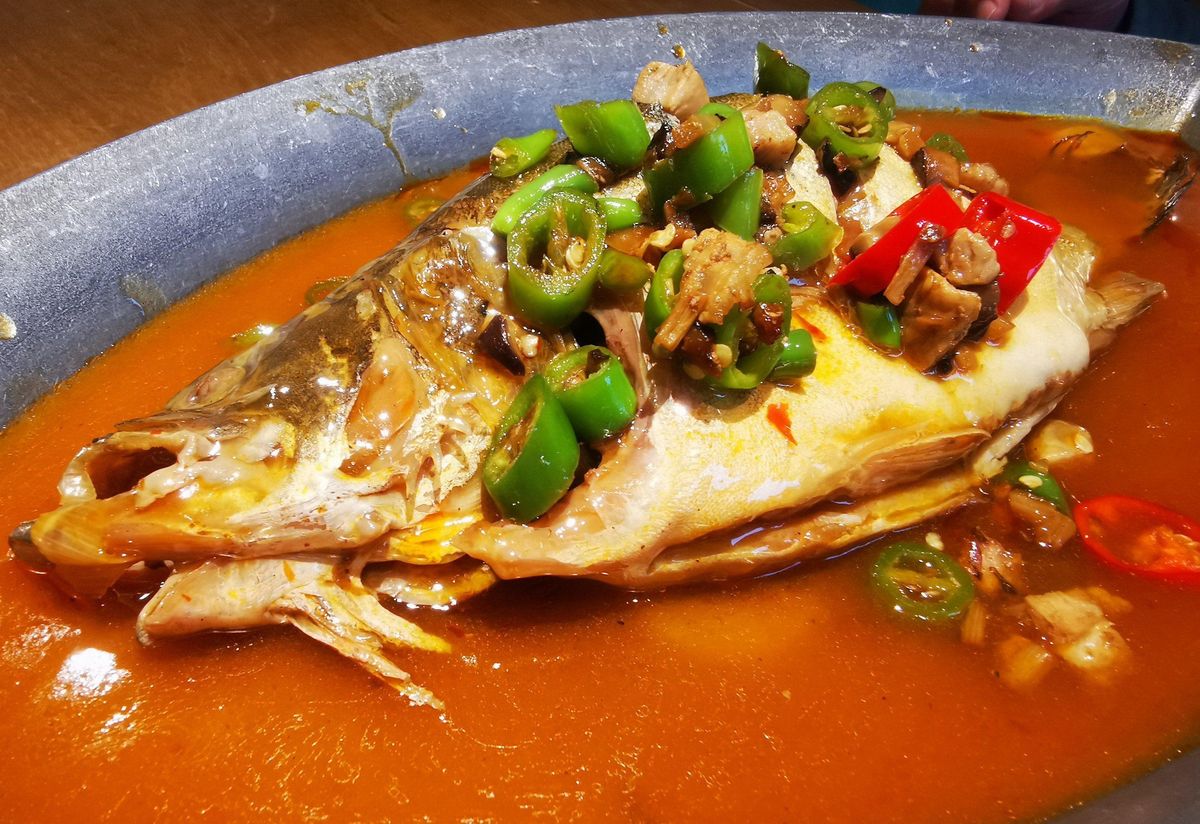
The sugar blanket. A cook frightened of the smell will bury the fish in sugar and vinegar until the sauce tastes like sweet-and-sour pork. Done right, the braise is restrained: pork belly for fat, bamboo shoot for crunch, ginger, garlic, dried chili, soy, a spoon of sugar and stock, reduced to a dark gravy that clings to the fish. If you cannot taste the fish, the cook has apologised for it.
My own rule, inherited and never once wrong: do not order 臭鳜鱼 at a restaurant with no other Anhui dish on the menu. The fish has been put on the list for the novelty. Everything it needs to be good lives in the same kitchen as 毛豆腐 and dried bamboo shoot braised pork, and if those are missing, the barrel is too.
Order It Late, Eat It Slow
One fish feeds three or four people, in the middle of the table, after the cold dishes have gone. Serve it over plain rice, because the sauce is half the point and rice is its vehicle. The gravy soaks the rice dark and glossy and sweet, and that is half of why people order this in winter.
Work from the belly in. The belly is the richest and the first to go. Then the back, flaking into those garlic cloves. The cheek is the single best bite on the fish and there is only one per side, so be quick. Underneath, buried in the sauce, are the bamboo shoots and the pork belly, which regulars quietly fight over. Take the chili and the scallion too. The bones come away clean if the cure was right, and if they don't, you have learned something about the barrel.
And get past the first second. The smell is a doorway, not a room. Six inches away it is loud, sour, and faintly alarming; on the tongue it is clean, firm, and quiet, a low savoury note humming under the sauce and turning sweet at the finish. The first time you eat it for the story. Every time after that you eat it because it is simply better fish than you were expecting.
Order it after the first cold snap — a braised fish this heavy belongs to winter — and drink a plain cup of tea, not beer. Then put your nose down and eat. Huizhou has spent five hundred years being told it made a mistake. It didn't.
I'll save the home-cooking side for another post. Doing this at home means building a salt-and-cold cure around a fish most Western kitchens have never handled, and getting the weight on top right is the difference between garlic cloves and paste. That deserves its own breakdown. Recipe coming soon.
💬 Comments