Rou Jia Mo: Xi'an's 2,000-Year-Old Burger That Puts the Golden Arches to Shame
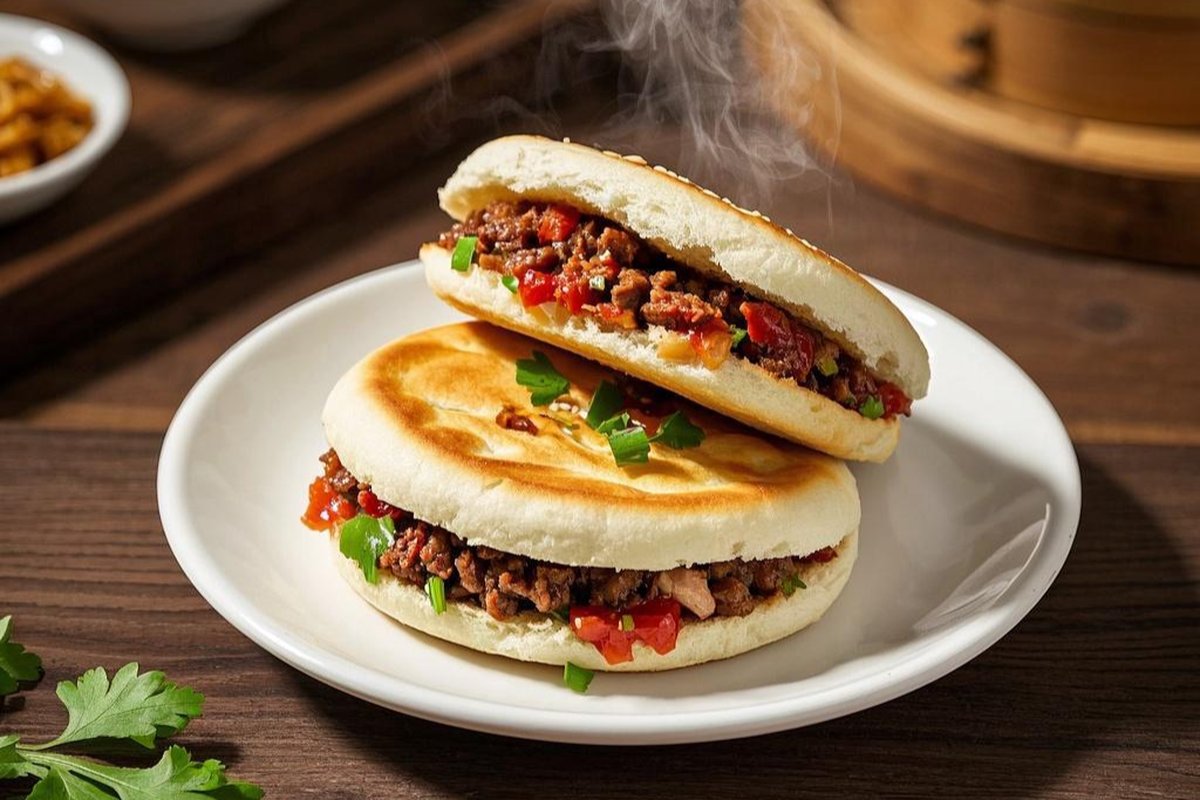
The vendor pulls a flatbread from the clay oven with bare hands — bare hands, because calluses earned over forty years don’t register 300 degrees anymore — and splits it with one motion. The bread cracks open along a seam you didn’t know was there. Steam escapes in a puff that smells like toasted wheat and anise. Then he reaches into a pot that has been simmering since before you woke up this morning, pulls out a hunk of pork belly the color of deep amber, and chops it on a wooden block with the rhythm of someone who’s done this a hundred thousand times. Chop chop pause. Chop chop splash — a spoonful of the braising liquid goes in. The chopped meat gets packed into the split bread. He wraps it in a square of wax paper and hands it to you. Total elapsed time: eighteen seconds.
You’re standing on a street corner in Xi’an, and you’re holding a Rou Jia Mo (肉夹馍, ròu jiā mó) that costs eight yuan. It is, gram for gram, one of the best things you will ever eat.
The Architecture of a Bite
I spent thirteen years chasing efficiency at Microsoft, Google, and NVIDIA. Rou Jia Mo is efficiency weaponized into food. Two components. Zero waste. Every decision serves the final bite.
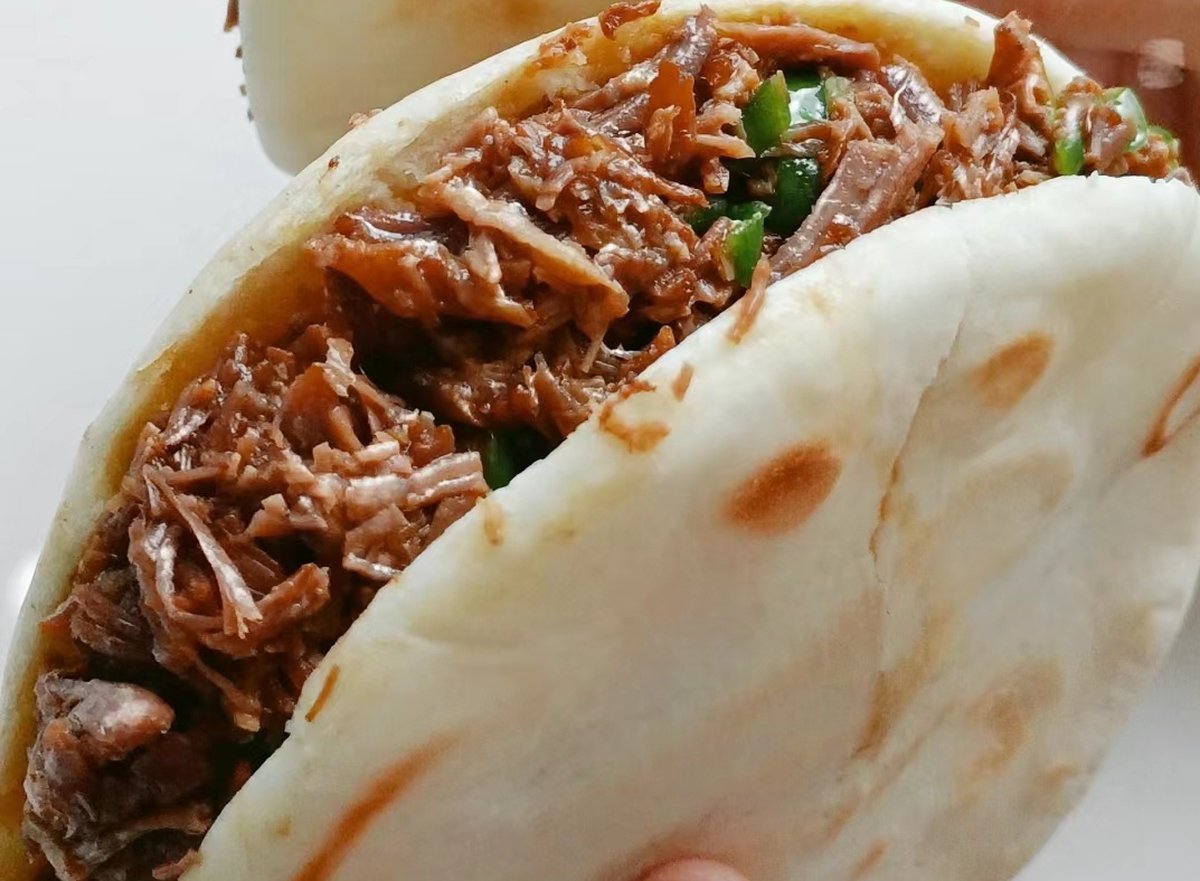
You bring it to your mouth. The báijí mó (白吉馍) — the bread — registers first on your lips: a dry, paper-thin crust that shatters like the top of a crème brûlée, then gives way to a soft, chewy interior that’s been steamed from the inside by the heat of the meat. The bread is not a container. It’s a participant. It’s been slapped against the wall of a clay oven called a tǒng lú (桶炉), where it blisters and chars in irregular patches. No two look the same. No two taste exactly the same either.
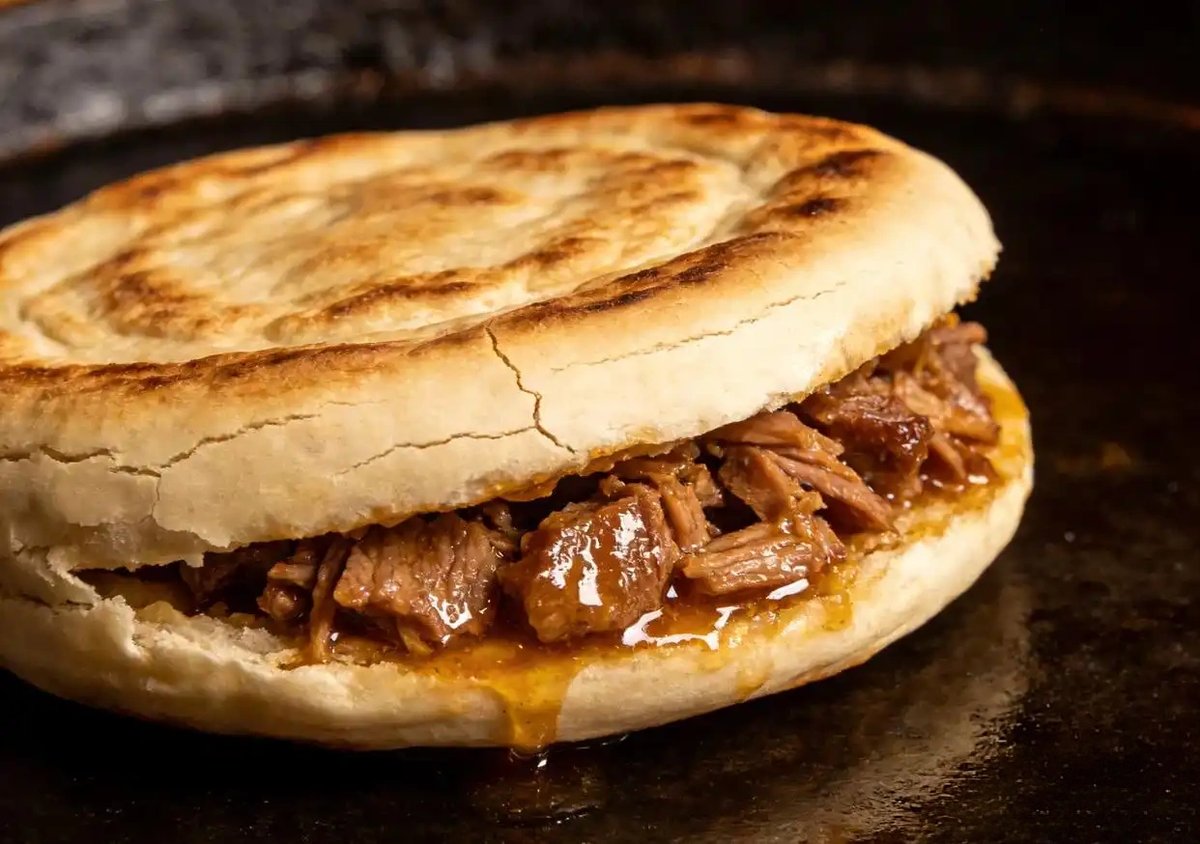
Your teeth hit the pork. It’s been braised for hours in là zhī (腊汁) — a master stock of soy sauce, rock sugar, star anise, cassia bark, fennel, cloves, Sichuan peppercorns, and about twelve other spices that every vendor guards like a state secret. Some of these stocks are decades old, refreshed daily, never emptied. The meat falls apart into shreds that range from lean to pure fat, and the fat is not optional — it’s what carries every spice into every corner of your mouth. The texture alternates between stringy and silken. The bread soaks up the braising liquid where the meat made contact. The wax paper catches what tries to escape.
A good Rou Jia Mo is crisp first, rich second, and warm all the way down.
2,000 Years of Meat in Bread
Every culture invents meat-in-bread. Rou Jia Mo got there first. The dish traces back to the Qin dynasty — 221 BC — making it older than hamburgers by roughly two millennia. The original version was called hán ròu (寒肉), cold meat preserved in its own fat, eaten by soldiers on the march. The bread came later, during the Tang dynasty, when Xi’an was the largest city in the world and the eastern terminus of the Silk Road. Merchants needed food that could be eaten standing up, one-handed, while negotiating camel prices.
The name Rou Jia Mo (肉夹馍) is a grammatical joke in Chinese — literally “meat sandwiches bread.” You are supposed to parse it as ròu jiā zài mó lǐ (肉夹在馍里) — “meat sandwiched inside bread.” The joke has survived 2,000 years. The bread has survived 2,000 years. That’s the kind of quality control that requires no certification.
The Enemies of Rou Jia Mo
The first enemy is the thick bread. Some versions use bāozi-style steamed buns, soft and pillowy. This is a different dish called hé yè bǐng jiā ròu (荷叶饼夹肉) and it is fine. It is not Rou Jia Mo. The real báijí mó must be thin, crisp, and blistered from dry heat — no oil, no steam. If the bread is fluffy, you’re eating a pork pillow, not a Xi’an burger.
The second enemy is the shredded lettuce. I don’t know who introduced lettuce to Rou Jia Mo, but I hope they’re having a difficult year. Lettuce adds cold, wet, crunch that fights everything the dish is trying to do. Real Rou Jia Mo has three additions, all optional: chopped cilantro, chopped mild green chilies, and a spoonful of the braising liquid. That’s it.
The third enemy is the wrong pork cut. Rou Jia Mo demands pork belly or pork shoulder — cuts with enough fat and connective tissue to survive a multi-hour braise without turning into dry shreds of regret. If the meat in your Rou Jia Mo is lean, stringy, and tastes like it was boiled in water with a Soy Sauce Packet wave, you’re eating a counterfeit.
Real Rou Jia Mo has: báijí mó flatbread baked in a clay oven, pork belly braised in aged là zhī master stock, and optionally cilantro and green chili. That’s it. Five ingredients. Two thousand years.
How to Eat It
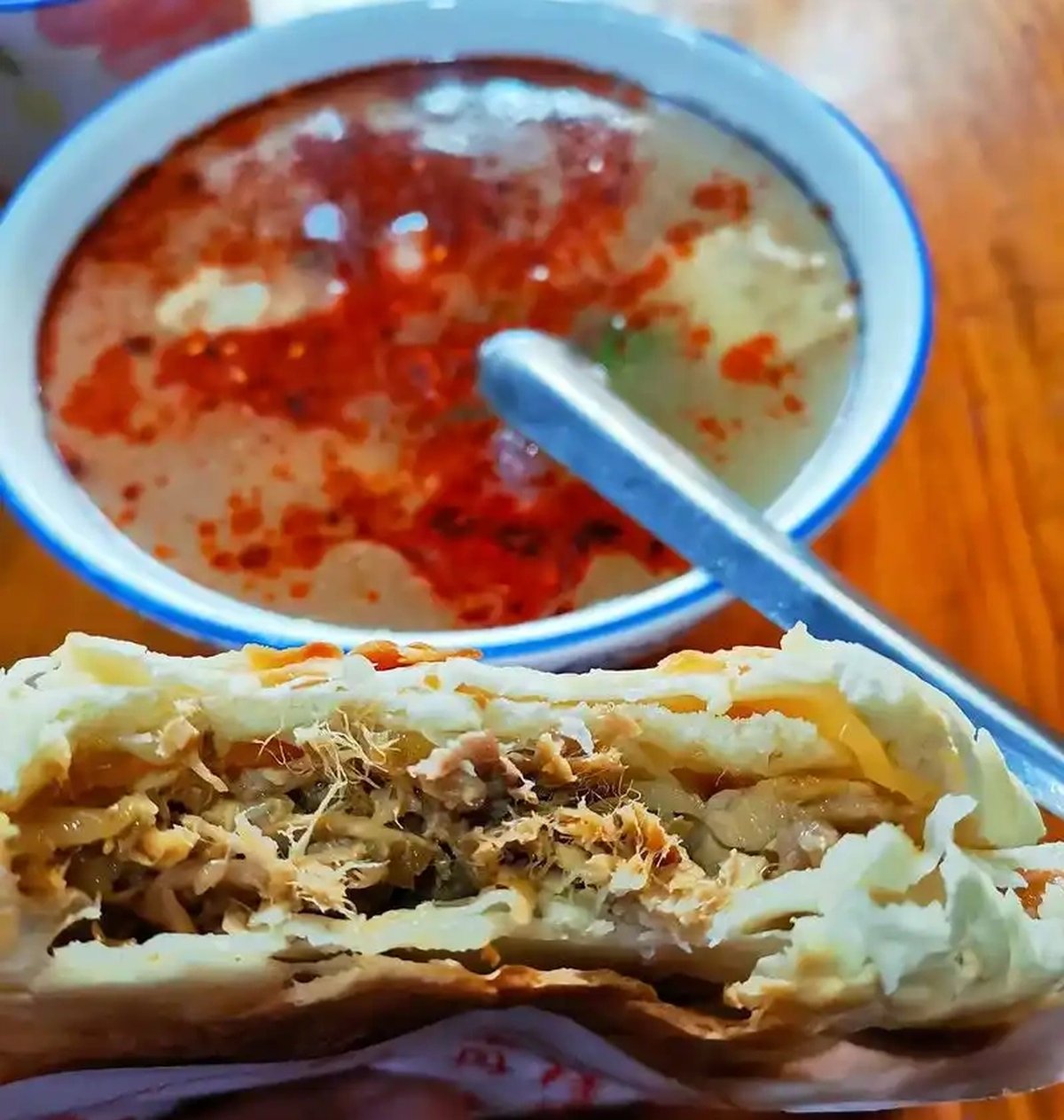
Eat it standing up. I’m serious. Rou Jia Mo is not a sit-down dish. It’s a sidewalk dish, a one-hand dish, a “I’ll have another while I’m deciding whether to have another” dish. The wax paper is not just packaging — it’s a drip-catcher, a heat shield, a structural support. Keep the paper on.
Lean forward slightly on the first bite. The juices will run. They’re supposed to run. Let them drip onto the wax paper, not your shirt. Chew slowly — the bread will soften as it absorbs the braising liquid, and the texture will change across the eating experience. The first bite is all crust. The middle bites are bread-and-meat equilibrium. The last bite, near the folded seam, is mostly fat-soaked bread and concentrated spice. That’s not an accident. That’s optimization.
I ate my first Rou Jia Mo at nineteen in the Muslim Quarter of Xi’an, a year before I started at Microsoft, on a trip with college friends who’d scraped together train fare for a week. We each had three. One of my friends kept the wax paper as a souvenir. It stained his backpack and smelled like star anise for the rest of the semester. We still talk about it.
Out of space for today — I’ll save the home-cooking breakdown for another post. The master stock is the whole game with Rou Jia Mo — and building one from scratch takes days and a spice cabinet your landlord will judge. Recipe coming soon.
💬 Comments