Red Willow Lamb: The Skewer Measured in Grams
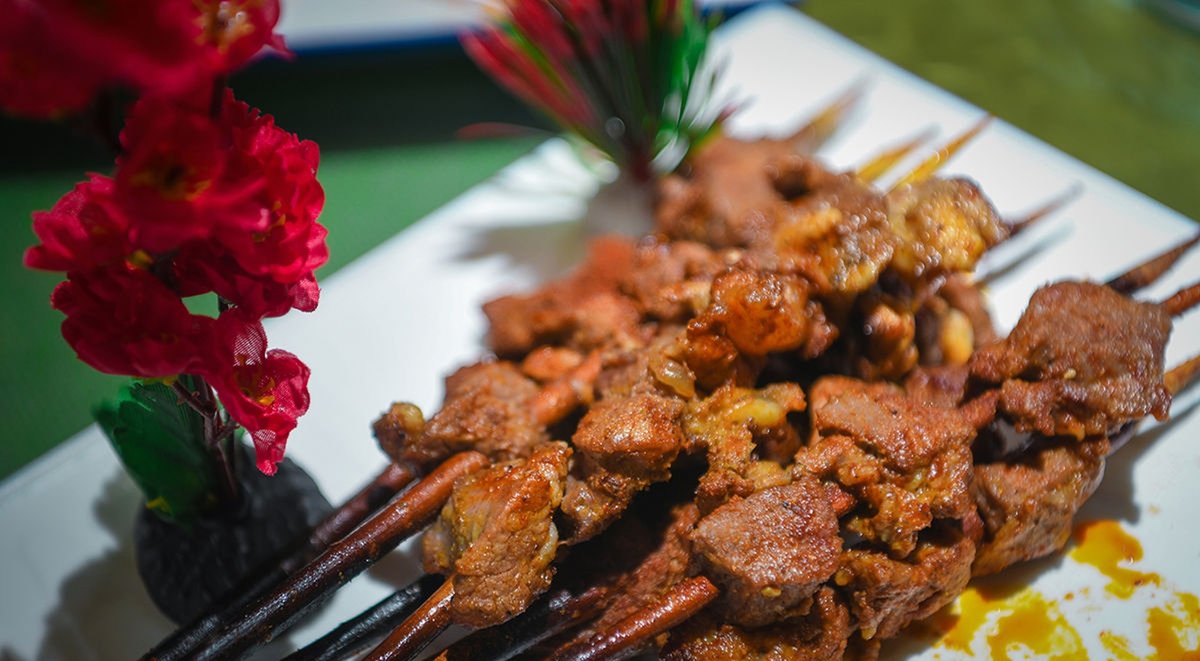
The skewer weighs more than your phone. Not the meat on it. The stick.
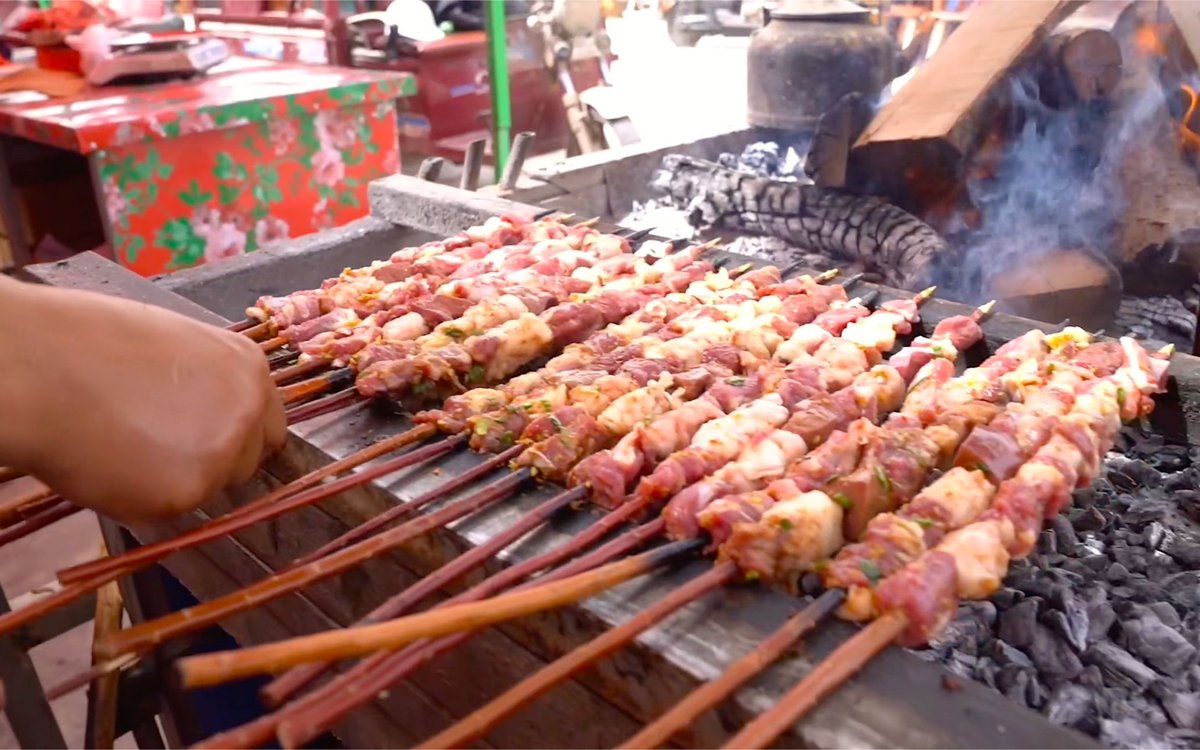
In Kashgar, behind the Id Kah Mosque, the night market fills up at dusk, but the smoke starts earlier than that. A man in a flat cap stands at a trough of coals the length of a canoe, a bundle of branches in his fist, fanning them the way you'd fan a hand of cards. The branches are green-grey and thumb-thick, cut that morning, standing in a bucket of water at his feet until the moment they're needed. Four or five cubes go on each one, fat and lean in strict alternation. The finished thing is as long as your forearm.
This is Red Willow Lamb (红柳烤肉, hóngliǔ kǎoròu), the big-skewer branch of the family. The little iron version, 羊肉串 (yángròu chuàn), is what you've eaten outside subway stations in every Chinese city on earth: same meat, same cumin, one third the size. They are not the same dish, and the difference isn't romantic. It's arithmetic.
Eighty to one-fifty
A red willow skewer carries 80 to 150 grams of lamb. An iron skewer in an inland city carries thirty, maybe forty. That's not a bigger snack, that's a portion. In Urumqi you order twenty small ones and pace yourself through them. In Kashgar you order three and start doing sums.
And the branch isn't decoration. It's the tool. A fresh willow branch, soaked half an hour, is thick enough not to burn through over coals that would eat a bamboo skewer in ninety seconds. It's rough enough to grip meat that wants to spin when you turn it. And it's wet inside. As the fire works up the wood, the moisture in the pith turns to steam and pushes out through the meat from the inside, basting it in something faintly green and resinous that no marinade reproduces.
People argue about that last part. Some will tell you the willow contributes nothing and it's all cumin and fat. I've eaten enough of them to say the branch is doing something, though I couldn't tell you whether it's flavor or just physics. What I can tell you is that a dry, reused, shipped-in branch does nothing at all, and half the red willow sold in city restaurants is exactly that.
The crust is the whole case
What you're buying, in the end, is a surface. The fat renders, runs down the cube, hits the coals, and comes back up as flame. That flare does two things at once: it chars the outside into a crust that cracks when you bite it, and it lays a layer of smoke on the meat that tastes like the inside of a chimney in the best possible way. Underneath, the lamb should still be pink at the center of the biggest cube. Grey all the way through means it sat too long over a low fire, and you can taste the failure — dry, woolly, and sad.
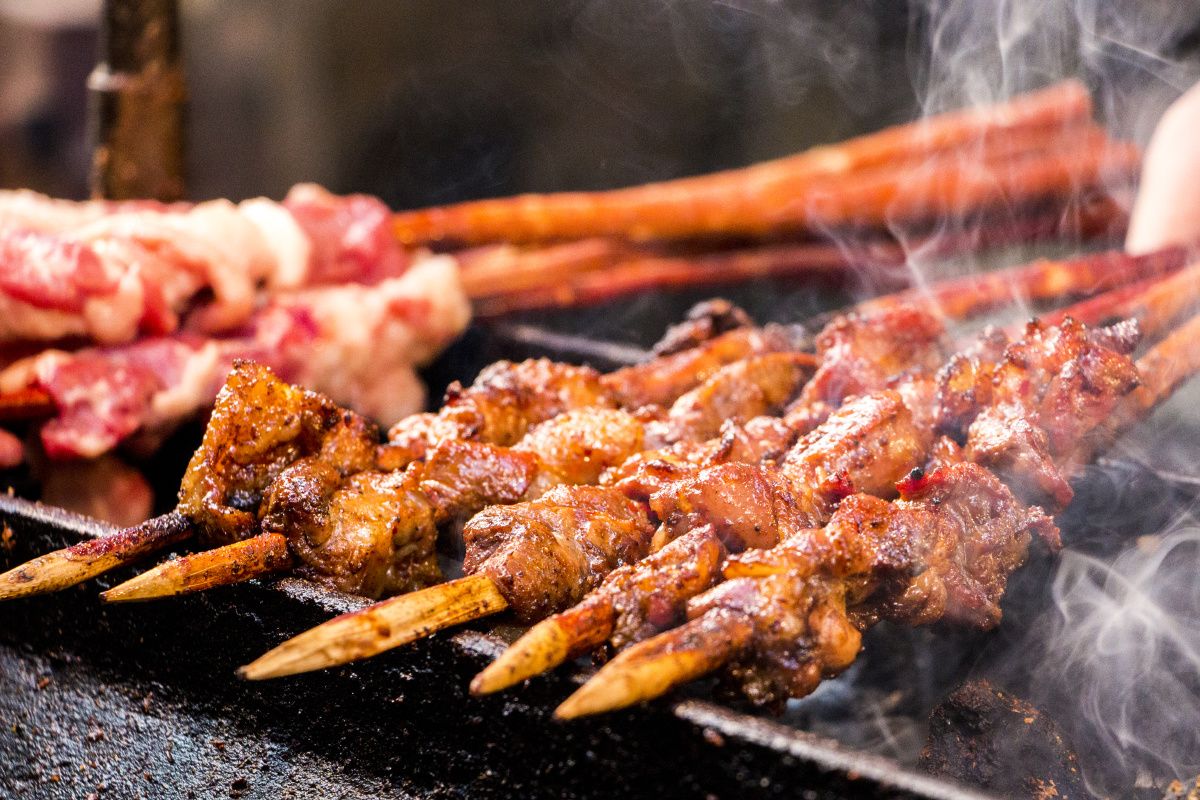
The first cube off the end is always the best one. It has had the least time to cool and the most direct exposure to the fire, because whoever is turning the bundle isn't being careful with the ends. That's not a flaw. That's the design.
Two schools, one branch
Kashgar cooks close. The branch lies across the trough, the meat hangs a hand's width above the coals, and the man turns it once, maybe twice, in the four or five minutes it takes. The fat falls straight into the fire. The flame comes up to meet it. You get soot on your fingers just holding the thing.
Urumqi cooks high. Restaurant grills there hold the skewers half a meter up, turn them every fifteen seconds, and never let the fat reach the coals at all. It's a cleaner, gentler, more even cook, and the lamb comes out juicier and paler. Both are correct. They're answering different questions. Kashgar is answering "how much smoke can this meat take," and Urumqi is answering "how do we serve forty tables in an hour without burning anything."
I went to Kashgar one October, mostly for the Sunday livestock market, and ate at the same stall four nights running. By the fourth night the man recognized me, which in a market that size means I was eating too much and tipping too well. The last skewer I ordered, I couldn't finish. I sat on a plastic stool with a branch in my hand, ash to the wrist, and watched him fan the next bundle for someone else. Worth it. Still worth it.
What the price is telling you
Red willow is priced per skewer, never per kilo, which is the first tell. The small iron ones run five or six yuan in Kashgar. The willow ones run twenty. That's four times the price for roughly three times the meat, and the missing quarter is the branch, the water it soaked in, and the fact that a man can only manage so many of these at once.
Branches don't travel well, either. They dry out, split, and lose whatever it was they had. By the time a "red willow" skewer reaches a menu in Shanghai it's usually a 60-gram portion on a dried stick at thirty-eight yuan, and the meat has been through a baking-soda marinade that turns it soft and slightly soapy. If the lamb is tender in a way lamb isn't, you're eating a chemical process, not a grill.
Other ways to get it wrong: gas instead of charcoal, which gives you browning without smoke and a crust that never quite sets. A honey or barbecue glaze, which is Beijing restaurant food and has nothing to do with this. Cumin applied at the end instead of throughout, so the first bite is dusty and the middle is bare. And lean meat with the fat trimmed off, which is the single saddest thing that can happen to a skewer. The fat is not optional. The fat is the point.
How you actually eat one
Standing up, with the branch in your fist like a torch. Bite the fat cube at the end first, while it's still hot enough to be liquid; cold lamb fat is a completely different and much worse substance. Then work down the stick, pulling with your teeth, not biting clean through — the cubes are hot enough inside to take the roof off your mouth. Hold a piece of naan underneath if you're smart. The drips are the best sauce in Xinjiang and they will land on your shoe otherwise.
Don't use a fork. Don't cut it up. Don't ask for a plate. The branch is the plate, the handle, and half the flavor, and when you're done you drop it in the oil drum by the stall and wipe your hands on the paper the naan came in.
You can't buy a red willow branch outside Xinjiang, so the home version starts with the next best thing: fat bamboo skewers, soaked two hours, not thirty minutes, and a charcoal chimney you actually wait for. The branch will be wrong and the smoke will be right. Recipe coming soon.
💬 Comments