Qishan Saozi Noodles: Thirty Bowls, and You Don't Drink the Soup
You are picturing a bowl. One bowl, a reasonable size, something you'd hold with two hands on a cold day. Stop. In a village house in Qishan county, what comes at you is a tray.
Ten bowls on it. Each one the size of a teacup, white glaze, rim chipped from thirty years of service. Each one holding four or five strands of noodles, a spoonful of broth, and a slick of red chili oil that floats on top like lacquer. You lift one in your left hand, get the whole thing into your mouth in a single motion, and set the empty bowl back down. By the time you have swallowed, someone has already swapped it for a full one.
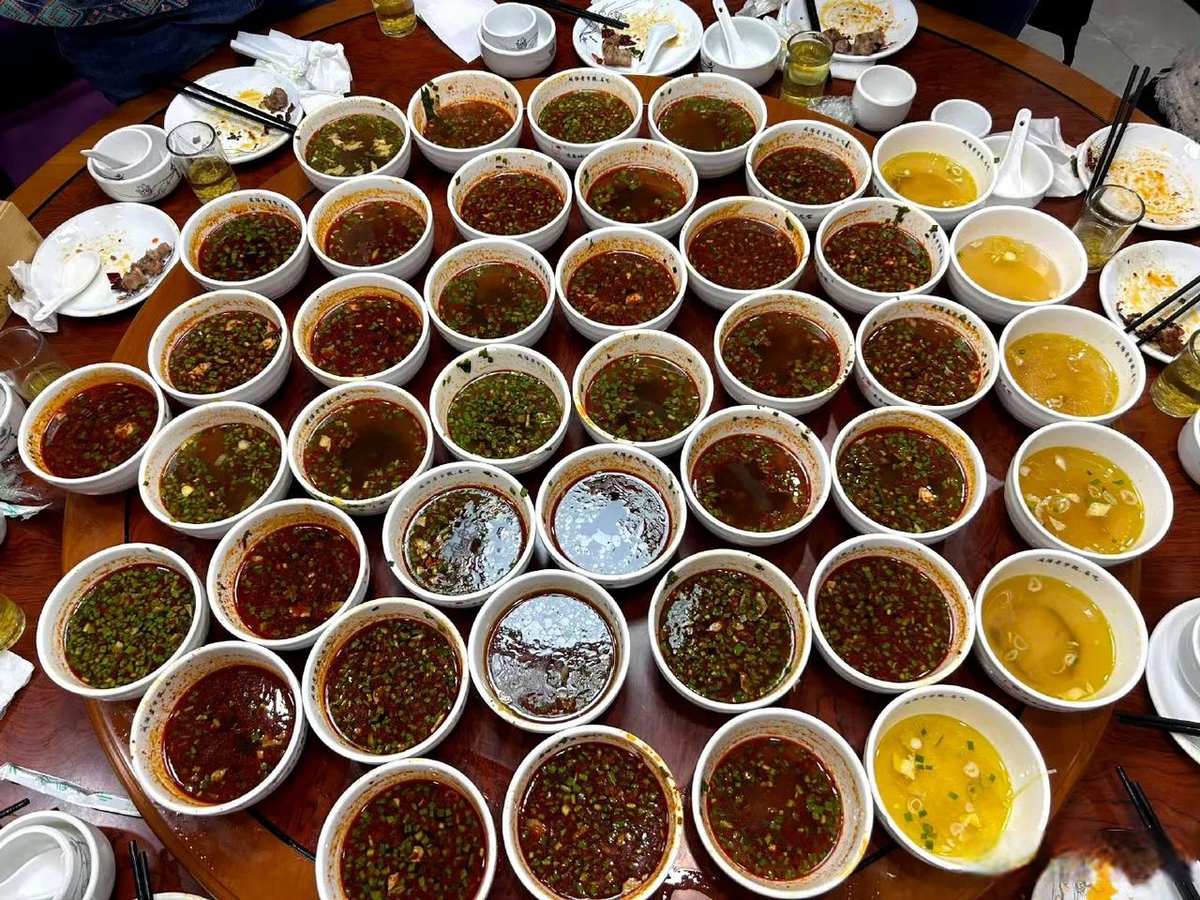
That is the entire architecture of Qishan Saozi Noodles (岐山臊子面, qíshān sàozi miàn): portions small enough that no bowl ever has time to go cold. The locals call it 一口香, yī kǒu xiāng — one-mouth fragrant. A grown man at a Shaanxi wedding table will put away twenty-five of them, sometimes thirty, and nobody at the table thinks this is remarkable. The bowls are not the meal. The rhythm is.
Everything in the bowl is built to be eaten fast. The noodles are rolled paper-thin, folded, cut fine, then cooked just short of soft so they keep a spring — 薄筋光, báo jīn guāng, thin-springy-glossy, the three words a Qishan cook checks before anything else. They arrive slick, not sticky. Four strands lifted together come off the chopsticks as one clean bundle, and if they don't, the dough was rested wrong.
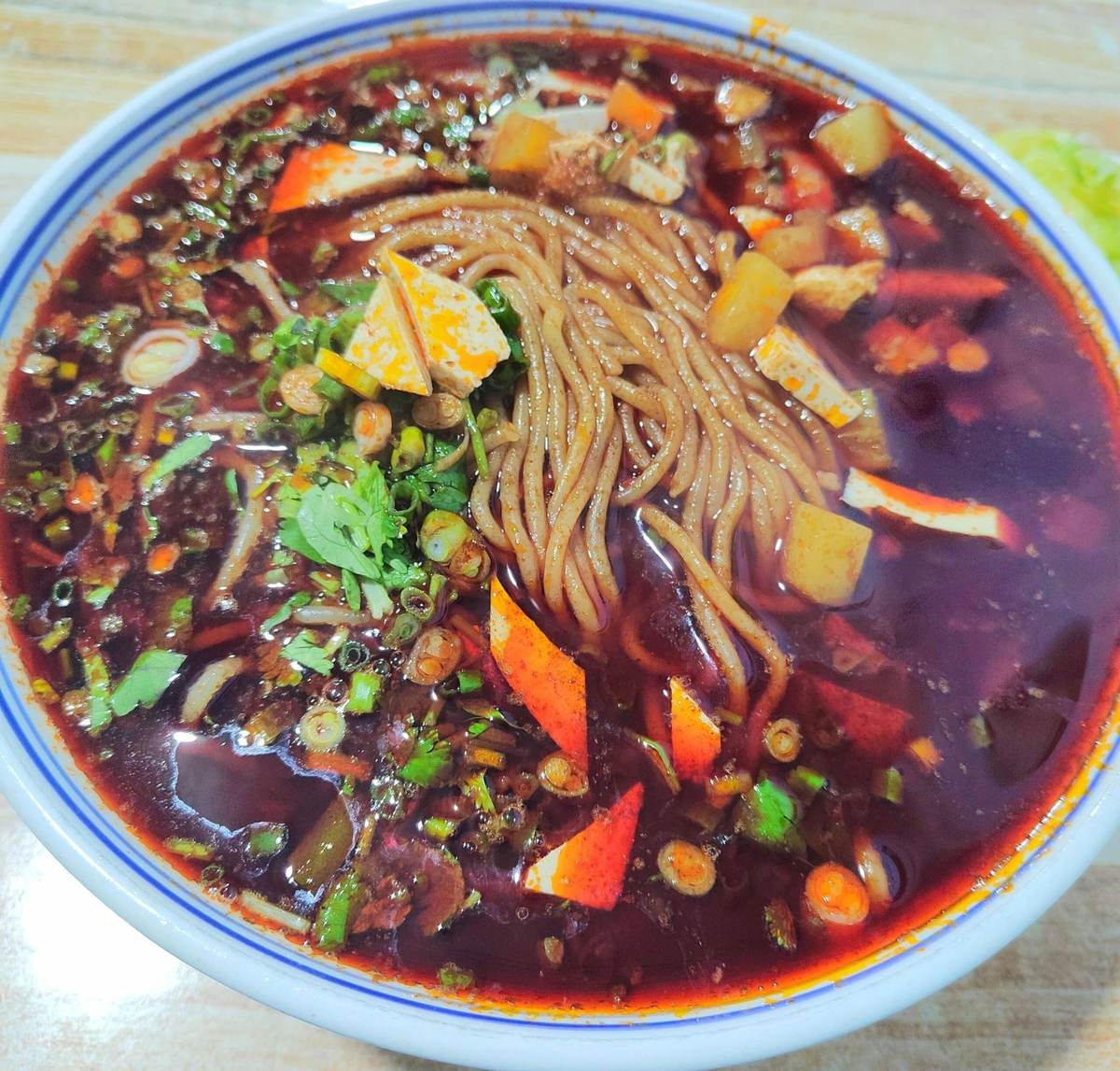
Then the smell, which reaches you before the tray does: vinegar steam. Not chili, not meat — vinegar. Qishan has been fermenting wheat bran and sorghum into its own dark, slightly sharp vinegar for centuries, and that vinegar, not the chili, is the soul of the dish. The broth is water, vinegar, and the fat from the pork, brought to a rolling boil and poured over the noodles so hot it fogs the bowls. The chili oil on top is there to hold the heat in.
One mouthful at a time
The 臊子 (sàozi) itself is diced pork belly, cut into cubes the size of a pea, cooked down slowly in its own rendered fat with vinegar, chili, ginger and a piece of star anise until the cubes shrink and turn a translucent amber. No soy sauce goes in a correct batch. No sugar either. It is sour and savory and it keeps in that fat for weeks, which is exactly why it shows up at every village wedding from October to March.
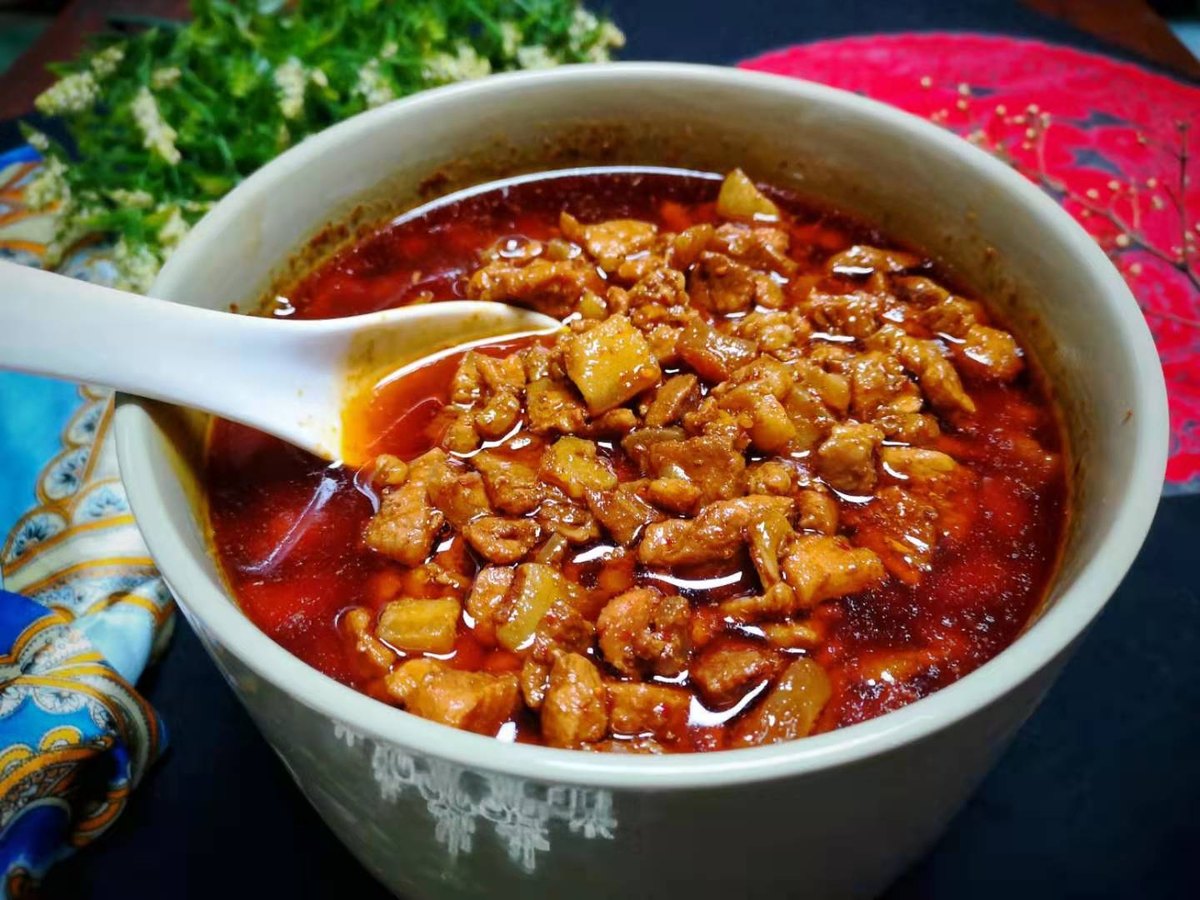
Every bowl then gets its handful of color: thin egg crepe cut into diamonds, wood ear mushroom sliced to threads, cubes of fried tofu, a scatter of garlic sprout, and a spoon of the 臊子 with the oil it sits in. The broth underneath is nearly clear until your chopsticks move, and then the whole bowl goes red.
The first slurp is sour. Genuinely sour, the kind that makes the sides of your jaw pull in. The chili arrives a beat later, warm rather than aggressive, and by the third mouthful you have stopped analyzing anything and just want the next bowl to be poured.
The soup goes back in the pot
Here is the part that trips up every visitor, and the reason a first-timer gets looked at sideways: you do not drink the soup. 吃面不喝汤 — eat the noodles, leave the soup — and in a village setting the reason is completely practical. The leftover broth goes back into the pot. 回汤.
One pot of broth, simmering all morning, feeding three hundred guests at a wedding. Trays go out, trays come back, the bowls with soup still in them get emptied into the pot and heated through again for the next table. Nothing is wasted and nothing is dangerous — it is held at a rolling boil for hours — but it does mean the broth is a delivery vehicle for flavor and heat, not something you sit and sip like tea. In a restaurant, where each bowl is poured fresh, you may drink it. At a real 红白喜事 you leave it, and no one around you finds that strange for a second.
A friend of mine married into a Qishan family in 2019 and I drove out for the wedding. His uncle worked the tray line all afternoon with the concentration of a man landing planes, and he counted the bowls out loud as he set them down. Twenty-two. Twenty-three. The man to my left stopped at twenty-seven, wiped his mouth, and asked for raw garlic. I got to nineteen, my shirt had three chili-oil spots on it, and I understood why the bowls are small: it is the only way the last one tastes as good as the first.
The name is a spelling accident. 臊 (sào) describes the smell of cooked meat; 嫂子 (sǎozi) means sister-in-law, and one popular story credits a sister-in-law who kept feeding her husband's hungry younger brother until the dish got her name. The official version points at the Zhou dynasty and a village in Qishan, thirty li east of Baoji. Both are decoration. What is not decoration is that Qishan has never let anyone forget where the dish comes from, and any Shaanxi cook will correct you on the vowel.
The version sold as saozi noodles almost everywhere else in the province, and in every Shaanxi noodle shop in Beijing, is a different animal: one enormous bowl, a thick starchy broth thickened with cornstarch, a sweet edge, chunks of carrot and potato drifting through it. That is 大烩菜 wearing a saozi badge. Three ways to tell you have been handed the wrong thing. If the broth is sweet, it is wrong — saozi is sour. If it is thick, it is wrong — the only body in the real dish is pork fat. And if one bowl fills you up, you have been served a lie, because the real thing is not supposed to fill you up until at least the fifteenth bowl.
Cradle the rim, then ask for the vinegar
Cradle the bowl at the rim with your left hand and keep your fingers off the sides; the glaze is close to boiling and it will not warn you. Chopsticks in the right, lift all four or five strands at once and get them in before they cool — bite nothing, the noodles are short enough. Do not stir. The chili oil is a lid, not a sauce, and the broth underneath it is hotter than the top looks. Between trays, a clove of raw garlic, chewed, is the Shaanxi way; nobody will find the smell offensive because everybody at the table has done the same.
And if the broth does not make your jaw ache, ask for the vinegar bottle. A bowl that is only spicy is a bowl that has been built for tourists. The point of a Qishan bowl is the argument between the sour and the heat, with pork fat refereeing from underneath.
You will arrive picturing one bowl, and you will leave having eaten nineteen tiny ones, still pleasantly hungry, smelling of vinegar and garlic, with a shirt that needs washing. Somewhere behind you, the auntie is pouring what you left back into the pot for the next table.
Out of space today — the home-cooking version deserves its own post. Getting saozi right at home means cooking the pork belly down until the fat separates and the cubes float, and building the broth on vinegar rather than chili. That is its own deep dive. Recipe coming soon.
💬 Comments