The Mooncake You Hate Is Not the Mooncake China Eats
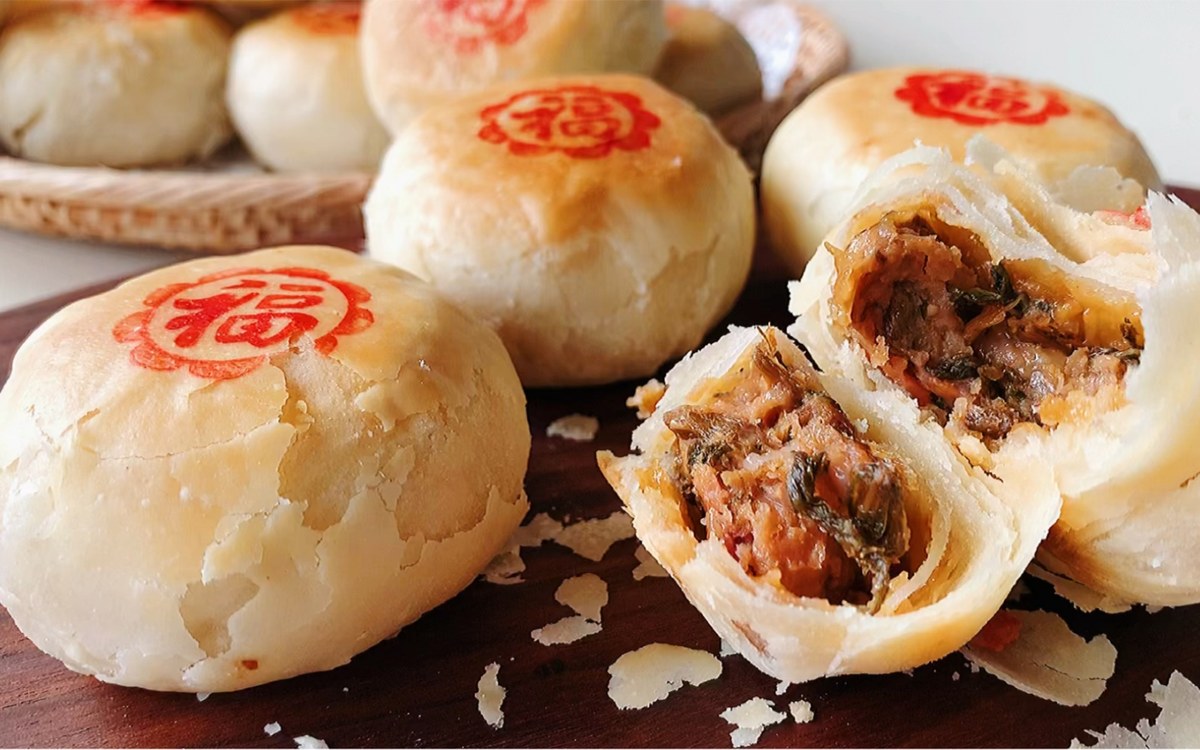
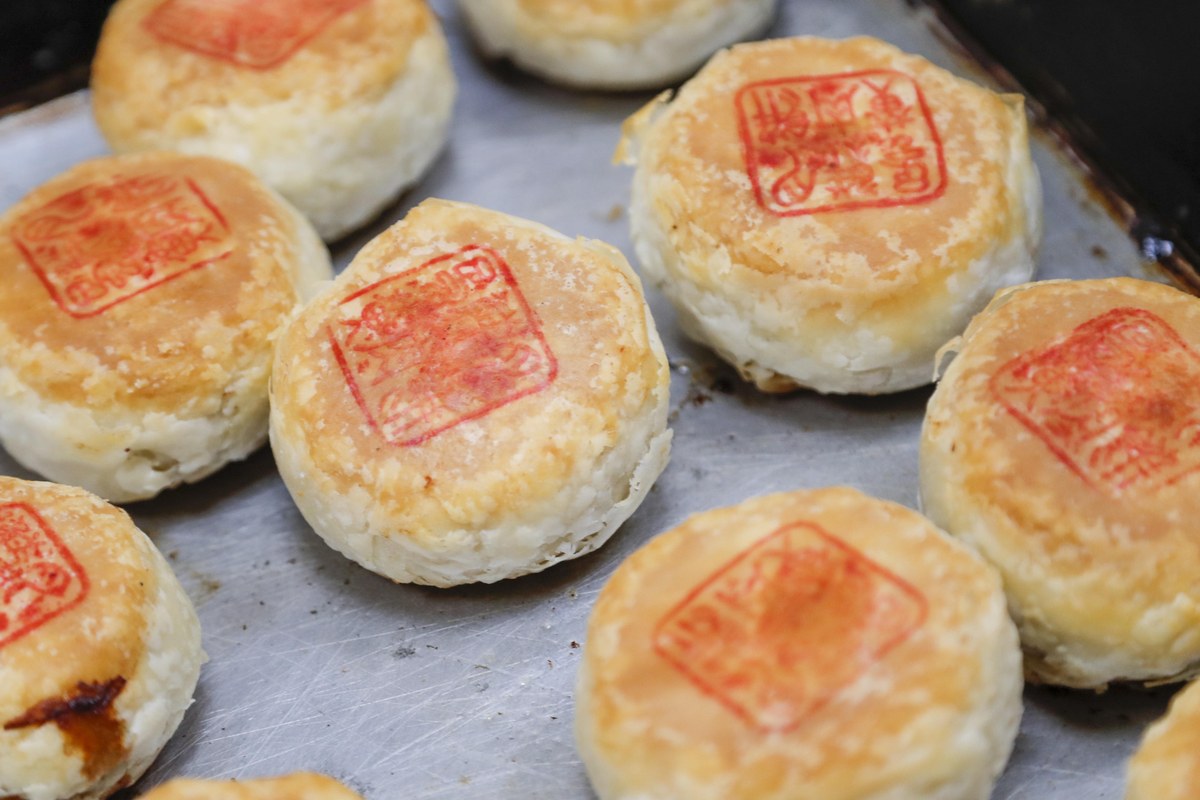
The queue starts at the door of Guangmingcun on Huaihai Road and bends around the corner, and nobody in it looks surprised. It is the second week of September. The woman in front of me has brought a folding stool. The man behind me has brought his mother. Somewhere inside, a tray of xianrou yuebing, pork mooncakes, comes out of the oven, and the smell arrives before the tray does: hot lard, wheat flour toasting, a hit of soy and scallion from the filling.
You buy them by the bag, four to a paper sleeve, and the grease goes through the paper before you reach the corner. You eat one standing up. The crust is a hundred thin flakes pressed together, and it does not hold. It gives with a dry little crackle, then collapses the moment your teeth touch it, showering your shirt with pale crumbs. Inside, the pork is still steaming, juicy enough to burn the roof of your mouth. You will burn the roof of your mouth. Everyone does. Then you eat a second one anyway.
That is a mooncake (月饼, yuèbǐng). If this surprises you, you are not alone. Most of the English-speaking world met this pastry in a square tin, in an office pantry, in October, and never forgave it.
What was in that tin
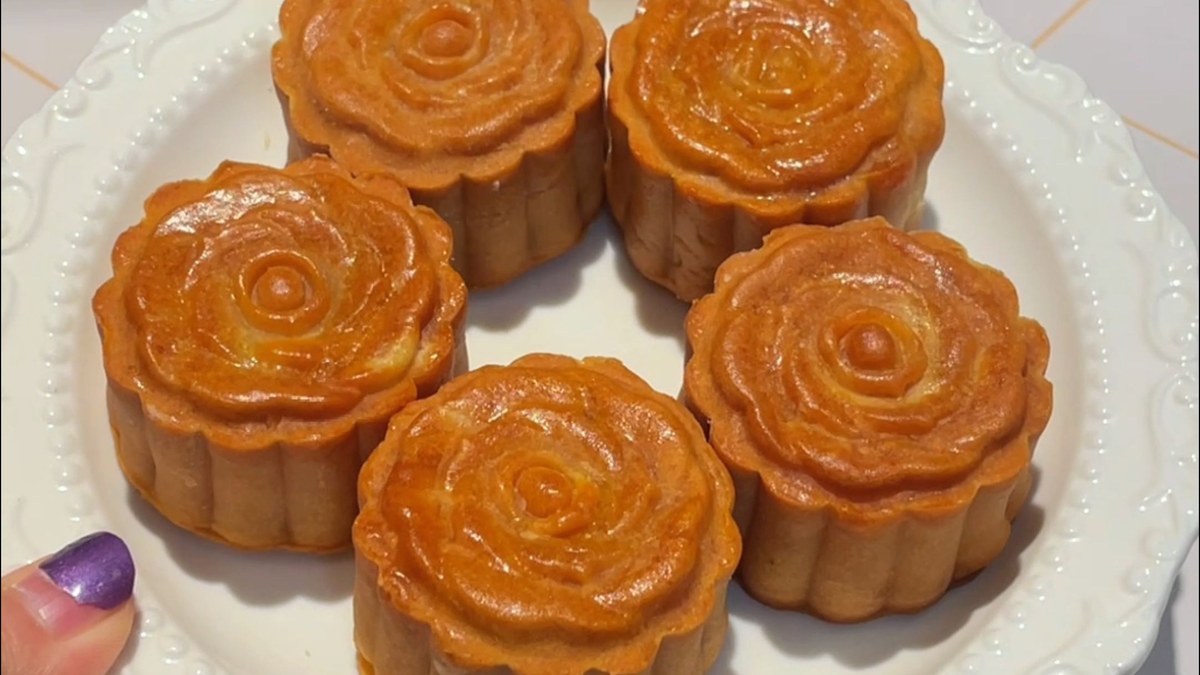
Let us be fair to the tin. A Cantonese mooncake, the glossy brown kind with lotus seed paste (莲蓉, lián róng) and a salted duck yolk at the center, is a real thing and a good one, made properly by people who have been at it for a century. The problem is the trip between the bakery and your desk.
The skin of a Cantonese mooncake is built on inverted syrup (转化糖浆, zhuǎnhuà tángjiāng), which keeps the pastry soft and makes it shine. Straight out of the mold it is actually a little hard. Bakers let it rest two or three days for the oil to creep back out of the filling into the skin, a step called huí yóu, returning oil. That is the design: a pastry built to travel and to keep. Which is exactly why it became the gift you hand to a client, a landlord, your cousin's boss. Which is also why the one you ate had been in that tin since August, and tasted like sweet sand pressed around a rubber sun.
So the mooncake you hate is not wrong. It is just old, and it is just one of six.
Six pastries wearing one name
Mooncake is not a recipe. It is a category: anything round, eaten at Mid-Autumn, meant to look like the full moon. Move a thousand kilometers and the crust changes completely.
Suzhou and Shanghai do flaky pastry (酥皮, sūpí), laminated with lard into dozens of layers, sweet or savory. That is the pork one in my paper bag. Chaoshan, down in Guangdong, does láo bǐng, heavier on the lard, with a filling so dense it is nearly a paste. Yunnan puts Xuanwei ham in theirs, salty-sweet with honey and a little fat, and it is the best thing to happen to a ham since the pig. Beijing has zìlái hóng, a hard little cake stamped with a circle of red dye, filled with sugar, nuts and candied peel, the kind of thing that survives a bicycle ride in a coat pocket. Cantonese is the glossy one. Then there is snow-skin (冰皮, bīngpí): no baking at all, sticky rice dough wrapped around cold custard, which is a mooncake the way a popsicle is a cake.
During the Yuan dynasty, when China was under Mongol rule, the story goes that rebel leaders hid the date of the uprising in mooncakes and passed them around for the Mid-Autumn festival. Whether or not a single message ever traveled that way, the pastry has been the country's excuse to gather in the eighth lunar month ever since, and the country takes the excuse seriously.
The knife
Here is the part nobody tells you. A mooncake is not a portion. It is a cake for a table.
My grandmother cut them with a paring knife, eight wedges, one per person, and the wedges went round on a plate next to the tea. Nobody ate a whole one. You had a wedge of lotus paste, a wedge of five-nut, and then, if you were small and lucky, the wedge with the salted yolk in it. The yolk stands in for the moon: salty against all that sweet, which is the entire point of the design. The white of the egg gets discarded, or salted and used elsewhere. The yolk is the moon. You do not get the moon every year.
The queue outside Guangmingcun is the other way to eat them. One at a time, standing up, too hot, no tea, no ceremony. Both are correct. What is wrong is a whole mooncake on a plate by yourself, which is how most of the world has been eating them, and why most of the world thinks they are too much.
The enemies
The tin from the corporate gift pile, six weeks old, filling sweet enough to take enamel off a tooth. The low-sugar mooncake that swapped sugar for maltitol and now finishes like chalk and regret. The luxury box with gold leaf and abalone inside, sold for four hundred dollars to people who will never open it. And five-nut (五仁, wǔrén), which has become China's most hated pastry and does not deserve the reputation. The version everyone hates is the cheap one, stuffed with qīnghóngsī, translucent red and green candied winter melon strips that taste like a dentist's glove. Good five-nut is walnut, peanut, sesame, melon seed and olive kernel, lightly sweetened, bound with a little cured ham fat. Bad five-nut is a sweet pillow full of plastic ribbon. Blame the ribbon, not the nuts.
What you want: a crust with visible layers, or a glossy skin that dents under your thumb. A filling you can smell before you bite it. A date on the box inside the last two weeks. If the crust bends instead of breaking, put it down.
How to eat it
Mid-Autumn, ideally outdoors, ideally with the actual moon in view. Cut it small. Serve it with tea strong enough to cut fat: a roasted oolong, a young raw pu'er, or in Shanghai, jasmine, because that is what was in the house. Take a wedge of the sweet one, then a wedge of the salty one. Cantonese yolk against Yunnan ham against fresh pork is the whole argument of the festival in three bites.
And if you are in Shanghai in September, skip the tin entirely. Find the queue. Bring a stool. Buy four, eat one on the way home, and let the crumbs fall where they fall.
💬 Comments