Lamb Skewers: The Silk Road on a Stick
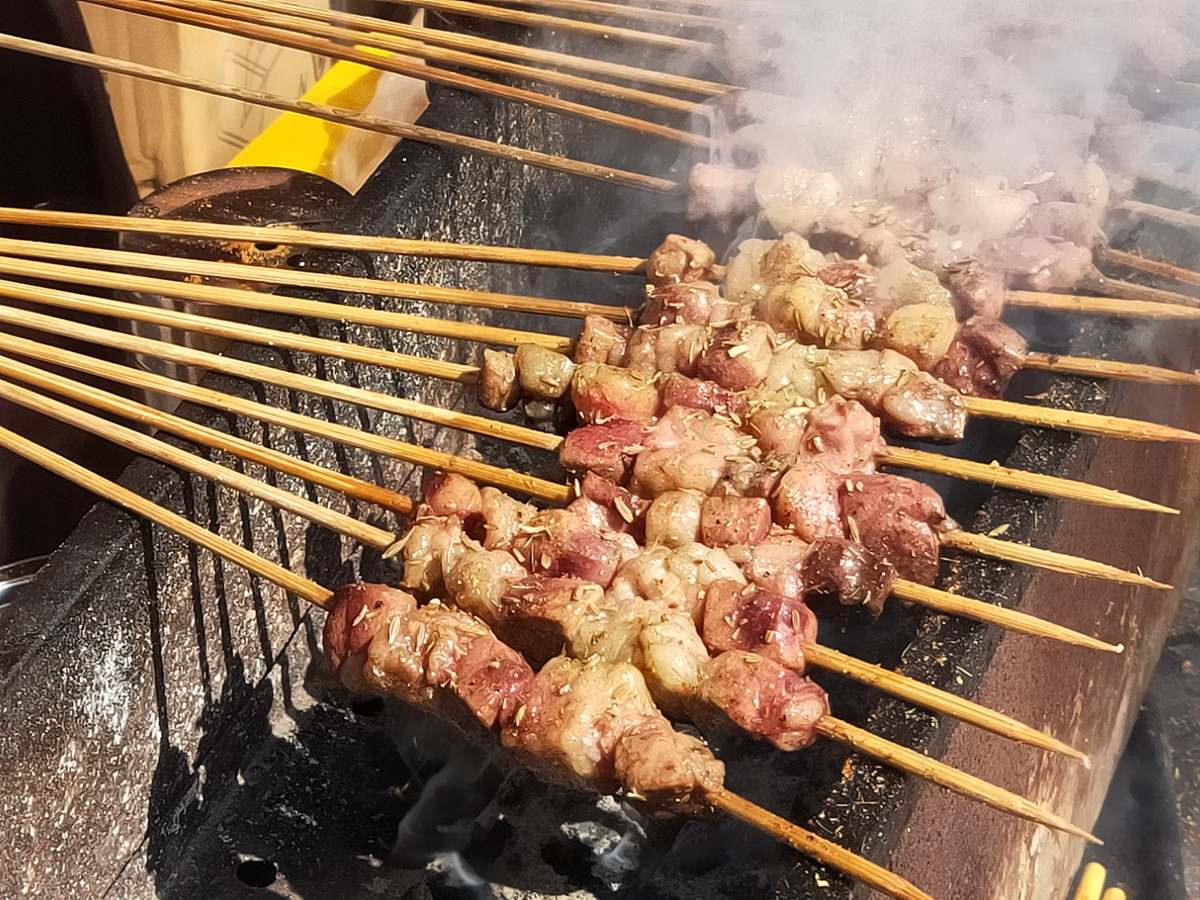
The smoke finds you before the stall does. It's not the clean smell of a backyard grill — it's charcoal and lamb fat and cumin, a smell so thick you could chew it, and it pulls you down the street like a hand on your collar. You round a corner and there he is: a Uyghur man behind a trough of glowing coals, a fan of skewers in each hand, turning them with the focus of a concert pianist.
The skewers aren't metal. They're red willow branches, stripped and sharpened, and they're not just a handle — the sap of the willow steams and infuses the meat as it grills, a flavor you can't get from a steel rod. On each branch: cubes of lamb, fat and lean alternating, the fat already turning to glass at the edges, the whole thing dusted with cumin and ground chili that hits the coals and sends up little bursts of smoke.
This is 羊肉串 (yángròu chuàn), lamb skewers, and it is the oldest street food in China — older than the noodle, older than the dumpling, older than the country itself, if you want to get pedantic about it. It came down the Silk Road with the traders and the nomads, and it never went back.
The Architecture of a Skewer
I've spent thirteen years building systems, and I've learned that the best ones strip away everything that isn't essential and then obsess over the three things that are. A lamb skewer is three things. That's the whole architecture.
The lamb. It has to be fatty. This is the non-negotiable. Lean lamb on a skewer is a tragedy — it dries into leather over open charcoal. The fat is what keeps the meat juicy, and as it renders, it drips onto the coals and flames up, charring the meat with smoke that you can actually taste. Xinjiang lamb — from the grass-fed sheep of the region — has a clean, almost sweet fat that's nothing like the muttony wool-taste that puts people off. The fat-to-lean ratio, alternating cube by cube, is the whole game.
The seasoning. Cumin (孜然, zīrán) and ground dried chili. That's basically it. The cumin goes on heavy, whole seeds and ground, and it's the dominant flavor — earthy, warm, faintly bitter, the smell of the entire Silk Road compressed into a seed. The chili is for heat and color. Sometimes there's salt, sometimes a pinch of Sichuan peppercorn, but anyone who buries the lamb under a barbecue sauce is missing the point.
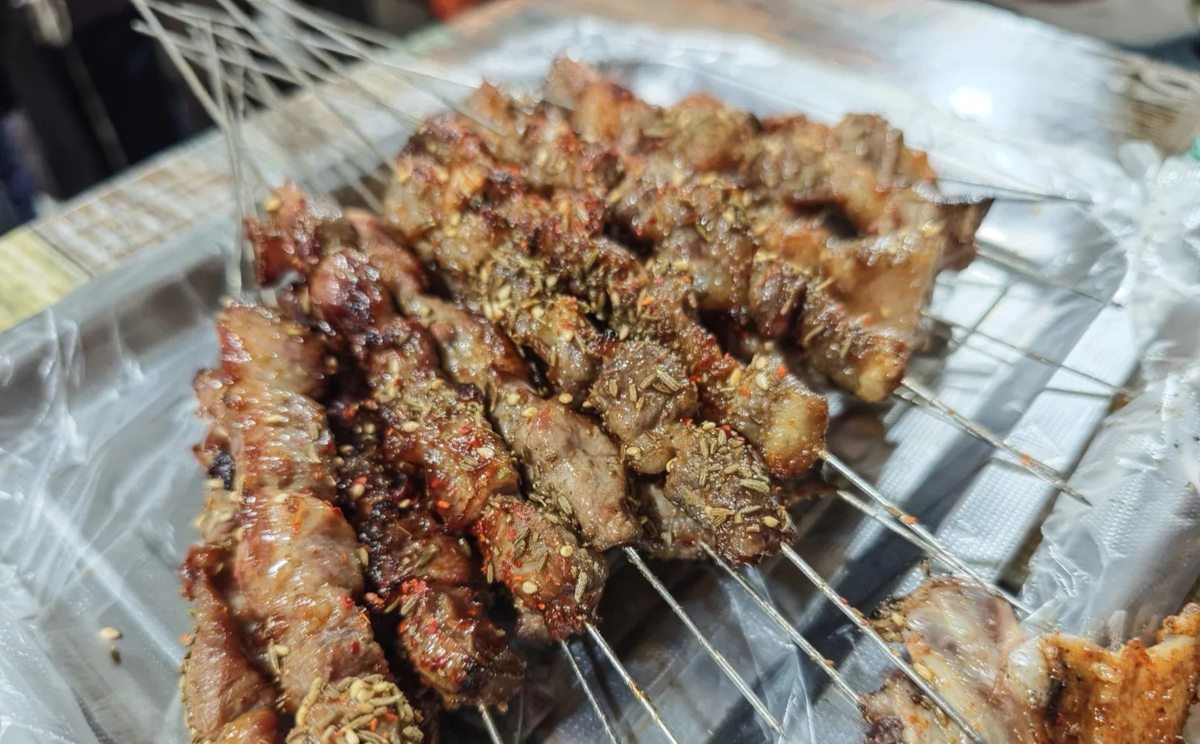
The fire. Charcoal, not gas. Open flame, not a pan. The skewers sit inches from the coals, turned constantly so the fat renders and flares without burning the meat. That flare — the little whoosh of flame when the fat hits the coals — is doing real work. It's charring the surface, sealing in the juice, and smoking the meat in a way a gas grill never will. This is why lamb skewers taste like a campfire and a feast at the same time.
A good lamb skewer is half char, half fat, all smoke, and gone in thirty seconds.
The Origin
Lamb on a stick predates every kitchen in China. The nomads of the northwest — the people who became the Uyghurs, Kazakhs, and others along the Silk Road — grilled mutton over open fires because it was what they had, and they seasoned it with cumin because cumin was what grew and traded along the routes they rode. When the traders settled, the skewers stayed. What was once a nomad's dinner is now the smell of every Chinese city after dark.
The Enemies of Lamb Skewers
The Lean, Frozen Version. Supermarkets sell lamb skewers made from lean, factory-farmed lamb, frozen for weeks, that come off the grill dry as cardboard. The fat is the dish. If the skewer is all red meat and no white fat, leave it on the shelf.
The Gas-Grill Version. A lot of city restaurants, banned from open charcoal, cook skewers on gas or electric. The result is cooked lamb, not charred lamb. No flare, no smoke, no soul. You can taste the difference in one bite — it's the difference between a campfire and a microwave.
The Over-Sauced Version. Barbecue sauce, sweet glaze, teriyaki — these have no business on a lamb skewer. The whole point is cumin and chili and lamb fat. If you can't taste the cumin through the sauce, someone is hiding a bad cut of lamb under a good bottle.
The Metal-Skewer-Only Version. There's nothing wrong with a steel skewer — plenty of great stalls use them. But the red willow branch isn't a gimmick. It genuinely flavors the meat from the inside as the sap steams. If you ever get a chance to taste the two side by side, do it. You'll never look at a steel rod the same way.
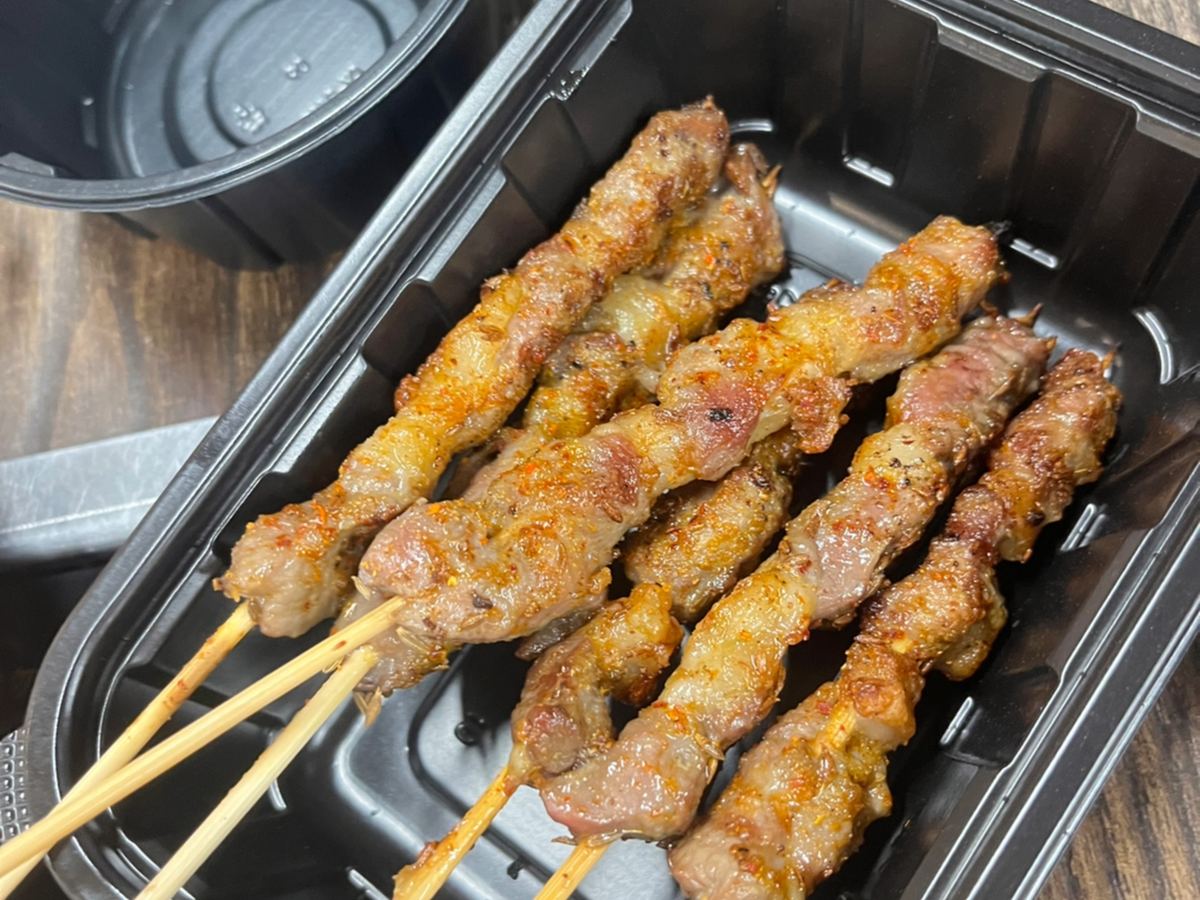
The right lamb skewer: fatty Xinjiang lamb, alternating fat and lean, dusted with cumin and chili, charred over real charcoal on a red willow branch, eaten standing up, still so hot the fat is liquid.
How to Eat It
You eat a lamb skewer standing up, in the street, as fast as it comes off the grill. The first skewer burns your mouth — that's fine, it's part of it. Bite the cubes off the branch, not daintily one at a time, and let the cumin get on your fingers and your face. Chase it with a bite of 馕 (náng), the flatbread, which soaks up the fat and the flavor, and with a cup of tea so strong it's nearly black.
I ate my first real lamb skewer in Xinjiang, years ago, standing in a night market in Ürümqi with my hands in my pockets and the cold coming down off the mountains. A vendor handed me a skewer without a word, the way you'd hand someone a truth. I bit into it, and the fat was still bubbling. I've had a thousand skewers since — in Beijing, in Shanghai, in cities that didn't exist when the Silk Road ran through here. None of them were as good as that first one, standing in the cold, because none of them were the first. That's how street food works. It's never the food. It's the night you ate it.
I'll save the home-cooking breakdown for another post. Getting the charcoal right — the flare, the fat rendering into smoke, the cumin bloomed over the coals — that deserves its own deep dive. Recipe coming soon.
💬 Comments