Lamb Pilaf: The Rice That Is Never Stirred
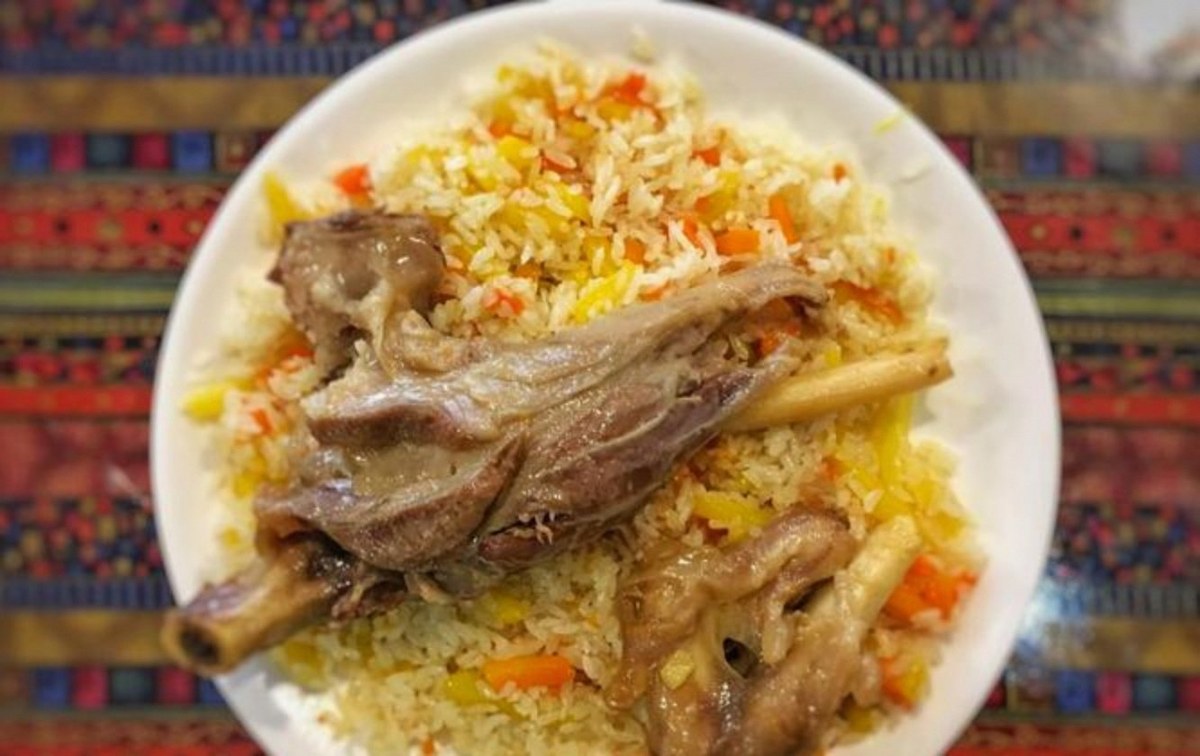
The lid comes off at one o'clock and the whole street knows. Steam rolls out of a pot wide enough to wash a child in, and under the steam is the smell: mutton fat, cumin, and carrots cooked past sweetness into something closer to jam. The man working the pot holds a ladle in each hand like a pair of oars. Underneath it all, the rice has gone the color of dark honey.
This is 手抓饭 (shǒu zhuā fàn) — literally "hand-grabbed rice" — which Uyghur cooks in Xinjiang call polo. It is not rice with lamb stirred through at the end. It is one pot, built in layers, and then left alone. That is the entire technique, and it is the part almost everyone gets wrong.
Built from the bottom up
You start with the fat. Chunks of bone-in shoulder go into hot mutton fat and stay there until the edges seize and brown — not until they are cooked, just until they have a crust. Then onion. Then carrots in a quantity that looks like a mistake: red ones and the yellow ones you barely see outside Xinjiang, sliced into thick fingers and cooked until they give up their structure and half their sugar to the oil. Cumin goes in late so it does not burn. Salt goes in with the water. The lamb sits at the bottom under a shallow braise, lid on, for the better part of an hour.
Then the rice. Short-grain, soaked, drained, spread over everything in an even blanket. The cook pokes holes down through it to the meat with the handle of a ladle, four or five chimneys, so the steam has somewhere to go besides straight up through the middle. Lid back on. Low heat. Forty minutes in which nothing happens, and nothing is what makes it work.
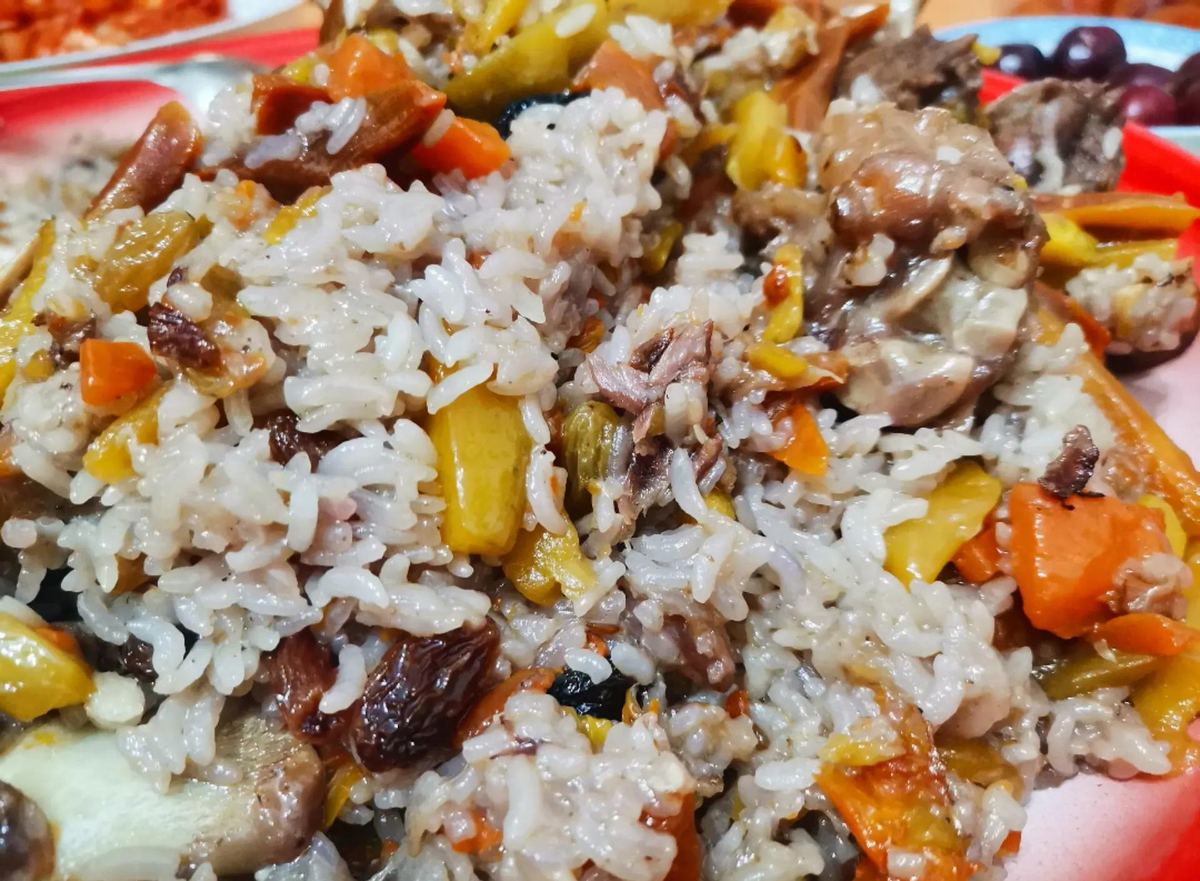
When the pot comes off the flame, the fold. One pass with the ladle, bottom to top, rice and carrot and lamb folding into each other exactly once — folded, not stirred — and then straight onto the plate. The first grains out are the ones that sat against the metal: darker, slightly crisp at the tips, tasting of everything the pot has been doing for the last hour.
Twelve yuan on Zheng Tong Road
I ate my first bowl in my second year at Fudan, at a Xinjiang place on Zheng Tong Road where the laminated menu had photographs and none of them matched the food. Twelve yuan. The owner's mother did the cooking in the back, and the pot came out at noon whether or not you were hungry. The first time, I reached for a spoon and the owner took it out of my hand, said something in Uyghur to his mother, and both of them laughed at me. Then he showed me how: right hand only, fingers curved, thumb pushing the rice into a ball against the palm, up and in. It took me three visits before the ball held together for a whole mouthful.
The salad on the side mattered as much as the rice. 皮辣红 (pí là hóng) — onion, tomato, green pepper, vinegar, salt, no oil — named for the three things in it: 皮牙子 (pí yá zi, onion, from the Persian piyaz), 辣子, and the red of the tomato. Raw onion against rendered fat. That is the whole logic of it. Alongside: a bowl of plain yogurt, a pot of salted milk tea, and a stack of 馕 (náng) to wipe the plate with at the end.
A pot that traveled
Polo came east along the Silk Road from Persia and Central Asia and stayed recognizable the whole way. Xinjiang changed three things: double the carrots, no saffron, and the local short-grain rice instead of the long-grain the Iranian versions prefer. Some houses add raisins or dried apricots, more often in the south around Kashgar than up in the north. That is it. Same pot, same layered build, same refusal to stir.
Where it goes wrong
Almost every bad version fails in one of three places. The first cooks the rice separately and tosses it with a lamb stew: grains slick on the outside, dry in the middle, a plate that tastes like two dishes that met in a bowl and never spoke again. The second uses basmati. Basmati is a fine rice and the wrong rice — it does not drink, so the carrot and the fat sit on top of it instead of inside it. The third seasons with curry powder. If your pilaf is yellow because somebody shook a tin, you are eating a rumor.
Then the smaller crimes. Boneless lamb stewed until it has nothing left to say. Cumin used as a volume knob. Raisins scattered on top as decoration by a kitchen that put none in the pot. And the worst one: the hotel buffet tray, rice pressed flat, lamb sliced thin, served lukewarm at seven in the evening. This food is cooked at noon and eaten at noon. It is not a dinner dish, and it does not improve with waiting.
One hand, one ball, no spoon
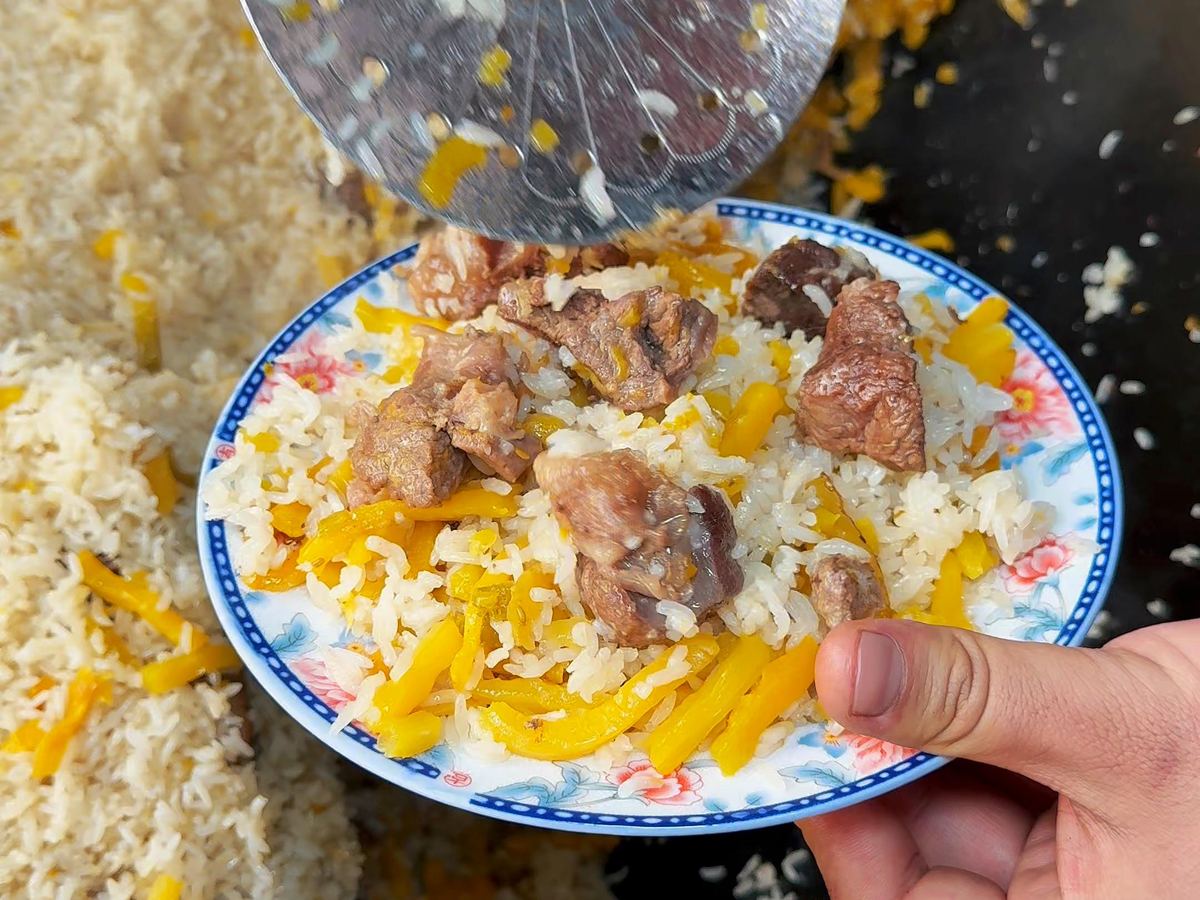
Go at lunch, not dinner, and go somewhere you can see the pot before you sit down. Order one portion each plus one extra for the table, because the second helping is the entire point of the meal. If you are sharing a plate, eat from your own edge of it. Right hand, three fingers, thumb doing the shaping — the ball should be small enough to fit behind your teeth in one go and it should carry rice, a piece of carrot and a shred of lamb together, not one at a time.
Between mouthfuls, the onion salad. When the lamb gives way under your fingers, drag the rice through whatever fat is left on the plate. Drink the salted tea, not beer — the tea cuts the fat and the beer just sits on top of it.
And ask for the bottom of the pot if you are on good terms with whoever is serving. Some cooks keep it for themselves, some will scrape it out for a regular. It is the best four mouthfuls in the dish, and it only exists because the rice at the base took direct heat for forty minutes while everything above it steamed.
The lid goes back on around three, and whatever is left sits on a low flame for the evening crowd. In Urumqi I once watched a cook eat his own lunch standing up, straight off the ladle, before he served a single customer. He had waited all morning for that one mouthful. Standing there with the steam on his face, I finally understood the order of operations.
The home version needs a heavy pot, a patient hour, and the discipline to leave the rice alone. That deserves its own post. Recipe coming soon.
💬 Comments