Kao Baozi: The Bun That Bakes Standing Up
The mouth of the pit is a hole in the ground about as wide as a man's shoulders, and the man kneeling beside it has his entire right arm inside. He pulls the arm out, dips his hand in a bowl of salt water, shakes the excess off, and goes back in. What he is doing in there is gluing raw dough to a wall.
The sound is the whole thing. A flat wet slap, then a hiss as the water on the dough meets clay that has been burning wood for two hours. Eight, ten, twelve of them, working around the inside of the pit in a slow rotation, and he does not watch his own hand. He is watching the queue.
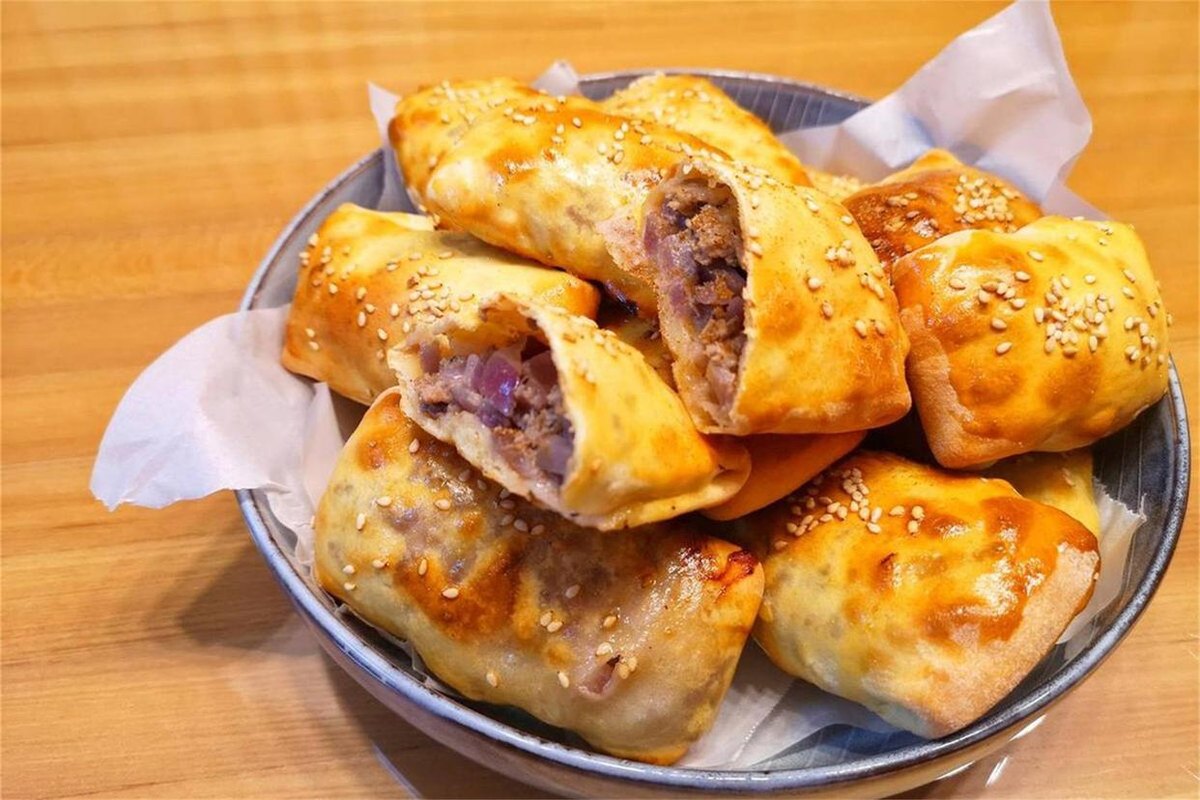
This is 烤包子 (kǎo bāozi), "baked bun" — the thing Xinjiang calls samsa and the rest of China walks past because it looks like a folded envelope. It is not a bun the way a bakery makes a bun. There is no soft domed top, nothing to squish, nothing to sandwich. It is a thin square parcel of dough with diced lamb and onion inside, baked standing up against the clay wall of a tandoor, and it comes out blistered on one face and pale on the other, hollow-sounding when you tap it, and hot enough to take the skin off your lip.
What the wall does
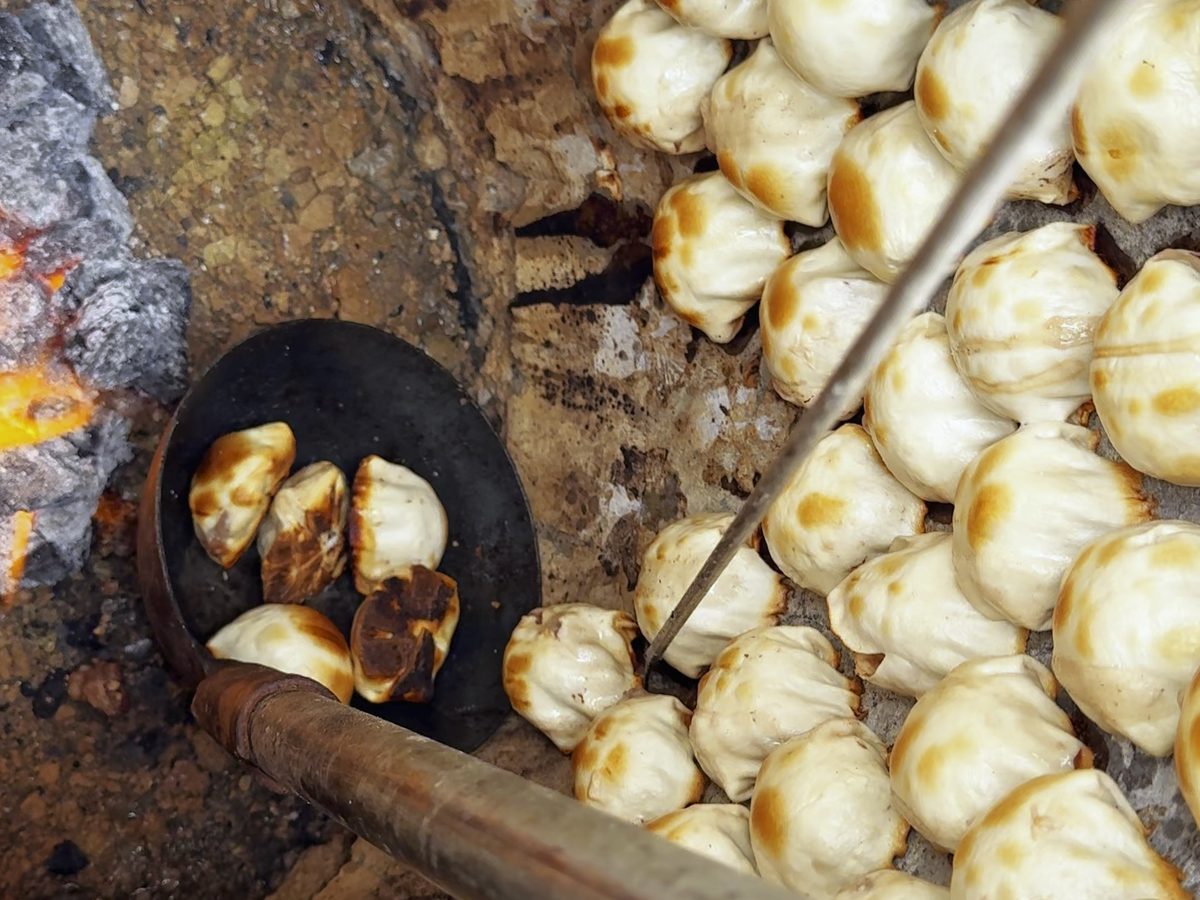
A 馕坑 (náng kēng) is not an oven. An oven surrounds food with hot air. A tandoor is a clay cylinder with fire at the bottom and two hours of heat banked in its walls, and it cooks by contact and radiation at once: somewhere north of 300°C at the surface where the dough lands. That is why the bun has to be stuck to the wall instead of set on a tray. The clay pulls moisture out of the dough in seconds. The face pressed against it sets into a crust almost immediately, blisters, and goes the colour of a burnt map. The face turned toward the fire browns slower and stays softer, so a single bun gives you two different breads.
The sticking is the skill, and it is not a thing you can fudge. Wet hand, dry dough: the film of water flashes to steam and pins the parcel to the clay for the eight or nine minutes it takes. Too wet and the bun slides into the embers. Too dry and it drops. The man in Kashgar who let me stand there and watch for the better part of an hour kept a bowl of salted water at his knee and re-wet his palm before every single one. His right forearm had a lattice of small round scars, the kind you get from reaching past your own limit into heat. He said he started at twelve. He said six hundred a day in summer.
The cleaver, not the grinder
The filling is lamb, and it is diced. Not minced, not ground. Two cleavers working a pile of fatty shoulder and a chunk of tail fat until it is a rough dice with cubes you can still see, then onion in almost the same volume, cumin, black pepper, salt, and nothing else. No soy sauce, no egg, no breadcrumbs, no ginger. The onion does the work people expect from a sauce: it gives up water and sugar into the fat, and the fat carries the cumin into everything.
Then the fold. A square of dough rolled thin — thinner than you think, thin enough that the corners go translucent and snap like a cracker — filling in the middle, corners brought in one at a time and pinched into a flat envelope. It goes against the wall seam-side down, so the same contact that bakes it also presses the seam shut. A good one has no thick knot of dough anywhere. That is the whole test, and I will come back to it.
Changde Road, and one morning in Kashgar
I grew up eating these in Shanghai, badly. There is a row of Uyghur shops around the Huxi Mosque on Changde Road where you can buy naan and kao baozi through a window, and for years that was my reference point: good enough, twenty minutes from home, gone before I reached the corner. Then I stood in front of a real pit in Kashgar at seven in the morning, cold air, smoke going sideways, and understood that I had been eating the reheated version of a food whose entire argument is freshness.
The difference is not the recipe. It is the eleven minutes between the wall and your hand. In Kashgar the buns come off the wall and go straight into a paper bag and the bag goes straight to you, and the crust is still moving — contracting, ticking, steaming at the seam. In Shanghai, and in most of the country, they come out in batches at dawn and sit in a warm cabinet, and by the time you get one the steam has gone back into the dough and turned it to leather.
How a bad one gives itself away
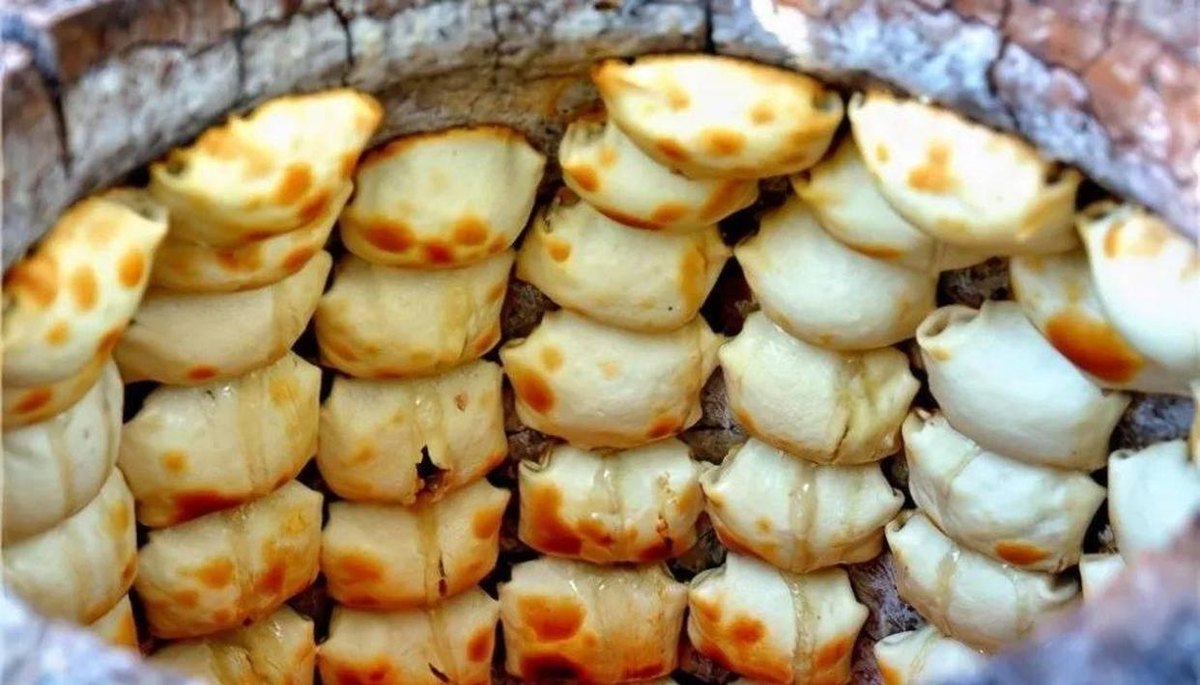
Start at the bottom. A real kao baozi has an irregular, blistered, faintly scorched face where it touched the clay: dark spots, pale spots, bubbles the size of a coin. A uniform tan bottom means it never touched a wall. It was baked on a tray in a convection oven, which makes a perfectly pleasant stuffed flatbread and a completely different food. Those also sit in their own fat, so the bottom comes out greasy instead of crisp.
Second, cut it open. If the filling is a paste, someone used a grinder because it is faster, and you are eating a lamb meatball wearing bread. The real thing is a dice: some cubes still pink at the centre when it comes out, fat melted into the onion, juice running onto the paper. Third, look at the corners. Dough rolled thick "so it doesn't tear" is the most common failure of all, and it produces something closer to a calzone — a mouthful of bread with a spoonful of filling hiding in the middle. Correct pastry is barely there.
And if it arrives lukewarm, walk away. Nothing about this food survives cooling. The fat sets, and the crust goes from shattering to chewy in about six minutes. It is not a snack you can save for later.
Four bites
Hold it in the paper, not in your fingers, unless you want to smell of cumin for the rest of the day. Bite a corner first and let the steam out the way you would with a soup dumpling — the filling is a sealed pocket of lamb fat and onion water, and a first bite taken from the middle will take the roof off your mouth. I know this from experience. Twice.
Then eat around the edges toward the centre. The last bite is the middle, where everything has run downhill while you were working: the wettest, fattiest, most cumin-heavy mouthful of the whole thing, saved for the end without anyone telling you to. In Kashgar it comes with cold plain yogurt or a pot of salted milk tea, and both do the same job, cutting the fat between bites so you can keep going. Nobody puts chili sauce on it. If someone hands you a sachet, hand it back.
A good one is gone in four bites and leaves your fingers shiny. Wipe them on the paper, or on your trousers, which is what everyone standing at the stall actually does. The ones who wait until they get home have already missed it.
💬 Comments