Chicken Frame: The Best Part of the Bird Is the Part Nobody Wanted
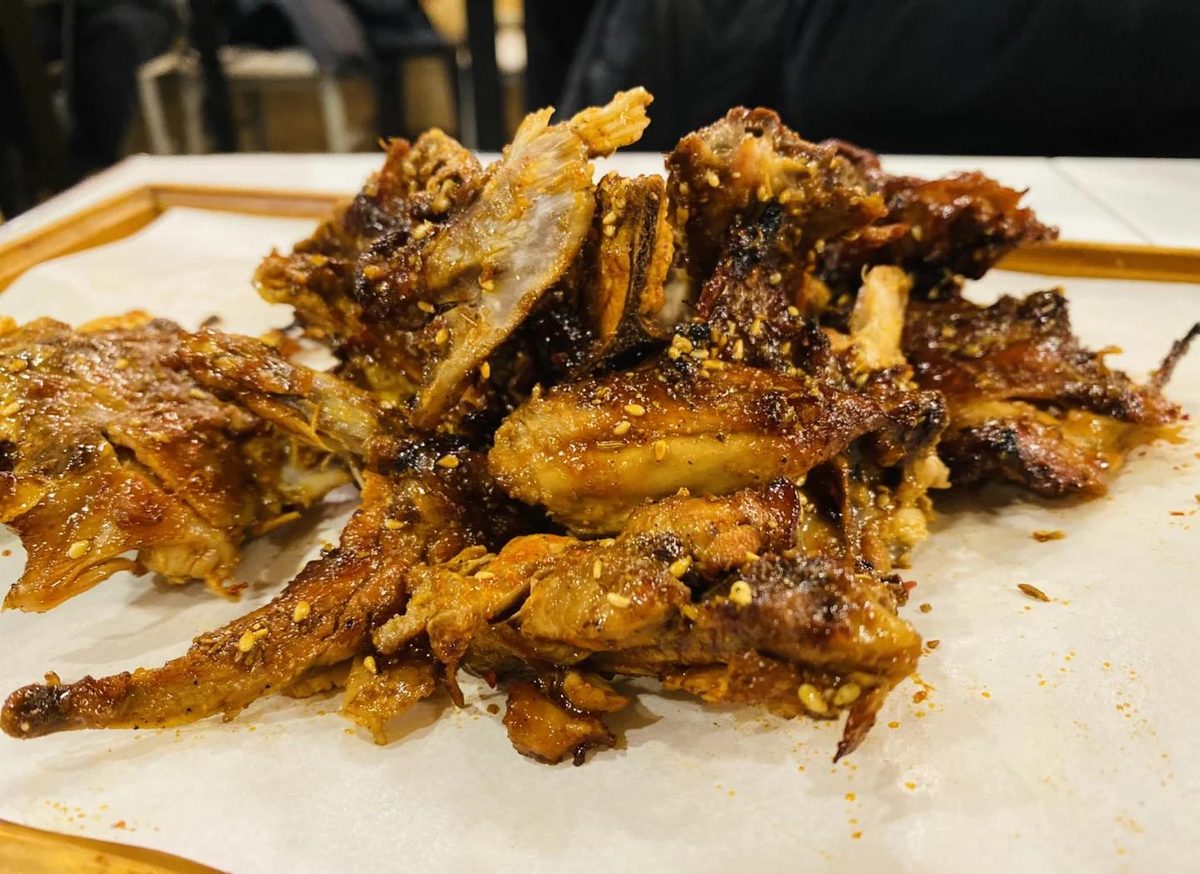
"Shenyang invented it," the man says, without looking up. "Ask anyone up there. We just cook it better."
He has a chicken frame pinned flat under a hinged iron clamp and he is pressing it down onto the grate the way you'd close a book you were annoyed at. Fat runs off the ribs and falls into the charcoal. The smoke that comes back up carries cumin, burning sugar, and something dark and roasted that isn't either of those things.
It's eleven at night in Linghe, the old quarter of Jinzhou (锦州), a small city in western Liaoning that most of China could not place on a map and every barbecue cook in the northeast respects. The grill in front of him is four meters long and holds about thirty frames at once, all of them opened flat, all of them hissing. Behind him: plastic stools, a folding table with a case of beer on it, six people still arguing about a football match that finished two hours ago.
This is 鸡架 (jī jià), the chicken frame. Not a cut, exactly. A remainder.
What's left after the bird pays for itself
Take a whole chicken and remove the parts that sell. What's left is a spine, two racks of ribs, the shoulder girdle, and whatever dark meat is welded into the gaps between them. In most of the world that's stock. In Liaoning it's dinner, and it has been dinner for thirty years.
The meat clinging to those bones is 贴骨肉 (tiē gǔ ròu), "meat against the bone." Dark, fatty in a way breast meat has never managed, and more chicken-tasting than chicken. There isn't much of it. You don't eat a frame for volume; you eat it because the little meat on it is the best meat on the animal, and getting at it takes time, and time is what a night out is made of.
Jinzhou: raw, flat, over coals
The Jinzhou method starts with a raw frame. Not boiled, not braised, not pre-cooked in any way. It's split down the back, opened flat like a book, salted lightly, clamped. Charcoal only, because a gas grill gives you heat but not the second half of the flavor, which is chicken fat rendering into coals and coming back up as smoke.
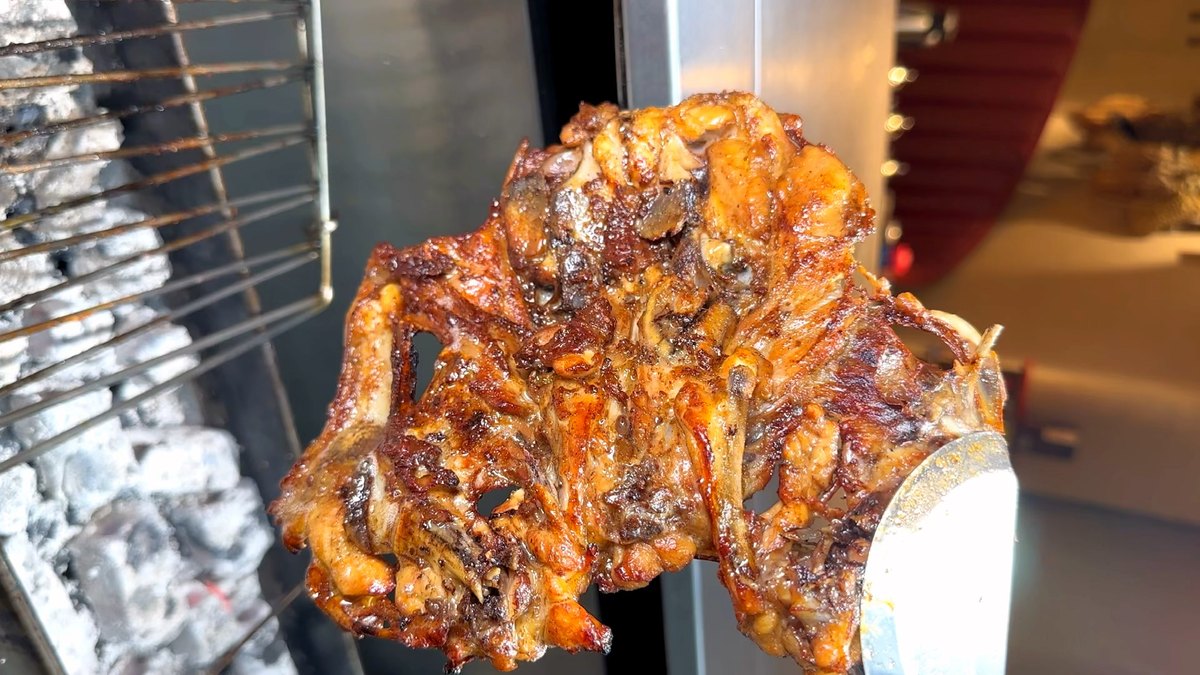
Ten minutes in, the cook brushes on the sauce. Every stall has its own and every cook will lie about it: garlic chili paste, sweet bean sauce, soy, sugar, sometimes beer to thin it. Then, in the last thirty seconds, the dry dust. Cumin, chili flake, sesame, crushed peanut, a pinch of MSG that nobody admits to. The five verbs of Jinzhou barbecue (锦州烧烤, Jǐnzhōu shāokǎo) are dip, brush, dust, grill, turn, and in 2021 the national government added the technique to its intangible cultural heritage list. The technique. Not a recipe, not a dish. A set of hand movements.
What arrives is a frame with the rib tips gone dark and crisp at the edges, like the ends of a bacon rasher; meat in the gaps still juicy because it never left the bone; and the cartilage at the breastbone soft enough to chew, snap, swallow. The first bite is all cumin. The second is chicken. The third is fat and smoke, and you reach for the beer.
Shenyang: boil it, smoke it, tear it apart
Shenyang, ninety minutes up the railway, disagrees. It calls itself the chicken frame capital of China. Its signature is 熏鸡架 (xūn jī jià): braised first in a spiced stock of star anise, cassia and clove, then smoked over burning sugar in a wok until the skin goes lacquered and amber. The meat comes away in soft strips. It tastes of tea smoke and soy.
Then there's 拌鸡架 (bàn jī jià), the same frame torn apart by hand and tossed in a stainless bowl with black vinegar, chili oil, garlic, cilantro and sugar, served cold. And 铁板鸡架 (tiěbǎn jī jià), pressed flat on a griddle with onions and cumin until the edges fry. Shenyang eats all of it with the same beer and the same arguments, and considers the Jinzhou version a spice delivery system with a bird underneath.
Jinzhou's answer is that Shenyang's frame is a stew that got smoked. Both cities are right, which is why the argument has lasted thirty years.
Why the frame at all
Chicken frame culture in Liaoning is not folk wisdom handed down through dynasties. It's a decade. In the 1990s the state-owned factories of the northeast closed, and a lot of people who had been on a payroll their whole adult lives were suddenly not. The province's processing plants were shipping breasts and legs south and overseas; the frames, the part with no export value, sat in wet markets for almost nothing. Laid-off workers bought them by the bag and learned to make a meal and a night out of the cheapest thing on the counter.
That's why nobody in Shenyang or Jinzhou treats the frame as a novelty. It isn't kitsch, and it isn't "nose to tail" ideology. It's what a hard decade tasted like, and people kept eating it after the money came back because it turned out to be good.
What gets sold as chicken frame elsewhere
The deboned version. If a chef has taken the bones out for your convenience, he has taken the dish out. There is nothing left to eat.
The sauce mop. A thick sweet glaze, painted on until you can taste neither bird nor smoke. This is how a boiled frame gets rehabilitated.
The gas grill. Clean heat, no fat in the coals, no smoke coming back up. The frame looks right and tastes like a warm room.
The parboiled shortcut. Boiled in the morning, finished on the fire at night. The outside chars, the inside is grey and wet, and the meat already gave everything it had to the water.
The flattened young chicken. A whole small bird pressed flat is a fine thing, four times the price, and a different dish. If the menu calls it a frame, it's lying about the bill too.
And a frame that sat under a heat lamp. Ten minutes is the window. After that the crisp edges go leathery and you're chewing instead of eating.
The correct way to take it apart
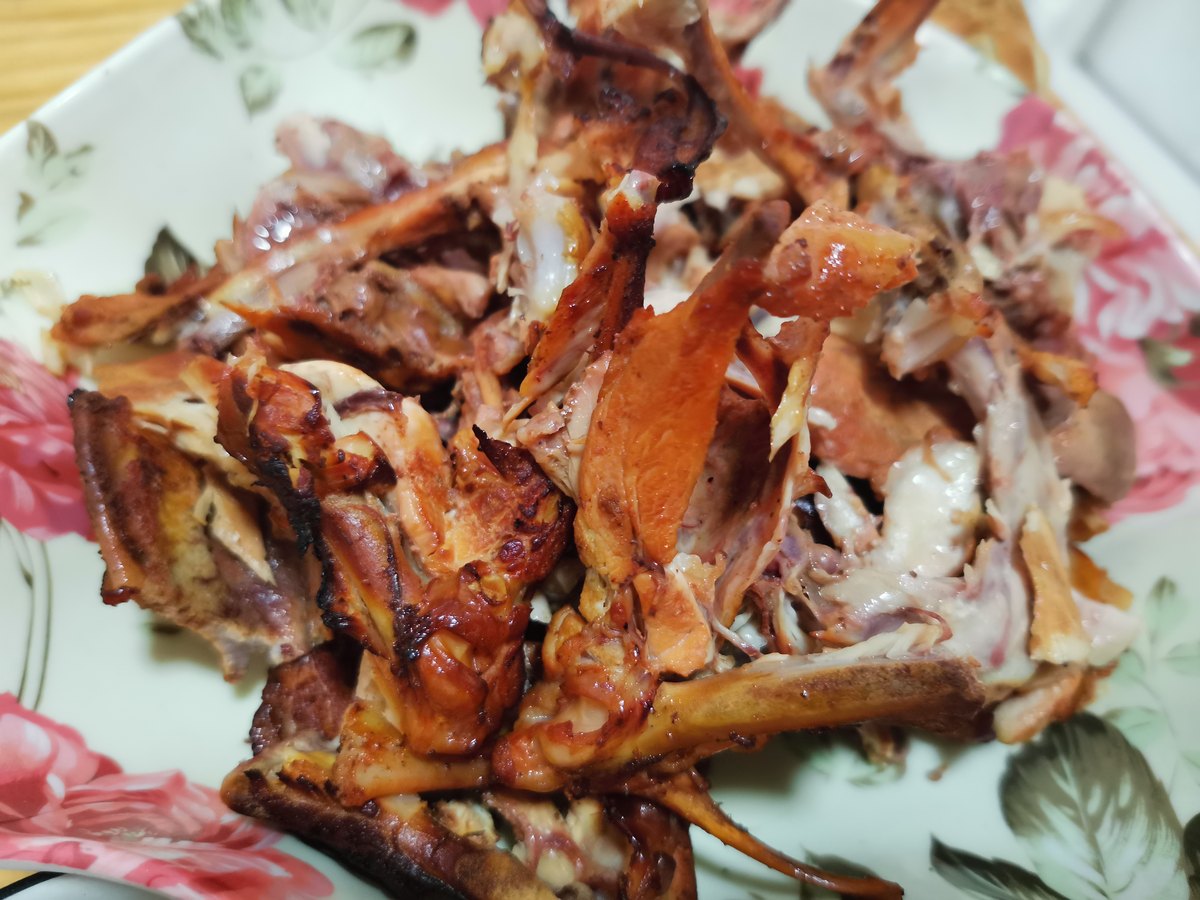
Hands. Gloves are for people who have somewhere to be afterward. Pull the rib racks away from the spine along the seam, which gives with a small crack, and eat the rib tips first while they're still crisp. Then work the meat out of the gaps with a thumbnail. Then the shoulder cartilage, the best single bite on the frame when the cook got the timing right. Then the spine, where the marrow is, and where you will make a noise and not care.
Beer, cold, and not a delicate one. In Liaoning that means 老雪, which is stronger than it tastes and has ended more evenings than it started. Between frames you eat sunflower seeds and boiled peanuts and wait for the next one. If the tail is still on, it's yours. It always was.
I ate my first one at twenty-seven, in February, in Shenyang, at a stall behind the train station with a colleague who had grown up four streets away. It was minus eighteen and we ate with our gloves on, which is the wrong way, and it was still the best thing I ate that winter.
Two cities, one bird, and the best part of it is the part nobody wanted. Ask a Shenyang man and a Jinzhou man and you'll get two answers and a third beer. Ask me: Jinzhou for the coals, Shenyang for the cold bowl, and no reason to pick only one.
💬 Comments