Jinhua Ham: The Leg That Waits Three Years
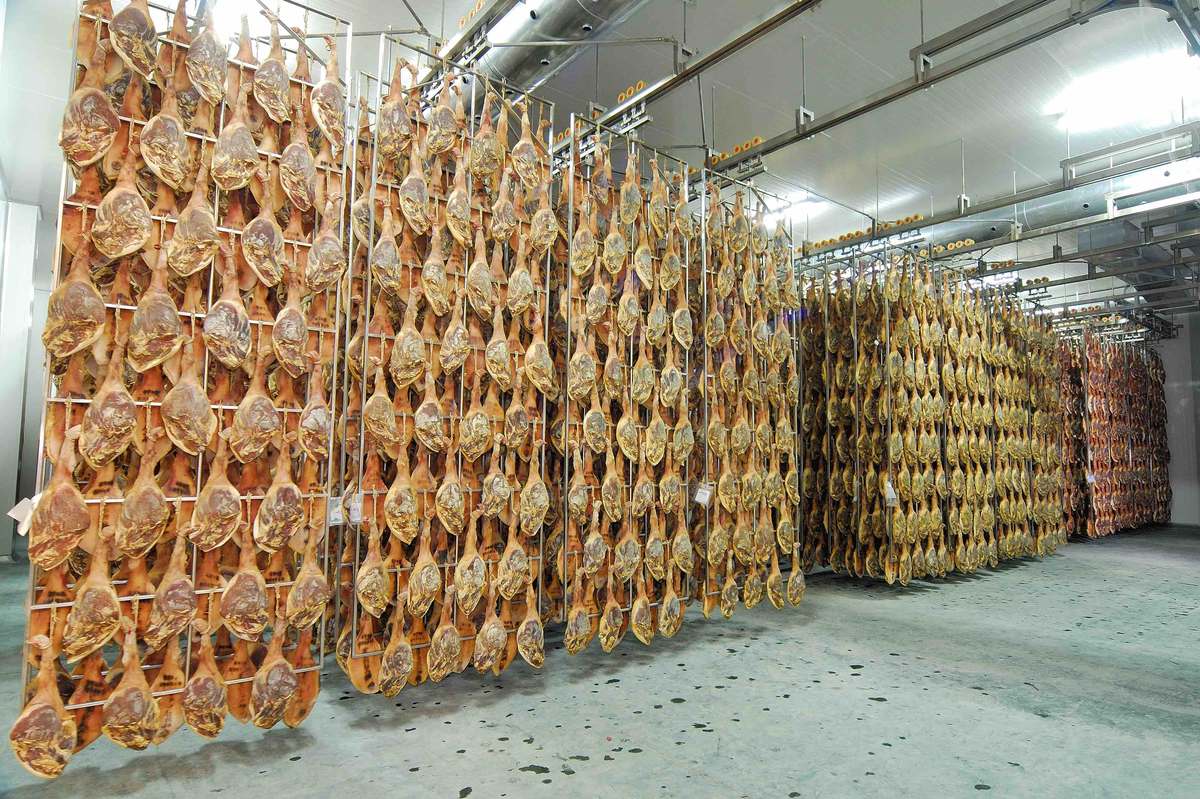
The loft is dark, and it smells like a butcher's shop crossed with a library. Salt, cold fat, old pine beams, and under all of it something sweeter, like dried fruit left too long in a drawer. My eyes adjust. The legs are hanging in rows, hundreds of them, tied at the ankle with hemp rope, turning a little in the draft. Where the skin shows they are the color of dark honey, almost black at the shank. Nobody is talking. Somewhere at the far end, a radio is playing to itself.
A man in a blue apron walks the row with a bamboo splint in his hand, sharpened at one end. He stops at a leg, pushes the splint into the meat near the bone, pulls it out, and smells it. Then he does it again, lower. Then a third time, down by the shank. He says nothing. He moves to the next leg. The whole inspection takes four seconds.
This is 金华火腿 (Jīnhuá huǒtuǐ), Jinhua ham, and that splint is the only exam that counts. Three insertions, three sniffs. The trade name for the standard is 三签香, “three-splint fragrant.” If all three come out clean and deep, with no sourness and no ammonia, the leg is top grade. If one smells like a wet basement, it gets demoted, sold cheap, or chopped into something anonymous.
I had come to Dongyang, an hour outside Jinhua in Zhejiang, to watch a leg of pork turn into something that costs more per kilo than beef tenderloin.
Seven rubbings of salt
The leg comes from a 金华两头乌 (Jīnhuá liǎngtóu wū), the “two-end black” pig: black head, black rump, white in the middle. It is a slow-growing breed that nearly vanished in the 1990s when farms switched to lean commercial hogs. The fat is the point. A ham maker wants a hind leg of five or six kilos, with a thick cushion under the skin and a clean line where it left the carcass.
Then comes the salt. Not a brine. A rub, by hand, six or seven times over the first month. Each round pulls more water out of the leg, and by the end it has lost roughly a third of its weight without ever seeing heat. Between rubbings the leg is stacked under wooden boards weighted with stones, so the meat presses flat and the moisture drains away. The salt has to go in slowly. Salt it fast and the outside turns to leather while the bone stays raw.
After that: a wash, a week or so hanging in the winter sun until the skin tightens and goes amber, and then the long climb into the loft. It will hang there through a spring, a summer, and another winter. The summer is the part that matters. In July the loft touches 40°C, the fat softens just enough to move through the muscle, and the enzymes that have been asleep since the pig was alive wake up and start rearranging the meat.
The mold is the work
By autumn the legs are furred. White first, then a green-grey bloom along the seam where meat meets bone. To a Western eye it looks like a disaster. The ham maker laughed at me. The mold is not a mistake; it is the process. It breaks fat and protein into the compounds that make cured ham taste like cured ham, the same logic as the rind on a good cheese or the white crust on a dry-aged steak.
He brushes it off with a dry cloth. It comes back. He brushes it off again. After the second summer it stops returning, the surface goes hard and faintly waxy, and the leg has dropped about 40% of its starting weight. The meat inside has gone from pink to garnet, translucent at the edges, dense enough that a knife has to be pushed rather than drawn.
My grandmother kept one of these in the pantry of our Shanghai flat, wrapped in newspaper and hung from a hook beside the rice bin. Every few weeks she took it down, unwrapped it, and scraped the mold off with the back of a knife. I asked her once why she didn't throw it away. She looked at me as if I had asked why she didn't throw away the stove. “That's not dirt,” she said. “That's the flavor.” Then she shaved six slivers into a pot of winter melon soup and the entire kitchen changed.
A seasoning, not a meat
This is where most foreigners get Jinhua ham wrong. It looks like prosciutto. It is a cured leg. It slices thin. So you buy a pack, put it on a board with some cheese, take a bite, and find it salty, hard, and a little funky, and conclude that Chinese ham is the inferior cousin.
It isn't inferior. It is a different tool. Prosciutto is built to be eaten raw in paper-thin slices, as the main event, cured with a light hand so the pork still tastes like pork. Jinhua ham is salted hard and aged through real heat, and its job in a Chinese kitchen is the same as an anchovy fillet in Italian cooking or a parmesan rind in a pot of minestrone: it disappears and leaves umami behind. You don't eat the anchovy. You eat what it did to the sauce.
So: six slivers in winter melon soup. A chunk in the water when you poach a chicken. The bone and rind simmered two hours for a stock that tastes like it cooked all day when it cooked for forty minutes. 蜜汁火方 (mì zhī huǒ fāng), honey-glazed ham, is the one banquet dish where the ham is the star, and even there it gets soaked, steamed, and glazed for hours to tame the salt before it reaches the table.
Which is why grading matters. A three-year leg has a sweetness under the salt that cannot be faked. An eight-month leg tastes flat and simply salty. The splint tells you which one you are holding.

What to buy, and what to refuse
The vacuum-packed “Jinhua ham” slices in Western supermarkets are usually the worst version of this food: wet-cured, injected, pale, and close to 40% water. They taste like salty lunch meat and never develop any depth. If the label says “cooked ham,” or lists nitrites and “ham flavor,” put it back.
Worse are the boneless “whole hams” pressed into a leg-shaped block. That is trim and scraps glued together, no bone, no rind, no marrow, which means none of the parts that make a stock good. You are paying leg prices for deli meat in a costume.
What you want has skin on, a bit of bone, and a hard, waxy surface. In a Chinese grocery, ask for 金华火腿 and look for dark amber skin, meat that is rosy-red rather than brown, and a dry, clean smell. A whole leg is overkill for most kitchens. A 500g piece with bone will last a home cook a year in the fridge, wrapped in paper.
And use it small. A quarter-inch slice cut into matchsticks is enough for a pot of soup for four. If you taste salt before you taste the soup, you used too much. That is the entire learning curve: the ham is there to be felt, not found.
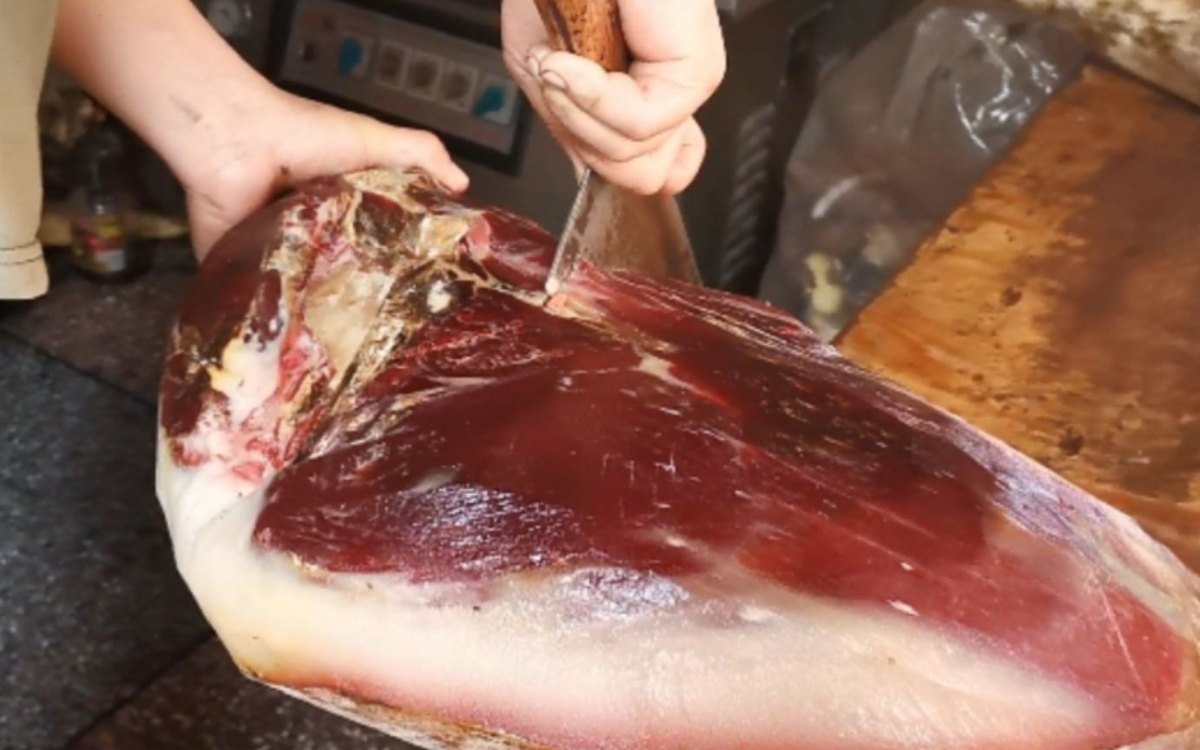
The man in the blue apron finished his row and went to wash his hands. Three years of weather, one bamboo splint, four seconds a leg. I asked what he looks for in the smell. He thought about it, then said the thing every good cook says eventually. “You know it when it's right.” Then he went to lunch.
💬 Comments