Hakka Stuffed Tofu: The Dumpling That Lost Its Dough
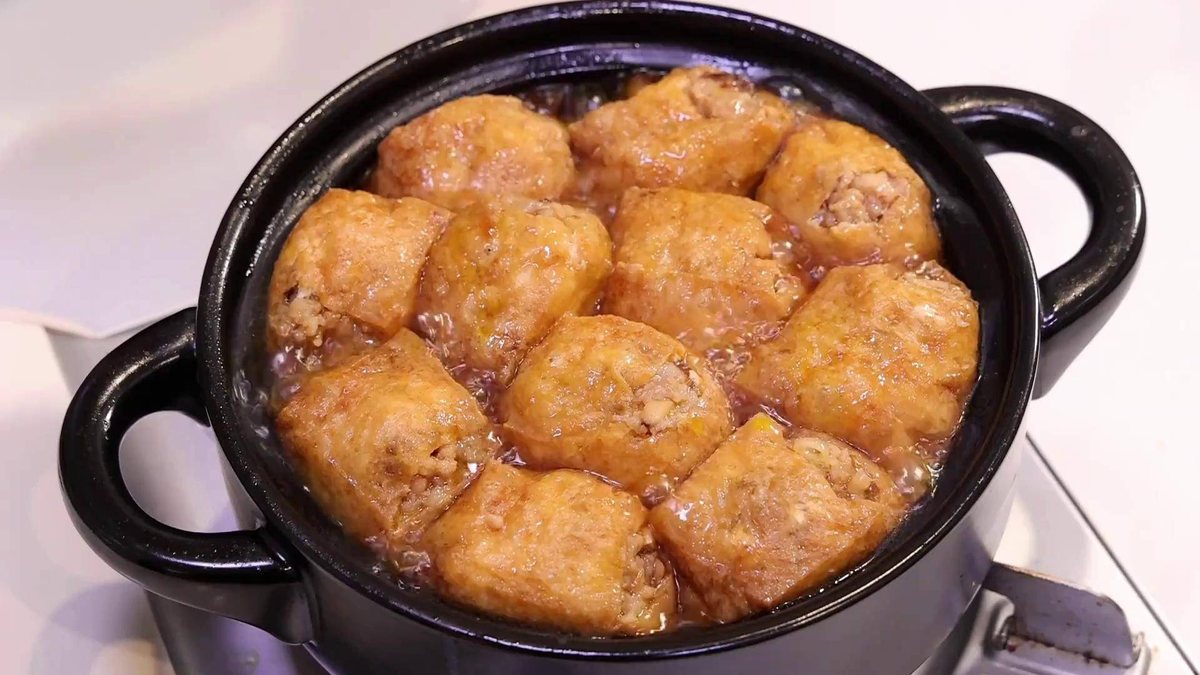
You hear it before you smell it. A wet crackle from the next room, hard and fast, like someone arguing with a small fire — and then the smell arrives: lard, dried fish, scallion, and under all of it the cool green smell of fresh soybean curd. Somebody has just laid a stuffed tofu face-down in a hot pan.
In a Hakka kitchen that sound happens four or five times a week, and it has sounded the same for a very long time.
I went to Meizhou in 2019 to eat this properly. Three days, no plan beyond niang doufu, and by the second afternoon I had eaten nine plates and stopped counting. The one I still think about was not in a restaurant. It was a shop on an old street with four tables, a tiled floor, and a menu that had one item on it. The owner sat by the door with a basin of pork and a tray of tofu and a single chopstick, and she stuffed them one after another while she talked to a neighbour, without looking down. Her hands knew the depth of the pocket. Mine, when I tried later, went straight through the wall.
That is the whole dish: a dumpling with no dough, made by people who could not have dough.
Niang doufu (客家酿豆腐, kèjiā niàng dòufu) belongs to the Hakka (客家人, literally "guest people"), who moved south out of the Central Plains over centuries and kept moving. Wheat does not grow in the wet south. No wheat, no dumpling skins — and for a people who measured the year in dumplings, that was a problem worth solving with whatever the new land had. Tofu was the wrapper. So the filling stayed a dumpling filling, and the argument about whether it tastes right is still a dumpling argument.
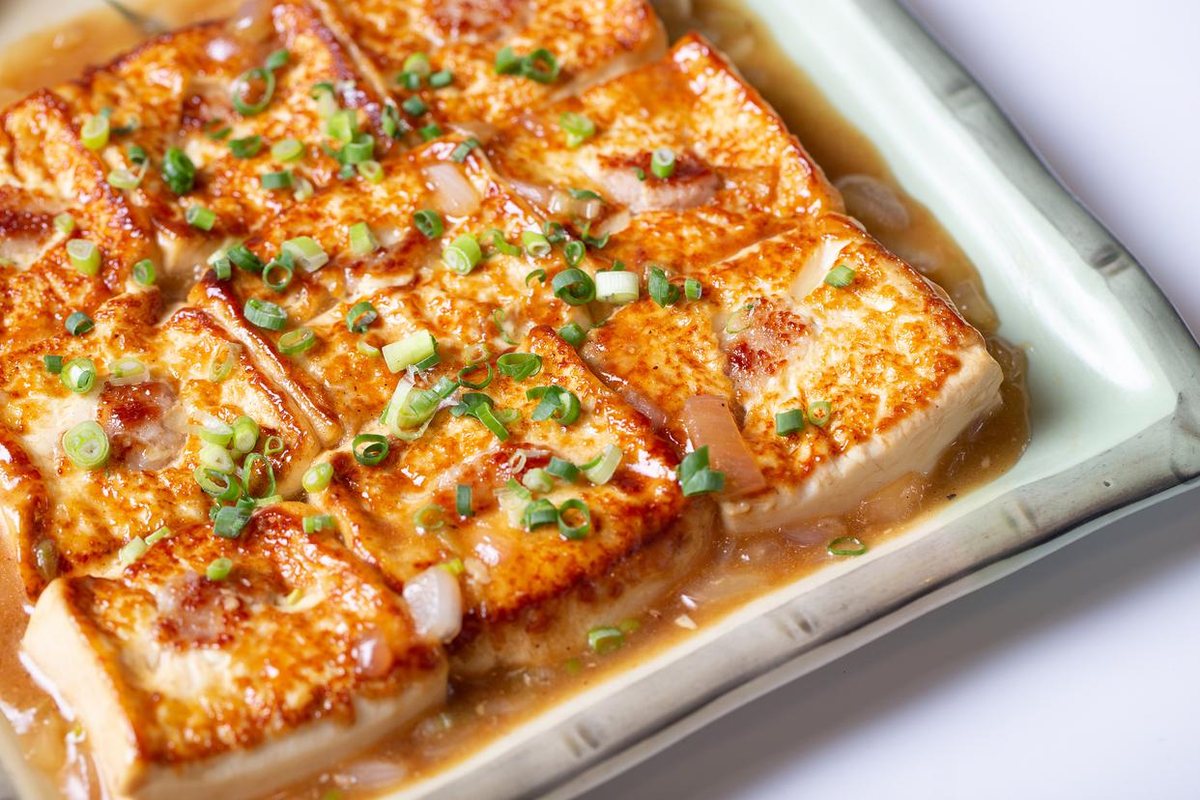
The pocket is the dish
You cannot use silken tofu. You cannot use the firm brick from a Western supermarket either, the one that squeaks. You want the middle: slab tofu set with gypsum, maybe an inch and a half thick, soft enough that a spoon goes through it and firm enough that it holds a shape while you work. Cut it into triangles, or blocks the size of a matchbox, and cut a slit in the broad face — not the edge, the face — then open it with the tip of a chopstick until there is a pocket that will hold a walnut of pork without splitting the wall. Do it a hundred times and your wrist learns the angle. Do it five times and you will be eating broken tofu for dinner.
The other half is the filling, and here the home cooks get religious. Pork shoulder, roughly a third of it fat, chopped by hand. Not minced, not ground, not pulsed in a machine. This is not nostalgia — machine mincing smears the muscle fibres into a paste, and a paste cannot spring. Hand-chopping leaves them in short segments, so the filling gives when you bite and then pushes back. Into it: a scrap of salted fish or dried sole ground to powder, which is the Hakka kitchen's quiet umami trick; a few dried shrimp; shiitake; water chestnut for a clean crunch; ginger water, white pepper, scallion white, a spoon of starch, sesame oil.
Then the part nobody writes down. You stir cold stock into the meat in one direction, a spoonful at a time, until the mass turns pale and tacky and starts to hold its own shape. If it looks like it will stay together, it is too dry. It should look slightly wetter than you trust.
Two houses cook it two ways, and both are right. Meizhou and Xingning sear the stuffed face in lard until it is gold with a few black corners, then stand the pieces up in a clay pot and braise them in stock with salted fish or a handful of soybeans until the curd slumps. Heyuan steams them instead, or slips them into simmering broth; the skin stays white and the soup does the talking. Anyone who tells you the other version is not real has not eaten enough of it.
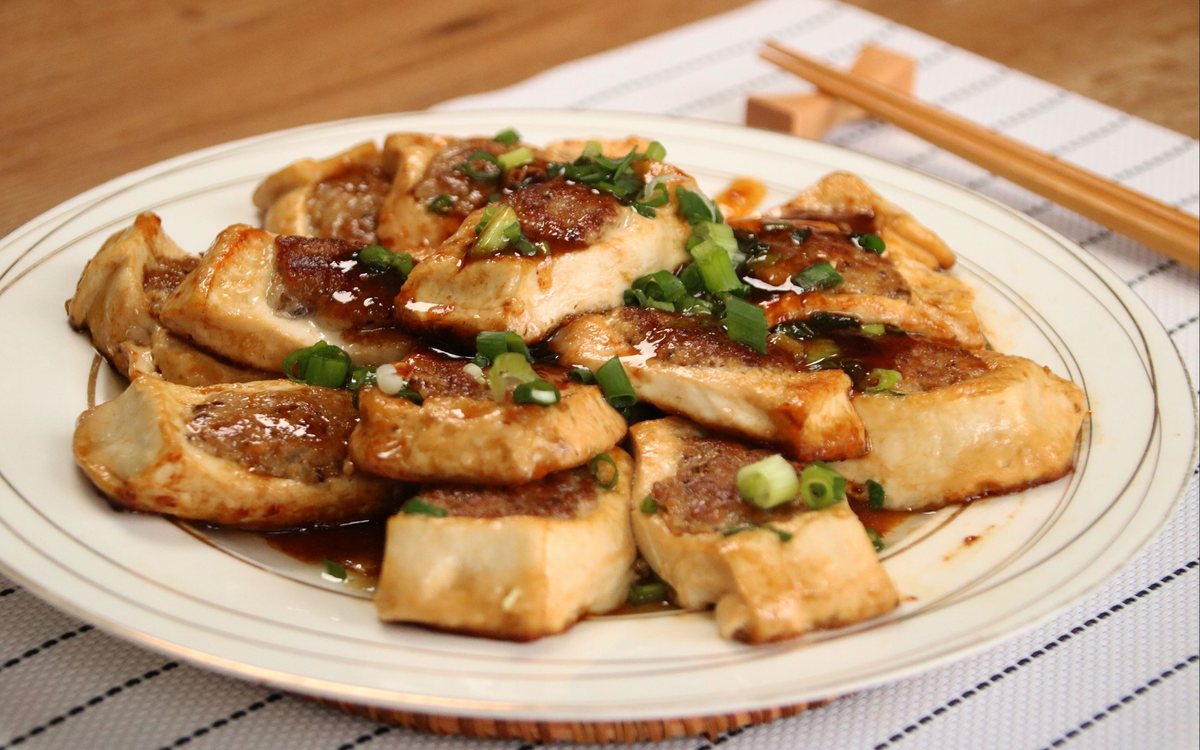
What goes wrong
The frozen supermarket version is the enemy, and it is everywhere. The tofu has been through a freezer, which wrecks its structure into a grey sponge, and the filling is mostly starch with a lot of seasoning standing in for pork. It sits in a sauce the colour and texture of wallpaper paste. If that is your reference point, you have never had this dish.
The banquet version is a different failure. Shrimp, crab, a slick of abalone sauce, a price with three digits — it is a fine plate of food and it is not this. Niang doufu exists because a Hakka family had pork and tofu and not much else. Dressing it up is missing the reason it was invented.
Deep-frying it is a third way to lose: you end up with a meatball inside a sponge, all crust and no custard. And if the gravy coats the back of a spoon like paint, the kitchen is hiding a weak stock behind starch. Send it back, or don't order the second plate.
Rice, chili, and thirty seconds of patience
You eat it with rice. Not noodles, not bread, not a fork — a bowl of plain white rice, and you spoon the braising liquid over it until the rice is glossy and half submerged. In Meizhou the table sauce is 紫金椒酱, a rough chili paste from Zijin county, sharp and salty and slightly fermented; a spoon of it on the side of the plate, not on the tofu, so you can choose per bite.
Then wait. Tofu holds heat like a stone, and the pocket of pork holds more. The first piece out of the pot will take the roof off your mouth. Press it gently with your chopsticks, let the steam out, count to thirty. I burned myself on plate three in Meizhou and did exactly the same thing on plate five, because the smell overrides arithmetic.
What you are chasing is a sequence: the seared face, dark and slightly bitter at the edge; then the curd, which should collapse rather than resist; then the pork, coarse and springy and tasting of dried fish in a way you cannot quite place. Three textures in one mouthful, and the broth tying them together. That is a dumpling, rebuilt out of what the south had.
Doing this at home turns on one thing — cutting the pocket without breaking the wall, and then getting the filling wet enough without letting it go loose. That deserves its own walkthrough. Recipe coming soon.
💬 Comments