Grilled Pig Brain: Custard, If Custard Had a Chili Habit
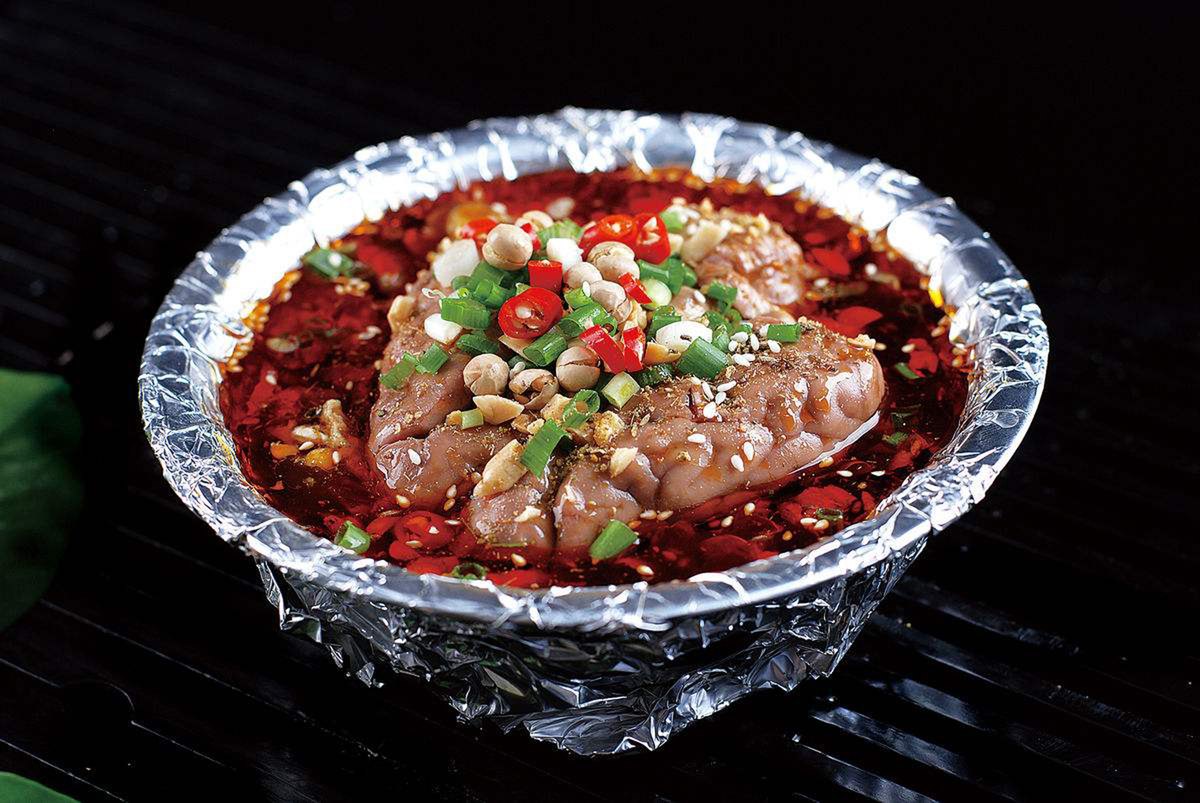
It is twenty past midnight in Jiulongpo and the man at the grill hands me a foil cup so hot I have to juggle it between both hands. Inside is something pale and quivering, half-submerged in red oil. It does not look like dinner. It looks like a biology class that got out of hand.
You have already decided you are not eating this. That is fine. More for me.
I understand. In English the name does all the damage before the food gets a chance: Grilled Pig Brain (烤脑花, kǎo nǎo huā), "brain flower," which is somehow worse than plain "brain." Add a childhood of zombie films and the assumption that offal tastes like hot pennies, and the decision gets made at the menu.
Here is what nobody tells you. Pork brain barely tastes of anything. It is fat and water and a little protein, and it takes the flavor of whatever it cooks in. The reason people in Chongqing argue over the last cup is not the taste of the brain. It is the texture. Cooked right, it is silkier than silken tofu, a custard that holds its shape just long enough for the spoon to reach your mouth and then collapses into something closer to foie gras than to meat. The first time I ate it I stopped mid-sentence and asked what it was. The answer arrived after the second spoon.
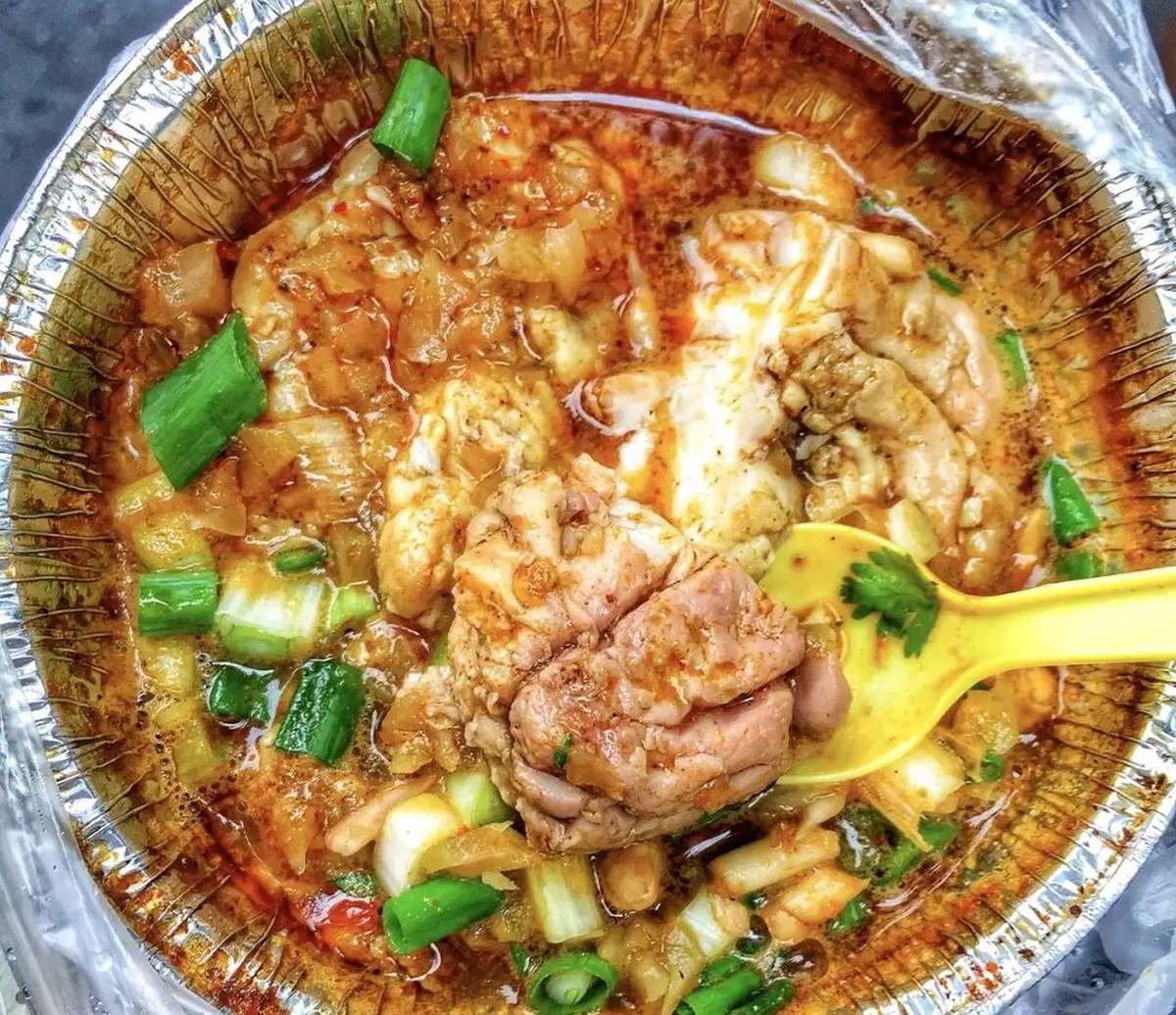
The cup, from the inside
Start with the cleaning, which is the part nobody photographs. The membrane has to come off the brain. It is a fiddly, cold, unglamorous job, and it is the reason 烤脑花 stayed a street food for so long. What is left gets a two-minute blanch in water with ginger and a splash of Shaoxing wine, just enough to firm the surface so it can be lifted without falling apart.
Then the broth, and this is where the dish actually lives. Doubanjiang goes into hot oil until the oil turns the color of a brick. Chili powder, ground Sichuan peppercorn, garlic, a small ladle of stock, chopped zhacai, the pickled mustard tuber that brings salt and a sour little bite. Some cooks add fermented black bean. The brain goes into a foil cup, the broth goes over it, the top gets crimped shut, and the whole thing sits on charcoal for eight to ten minutes.
It comes off puffed at the edges and barely set in the middle, finished at the pass with raw scallion, crushed peanut, another spoon of chili oil and, if the stall is serious, a handful of 折耳根 (zhé'ěrgēn), fish mint, the herb that splits China in half. It tastes green and faintly metallic and slightly of river. It is the thing that keeps the fat from winning.
The history is short. Chongqing, early 1990s: offal was what you ate when money was tight, and a pig's brain was the cheapest thing at the butcher's counter because nobody wanted it. Stall cooks seasoned it the way they seasoned grilled fish, wrapped it in foil because foil was what they had, and the night market finished the job.
How it goes wrong
The first failure is the most common away from Chongqing: it is not brain at all. Some kitchens serve soft tofu in the same foil cup with the same red broth, and at a glance you cannot tell. Spoon into it, though, and tofu gives you a clean, uniform edge. Brain has a faint lace to it, tiny veins, a whisper of iron at the back of the throat. No iron, no brain.
Second failure: the clock. Nine minutes makes custard. Fifteen makes grainy scrambled egg with water pooling around the edges, and nothing at the table fixes that. Nudge the cup. A good one trembles. If it sits there like a hockey puck, it has been on the fire too long.
Third: oil poured over at the end until the cup is a third grease. It should be braised in its liquid, not swimming in it. If your spoon comes up coated, someone is hiding a bad brain behind good chili oil.
Fourth: temperature. Brain fat sets fast. It has to arrive hot enough to make you wait, because at room temperature it turns to glue.
And the quiet one: no 折耳根. Plenty of places leave it off for tourists. Without that green, metallic snap, the whole cup reads as rich and nothing else, which is exactly what people who hate this dish remember about it.
Six spoonfuls
Do not stir it. A cup holds maybe six good spoonfuls, and stirring turns custard into paste. Work from the edge inward and get a little broth and a piece of zhacai in every spoon. Order rice, plain, in a steel bowl, and let the red oil soak in. Order the cheapest cold beer on the list.
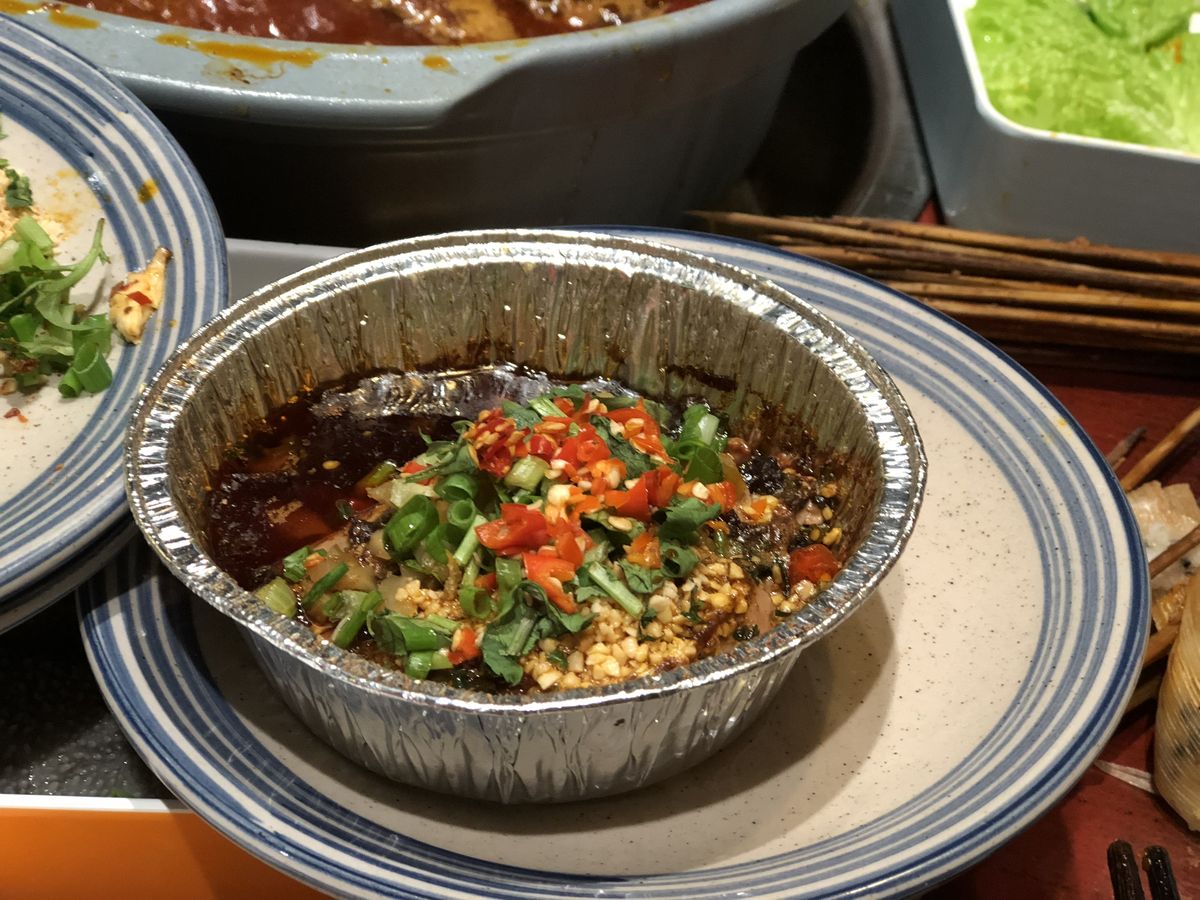
I had my first cup in 2019, on a trip to Chongqing with two friends. One of them grew up there and ordered three without saying what they were. I finished mine in about ninety seconds and asked for another before anyone explained. He laughed and said the Shanghai ones never order it twice. He was wrong about that.
Shanghai barely has this dish. A handful of Chongqing noodle shops will make it if you ask, usually on a gas grill instead of charcoal, and it is fine. Not the same. The charcoal does something, a little smoke works under the crimped foil and lands in the broth, and that is the note I chase every time I order it in a city that is not Chongqing.
So: the pale thing in the foil cup. Custard with a chili habit. Get past the name and you have about six spoonfuls to decide whether all those years of squeamishness were worth it.
Cooking this at home is a different problem. The membrane is the whole game, and a home oven will not give you the smoke. That deserves its own post. Recipe coming soon.
💬 Comments