Ginger Milk Curd: The Dessert You Don't Cook, You Collide
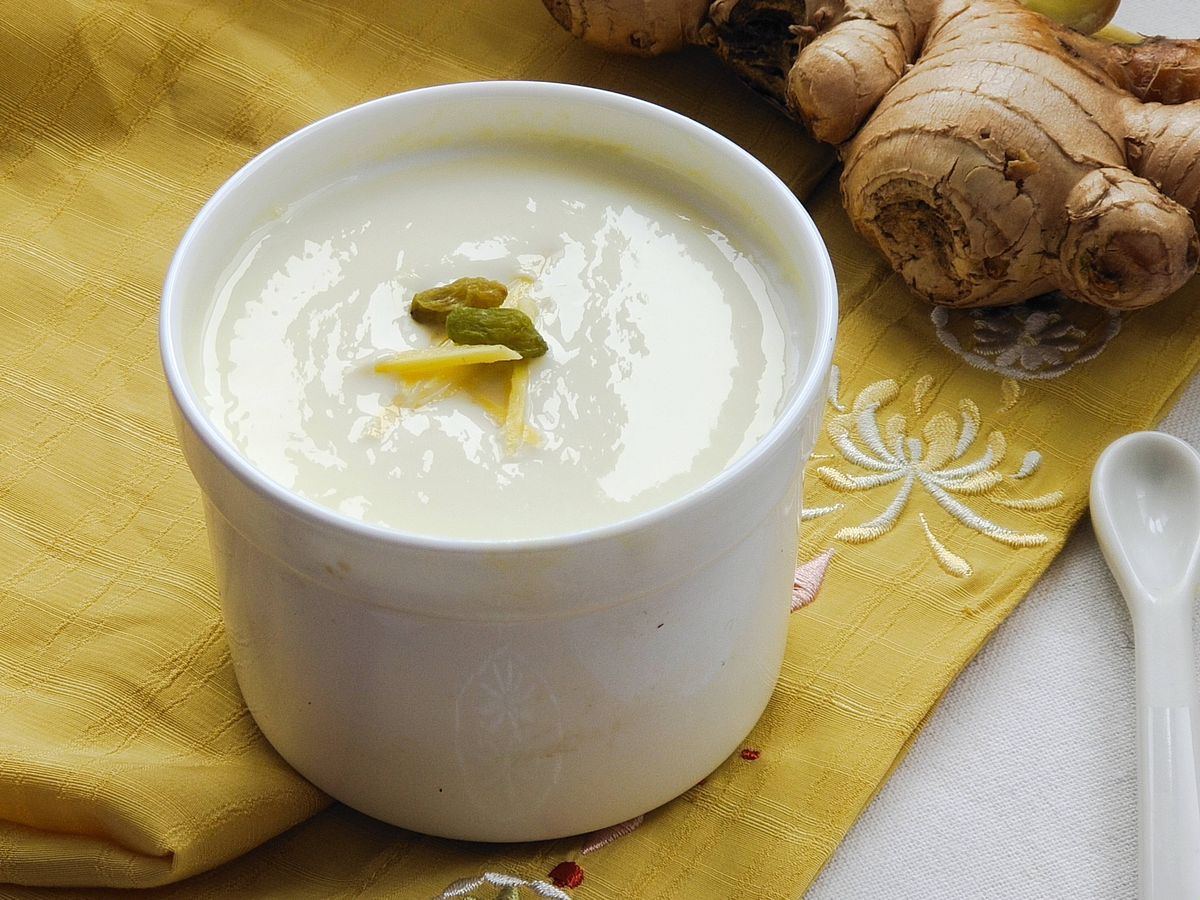
The bowl lands on the melamine table and the surface keeps moving. Not soup-moving. Something tighter. It shivers the way the skin on a pot of cooling milk shivers when you walk past it, and then it stops, and it holds.
You put the spoon in expecting to break through. It doesn't break through. There's a soft wall in there — the resistance of a custard that has only just made up its mind, or a very young tofu. The spoon comes up with a clean white slab balanced on it, and the hole it left behind fills slowly with a thin, cloudy liquid.
The smell gets to you before the spoon does. Fresh ginger, sharp enough to feel like a color, sitting on top of sweet milk. Then you eat it: sweet for a second and a half, then the ginger arrives at the back of your throat and stays there, warm, like a hand on your back.
That's 姜撞奶 (jiāng zhuàng nǎi), ginger milk curd. The name is basically the recipe. Ginger. Collide. Milk.
It sets because of an enzyme, not because of you
There's no gelatin in a proper bowl of this. No rennet, no agar, no cornstarch, nothing from a packet with a cow on it. What sets it is a protease in fresh ginger juice — an enzyme that goes after the casein in milk the same way rennet does in a cheese vat, snipping the proteins in a way that makes them clump and trap the water.
Which means the whole dish is a temperature negotiation. Heat the milk too far and you cook the enzyme dead; it can't curdle anything ever again, and you're left with a bowl of sweet hot milk. Don't heat it enough and the enzyme works too slowly, then not at all. The window is somewhere around 70 to 80°C — hot enough that the bowl is uncomfortable to hold, cool enough that it doesn't steam like a kettle. Old ginger, grated and squeezed, gives you the strongest juice. Young ginger tastes green and does almost nothing.
The verb is the part people skip. 撞 means to bump, to collide. You don't stir the juice into the milk and you don't pour gently down the side of the bowl. You hold the pot a foot above and pour straight down, hard, so the milk hits the ginger juice and folds it up in one motion. It's loud. It splashes. And it does two jobs at once: it mixes the enzyme through evenly without any stirring (stirring would start breaking the curd you're trying to build) and it knocks a few degrees off the milk on the way down.
Then you wait. Five minutes, ten if the room is cold. Nothing visible happens for most of it, and then the surface goes from glossy to matte, and it's done.
Shunde, where the milk is not ordinary milk
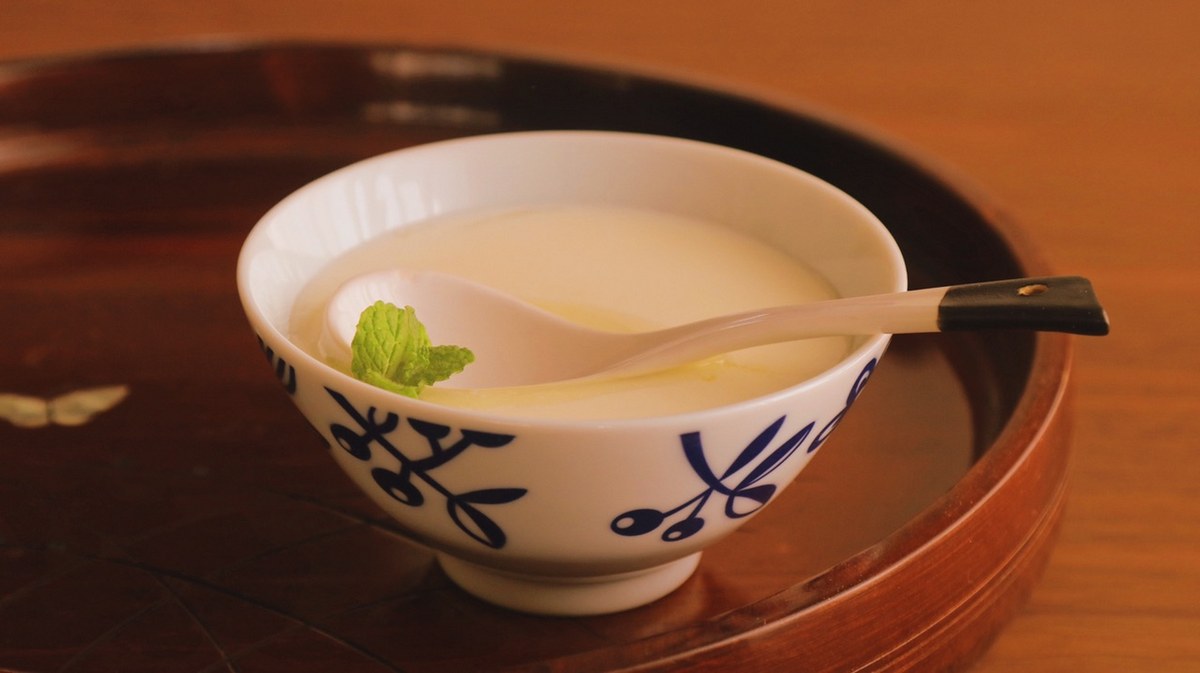
This is a Shunde dish, from the water town south of Guangzhou, and it only really works there because of the buffalo. Shunde keeps water buffalo for milk, and that milk is a different animal from what's in your fridge — around seven or eight percent fat, protein to match, thick enough that a drop of it holds its shape on your finger. That richness is why the curd sets firm enough to hold a spoon without anything added. The story of how it was discovered is a two-sentence kind of story: a farmer's wife in the Qing dynasty poured hot milk into a bowl that happened to have ginger juice in it, to warm her husband's stomach, and it set. Whether or not that happened, the bowl has been on Shunde tables ever since, usually a few doors down from a shop selling its famous cousin, double-skin milk.
What passes for it, and shouldn't
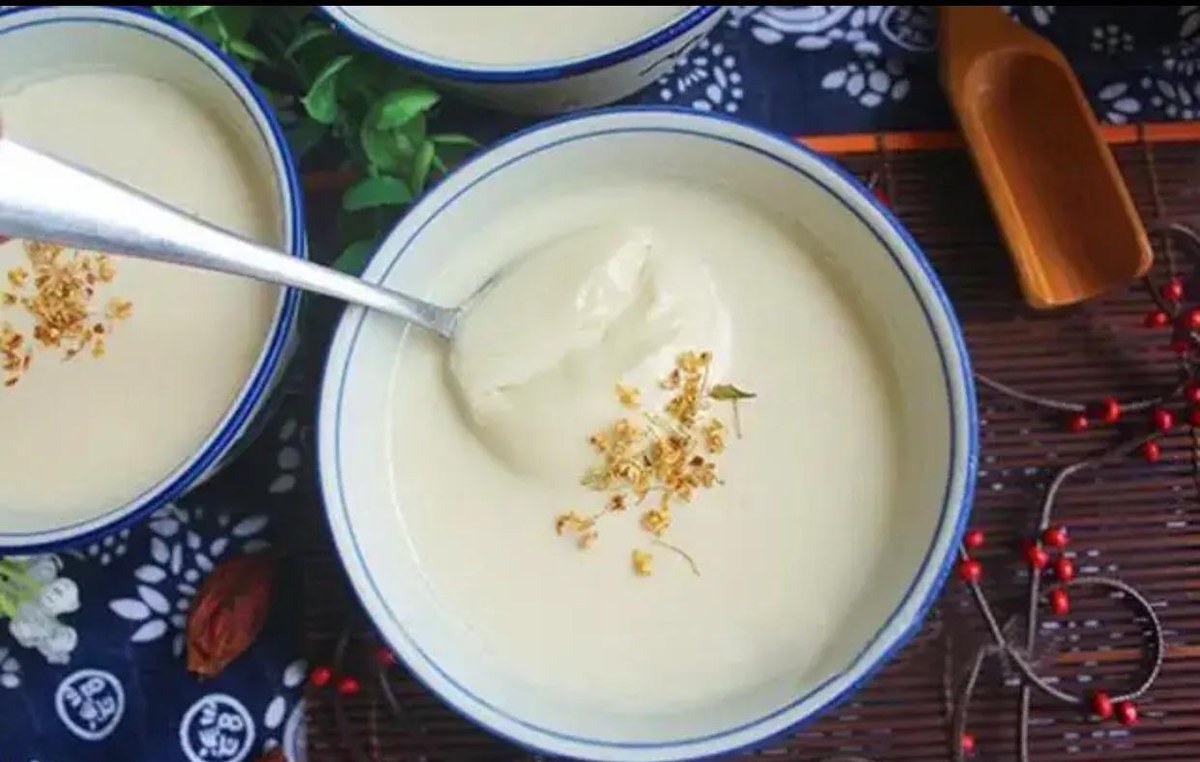
The gelatin version. It slices. You put a spoon in and it comes out with a clean edge, like a panna cotta that has been to a wedding. Real ginger milk curd collapses when you dig into it. If it holds a shape after you cut it, someone helped it.
The ginger powder version. Powder is dried and dead — no active enzyme left. Which means if a shop is using powder, they are setting the bowl with starch or gelatin and using the powder for flavor, and you can taste the difference: the ginger sits on the surface of the milk instead of inside it, and the texture goes gluey at the bottom of the bowl.
The cold version, served in a glass, out of a fridge, next to the mango sago. Ginger milk curd is a hot dessert. It comes to the table at roughly the temperature of a bath you'd get into slowly. Cold, the ginger turns harsh and slightly bitter, the milk tastes thin, and the whole thing reads as a failed panna cotta instead of what it is.
And the too-sweet version. A good bowl is barely sweet — rock sugar, a light hand — because the ginger needs somewhere to land. Oversweeten it and you've made ginger candy with a milk problem.
The spoon test, and three failures of my own
The test at the table is one move: put a spoon in flat and lift. It should come up with curd on it and leave a small pool behind. Then eat from the top and don't stir. Stir it and the gel shears apart, and in about ten seconds you're drinking sweet ginger milk, which is a fine drink and a sad ending to a good bowl.
I tried to make this at home four times before it worked. The first attempt used the milk in my fridge, which was ultra-high-temperature and homogenized, and nothing happened at all — the proteins had already been through too much. The second attempt I heated the milk until it steamed properly, proud of myself, and got sweet ginger milk. The third I underheated it, out of fear, and got sweet ginger milk again, just cooler. The fix was stupidly simple and took a thermometer to find: whole milk that hasn't been UHT-treated, a heavy splash of cream to stand in for the buffalo fat, and the pot pulled off the heat at 75°C, exactly.
What I can't reproduce at home is the room. Ginger milk curd belongs to a fluorescent-lit dessert shop at eleven at night, plastic stools, a laminated menu with forty items, a woman behind the counter who has made this bowl four hundred thousand times and can tell by the sound of the pour whether it's going to set.
Order it in Shunde, order it in Guangzhou, order it in a Hong Kong dessert house at midnight. When it comes, don't talk for a minute. Let it sit in front of you and shiver, and then put the spoon in. If the spoon goes straight to the bottom, send it back and order the double-skin milk instead — at least that one can't pretend.
💬 Comments