Garlic White Pork: Slicing It Thin Enough
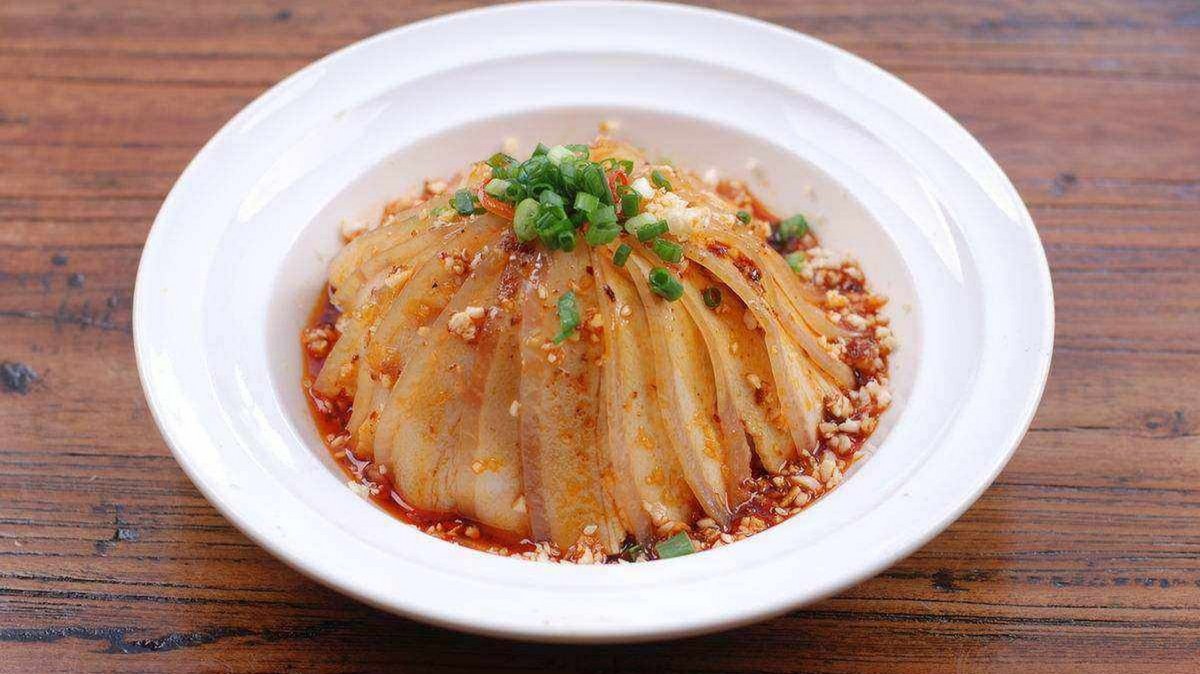
Editor’s Note: This is the kitchen companion to Suan Ni Bai Rou: A Cold Dish That Lives or Dies by the Cleaver. Quantities, temperatures and the failure points are below. Read the technique once before you shop.
Why the Pot Never Comes to a Boil
You are poaching a 700g slab of skin-on belly, and the water should sit between 85°C and 90°C for 35 to 40 minutes: small bubbles form on the bottom and dissolve before they reach the surface. If your pot bubbles like a kettle, it is too hot.
At 100°C the fibres contract hard and fast, wringing water out of the meat. The outside goes chalky while the centre is still pink, and a rolling boil abrades the skin until it splits. Held at 88°C, the collagen wrapping the fibres unwinds into gelatin slowly, over half an hour, and the meat stays plump because it is never hot enough to squeeze itself dry. The centre should read 72°C to 75°C when it comes out.
Bring the water to a bare simmer, add the aromatics, turn the heat off and set the pork in. A covered pot on a domestic hob sits near 88°C for about 12 minutes before it drifts; relight for 90 seconds every 10. I clip a thermometer to the side. Why this matters: 88°C and 96°C give you slices that hold and slices that crumble.
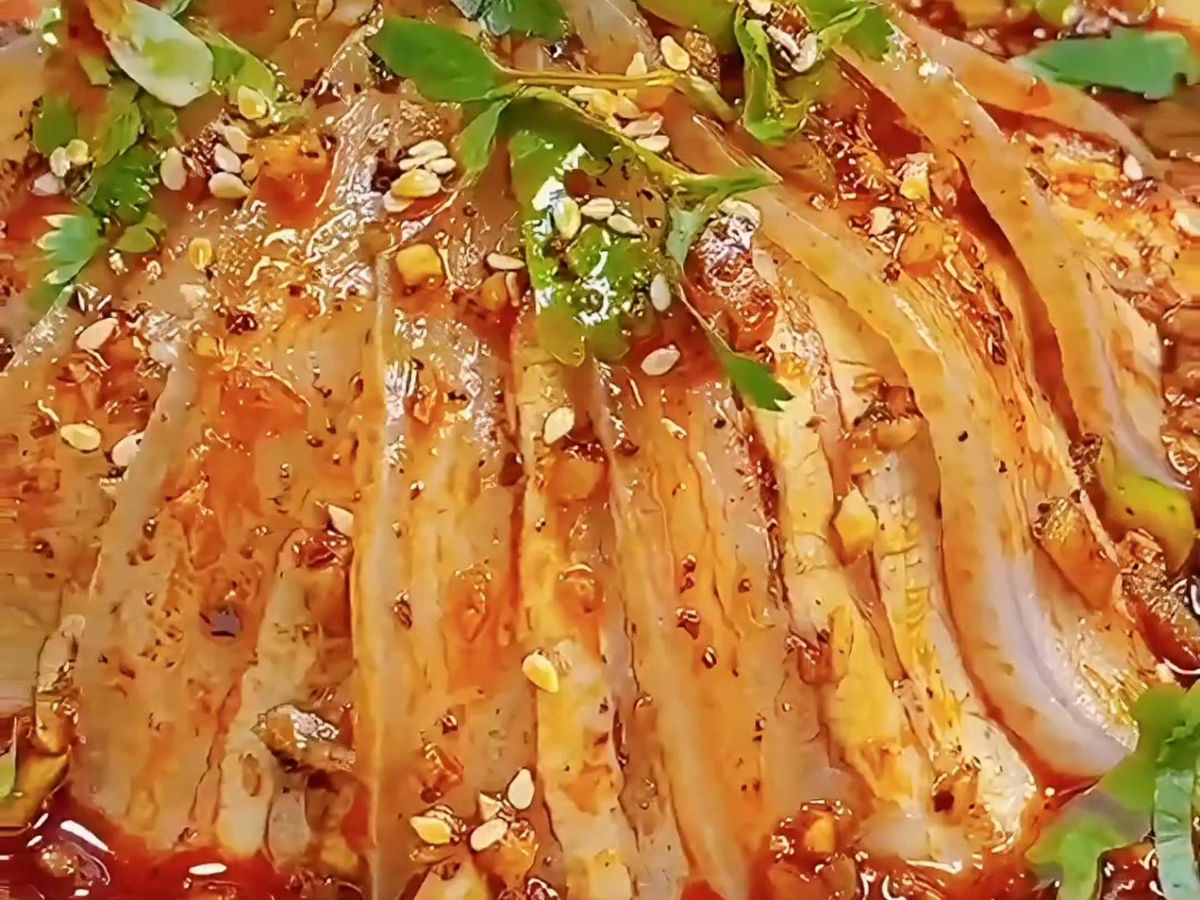
Then the meat has to get cold, and this is the step people skip. Ten minutes in an ice bath stops the cooking and sets the skin; at least an hour in the fridge firms the fat. Warm fat tears. At 30°C it smears under the blade and the slice collapses; at 4°C it is waxy and the blade passes through in one stroke. Cold meat slices thin; warm meat slices thick.
The slice is 2mm and it needs a cleaver, not a chef’s knife. A cleaver is tall enough to cut the full 2mm in one push rather than a saw. Lay the slab skin-side down, put the blade flat so the edge sits 2mm above the board, rest your left palm on the flat, and press down and slightly forward. For the last piece, roll the slab into a cylinder and press again.
The garlic is pounded, not chopped. Six cloves with half a teaspoon of salt, worked for a full minute until smooth and sticky. Chopped garlic leaves chunks that taste raw and sit in the oil like grit; pounding ruptures the cells at once and the salt helps the paste cohere.
The dressing is built around that paste: 2 tbsp garlic paste, 3 tbsp chilli oil with its sediment, 1 tbsp light soy, 1 tsp sugar, 1 tsp aged vinegar, 1 tsp sesame oil. The cucumber ribbons underneath are salted for five minutes and squeezed, so they season the dish without watering the dressing.
Twice-cooked pork uses the same cut, but the meat is sliced thick, returned to a hot wok with chilli bean paste and cooked again. Here nothing is cooked after the poach: cold meat, cold sauce, no wok. The heat comes from the chilli oil, not the pan.
Ingredients
For the pork
- 700g skin-on pork belly, one even slab about 5cm thick
- 4 spring onions (60g), cut into 5cm lengths
- 30g fresh ginger, sliced 3mm thick
- 2 tbsp (30ml) Shaoxing wine
- 1 tsp (3g) Sichuan peppercorns
- 2 tsp (10g) fine salt, for the poaching water
For the garlic dressing
- 6 cloves garlic (24g)
- 1/2 tsp (2.5g) fine salt, for pounding
- 3 tbsp (45ml) chilli oil, with sediment
- 1 tbsp (15ml) light soy sauce
- 1 tsp (4g) caster sugar
- 1 tsp (5ml) aged Chinkiang vinegar
- 1 tsp (5ml) sesame oil
To finish
- 1 cucumber (250g), cut into ribbons
- 1/2 tsp (2.5g) fine salt, for the cucumber
- 1 tsp (3g) toasted sesame seeds
- 2 spring onions (30g), greens sliced thin
Substitution notes: If no slab with the skin on is available, ask the butcher to cut one from the belly rather than buying pre-sliced pork; skinless belly works, but the slices hold together less well and lose the contrast of skin against fat. Chinkiang vinegar can be replaced with rice vinegar at the same volume, with an extra quarter teaspoon of sugar.
Chilli oil varies in heat. If yours is mild, add 1 tsp of chilli flakes and let it sit five minutes; if very hot, cut the oil to 2 tbsp and make up the volume with poaching liquid.
Prep: Twenty Minutes of Hands-On Work, Then Waiting
1. Temper the pork and aromatise the water (20 minutes)
Take the slab out of the fridge 20 minutes ahead, so the centre is not cold when it goes in. Fill a pot wide enough to hold it flat with 2.5 litres of water, add the spring onion, ginger, Shaoxing, peppercorns and 2 tsp of salt, and bring to 90°C.
2. Poach at 85-90°C (35-40 minutes)
Lower the pork in skin-side up so the skin does not sit against the base of the pot. Check every 10 minutes and give 90 seconds of flame if the water drops below 85°C. At 35 minutes, push a chopstick into the thickest part: it should pass the fat with slight resistance and the lean with none. Lift the slab out with two spatulas so it does not bend.
3. Ice bath, then chill (10 minutes plus 60 minutes)
Drop the slab into iced water for 10 minutes to stop the carryover cooking and firm the skin, then wrap loosely and refrigerate for at least an hour, or up to two days. Do not skip the hour even if the edges feel firm; the centre sets more slowly than the surface.
4. Pound the garlic and mix the dressing (6 minutes)
Pound the garlic with the salt for a full minute, scraping down the sides, until there are no visible pieces. Whisk in the chilli oil, soy, sugar, vinegar and sesame oil. Taste: salty first, then hot, then faintly sweet and sour. Cut the cucumber into ribbons, salt for 5 minutes, squeeze dry and lay them in a shallow well on the serving plate.
Step by Step: The Slice and the Plate
Step 1: Square the slab (2 minutes)
Unwrap the chilled pork and trim the ends so you have a neat rectangle with a flat side to sit on. If it is wider than your cleaver is long, cut it in half lengthways so every slice can be made in one stroke.
Step 2: Slice 2mm with the cleaver (8 minutes)
With the blade flat against the meat and your left palm on the flat of the blade, press down and forward in one motion, slide the blade back and reset 2mm lower. Do not saw. Every few slices, turn the slab so the cut face stays square. The slices should be thin enough to read the layers through: skin, fat, lean, fat. Why this matters: at 2mm the fat softens on the tongue before the lean, which is the point of the cut. If one tears, the meat is too warm; return it to the fridge for 10 minutes.
Step 3: Fan the slices (3 minutes)
Lift each slice by the skin edge, let it drape over your fingers and lay it on the cucumber, working around in a circle and overlapping by about half. Build upwards into a low dome. The fanned edges catch the dressing; a flat pile leaves the middle dry.
Step 4: Dress at the table (1 minute)
Spoon the dressing over the dome from the top down, letting it run between the slices, and finish with sesame seeds and scallion greens. Do not toss. Dress no more than 15 minutes before eating; beyond that the salt draws water out of the meat and the plate fills with a pink pool.
Key Pitfalls
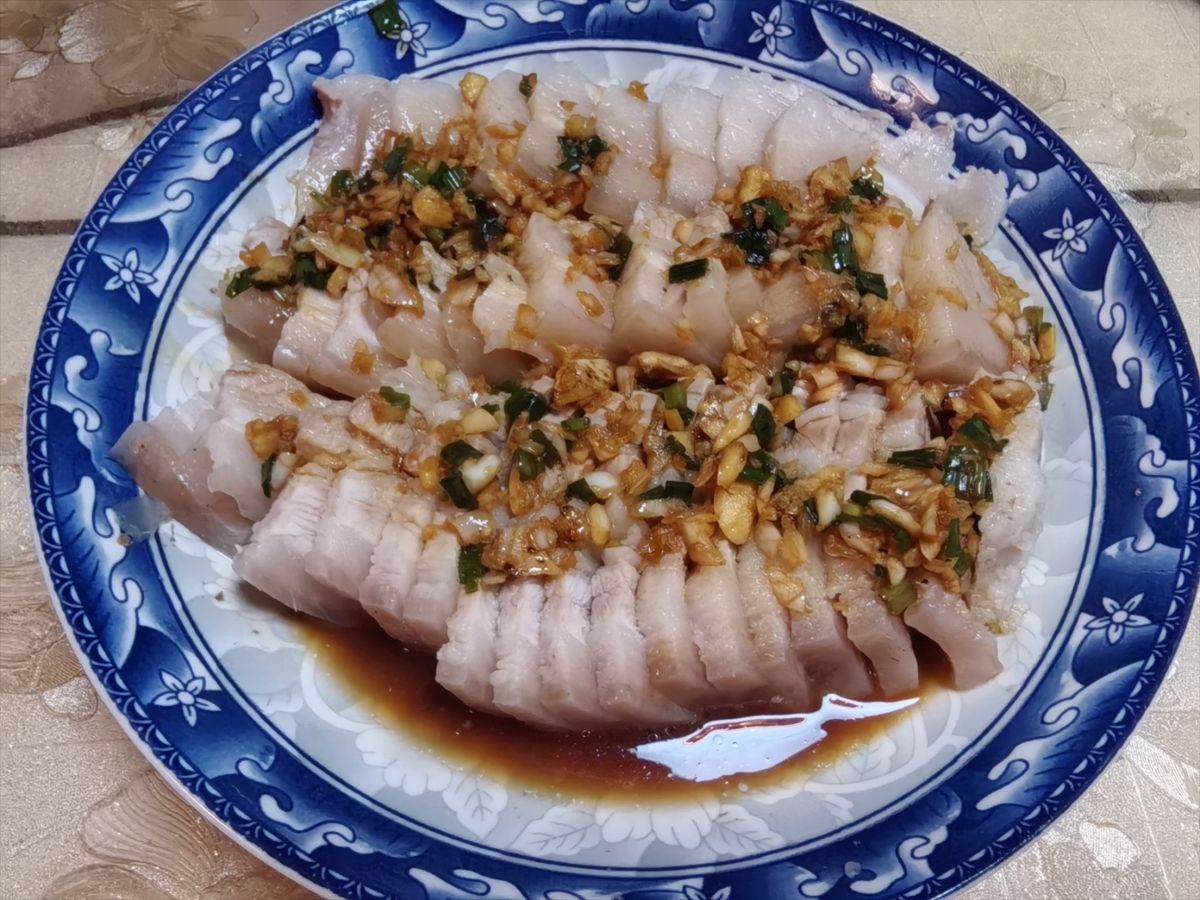
The pork came out dry and stringy. The water boiled. At 100°C the fibres contract and squeeze out their water within minutes. Hold 85-90°C, check with a thermometer, and pull the slab at 72-75°C in the centre.
The slices tore and the fat smeared. The meat was sliced warm, or the hour in the fridge was cut short. Fat has to be firm to cut cleanly. Ice bath for 10 minutes, then 60 minutes at 4°C.
The slices were thick and chewy in the middle. A chef’s knife was used instead of a cleaver, so the cut became a saw. A cleaver cuts the full 2mm in one stroke: blade flat, palm on the blade, press down and forward.
The dressing tasted raw and sharp. The garlic was chopped rather than pounded. Chunks stay sharp and never meld with the oil. Pound it with salt for a full minute, then whisk in the liquids.
The plate was swimming in pink liquid. The cucumber was not salted and squeezed, or the dish was dressed too early. Salt the ribbons 5 minutes, squeeze, and dress within 15 minutes.
The skin split during poaching. The water was boiling and the slab was dropped in from a height. Lower it in skin-side up and keep the water below a simmer.
The dish tasted flat despite plenty of chilli oil. Not enough salt, and no acidity. The poaching water seasons the meat from the inside, and the teaspoon of vinegar lifts the fat. Taste the dressing and adjust in quarter-teaspoon steps.
Serving Suggestions
Serve it as the cold dish at the start of a Sichuan meal, or as one of three with rice. Because belly is rich, three or four slices per person is a portion, and the cucumber underneath is what makes the richness readable.
The poached slab can be cooked two days ahead and kept wrapped in the coldest part of the fridge; slice and dress at the last minute. Leftover slices do not improve, but the pork can go into a soup or fried rice. Drink a light tea or a dry riesling, since the chilli oil coats the mouth.
This is the companion recipe to Suan Ni Bai Rou: A Cold Dish That Lives or Dies by the Cleaver. Read the story, then cook the dish.
💬 Comments