Dragon's Beard Candy: A Sweet With a Four-Minute Shelf Life
The stall is a folding table, a gas burner, a slab of marble, and a plastic tub of pale flour. The man behind it takes a lump of amber sugar the size of a fist, flattens it with his palm, pokes two fingers through the middle, and stretches it into a ring. Then he starts. Down into the flour, up, twisted into a figure eight, folded, pulled. Down, up, twist, fold, pull. His arms open to shoulder width, then wider, and the ring gets thinner without ever quite breaking.
Eight minutes later he is holding a bundle of white filaments so fine you can see the light through them, webbed together like something a spider gave up on. This is 龙须糖 (lóng xū táng), dragon's beard candy. Of all the sweets in China it is the one least defined by its recipe and most defined by its deadline.
I first watched it made on Qibao Old Street, the tourist lane south of Shanghai where the snack stalls start at the bridge and do not stop. I was nine. My grandmother bought me a paper tray for two yuan. I ate the first piece standing at the table, then carried the tray in both hands for the rest of the walk because I did not want it in a bag where it would get crushed. By the time we reached the car it had begun to slump at the corners. I remember feeling that I had done something wrong. I hadn't. That is simply what the candy does.
What his hands are doing
The sugar is maltose, softened with white sugar and cooked until it hits hard crack, then poured onto the slab and turned while it cools. The window he waits for is narrow: cool enough to handle, warm enough to move. Too early and it welds itself to his fingers. Too late and the first pull snaps it into shards. He tests it with the back of his hand, the way a baker tests a proof.
Then the doubling. Fold, twist, pull; every cycle doubles the number of strands running through the bundle. Fourteen cycles is 16,384 threads, which is the number vendors say out loud, and nobody has ever counted. What matters is the last four cycles, when the sugar stops behaving like candy and starts behaving like cloth. It goes white. It goes soft and almost weightless in the hand. The strands end up finer than the hair on your forearm, and the bundle stops looking like food and starts looking like something you'd use to dress a wound.
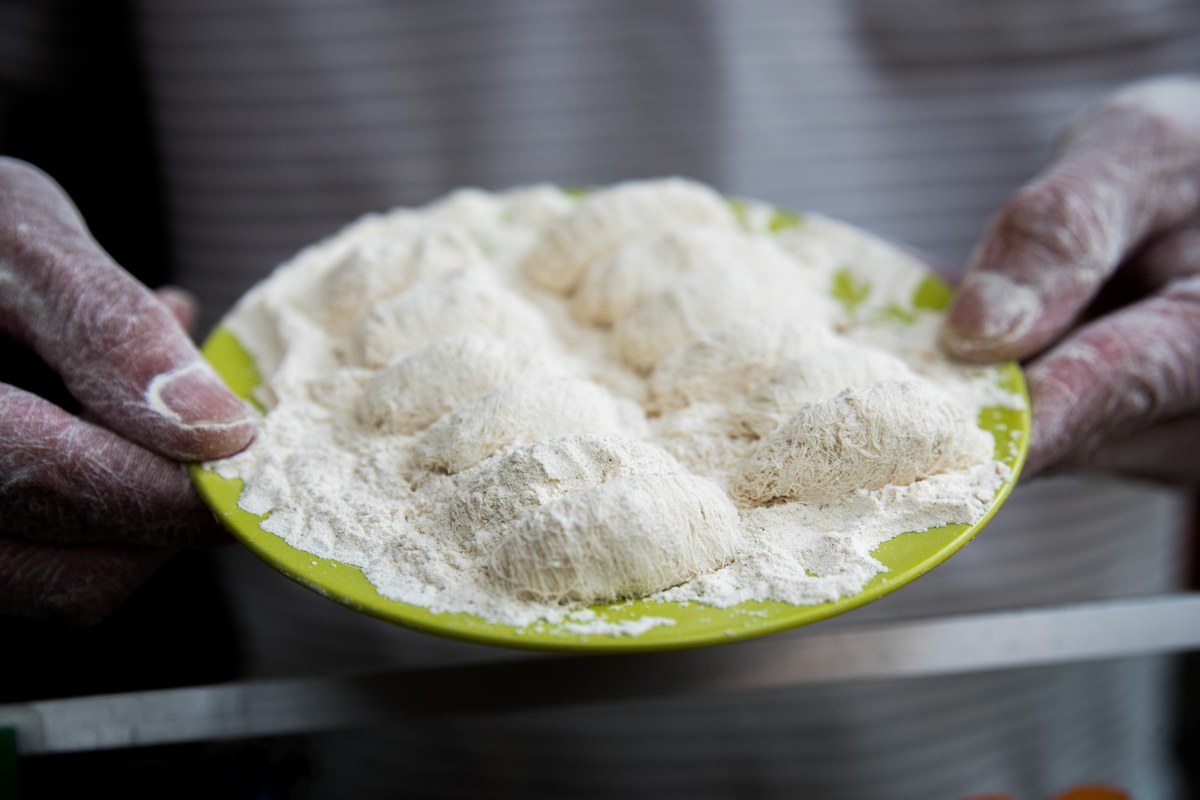
The flour is not decoration. It is roasted glutinous rice flour, dry and faintly nutty, and it is the only thing standing between sixteen thousand strands and one solid block. Every time the sugar comes down it picks up a film of it. Skip a dip and the bundle fuses; overdo it and you are eating chalk. His table looks like a bakery exploded because the margin is that thin.
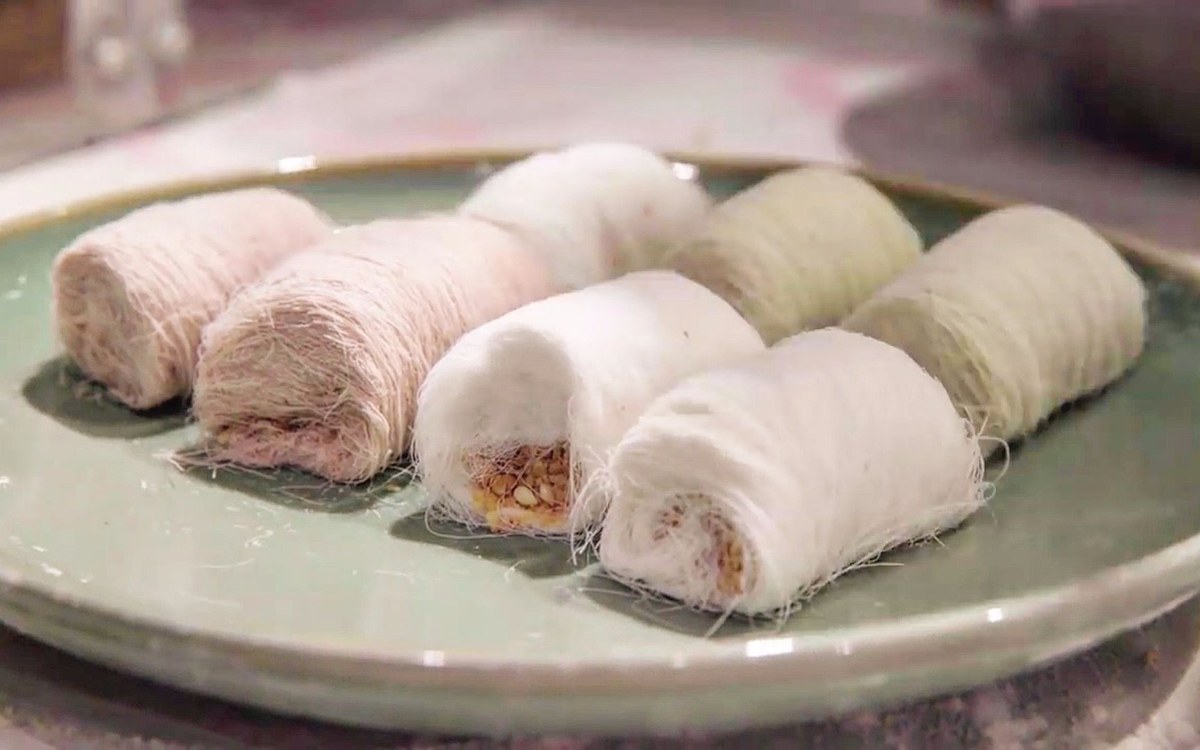
Then the filling: crushed peanut, sesame, sugar, sometimes coconut. He lays the stretched bundle flat, runs a dark line down the middle, and closes it into a long white rope. A few fast pinches and it becomes a row of short pieces, each one a puff of threads around a core of nuts. From the last pull to the tray is under two minutes.
A shelf life measured in minutes
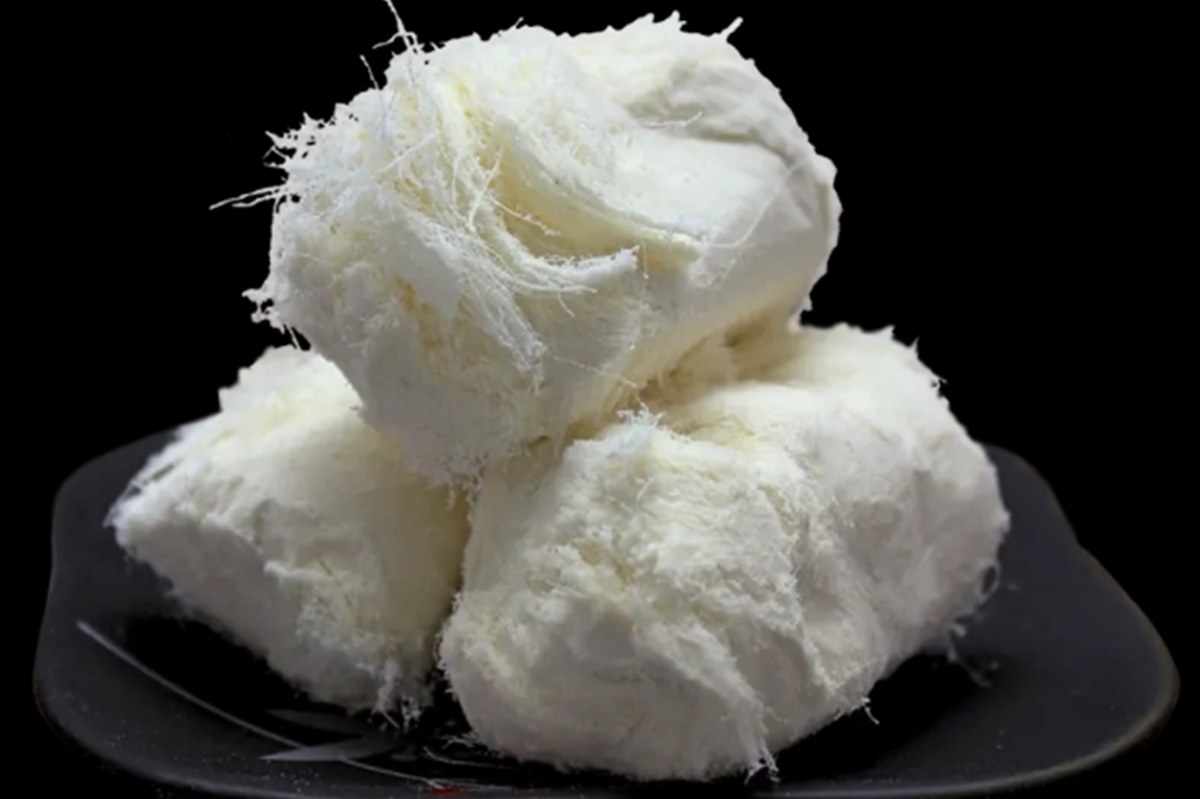
Sugar is hygroscopic. It pulls water out of the air, and this candy has almost no mass to hold its own structure. In dry Beijing winter air, standing outside, you might get twenty minutes before the surface goes tacky. In a Shanghai summer at a street stall, you get four. After that the bundle sags, the threads weld where they touch, and what is in your hand is a chewy lump of sugar with a soft middle. Still sweet. Nothing to do with what it was.
The history is short and mostly unverifiable. A Qing court pastry cook, an emperor, a beard the candy was said to resemble. That is the story, and it holds together about as well as the candy does. What is certain is that the technique left the palace a long time ago and now lives on folding tables, passed from one pair of hands to another. Anhui has a cousin called 龙须酥 (lóng xū sū) that looks similar, is pressed into dense blocks, and keeps for a month. Fine sweet. Different sweet.
Three ways to spot a fraud
Look at the strands first. Real ones are uneven, some thick, some nearly invisible, because hands are not a machine. Hair-straight uniform strands came off a die. Second, the packaging: if it is sealed in plastic film with a printed expiry date, it was never alive. A real vendor hands you an open paper tray and tells you to eat it now. Third, bite one. Good dragon's beard collapses against the roof of your mouth and is gone. A bad one fights back, like chewing a ball of yarn.
Eat it standing up
Do not bite down. Tip your head back, set the piece on your tongue, and let it sit. It collapses on its own in about two seconds, and the filling arrives after. Sugar first, nuts second, nothing to chew. Bite it and you will inhale; you will spend the next minute coughing powdered sugar and the rest of the day wearing it. I know this from Qibao, and from every visit since, because I am not a fast learner.
If you cannot eat it at the stall, keep the tray flat and open, stack nothing on it, put it in no bag, and do not walk more than a block. The vendor will tell you all of this. He is not being modest about his own product. He is telling you what it is.
What stays with me is not the candy but the eight minutes before it: a man at a folding table doing the same four motions a few hundred times an evening, and the fact that no machine has improved on him. A machine would have to be as slow and as uneven as a person to make this. The candy is a four-minute argument for that, and then it is gone.
💬 Comments