Shanxi Sliced Noodles: The Knife Never Touches the Board
You hear the shop before you see it. Not the shouting, not the ladle ringing the pot — a knock, wooden and steady, about three times a second. Then you reach the doorway and the sound has a source: a man with his left arm bent over a pot of boiling water, a wedge of dough balanced on a board in that hand, and a thin curved blade in his right, working the top face of the dough. Every slice leaves the blade as a leaf — fat through the middle, tapered at both ends, about the size of your thumb joint. It turns once in the air, drops into the steam, and is gone. He doesn’t watch it land. He is already taking the next one.
That is Shanxi sliced noodles — 刀削面 (dāoxiāomiàn), knife-shaved noodles, and the shaving is not decoration on the idea. It is the idea. Nothing in the process touches a board.
The first one I ever watched worked out of a shop the size of a bus shelter on a lane behind the Fudan campus. I was nineteen, newly arrived from the other side of the city, and I ate there often enough that the man stopped asking what I wanted. He never gave me his name. The regulars called him 师傅 — shīfu, master. He owned one knife: a rectangle of steel with a curl worked into it, ground so thin that light came through the last centimetre. He took a bowl from dough to pot in about forty seconds, and he did it while arguing with the woman at the register.
The dough is where the argument is. 刀削面 dough is stiffer than any other noodle dough in China — roughly one part cold salted water to two and a half parts flour, kneaded and folded until it is smooth and slightly glossy, rested barely at all. Slack dough is a disaster here. Press a blade into it and it smears and tears instead of leaving in a clean curl. Hard dough fights your hands for ten minutes and then behaves.
Watch him work and you notice what is missing. No rolling pin, no cutting mat, no floured board, no machine. He holds the wedge out over the water at arm’s length, which is a strange posture to keep for a ten-hour shift, and shaves the top face at a shallow angle, flicking each noodle free with his thumb. There are rolling pins somewhere in that kitchen, I am sure. They have nothing to do with what you are eating.
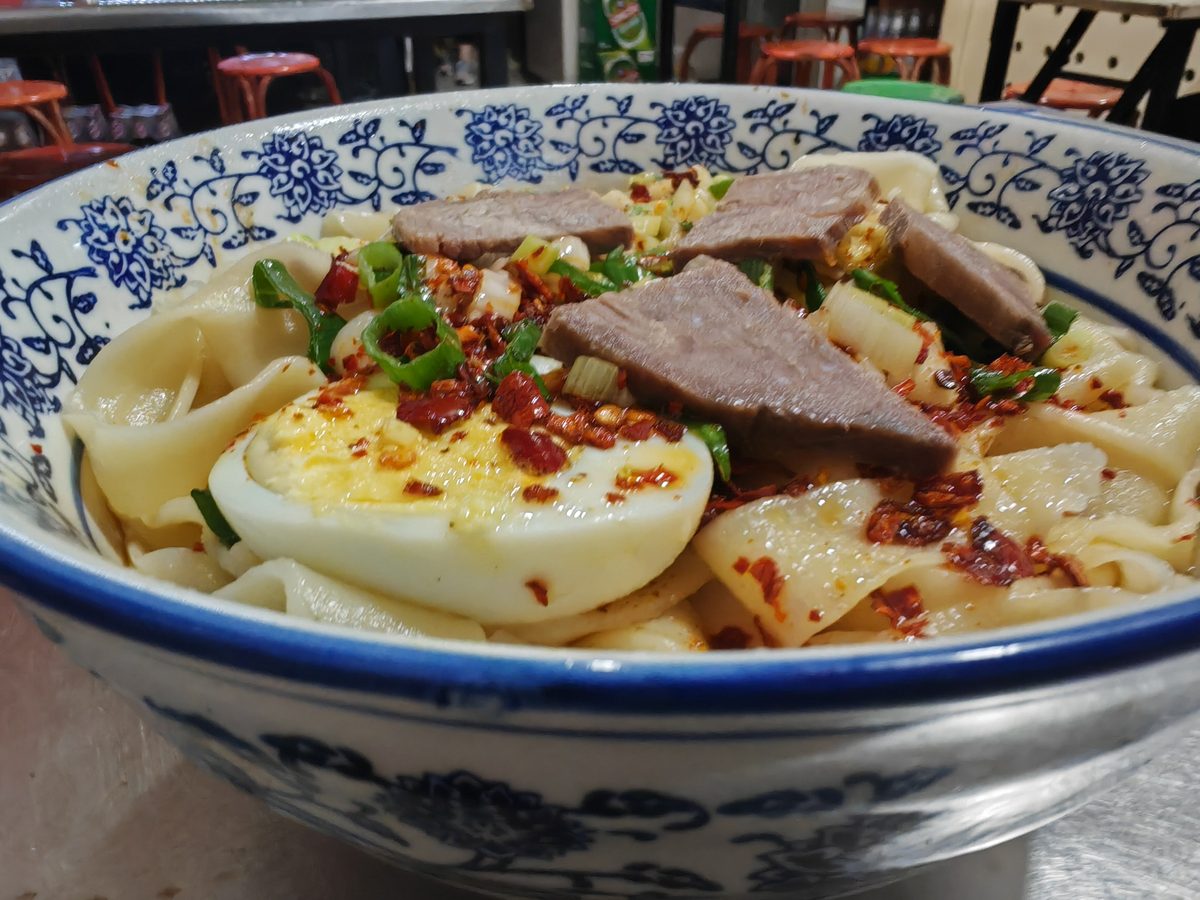
The shape is the point, and it is why a proper bowl has two textures in one bite. Each piece carries a thin edge and a plump middle. The middle is where the chew lives, dense and springy, the kind that pushes back at your teeth; the edges are where the braise hangs. A hand shave gives you both at once. I have never met a machine that does.
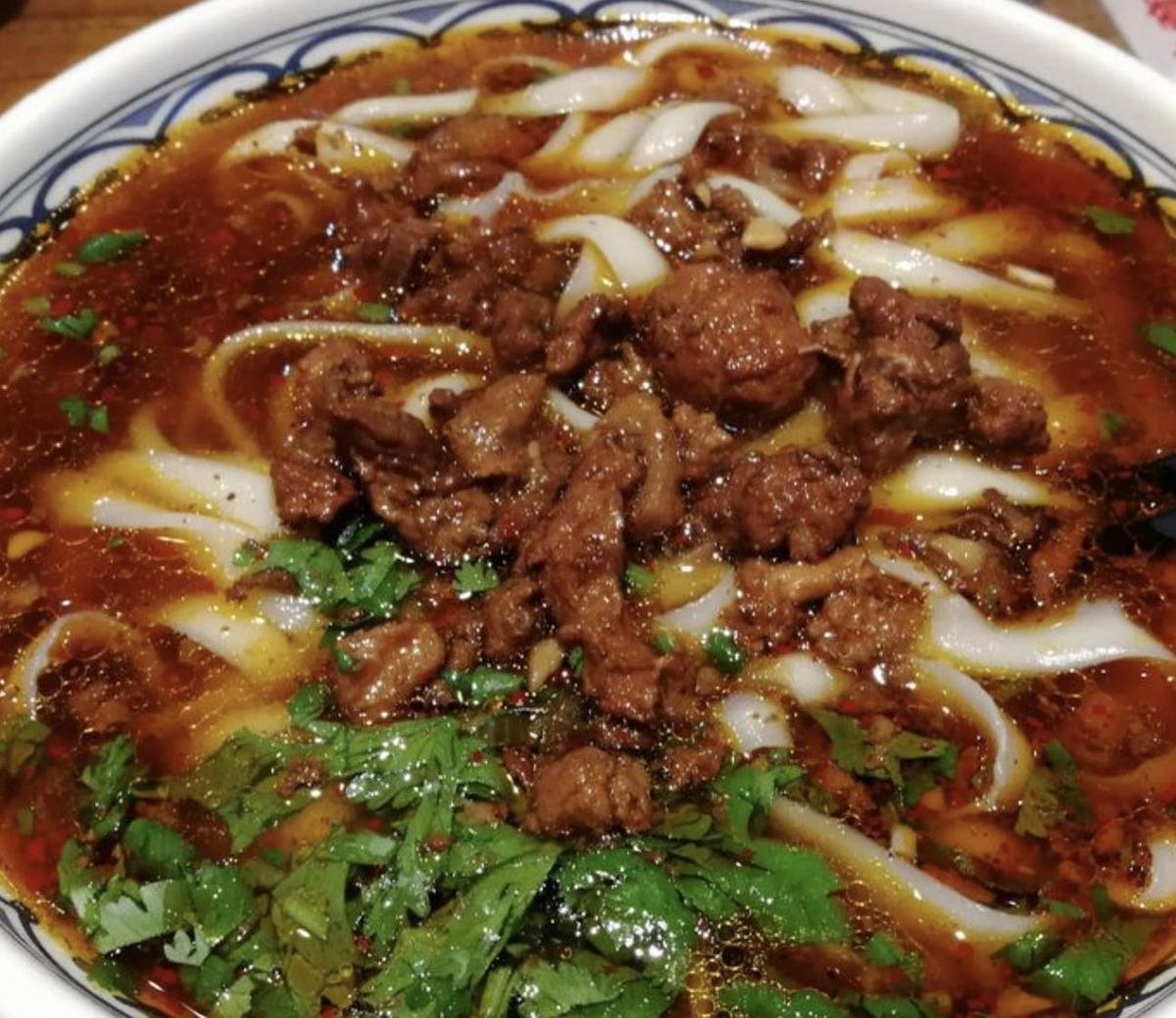
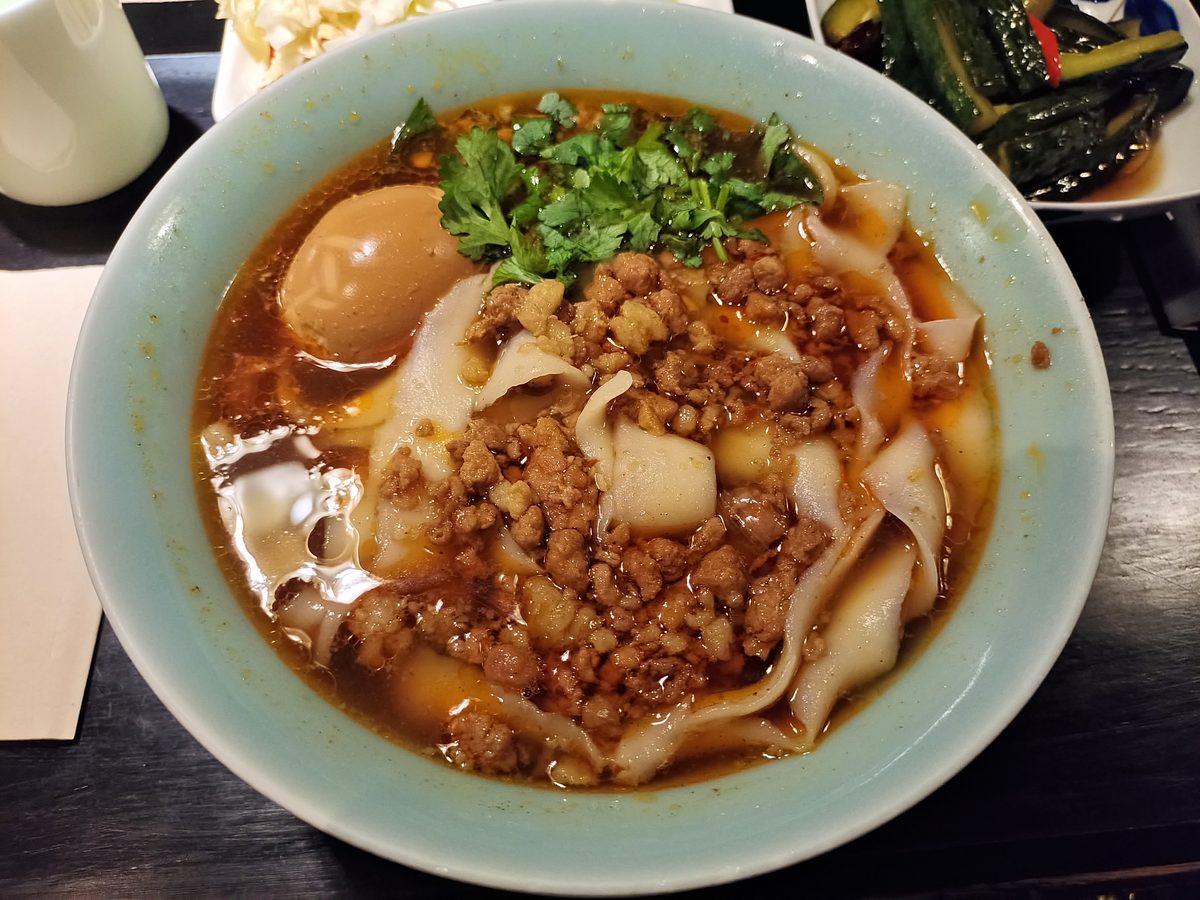
The topping is a separate decision. In most Shanxi shops you pick a 浇头 (jiāotóu), a spoonful of something cooked down and ladled over the top: pork and mushroom, tomato and egg, a dark braise of beef, sometimes nothing but scallion oil. It lands on the noodles, not under them.
Which brings me to the bad versions, because there are many and they are easy to spot. If the noodles come out of a warmer, pre-shaved and dusted with flour in a tray, you are too late — 刀削面 goes from blade to boiling water and it does not wait anywhere in between. If the pieces are the same thickness end to end, neat uniform trapezoids, nobody shaved anything; a machine with a marketing budget did. If the braise tastes sweet, that is a Cantonese hand on a Shanxi dish. If the bowl is a thin brown ocean with a skimming of topping, it is soup with noodles in it, which is not what you ordered. And if there is no bottle of Shanxi aged vinegar on the table — 老陈醋 (lǎochéncù), almost black, almost syrupy — get up and leave.
Shanxi is China’s noodle province, and this is the noodle that left home. The province counts hundreds of named shapes, each one a specific movement of the hand, and 刀削面 is the most photogenic of them, which is why it ended up on signs from Harbin to Singapore. Datong, up in the north, claims it. There is a story about a Mongol-era ban on household knives that supposedly left people shaving dough with a scrap of iron. Good story. Nobody can date it, and the noodle does not need it.
Eat it like this. Order the bowl with the braise, not the plain soup. Stand where you can see the pot, because it is thirty seconds of the best free entertainment in the building. Vinegar first, a full spoon of it, then chilli oil, then stir from the bottom up, because the braise sulks down there. Finish inside five minutes — the noodles keep drinking, and by minute ten you are no longer eating a dish, you are eating paste. If there is a bowl of raw garlic on the counter, take a clove. One bowl, not two.
Years later, after I had become a regular with a job and a laptop and no time to sit, the shīfu behind the Fudan shop put his blade in my hand. It weighed almost nothing. The steel had worn into a thumb groove, and the edge, where his fingers had guided it for years, had gone from straight to a shallow curve. He took it back without a word and started again. Three knocks a second. I finished the bowl and went back to work.
Doing this at home is a different fight, and it is not the blade. It is the dough: it has to be much stiffer than your hands expect, and you have to knead it longer than you want to. Get that wrong and no knife on earth saves the bowl. Recipe coming soon.
💬 Comments