Dan Dan Noodles: The Street Snack That Outran Its Own City
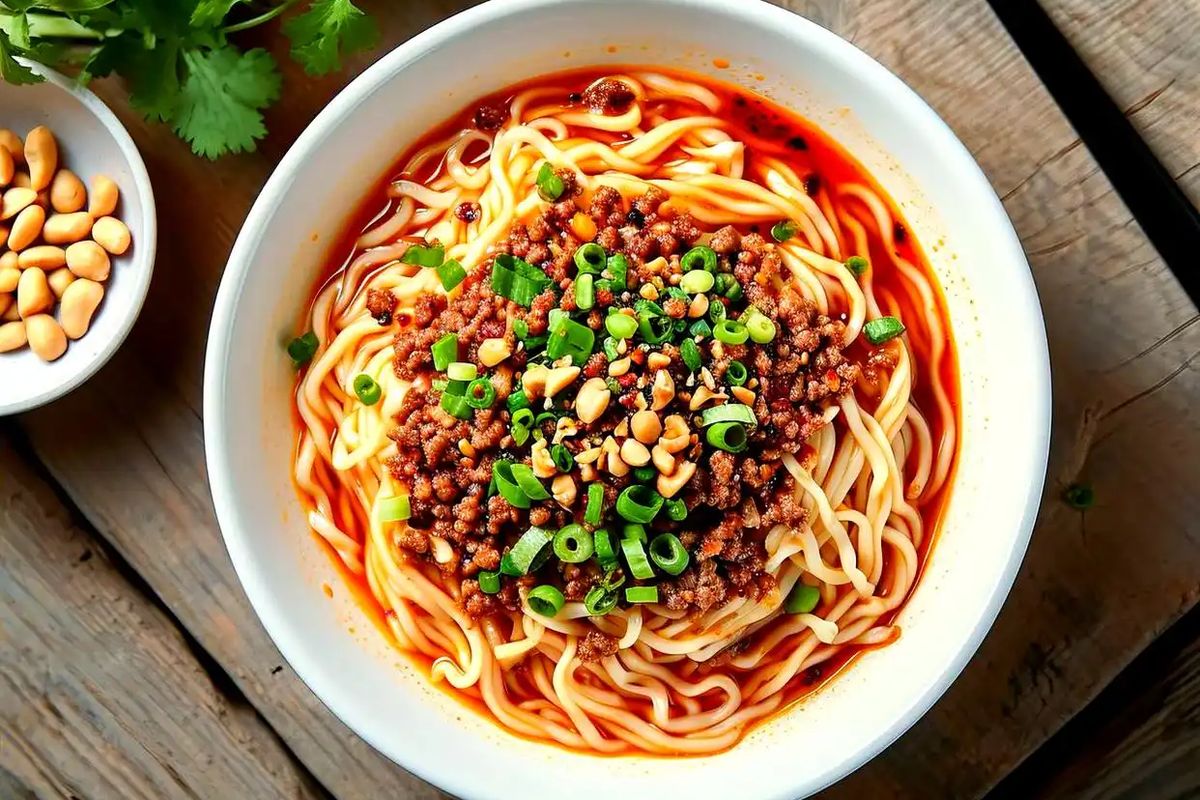
It’s 11pm in Chengdu and the alley is mostly dark except for one cart with a single bulb swinging from a wire. The cart has two cabinets — one holds a charcoal stove, the other stacks of blue-rimmed bowls. The man behind it scoops a spoonful of sesame paste into a bowl, then chili oil the color of brake lights, then a splash of black vinegar. The smell hits you ten feet out: roasted huājiāo sizzling in rendered pork fat, fermented yácài releasing its funky-sweet depth, garlic crushed rough and still raw.
By the time you sit down on a plastic stool the size of a dinner plate, the noodles are already in the pot. They take forty-five seconds. You watch him shake the water off in three sharp flicks, drop them into the bowl, spoon a rubble of fried minced pork on top, and push it toward you without ceremony.
Mix everything from the bottom. Do it now, before the noodles drink the sauce dry. This is Dan Dan Noodles (担担面, dàndàn miàn). It costs about nine yuan. It will ruin every other noodle dish you eat this week.
The Architecture of a Bite
I spent thirteen years in software — Microsoft, Google, NVIDIA — debugging systems where a single broken dependency could cascade into catastrophic failure. Dan Dan Noodles operates on the same principle. Five components. None optional. If one isn’t right, the whole bowl collapses into sadness.
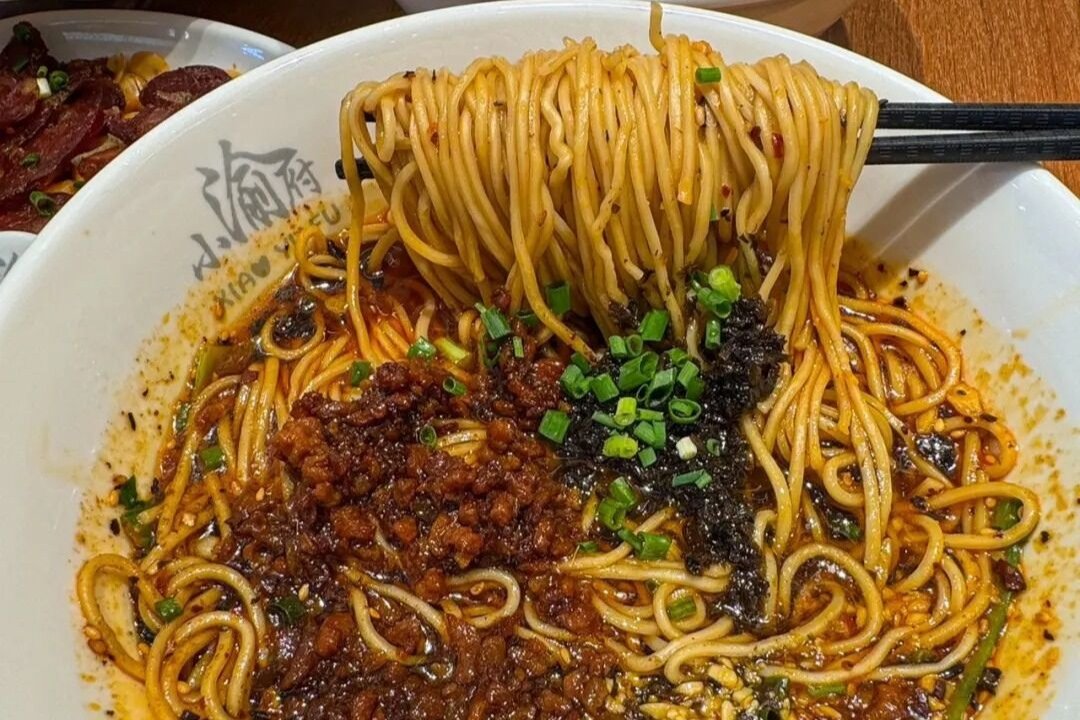
You lift a tangle of noodles with your chopsticks. These are alkaline wheat noodles — jiǎn shuǐ miàn (碱水面) — thin as angel hair but with backbone, the kind that resist going soft. The sauce clings to every strand like wet paint. First thing your tongue registers: sesame. Real Chinese sesame paste (芝麻酱, zhīma jiàng), dark and bitter-edged, not the pale sweet stuff from the Middle Eastern aisle. It coats your mouth in a blanket of nutty fat, and just when you start to think this might be a gentle dish, the chili oil arrives.
This isn’t a slow-building heat. This is Sichuan chili oil (红油, hóng yóu) made from èr jīng tiáo chilies (二荆条) — the long, wrinkled ones dried and then infused into caiziyou rapeseed oil at exactly 140°C until the oil turns crimson and smells like toasted leather. The heat lands mid-palate and stays there, a steady throb.
Then the Sichuan peppercorns (花椒, huājiāo) kick in. Your lips go electric. Your tongue vibrates at maybe 50 hertz. You reach for the next bite before you’ve finished swallowing because the numbness is not a finish line — it’s a starting gun.
The pork hits next. Minced belly, fried dry in a wok until every granule is a crisp, concentrated flavor node. And underneath everything: yácài (芽菜), fermented mustard greens from Yibin, chopped fine, carrying a funky, faintly sweet umami that you can’t place unless someone tells you.
A good bowl of Dan Dan Noodles doesn’t have soup. It’s a sauce delivery system. You mix from the bottom, you eat fast, you don’t pause to check your phone.
The Man Who Carried a Kitchen
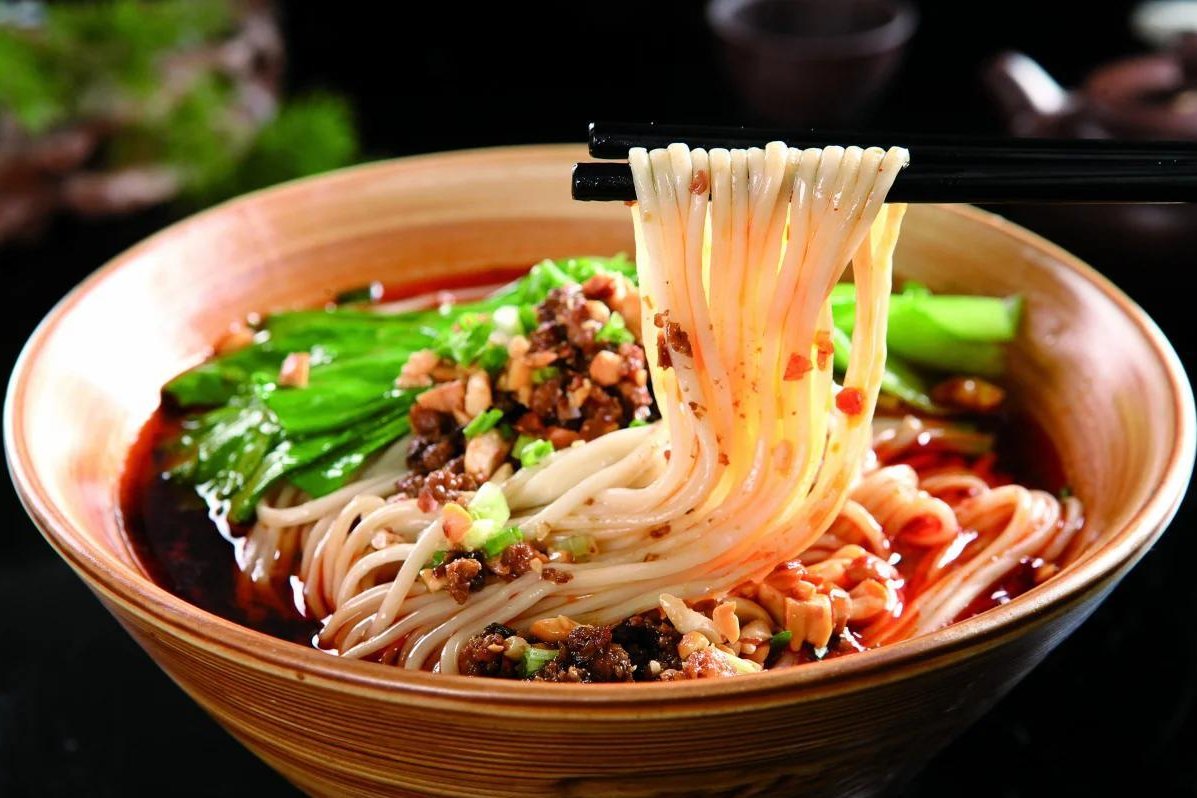
In 1841, a man named Chen Baobao (陈包包) walked the alleys of Chengdu with a bamboo shoulder pole — dàn (担) — a stove on one end, ingredients on the other. He sold noodles by the bowl to dock workers and night laborers who needed something cheap, fast, and strong enough to put feeling back into exhausted limbs. People called it “pole noodles.” Chen never opened a restaurant. He didn’t need to. The pole went where the hungry were.
The Enemies of Dan Dan Noodles
A lot of what travels under this name outside Sichuan is a crime scene in a bowl.
The worst offenders float in soup. Dan Dan Noodles should be dry-tossed (干拌, gān bàn) — the sauce should cling to each noodle like a second skin. If your “Dan Dan Noodles” arrives in a lake of broth with noodles swimming in it, you are eating something else. Probably a decent noodle soup. Not Dan Dan Noodles.
Then there’s the peanut butter substitution. Sesame paste costs money. Peanut butter is cheap. Restaurants outside China swap one for the other and hope you won’t notice. You will. Peanut butter is too sweet, too smooth, missing the bitter backbone that real zhīma jiàng brings. It turns the dish into a dessert that happens to have chili in it.
Other tells: ground chicken instead of pork (wrong texture, wrong fat content). Thin, sad chili oil that tints the noodles orange but brings zero heat. Absent yácài — a mortal sin. And noodles that arrive in a sticky clump because they sat too long after boiling.
Real Dan Dan Noodles has exactly:
- Alkaline wheat noodles, thin and springy. Not udon. Not lo mein. Not spaghetti. You need the chew.
- Chinese sesame paste (芝麻酱), not tahini, not peanut butter. Darker, stronger, slightly bitter.
- Sichuan chili oil (红油), made from èr jīng tiáo chilies at precise temperature — too hot and it scorches, too cool and the aromatics never bloom. The oil should be brick-red and fragrant, not just spicy.
- Sichuan peppercorns (花椒), freshly ground, not pre-powdered. The numbing sensation fades within 90 seconds of grinding. Freshness is the whole game.
- Yácài (芽菜), those fermented Yibin mustard greens. They take months to make. They deliver in seconds what most umami bombs need an hour of reduction to achieve.
- Minced pork belly, fried crisp in its own fat, seasoned with sweet bean sauce and Shaoxing wine.
- Garlic, crushed raw and added at the end. It should punch you.
- The sauce base: soy sauce, Chinkiang black vinegar, sesame oil, a whisper of sugar.
How to Eat It
You have about four minutes from the moment the bowl hits the table to the moment the noodles start absorbing the sauce and turning into a solid mass. This is not a dish for conversation. This is a dish for focus.
Drive your chopsticks to the bottom of the bowl and lift. Fold, don’t stir — stirring breaks the noodles. Fold three, four times until every strand wears a coat of red. The pork and yácài will distribute themselves through the tangle.
Eat fast. The first bite is the best, but the tenth is still good if you keep moving. When you’re done there should be a shallow pool of red oil at the bottom of an otherwise clean bowl. That’s the marker. Leave the oil. You’re not supposed to drink it.
My friend Lao Wei, who runs a noodle shop on Yulin West Road in Chengdu, once told me: “The customer who talks is the customer who eats cold noodles.” He said it in Sichuanese and it rhymed. It was better in Chinese. But you get the point.
Like this? Try our Kung Pao Chicken feature for another Sichuan classic, or Mapo Tofu for the dish that invented málà.
💬 Comments