Dai Barbecue: The Herbs Are the Recipe, Not the Garnish
The night market in Jinghong was beautiful, and it was lying to me.
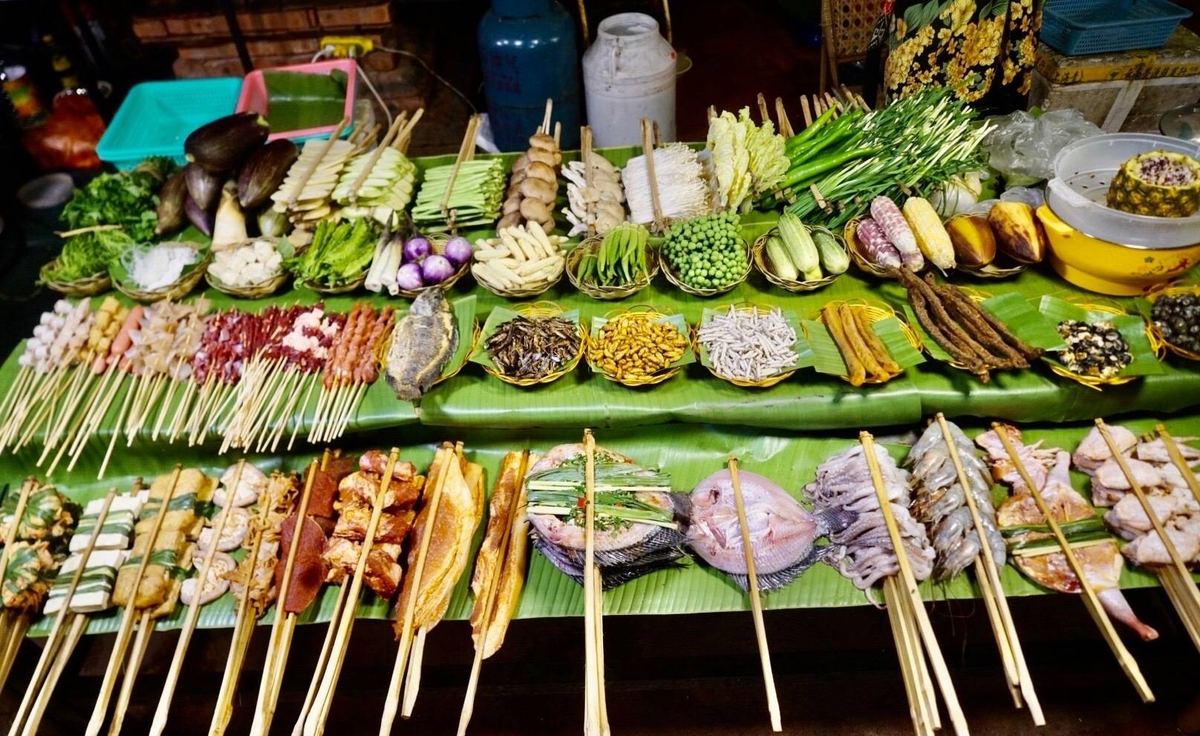
Lanterns strung between palms. A row of grills throwing orange light onto wet pavement. A woman fanning charcoal under a fish wrapped in a banana leaf, and every twenty seconds the coals would flare and the smoke would shift and the whole street would smell like it was about to be dinner.
I took a plastic stool and ordered. The skewers came dusted with the same cumin-and-chili powder you can buy at any night market between Harbin and Haikou. The fish was fine. It had a lemongrass stalk shoved in its mouth like a straw, and when I pulled the stalk out it came out whole, still green, still cold at the tip. It had never been inside anything. It was decoration dressed as an ingredient.
A colleague from Baoshan, an hour from the Dehong line, listened to me describe it for about fifteen seconds. "That food is for people who bought a plane ticket," he said. "Go west."
So I did. The bus from Jinghong to Mangshi eats a day, most of it climbing through mountains that keep the two prefectures in different weather. I got in after dark, dropped my bag, and walked until I found a street with no lanterns on it: two folding tables, a steel trough of charcoal, stools the height of a curb.
The first thing the woman brought me was not meat.
It was a plastic basket of raw herbs. 大芫荽 (dà yuánsui) — culantro, the long serrated leaf that tastes like cilantro with the volume turned to eleven — plus mint, torn kaffir lime leaf (柠檬叶, níngméng yè), lettuce, half a lime, and a saucer of 腌菜膏 (yāncàigāo): pickled greens pounded into a paste the color of wet clay, sour enough that your jaw aches before the first skewer lands.
Then the fish.
Dai grilled fish — 香茅草烤鱼 (xiāngmáocǎo kǎo yú) — gets split down the back and packed: bruised lemongrass, culantro, garlic, salt, and enough 小米辣 (xiǎomǐlà, those small green-and-red firecrackers) that you can smell the heat before the fish. Then it goes into a banana leaf, and the leaf goes onto the charcoal, and someone puts a brick on it.
You can hear the whole process. First a hiss as the leaf's moisture hits the fire. Then crackling at the edges, where the leaf is already going black in patches. Then a quieter bubbling, which is the fish steaming in its own liquid, sealed in. Ten minutes, twelve, and she lifts the brick with a rag and peels the parcel open at the table, and the smell comes out in three separate waves: green first, then smoke, then fish fat.
The flesh comes off the bone in sheets. It is not crisp. It was never trying to be crisp. Sour hits the front of your mouth from the lemongrass, and the chili arrives about a second and a half later at the back of your throat, and between those two things there is a fish so tender it barely holds together on the chopsticks.
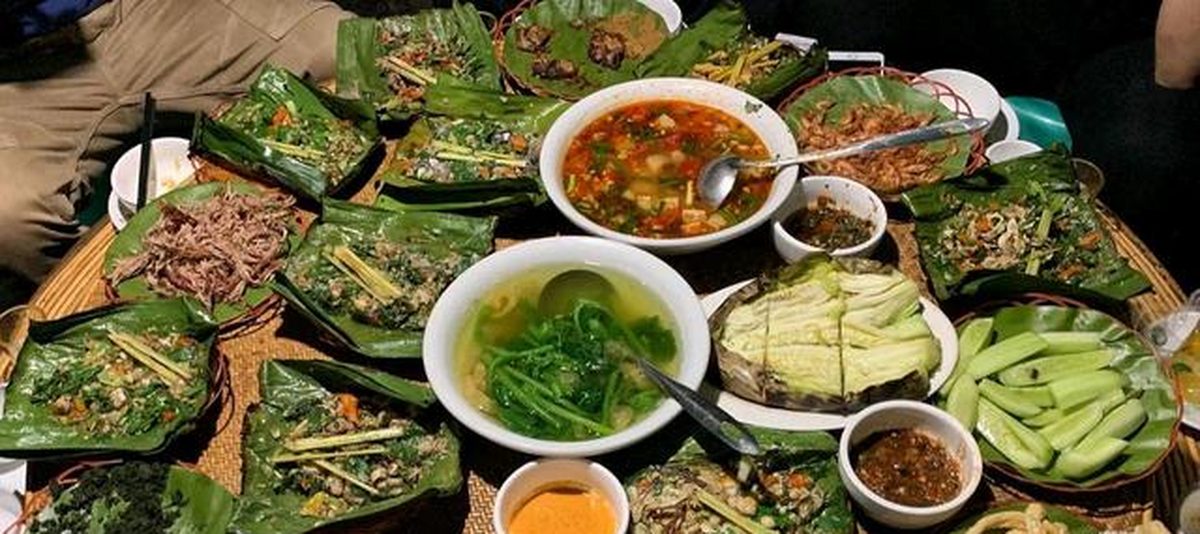
This is 包烧 (bāoshāo), cooking inside a parcel, and in Dehong it is not a technique for fish alone. Tofu, enoki mushrooms, sour bamboo shoots, a whole eggplant, pork brains — anything that would dry out or fall through a grate gets wrapped, weighted, and steamed in its own steam with a fistful of herbs.
The Dai are Tai-Kadai speakers, cousins of the people just across the Myanmar and Laos borders, and their cooking comes out of that tropical belt rather than out of the Chinese eight great cuisines. Sour comes from lime, lemongrass, and fermented greens instead of vinegar. Herbs stay raw. Chili is fresh, not dried into oil. Chinese kitchens elsewhere treat a handful of herbs as seasoning; Dai kitchens treat it as a vegetable, and put it on the table by the basket.
Three things separate the real thing from the version that gets sold to tourists, and they are all small.
The herbs go inside. Not on top, not alongside. Stuffed into the cavity, layered under the skin, folded into the parcel before it's sealed. If the herbs arrive on the side of the plate, you are looking at a garnish. If they go in, you're eating dinner.
The leaf is a vessel, not a plate. A banana leaf laid flat under a grilled fish does nothing except look tropical. A banana leaf wrapped around the fish, tied or folded shut, is a pressure cooker with a burn line, and it's where half the flavor comes from.
And the dip is sour. 腌菜膏 with chili and more culantro, or just lime and salt and 小米辣. Sweet chili sauce — the Thai bottled stuff — is a different country's answer to a different question. A "Dai" restaurant in Shanghai that hands you a ramekin of it has told you everything you need to know about the kitchen.
The other enemy is the powder. Somewhere between Yunnan and the coast, Dai barbecue picked up the northern habit of dusting everything with cumin and chili flakes, the same red snow that falls on lamb skewers in Beijing. It's not bad. It's just a completely different idea — one that covers the meat, when the whole point here is that the meat is a delivery system for herbs.

How to order, since the menu will be a wall of characters and a fridge of raw ingredients: get the fish first, because it takes the longest and everything else is fast. Then pork belly, thin-sliced and grilled hard at the edges. Then eggplant, split and buried in the sour paste. Then whatever is wrapped in leaves that day. When the meat comes, you don't eat it off the stick. You take a lettuce leaf, lay down a skewer's worth of pork, add a culantro leaf and a slice of chili, spoon the sour paste over it, fold, and eat it in one bite. The basket of herbs will empty before the plate of meat does. That's correct.
I grew up in a city where sweetness was a form of politeness — Shanghai puts sugar in things to smooth them over. Nobody in that street in Mangshi was being polite. The sour was sharp, the chili was rude, the herbs tasted like they'd been picked an hour ago because they had. I sat on a stool too low for the table and ate until the charcoal went grey, and the woman running it never once asked me whether I liked it. She could see that I did.
Out of space for today — I'll save the home version for another post. Doing this in a city apartment means solving one problem first: getting a banana leaf to seal and char without a charcoal trough under it. That deserves its own deep dive. Recipe coming soon.
💬 Comments