Crab Roe Soup Dumpling: The One You Drink Through a Straw
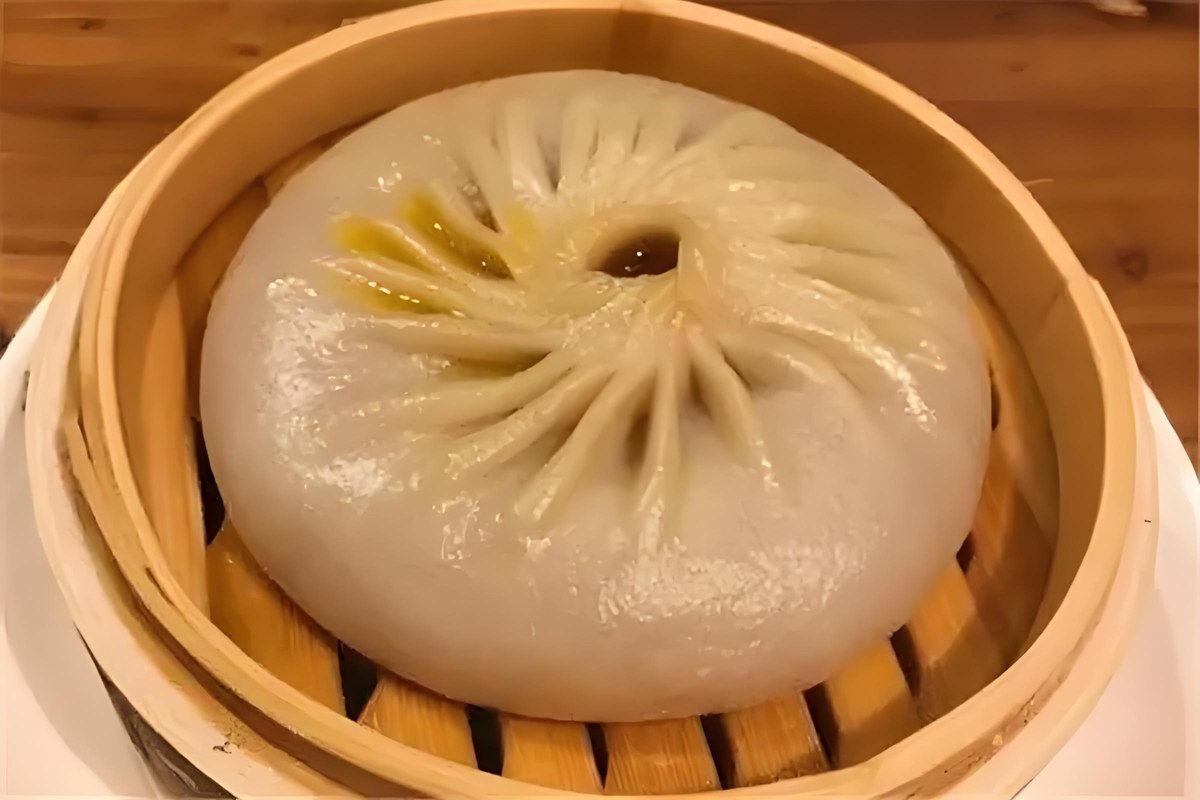
The basket lands on the table and the whole thing wobbles. Inside is one dumpling, the size of both your fists together, skin pulled tight and glossy, sitting in its own shallow dish like something that might still be breathing. It is steaming hard enough to fog the table in front of you. Next to it, laid on a saucer, is a straw. A wide one, the kind you get with a bubble tea.
Nobody explains it. In Jingjiang, nobody has to. You put the straw through the skin and you drink your dumpling.
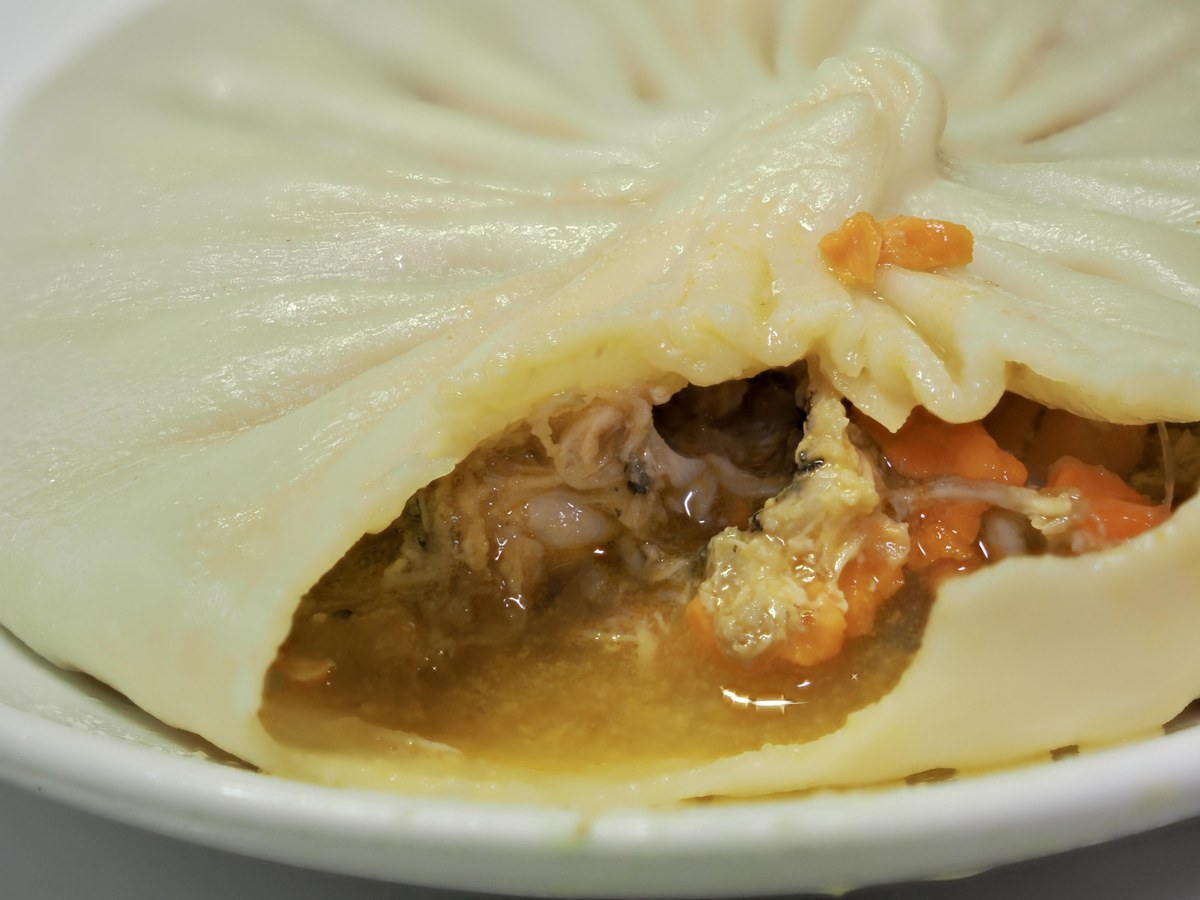
Crab Roe Soup Dumpling (蟹黄汤包, xièhuáng tāngbāo) has no filling in the way you think a dumpling has a filling. It has soup, and the thing holding that soup together is a pastry skin that was pinched shut while the soup was still solid. Every one of them is a small trick performed in front of the customer.
The trick is pork skin. You simmer pork skin and chicken bones for hours until the liquid turns to glue, chill it overnight, and it sets into a firm, wobbling jelly — 皮冻 (pídòng). Chop that jelly fine, fold it with picked crab meat and crab roe, spoon the cold mixture onto a thin wrapper, pleat it shut with somewhere between thirty and forty pleats, and steam it. The jelly melts. The skin, seen off by the steam, stays sealed. Solid goes in, liquid comes out, and the only thing between the two is a few tenths of a millimeter of dough.
Get the ratio wrong and you get one of two failures. Too little jelly and you are eating a dense pork meatball in a leather pouch. Too much and the skin gives way in the basket, which means you paid for a bowl of soup that leaked out before it reached you.
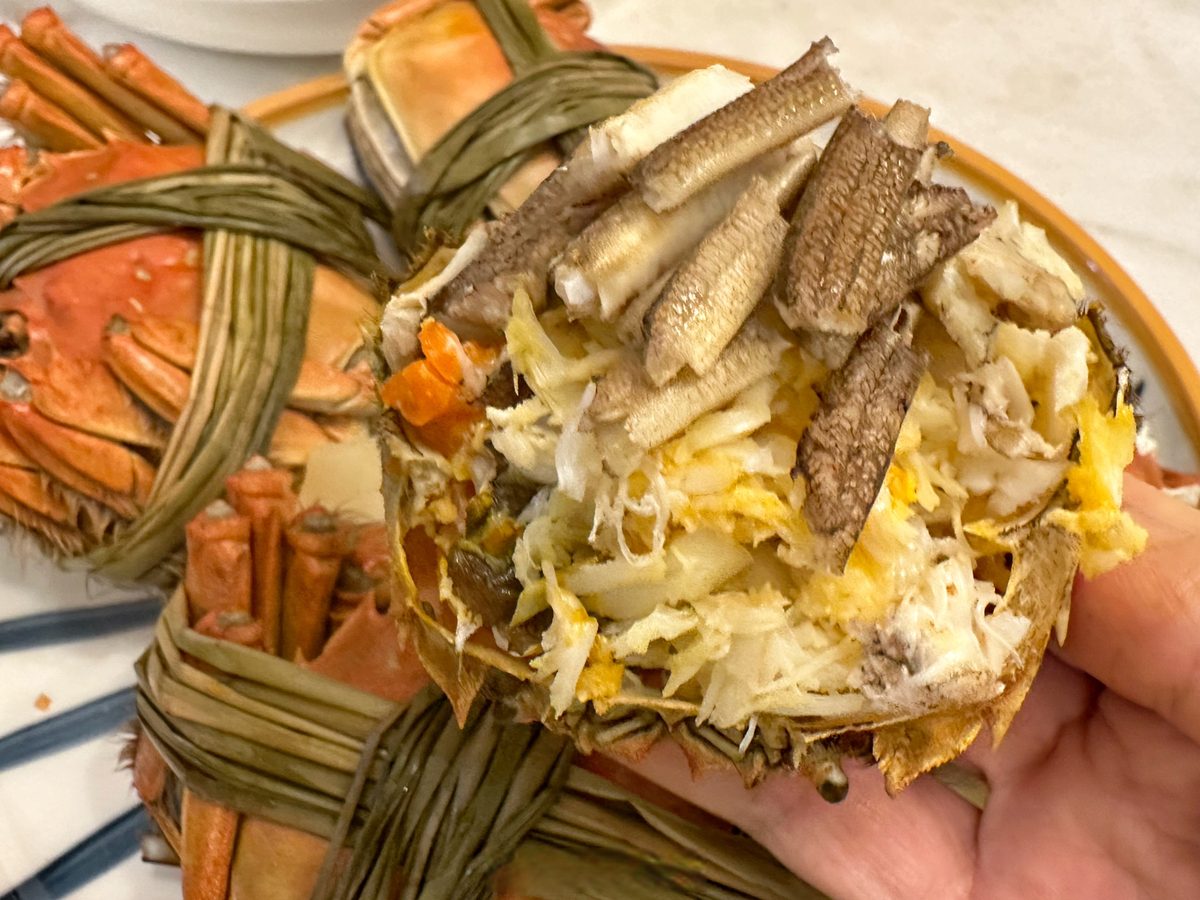
The crab is the reason this is an autumn dish and not a year-round one. Hairy crab (大闸蟹, dàzháxiè) from the Yangtze delta runs roughly September to November, and every gram of roe in that dumpling was taken out by hand. A practiced picker with a little pair of tools and sharp fingernails gets through maybe one crab in five minutes, and comes away with a spoonful. A serious Jingjiang soup dumpling holds the roe and picked meat of two or three crabs. Sit in a shop in late October, look at the pale orange pile in the tray by the window, and you are looking at somebody's entire morning.
Two cities, one crab
Ask for a crab soup dumpling in Shanghai and you will get something else entirely: 蟹粉小笼 (xièfěn xiǎolóng), a crab roe xiaolongbao, small enough to sit on a soup spoon. Bite a window in the side, let the steam out, slurp, then eat the whole thing. Order four. In Shanghai the crab is a seasoning — a spoonful of roe folded into a pork dumpling that would have been perfectly good without it. That is not a criticism. It means the crab has to share the stage with ginger, vinegar, and a lot of sweet pork fat, and the result is a milder, rounder thing you can eat in a mouthful.
In Jingjiang, twenty minutes north of the river, the crab does not share anything. The dumpling is huge because it is mostly liquid, the liquid is crab and broth and nothing else, and the pork is present only as structure. You do not bite it. You do not put it in your mouth whole. You drink it, and then you eat the empty skin with vinegar and ginger threads, feeling slightly foolish and extremely pleased.
Which one you want depends on who you are. If you eat for balance, order the Shanghai version and stop reading. If you want the dish at its most unreasonable — the version that takes a set of tools, a season, a pair of tweezers and three crabs to produce one mouthful — cross the river. And order one, not two. Two giant soup dumplings is a dare, not a meal.
How to spot a bad one
Thickened with cornstarch. If the "soup" pours out like gravy, nothing in there was ever jelly. Real soup dumpling liquid is thin, clean, and tastes of crab first and bones second. Cornstarch is what a kitchen uses when it wants volume without crab.
Served on a cold plate. The skin of a soup dumpling is barely structural to begin with. Cold ceramic grabs it, the bottom tears, and the whole thing empties onto the plate while you watch. The dish must arrive on something warm, lifted out of the basket with a spatula, and placed in front of you with a certain amount of ceremony and haste.
Available in July. There is no fresh crab roe in a Chinese July. If a shop sells 蟹黄汤包 all year round without a seasonal pause, the roe came out of a freezer bag, and it will taste of freezer bag.
Orange for the sake of orange. Crab roe is a muted amber, sometimes with streaks of darker red from the crab's own fat. A violently orange filling is usually tinted, and often bulked out with shrimp roe, which is cheaper and coarser and does not taste like crab at all.
Machine-pressed skins. Uniform, slightly translucent, zero bubbles, and identical to each other. A hand-rolled wrapper has a thicker center, a thinner edge, and visible irregularity.
Then the part nobody warns you about. A crab soup dumpling arrives too hot to drink and it will still be sitting there in four minutes. Wait. Steam coming off the surface means the liquid inside is well past what your mouth can take, and a scalded tongue is a fifteen-minute sentence during which you can taste nothing at all. Give it three minutes. Drink slowly through the straw — thick soup, not a gulp — and stop as soon as the crab is followed by bone. Then lift the skin, dip in ginger-thread vinegar, and finish it.
My grandmother's family came from the Taizhou side of the river, and every November of my childhood involved a Sunday morning drive across the Yangtze bridge for breakfast. Her system predated the restaurants that sell the dumplings by the tray. She bought her own crabs, sat on a low stool with a pair of eyebrow tweezers and a bowl, and worked for two hours, and my entire job in that kitchen was to stop talking. One small bowl of roe came out of it. It went into the freezer in portions and came out at New Year, and I did not understand until I was in my thirties that she had spent two hours picking crabs so that a nine-year-old could eat them without any work at all.
You cannot reheat that. You can only eat it in season, in the place where it made sense, with a straw.
The home-cooking version is a different animal and I'll give it a post of its own. Short version: the jelly ratio and the pleat count are the two places everyone fails, and neither one can be rushed. Recipe coming soon.
💬 Comments