Chuan Chuan Xiang: Dinner, Counted One Stick at a Time
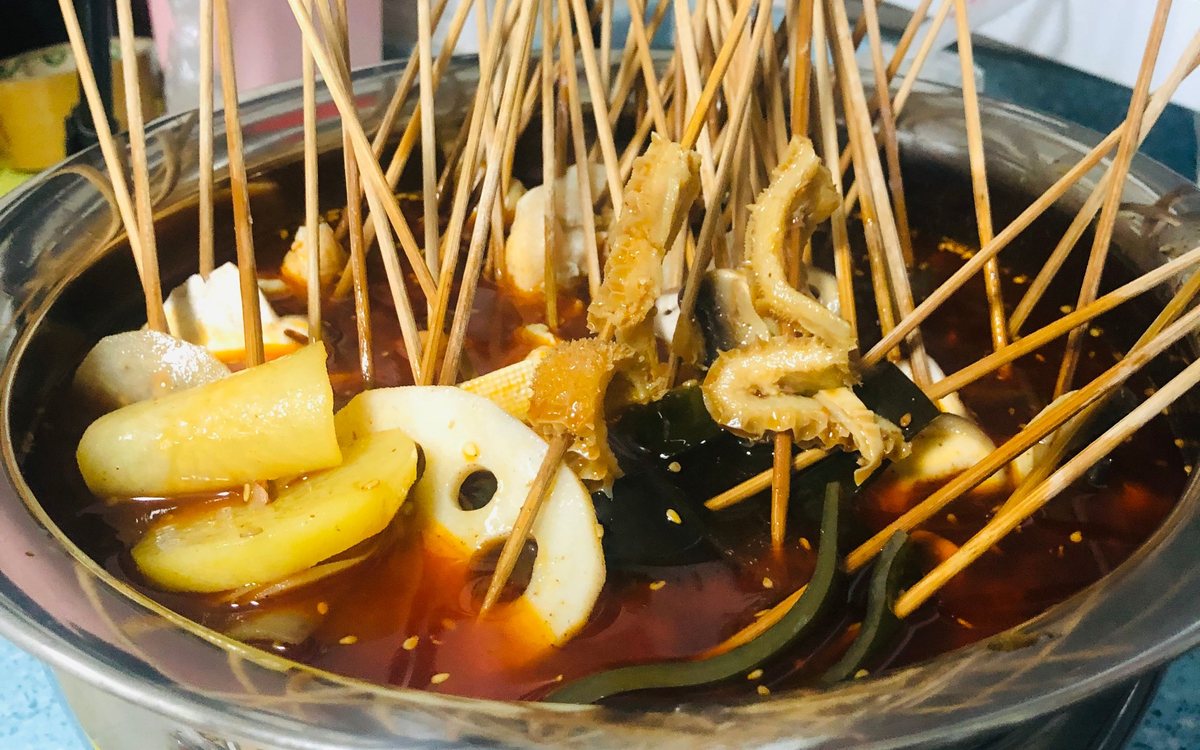
You know the meal is over when the bucket comes out.
Not the bill. The bucket. Somewhere past eleven, the woman who runs the place walks over with a plastic tub and sweeps the skewers off your table into it — a hundred-odd bamboo sticks, stripped clean, clicking against each other like a wind chime made of dinner. She counts them where you can see her do it. Fast. Flick, flick, stacks of ten, lips moving. Then she says a number. You pay. She is already halfway to the next table.
Nobody in that room is surprised. This is how the meal was always going to end. In Chengdu they call it 数签签 (shǔ qiān qian) — counting the sticks — and it is as much a part of dinner as the chili oil.
Chuan Chuan Xiang (串串香, chuàn chuàn xiāng) is hot pot disassembled. Instead of a menu and a waiter and a plate of raw beef arriving on a tray, there is a refrigerated wall of bamboo skewers. You take a plastic basket. You open the glass door. You pile in whatever looks good — thirty sticks, fifty, more — and carry it back to your table, where a pot of beef tallow and chilies is already rolling. You cook it yourself, stick by stick, and you pay for what you ate by the stick.
Two yuan a skewer in most of Chengdu. Maybe three for the good beef. It is the cheapest way to eat well in a city that is very good at eating.
The meal built for one
Here is the thing nobody tells you about hot pot: it's a group dish. Ordering a pot alone in Chongqing gets you a look usually reserved for people who ask for ketchup. The broth is built for four, the table is built for four, and the whole social contract of the meal assumes you are going to argue with someone about how long to cook the tripe.
Chuan chuan removes all of that. A single stool, a single small pot, a basket of sticks, and no one to negotiate with. You cook a lotus root slice. You eat it. You cook a quail egg. You eat it. Nobody counts how many you've had except the woman with the bucket, and she doesn't care.
I ate my first proper chuan chuan at twenty-four, on a work trip to Chengdu, taken there by a colleague who grew up three streets from the shop. It was behind a residential compound, no sign, a blue tarp for a roof, and the floor was so slick with oil that you shuffled rather than walked. He ordered nothing. He just pointed at the fridge and said, "take the beef first, it goes fastest." I still take the beef first.
What I remember isn't a single bite. It's forty people cooking at once — sticks tapping the rim of the pot, broth at a hard boil — and the smell of beef fat and 草果 (cǎo guǒ, tsaoko pod) sitting in the air like a wet blanket you're happy to wear.
Hot pot, cold pot, and the argument in between
The broth is the whole religion. Beef tallow, dried chilies by the handful, Sichuan peppercorn, ginger, fermented broad bean paste, a spice bag that smells like a pharmacy in the best way. Dark red, slightly thick, tasting like it has been simmering since the afternoon. That fat is the point — it carries flavor onto a slice of potato in a way water never will.
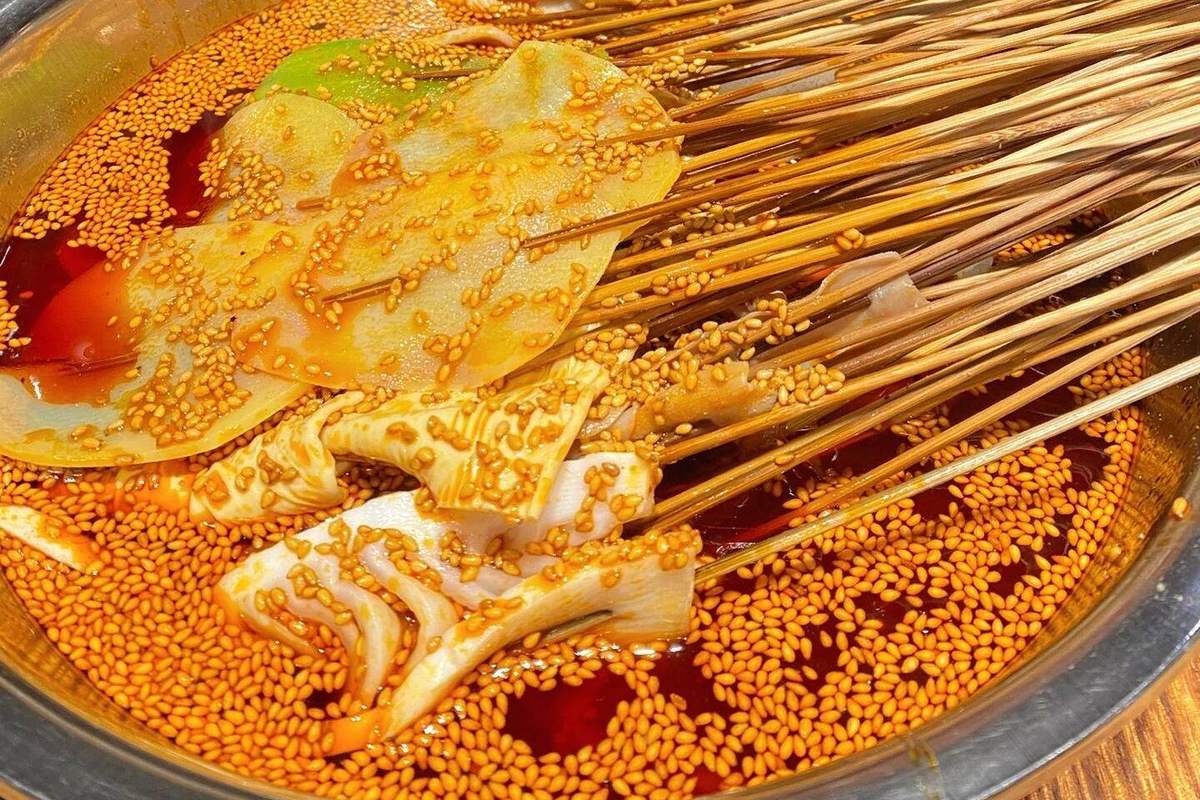
Then there's the Chengdu heresy: 冷锅串串 (lěng guō chuàn chuàn), "cold pot." The kitchen cooks your skewers for you, then slides them into a wide bowl of broth that arrives at the table barely warm. No flame, no bubbling, no mess. Purists from Chongqing call it soup. Chengdu people call it Tuesday. I'll say this much — a cold pot lets you taste the broth instead of just the fire, and it doesn't leave your clothes smelling like a wok for two days.
Both versions are correct. Order the hot one if you want the ritual. Order the cold one if you have somewhere to be afterward.
What goes on a stick
Everything. That isn't a joke — the fridge is a cross-section of a Sichuan kitchen. Beef wrapped around a bundle of 折耳根 (zhé ěr gēn, fish mint), which is the most divisive leaf in China and tastes like a wet stone in the best possible way. Beef with cilantro. Chicken gizzard, scored so it curls and holds sauce. Duck intestine, eight seconds and no more. Lotus root, sliced thin so it goes crunchy-then-soft somewhere around second twenty. Quail eggs. Enoki tied in a knot. Wide sweet potato noodles that drape off the stick like laundry. A whole pig brain, if you're brave and it's that kind of night.
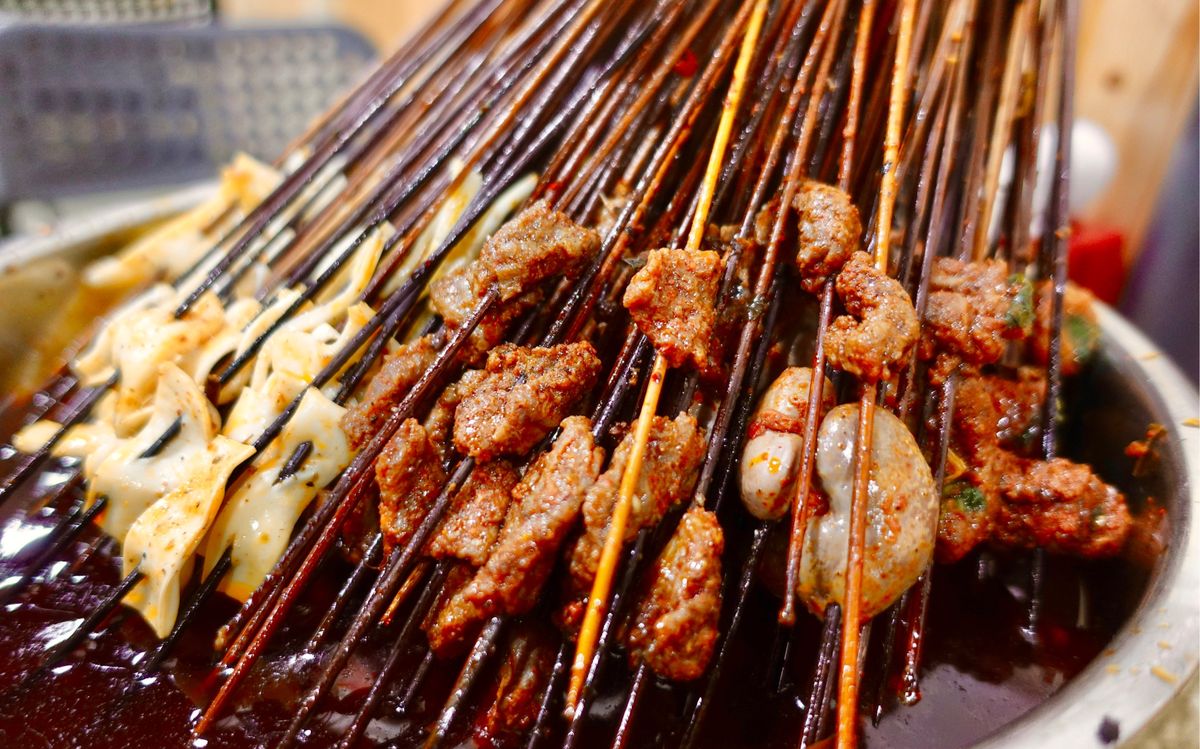
Vegetables cost less and cook faster, which is how the economics work: you fill up on potato and lotus root, and the meat is the treat you ration. Every local has a ratio. Mine is roughly three vegetables to one meat, which my Chengdu friend says is the ratio of a man who is afraid of the bill.
The stick is the pricing unit, the cooking tool, and the record of your evening. Different colored handles can mean different prices in the bigger shops, which is why nobody throws theirs away until the count.
Where it goes wrong
The all-you-can-eat version. Skewers laid out on an unrefrigerated tray at nine in the evening, meat gone grey at the edges, someone's tongs resting in the middle of it. Beef tallow doesn't have to be fresh, but raw pork does. If the fridge door isn't cold, walk out.
The scale. Some tourist-facing shops weigh your sticks instead of counting them, which sounds fair and isn't — bamboo soaks up broth, and a wet stick weighs more than a dry one. Counting is honest. Weighing is a business model.
The microwave shop. Pre-cooked skewers, reheated, drowned in chili oil at the last second. The meat is grey all the way through, the vegetables have given up their texture, and the broth has never met a flame. You can taste the shortcut. It tastes like nothing.
And the stingy stick: thirty centimeters of bamboo with three cubic millimeters of beef near the tip. In a good shop the meat wraps the stick twice and hangs off the end.
The dip decides everything
Two schools. 油碟 (yóu dié) is a small bowl of sesame oil with garlic and cilantro — cooling, nutty, the Chongqing default. 干碟 (gān dié) is a dry pile of chili flakes, ground roasted peanuts, salt and a little MSG; you drag the skewer through it and it sticks. Chengdu runs on dry dip.
Do both. The oil dip first, to cool the stick enough that you can actually taste it, then the dry dip for the crunch. Anything more elaborate than that is a sauce bar, and a sauce bar is where good broth goes to die.
Order a bottle of 唯怡 (Wéiyí) soy milk, the kind every Sichuan table has, or a bowl of 冰粉 (bīng fěn) at the end — cold jelly with brown sugar and crushed peanuts. Your mouth has been on fire for two hours. It will thank you.
Then the woman comes with the bucket, and the sticks clatter, and the number is smaller than you expected. That's the last trick of the whole format: you ate for two hours, you cooked every bite yourself, and it cost less than a plate of beef at a proper hot pot. The sticks were keeping score the whole time.
---I'll save the home version for another post — building the broth at home is mostly about buying the right tallow and being patient with the spice bag. Recipe coming soon.
💬 Comments