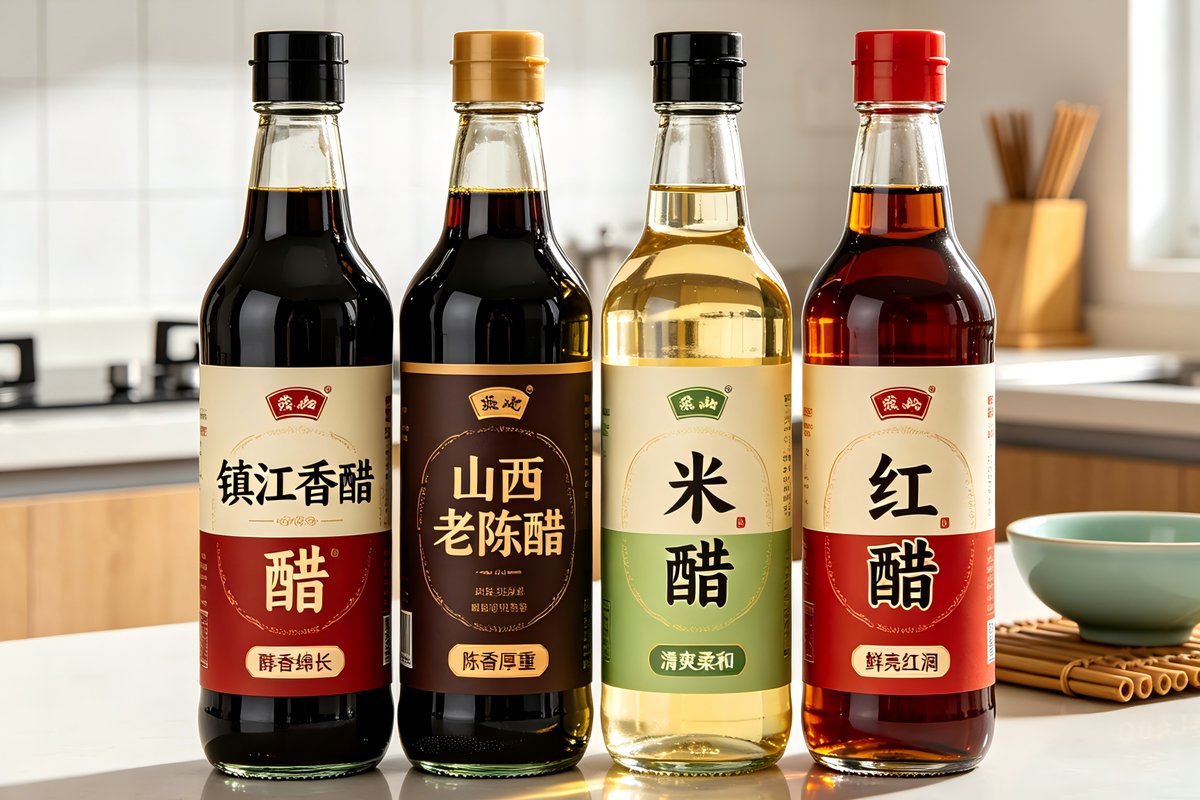
Chinese Vinegars 101: The Four Bottles That Belong in Your Kitchen
As an Amazon Associate, I earn from qualifying purchases.
How many bottles of vinegar do you own? If you're a Western home cook, the answer is probably one. Maybe two, if you count balsamic. A Chinese kitchen has three or four. This isn't hoarding. It's not aspirational. It's because in Chinese cooking, vinegar isn't one thing doing one job. Different vinegars carry different weights. They de-funk meat, wake up a stir-fry, cut through the oil slick of a braise, and sit quietly on the side of a dumpling waiting to be noticed.
This is the fourth installment in our kitchen series — after pantry sauces, the wok, and spices. We're going into the vinegar cabinet. There are really only four you need to know about. And one of them handles eighty percent of everything.
Chinkiang Black Vinegar (镇江香醋)
This is the one. If you own no other Chinese vinegar, own this. Chinkiang vinegar — named after the city of Zhenjiang in Jiangsu province — is made from glutinous rice and aged in clay pots until it turns deep amber-black. It's not sharp like distilled white vinegar. It's round. It has a faint sweetness, a whisper of smoke, and a complexity that makes balsamic vinegar seem one-dimensional.
The flavor sits somewhere between balsamic and Worcestershire sauce, but that comparison undersells it. Chinkiang has umami. It has depth. A spoonful of this in a stir-fry doesn't just add acid — it adds body. It's the vinegar equivalent of a bass note.
What it does: Everything. Dipping sauce for dumplings (mixed with soy sauce and a few slivers of ginger). The acid in sweet-and-sour pork and tang cu pai gu (sweet and sour ribs). A splash into braised dishes to cut the richness. Cold appetizers — smashed cucumber, wood ear mushrooms — dressed in it. The dark color is intentional: Chinkiang stains food a rich mahogany, which is part of its job. White vinegar would leave the same dish looking pale and unfinished.
No substitute. There isn't one. Balsamic is too sweet. Red wine vinegar is too sharp. Malt vinegar is too one-note. Buy Chinkiang.
Recommended: Gold Plum Chinkiang Vinegar — the gold standard. For a reliable backup: Soeos Chinkiang Vinegar, 3 Years Aged.
Shanxi Aged Vinegar (山西老陈醋)
If Chinkiang is the weekday vinegar — versatile, reliable, goes with everything — Shanxi aged vinegar is the weekend bottle. It's darker. Smokier. More aggressive. Aged for at least three years (the good ones go five to ten), it develops a complexity that Chinkiang can't match — a roasted, almost caramelized depth that comes from the sorghum, barley, and peas in its mash bill.
Shanxi province in northern China drinks this stuff straight. No, seriously — there are vinegar bars in Taiyuan where people order shots of aged vinegar like it's whiskey. The local saying is "no vinegar, no meal" (无醋不成席). Northern Chinese cooking uses aged vinegar the way Italian cooking uses olive oil: it's on the table at every meal, a pot of it next to your noodles.
What it does: Noodle dressing. Shanxi knife-cut noodles (dao xiao mian) get a splash of this straight from the bottle. Dipping sauce for dumplings — a darker, more serious version than Chinkiang. Braised dishes where you want a smokier, rougher edge. If Chinkiang is a silk shirt, Shanxi aged vinegar is a leather jacket.
Do you need it? Not on day one. But if you find yourself reaching for Chinkiang constantly and wanting something with more presence, this is your next bottle.
Premium Shanxi Vinegar — Shuita Brand, 5 Years Aged on Amazon →
Rice Vinegar & Red Vinegar
These two are the light-touch players. They don't dominate dishes. They support them.
Rice vinegar (米醋) is clear or pale yellow, mild, and slightly sweet. It's the workhorse acid for stir-fries where you don't want vinegar to announce itself — a splash into tomato and egg stir-fry, or the finishing touch on a quick vegetable sauté. It brightens without darkening. Unlike Chinkiang, which stains everything it touches, rice vinegar leaves no trace. What it is NOT: sushi vinegar. Sushi vinegar has sugar and salt already mixed in. If you buy a bottle labeled "seasoned rice vinegar" and dump it into a stir-fry, you're adding sugar you didn't ask for. Buy plain, unseasoned rice vinegar.
365 by Whole Foods Market, Organic Rice Vinegar on Amazon →
Red vinegar (浙醋 or 大红浙醋) is a Cantonese specialty — rice vinegar tinted red with red yeast rice. It's milder than Chinkiang and slightly sweeter, used almost exclusively as a dipping vinegar for dim sum. You'll see it on tables at Cantonese restaurants in little plastic squeeze bottles, served alongside xiao long bao (soup dumplings), spring rolls, and pan-fried dumplings. It's the lightest of the four — more of a condiment than a cooking ingredient. If you never cook dim sum at home, you don't need this bottle.
How Many Do You Actually Need?
Here's the priority list. Start at the top. Stop when you feel done.
1. Chinkiang black vinegar — Buy this first. It handles eighty percent of Chinese dishes that call for vinegar. Dumplings. Cold appetizers. Sweet-and-sour anything. Braised pork. Smashed cucumbers. This is the bottle that earns its space.
2. Rice vinegar — Buy this second. It's cheap, it's subtle, and it handles the delicate stir-fries where black vinegar would overwhelm. Unseasoned only.
3. Shanxi aged vinegar — Buy this third. You'll know when you're ready for it. It's for when Chinkiang starts to feel too polite and you want something with an opinion.
4. Red vinegar — Buy this fourth, or never. Unless you're making dim sum at home regularly, this bottle will sit in your fridge for two years growing a layer of sediment. It's nice to have. It's not essential.
What to Avoid
"Chinese cooking wine" is not vinegar. I've seen Western grocery stores label black vinegar as "Chinese cooking wine." This is wrong. Cooking wine is Shaoxing wine — a fermented rice alcohol, not an acid. They look similar in the bottle. They do opposite things in a pan. If the label says "cooking wine" and the liquid is black, you're holding vinegar. If it says "cooking wine" and the liquid is amber, you're holding Shaoxing. Buy both. Don't confuse them.
Sushi vinegar is not rice vinegar. Seasoned rice vinegar has sugar and salt dissolved in it. It's pre-mixed for sushi rice. If you use it in a stir-fry, you're adding sugar you can't control. Read the label: if it says "seasoned," put it back.
"Black vinegar" is not always Chinkiang. The bottle should say 镇江香醋 somewhere on the label. If it just says "black vinegar" or "dark vinegar" without the Zhenjiang name, it might be a cheaper blend — thinner, sharper, less complex. Gold Plum (金梅) and Heng Shun (恒顺) are the two brands I trust. Gold Plum is the gold standard. Heng Shun is the reliable backup.
Start with Chinkiang. It's the bottle you reach for when you don't know which vinegar to use. And that's most of the time.
Part of the Chinese Kitchen Essentials series:
← Part 1: The 11 Chinese Pantry Staples
← Part 2: The Wok: One Pan to Rule Them All
← Part 3: Chinese Spices 101
💬 Comments