Chinese Dried Goods 101: The Pantry That Doesn't Need a Fridge
As an Amazon Associate, I earn from qualifying purchases.
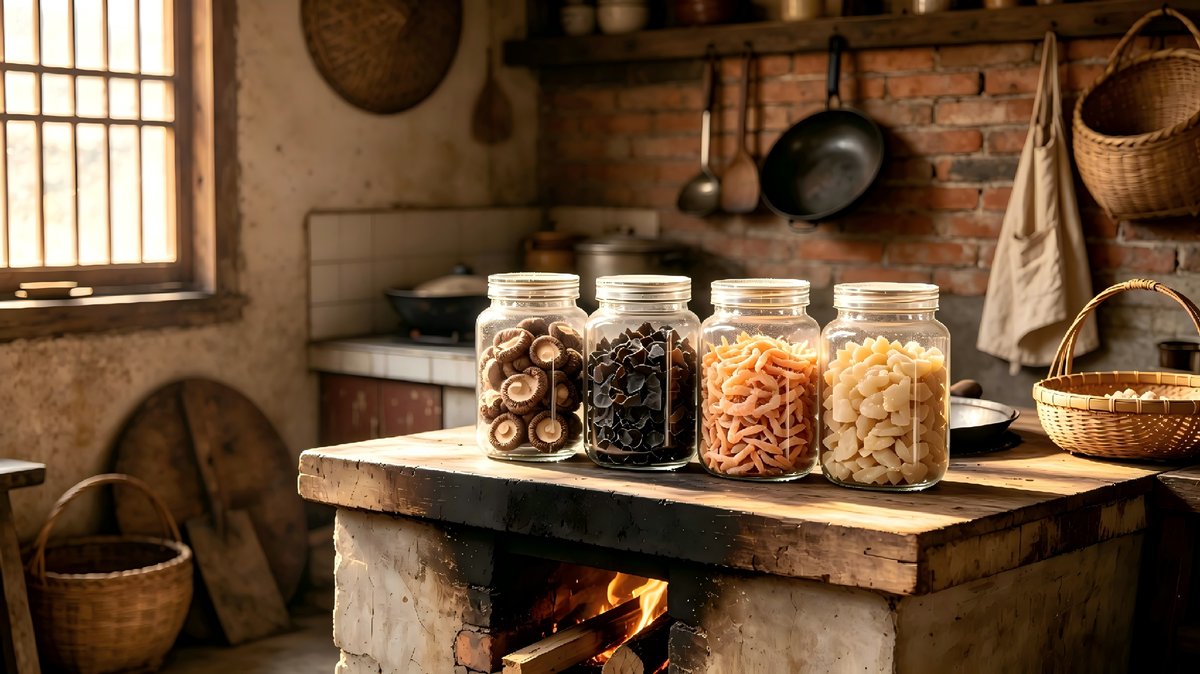
My grandmother had a shelf above her stove that I was not allowed to touch. On it: four glass jars. No labels. Inside each, something that looked dead. Shriveled brown mushrooms the size of bottle caps. Black curls that looked like torn fabric. Tiny orange-pink specks like fish food. And one jar of pale gold disks that caught the light. She reached for these jars every week without looking. One handful of this, a pinch of that, into a bowl of cold water. Twenty minutes later, the water had become stock and the dead things had come back to life. Chinese dried goods are not survival food. They're flavor concentration technology — a thousand years old and still better than anything you can buy fresh.
This is the fifth installment in our kitchen series. We've covered sauces, the wok, spices, and vinegars. Today: the four dried goods that earn their shelf space in any Chinese kitchen.
1. Dried Shiitake Mushrooms (干香菇)
This is the one you buy first. Fresh shiitake mushrooms are fine — earthy, meaty, serviceable. Dried shiitake are a different species of ingredient. During the drying process, the mushroom's cell walls break down and release guanosine monophosphate — a nucleotide that reads as pure umami on your tongue. Fresh shiitake don't have it. Dried ones do. This is not a subtle difference. It's the difference between mushroom soup and mushroom soup that makes you close your eyes.
What it does: Braised dishes, soups, clay pot rice. Soak them in cold water for twenty minutes (hot water makes them slimy), then slice off the tough stems — those can go into stock but not into the dish. The soaking water is gold. It's now mushroom dashi, and you should pour it into your braise or soup instead of plain water. One caveat: let it settle first. Dried mushrooms carry grit from the drying racks. Pour slowly, leave the last half-inch of silt behind.
How to buy: Look for caps that are thick, domed, and deeply cracked on the surface — the "flower mushroom" pattern (花菇). These are the premium grade, grown in cooler temperatures so the cap cracks open like a blooming flower. They cost more but deliver twice the flavor. If the bag says "花菇" on it, you're buying the good stuff. Thin, flat caps with no cracks are the economy grade — fine for stock, disappointing in a dish.
One bag lasts forever. A single dried shiitake, rehydrated, is roughly the size of three fresh mushrooms. A one-pound bag will outlast your next three apartments.
Recommended: NATURAURA Premium Whole Flower Shiitake, 16 oz — Grade AAA, thick cracked caps. For a budget-friendly backup: Mushroom House Dried Shiitake Mushrooms, 16 oz.
2. Wood Ear Mushrooms (木耳)
Wood ear is not about flavor. It's about texture. Rehydrated wood ear is crisp, springy, and slightly gelatinous — it crunches and then yields, a sensation that has no equivalent in Western cooking. The Chinese name, 木耳, literally means "wood ear," and yes, they grow on dead wood and yes, they look exactly like ears when they're fresh.
What it does: Mu xu rou (木须肉) — the classic northern stir-fry with pork, egg, and lily flowers. Hot and sour soup (酸辣汤) — those black ribbons floating among the tofu strands are wood ear. Cold appetizers — rehydrated, blanched, and dressed with Chinkiang vinegar and sesame oil. It doesn't carry flavor. It carries texture. In a dish where everything else is soft, wood ear is the crunch that keeps your chopsticks moving.
How to buy: Two types. Large black wood ear (黑木耳) — the standard, bigger, slightly tougher. Cloud ear (云耳) — smaller, thinner, more delicate, named because they look like tiny clouds when rehydrated. Cloud ear is the better version for cold dishes and soups. Black wood ear is fine for stir-fries. Both puff up dramatically — a handful of dried wood ear becomes a full bowl after soaking. Buy the smallest bag you can find. You will never finish it.
Warning: Don't buy pre-hydrated or "ready-to-eat" wood ear in plastic packets. They're treated with preservatives that leave a sour chemical aftertaste. Buy them dried, soak them yourself. Twenty minutes in cold water is all it takes.
Dried Black Fungus / Wood Ear Mushrooms, 5.29 oz on Amazon →
3. Dried Shrimp (虾米)
These are tiny dried shrimp, not much bigger than a fingernail — pale orange, slightly translucent, smelling faintly of the sea and something sweet. They look like fish food. They are not. They are the ingredient that makes people ask "what did you put in this?" when you stir-fried bok choy with nothing but oil and salt.
What it does: Stir-fried greens — toss a teaspoon of dried shrimp into the oil before adding vegetables. The shrimp infuse the oil, and suddenly your plain sautéed cabbage tastes like it has a secret. Steamed egg custard (蒸水蛋) — sprinkle a few on top before steaming. Congee — the shrimp dissolve into the rice porridge and disappear while leaving their flavor behind. Stir-fried rice, noodle soups, dumpling fillings. Dried shrimp are a background player. They don't announce themselves. They make everything around them better.
How to buy: Look for shrimp that are dry, intact, and uniformly orange-pink — not brown, not crumbly, not powdered at the bottom of the bag. The smell should be clean and oceanic, not fishy. A fishy smell means they're old. Store them in the fridge in an airtight jar — they'll keep for months. At room temperature they oxidize and turn bitter.
One bag, countless dishes. You'll use maybe a teaspoon at a time. A four-ounce bag will last you a year.
Dried Louisiana Shrimp, 4 oz on Amazon →
4. Dried Scallops / Conpoy (干贝 / 瑶柱)
This is the luxury item. Dried scallops — called conpoy in Cantonese cooking — are fresh scallops that have been boiled in salt water and sun-dried until they shrink into hard, pale-gold disks the size of a thumbnail. They look like fossils. They cost what feels like too much. But one dried scallop, soaked and shredded into a pot of congee or a bowl of steamed egg, transforms the entire dish. This is the umami equivalent of a cheat code.
What it does: XO sauce (XO 酱) — the legendary Hong Kong condiment made from dried scallops, dried shrimp, Jinhua ham, shallots, garlic, and chili — is built on conpoy. Steamed egg custard with shredded scallop on top turns a three-ingredient home dish into something you'd serve to guests. Soup stocks — drop one in and the broth gains a depth that no amount of salt can replicate. Lo mai gai (糯米鸡) — sticky rice wrapped in lotus leaf — has shredded conpoy in the filling.
Do you need it? No. This is the fourth bottle — the one you buy when you want to impress yourself. It's not essential. It's wonderful. If you're the kind of cook who enjoys having one ingredient on the shelf that makes people say "where did you learn to do that," this is it.
How to buy: Small ones are fine. You don't need the giant Japanese Hokkaido scallops that cost fifty dollars an ounce. Standard Chinese dried scallops, about the size of a dime, work beautifully. Soak in warm water for an hour, then shred with your fingers. The soaking water, as always, goes into the dish.
Greenlike Dried Japanese Scallops, 8 oz on Amazon →
How Many Do You Actually Need?
1. Dried shiitake mushrooms — Buy this first. One bag. It's the workhorse: braises, soups, clay pot rice, mushroom dashi. Nothing else on this list does as much for as little effort.
2. Dried shrimp — Buy this second. It's cheap, it's small, it hides in your pantry and makes every stir-fried green vegetable taste intentional. A teaspoon goes a long way.
3. Wood ear mushrooms — Buy this third. It's about texture, not flavor. If you make hot and sour soup or cold appetizers, you want it. If you don't, you won't miss it.
4. Dried scallops — Buy this fourth, or don't. This is the luxury tier. It's a special-occasion ingredient. If you're building a serious Chinese pantry, it belongs there. If you're cooking Tuesday night dinner, it can wait.
What to Avoid
Pre-soaked anything. Dried goods in plastic packets floating in liquid are not the same product. They've been rehydrated with preservatives, the texture is off, and the flavor is muted. Buy them dry. Soak them yourself. Twenty minutes of patience is the difference between an ingredient and a compromise.
"Mushroom seasoning" powder. Some brands sell mushroom extract powder as a shortcut for dried shiitake. It's MSG with mushroom branding. Use real dried mushrooms — the flavor is better and you control the salt.
Buying in bulk. These things multiply when wet. A one-pound bag of dried wood ear looks modest on the shelf and swells to the size of a pillowcase when soaked. Unless you're running a restaurant kitchen, buy the smallest package available.
Start with dried shiitake. Soak a handful tomorrow, slice them into your next braise, and pour the soaking water in with them. That's it. That's the whole trick.
Part of the Chinese Kitchen Essentials series:
← Part 1: The 11 Chinese Pantry Staples
← Part 2: The Wok: One Pan to Rule Them All
← Part 3: Chinese Spices 101
← Part 4: Chinese Vinegars 101
💬 Comments