Chicken & Mushroom Stew: The Mushroom Is the Point
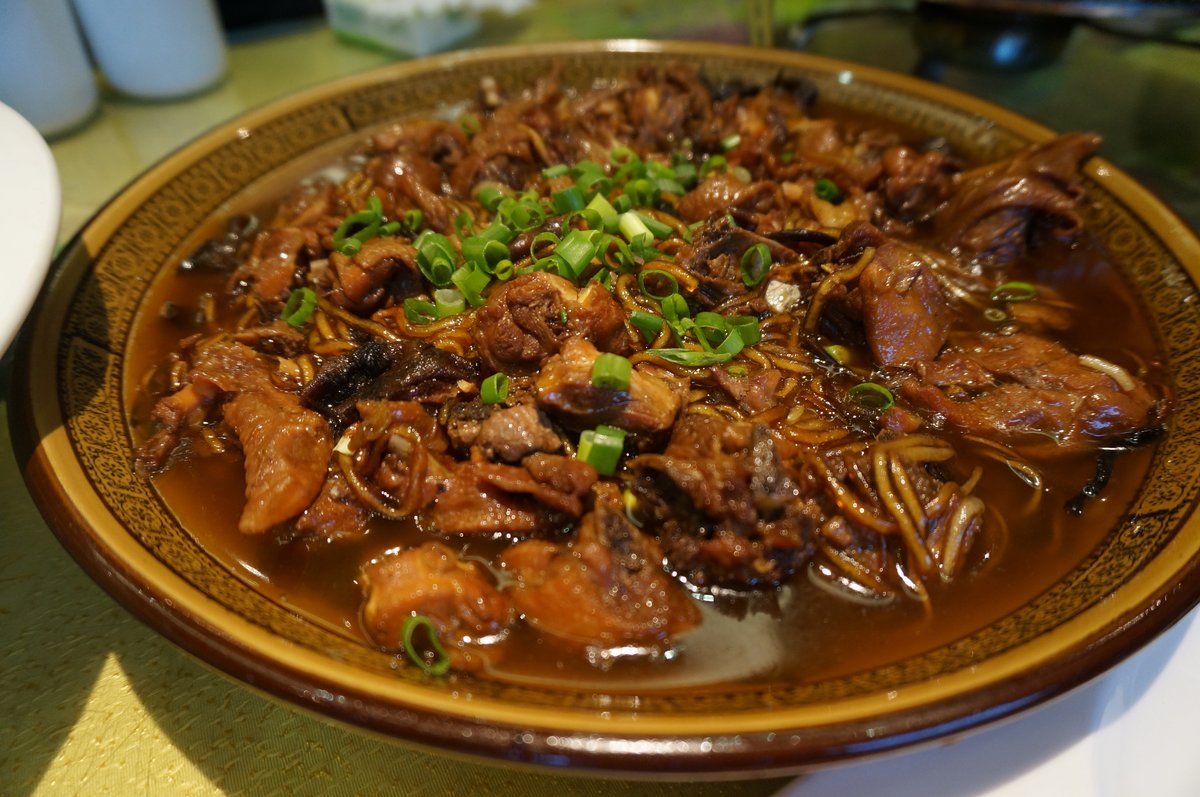
The first thing to reach you is not the chicken. It is the mushrooms — a double handful of dried 榛蘑 (zhēnmó), wild hazel mushrooms, dropped into a bowl of warm water at nine in the morning. Inside ten minutes the water has gone the colour of strong tea. By noon the whole kitchen smells like a forest floor after rain, and there is nothing left to do but wait.
Then the bird. In Dongbei — the northeast, Harbin and Changchun and every village in between — the chicken in this dish is not the pale, tender thing from a supermarket chiller. It is an old hen (老母鸡, lǎo mǔjī), two or three years old, with legs like rope and a breast that refuses to be sliced. You cannot roast her. You cannot stir-fry her. You can only simmer her, for a long time, until the meat finally gives up and the broth turns gold.
Chicken & Mushroom Stew (小鸡炖蘑菇, xiǎojī dùn mógu) is one of the few dishes that define home cooking in the north of China. Half a billion people have eaten it a hundred times each. Almost nobody outside the north has met the real version.
I first argued about it in my second year at Fudan, with a classmate from Harbin. I had called the dish "chicken soup with mushrooms." He looked at me the way you look at a man who has just described your mother as "a nice lady." The chicken is the vehicle, he said. And you do not use 香菇. It took me another decade to understand him. Then I ate it in a farmhouse outside Harbin in January, at minus twenty-five, with the pot still on the table and the windows fogged solid, and I understood all of it at once.
The mushroom nobody substitutes for
榛蘑 (zhēnmó) is small, honey-coloured and thin-stemmed, and it grows in clumps at the foot of oak and hazel in the Changbai Mountains. It is picked by hand across a few weeks in autumn, strung on thread and hung up to dry — and the dried version is the one you want. Drying pulls the flavour in tight, so that a mushroom the size of a thumbnail can perfume three litres of broth. There is nothing quite like it: chewy in the stem, slippery at the cap, tasting less of mushroom than of something underneath the mushroom — dark, faintly sweet, with a resinous edge at the back of the throat.
The other half of the dish is 粉条 (fěntiáo), sweet-potato starch noodles, sold in stiff grey bundles. They go in at the end and they do the quiet work. Twenty minutes in a dark broth turns them glassy, heavy and almost translucent, each strand a rope for hauling broth out of the pot. By the time the bowl reaches the table they are the best thing in it.
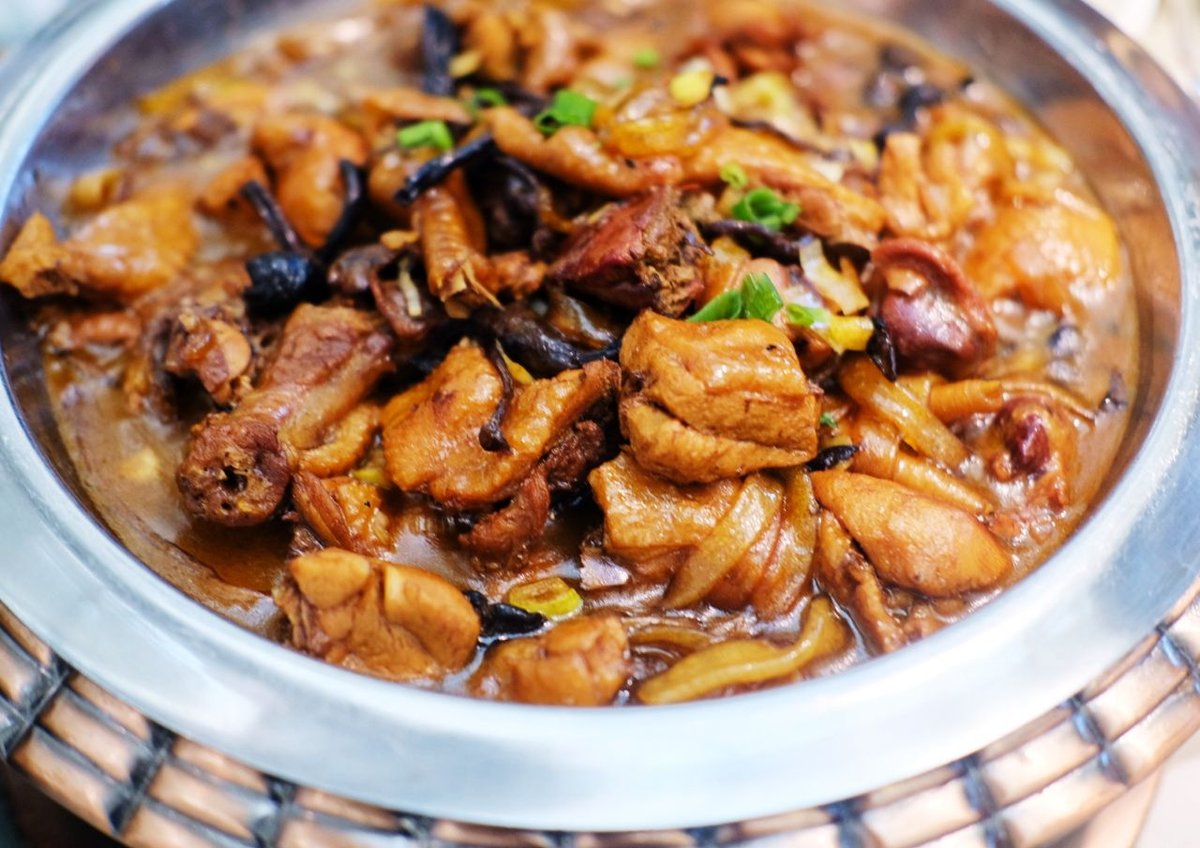
The broth is never thickened. Water, soy sauce, a few slices of ginger, a spoon of sugar if the cook is feeling generous, and time. Most restaurant versions get that wrong, because a thick sauce photographs well and because a customer who waits twenty-five minutes instead of ninety will not complain.
Two pots, one name
The real one is built in an iron pot: an old hen, a double handful of dried 榛蘑 and the dark water they soaked in, ginger, soy, low bubbles for ninety minutes, noodles stirred in at the end. The broth comes out dark and clear and faintly sweet. The chicken tastes like chicken used to taste.
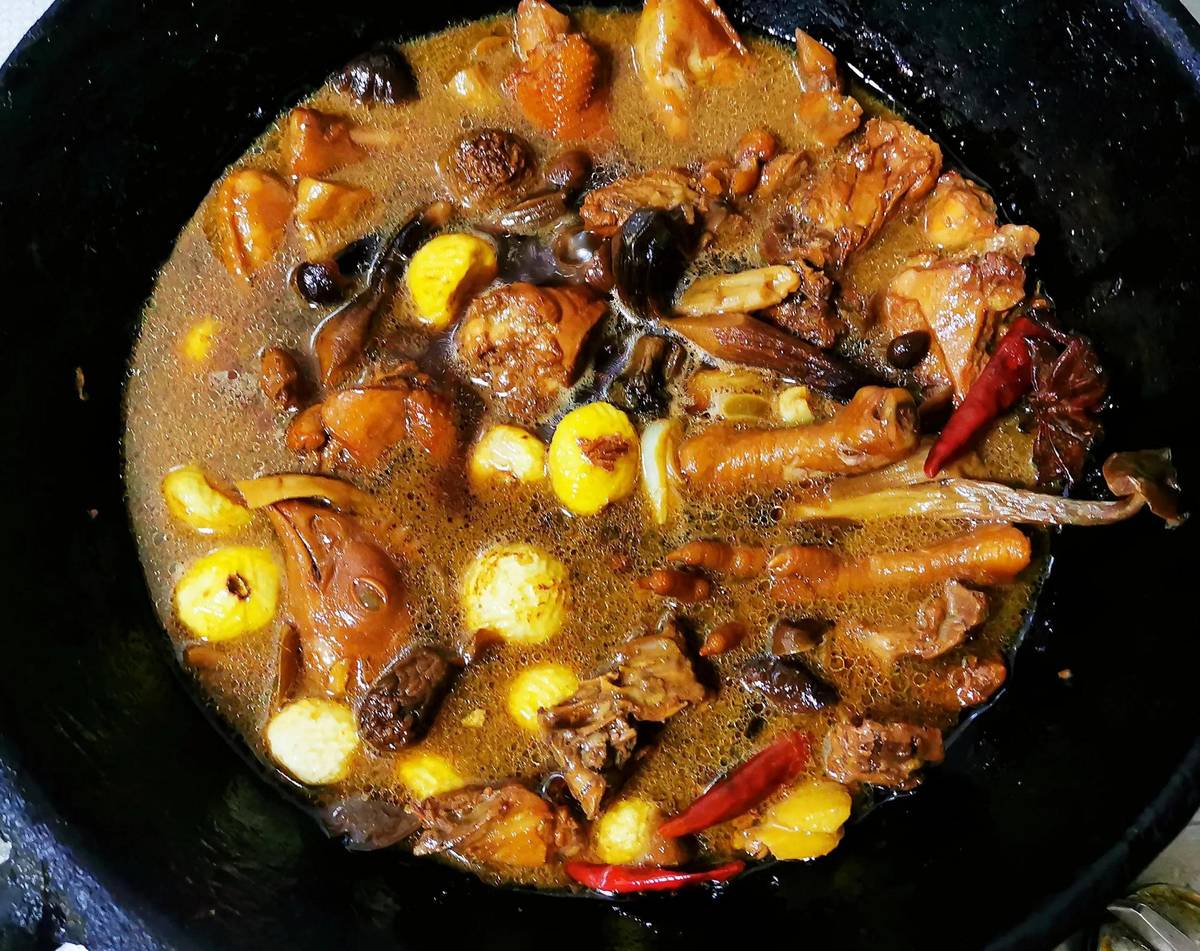
The other pot calls itself the same dish and is a different animal entirely: chicken breast, fresh shiitake, forty minutes, a spoon of cornstarch to make it look rich. It is not bad food. It is a fast, mild, pleasant braise — and it is why millions of people believe they have eaten 小鸡炖蘑菇 when they have eaten chicken with mushrooms.
The shiitake swap. Fresh shiitake is a perfectly good mushroom and a terrible stand-in here. The dish is not "chicken with mushrooms." It is the flavour of one wild mushroom that grew in the mountains and was dried in the sun. Substituting it is a remix with the original track removed.
The cornstarch pot. If the broth coats the back of a spoon like gravy, someone decided the dish looked thin and fixed it. The fix is the problem. Send it back.
The twenty-five-minute hen. A young bird cooked fast gives you meat with no depth and a broth that tastes of hot water and soy. This dish is a slow argument between a tough bird and a dry mushroom. Rush it and you are just reheating a soup.
The bowl at the end of the day
In the north this is a winter dish, and it comes to the table in the pot it was cooked in. You eat it with rice and a spoon. Broth first — one mouthful before anything else, to check the cook's nerve. Then the mushrooms; the stems are the good part, and the people who leave them on the side of the plate are the same people who eat the middle of a watermelon. Then the noodles, which vanish in three minutes because everyone reaches for them at once. Somewhere on the table there will be a cold dish — 酸菜, pickled cabbage, or cucumber with garlic — and cold-sharp-sour against hot-deep-savoury is the whole point of the meal. The pot stays where it is. The last bowl, half an hour later, when the broth has reduced to something almost black and the noodles have drunk everything they can hold, is better than the first, and in a Dongbei house everyone knows it and everyone is quietly racing for it.
There is a test I run now, whenever a Chinese restaurant outside China tells me it makes this dish. I ask which mushroom. If the answer is shiitake, I order something else, and I tell them why — not to be difficult, but because the gap between those two pots is the whole story. Most cooks say they have been meaning to change it for years.
I'll save the home-cooking version for another post. Half the battle is sourcing real 榛蘑; the other half is learning to soak them in the water you are going to cook in, which nobody bothers to tell you. Recipe coming soon.
💬 Comments