Chicken Feet: Chewing Is the Whole Point
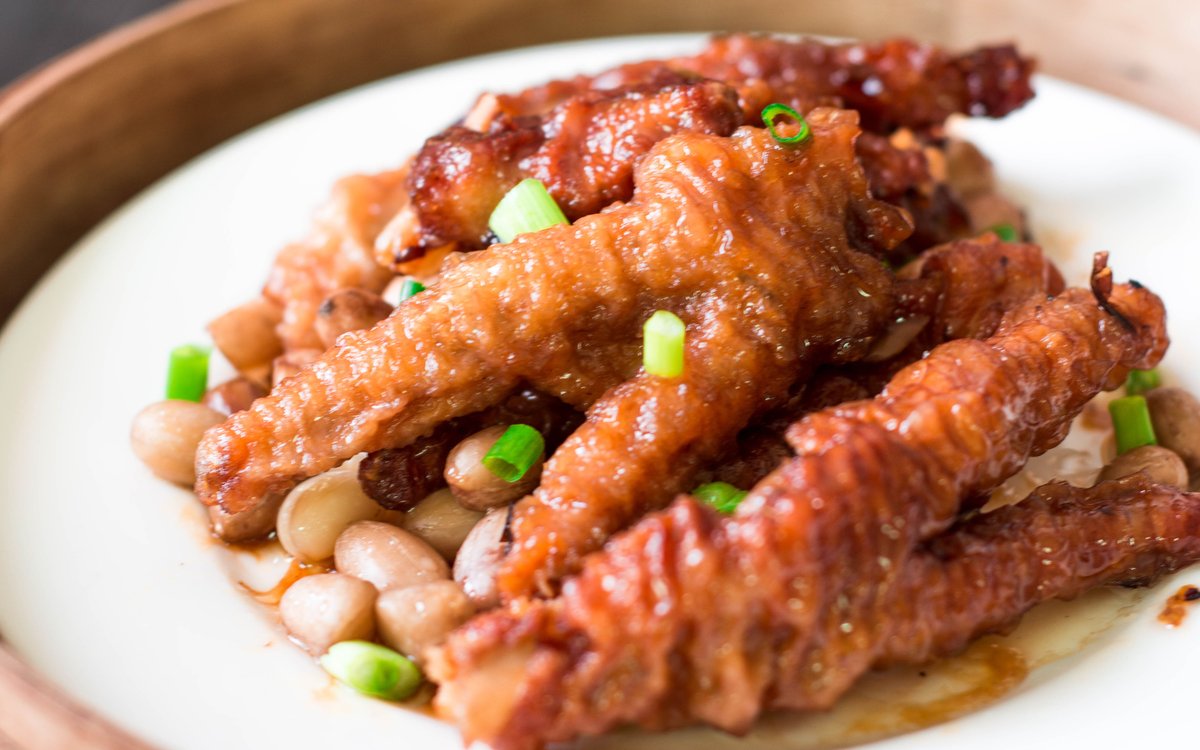
Nine in the morning in a teahouse in Guangzhou, and the table is already a wreck of bamboo lids, stained teacups and a pencil-scrawled order card. The cart stops beside you. The woman pushing it lifts a steamer and the smell arrives before the steam clears — dark soy, star anise, rock sugar reduced down to something closer to caramel. Inside: a dozen chicken feet, lacquered reddish-brown, the skin wrinkled into glossy folds, each one curled like a hand that fell asleep. The woman at the next table takes three before you have finished deciding. She eats them the way you eat grapes.
Then somebody at your table leans in and asks the question, quietly, the way you ask about a family member's drinking: what is the point? They have a case. There is no meat on a chicken foot. Maybe a thimbleful in the pad of the sole, and a bit of gristle along the ankle. They are not wrong about the anatomy. They are just asking the wrong question. You do not eat feng zhao (凤爪, fèng zhǎo) for meat. You eat them for everything meat does not have.
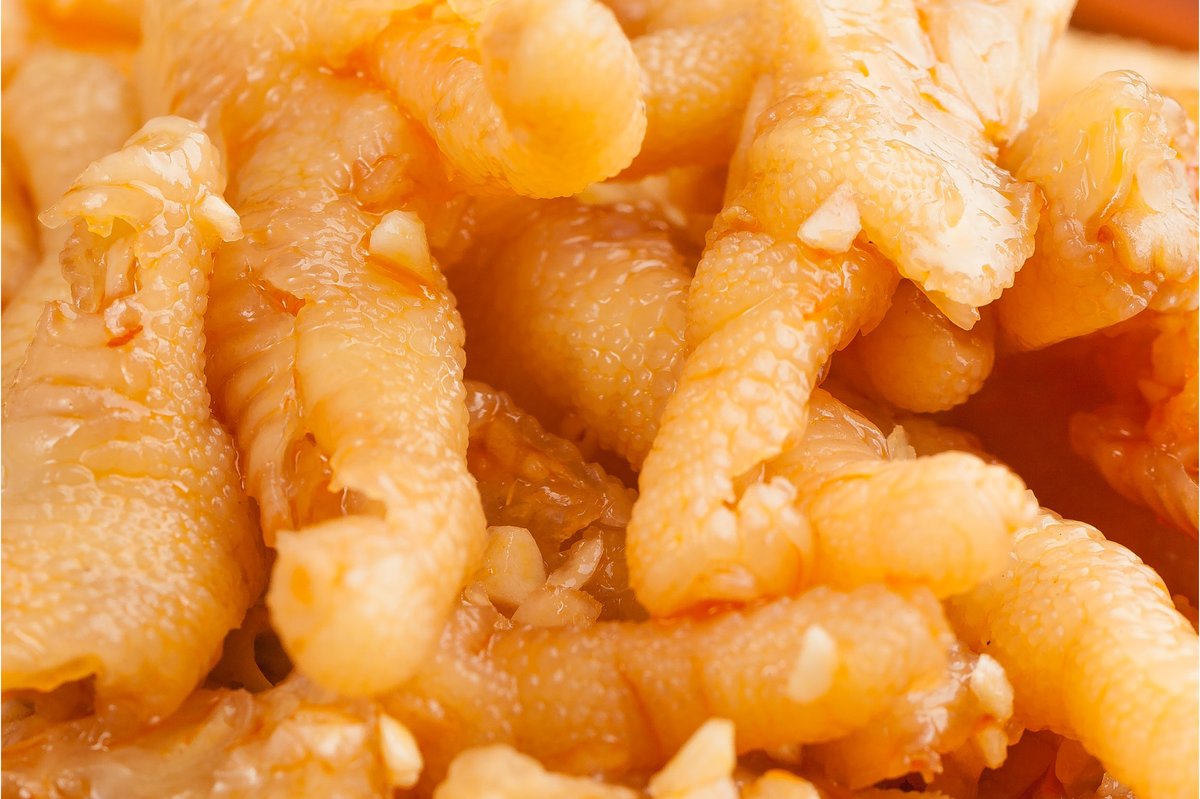
The word for it is kou gan (口感, kǒugǎn) — mouthfeel, the physical event of eating, which this cuisine treats as an entire category of pleasure and Western cooking mostly threw out with the bones. A chicken foot is four textures stacked into something the size of your thumb. The skin goes first, silky and faintly sticky, thick with collagen. Then the long tendon running along the top of the foot, which springs back at your teeth for a second before it gives. The cartilage at the ankle cracks like a knuckle. The pad underneath is dense and soft, the only part that could be mistaken for meat. And the skin is corrugated — all those folds and wrinkles — which means it holds sauce the way a crumpet holds butter. That is the real job of the thing. The foot is a delivery system.
I was eight, standing in my grandmother's kitchen in Shanghai, watching her braise a pot of them with dark soy, rock sugar, star anise and a strip of dried orange peel. She would fish one out with chopsticks, blow on it twice, and hand it to me over the stove, and I would burn my fingers and not care. What I remember is the sauce, reduced until it coated the back of a spoon, sweet and savoury and faintly perfumed. She never once called them chicken feet. Nobody in China does, at the table. Feng zhao — phoenix claws. Naming is half of appetite.
The version under that steamer is a Guangzhou dim sum house invention as much as anything else: the feet are fried first, then braised, so the skin blisters and puffs into the crackled surface the menu calls hu pi feng zhao (虎皮凤爪, hǔpí fèngzhǎo) — tiger-skin phoenix claws. Chongqing went the other way in the 1990s, cold and sour and loaded with pickled green chillies, sealed into plastic bags and sold from every corner shop in the country. Two cities, two completely different animals.
The Cantonese keep a third: bai yun feng zhao (白云凤爪, báiyún fèngzhǎo), blanched and then soaked in vinegar and ice water, no soy anywhere near it, served cold and squeaky and clean. If you have only ever had the braised kind, this is the one that will surprise you.
The bad version has three faces, and I have met all of them. The first is the vacuum-packed boneless kind, plumped with water until the skin turns the colour of a hospital corridor and the whole thing has the texture of a boiled eraser. Boneless chicken feet are an answer to a question nobody asked; the bones are where the flavour lives, and the work of getting around them is the point. The second is the pot left an hour too long on the fire: the skin collapses into one sad sheet, the joints give up, and you are eating porridge with bones in it. The third is a bar snack — battered, deep-fried, served with something creamy in a ramekin. Fine as a bar snack. Nothing to do with this.
Eating them is a small piece of manual labour, and you should not be shy about it. Lift one by the ankle with chopsticks, or with your fingers after ten at night, which is when everyone else gives up too. Press your thumb into the pad and twist the ankle joint until it pops. Pull the long tendon out in one piece — that is the prize, and the reason people order a second steamer. Then suck the skin off the smaller bones, and put the bones on the plate. The pile at the end is the receipt.
My grandmother ate hers with her hands, and kept a small bowl of water beside the plate to rinse her fingers. My mother used chopsticks and considered this a moral difference. I have eaten them both ways, in teahouses and on station platforms and once, memorably, out of a plastic bag on a hard sleeper from Chongqing, where the smell of pickled chilli and vinegar announced itself four rows away and half the carriage came looking.
So order one steamer next time and give it five minutes before you decide. I have never had a neutral answer out of anyone. Either the skin gets you — that first soft, sticky, sauce-heavy collapse — or the tendon does, that small springy resistance that finally yields. You will know which one you are within about four seconds.
Want to cook this? Here’s the step-by-step Braised Chicken Feet recipe.
💬 Comments