Char Siu: The Red-Glazed Pork That Stops You Mid-Step
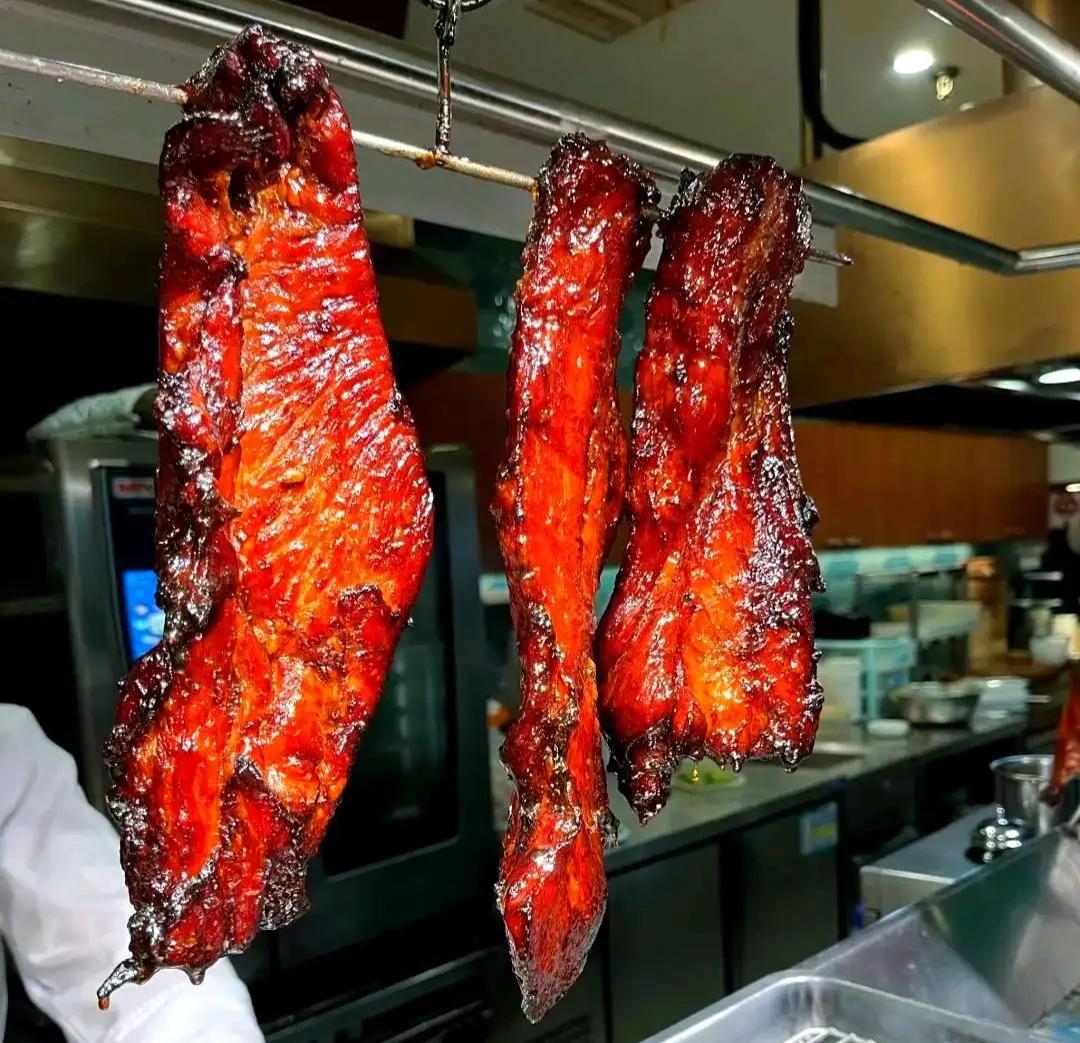
You’re walking down a side street in Hong Kong’s Mong Kok district and something makes you stop. It’s not a sound. It’s a window — a shopfront with hooks hanging from a metal bar, and on those hooks, long strips of pork the color of a sunset seen through amber glass. The glaze catches the fluorescent light. The edges are singed black in spots, the way a marshmallow gets when you hold it just above the flame.
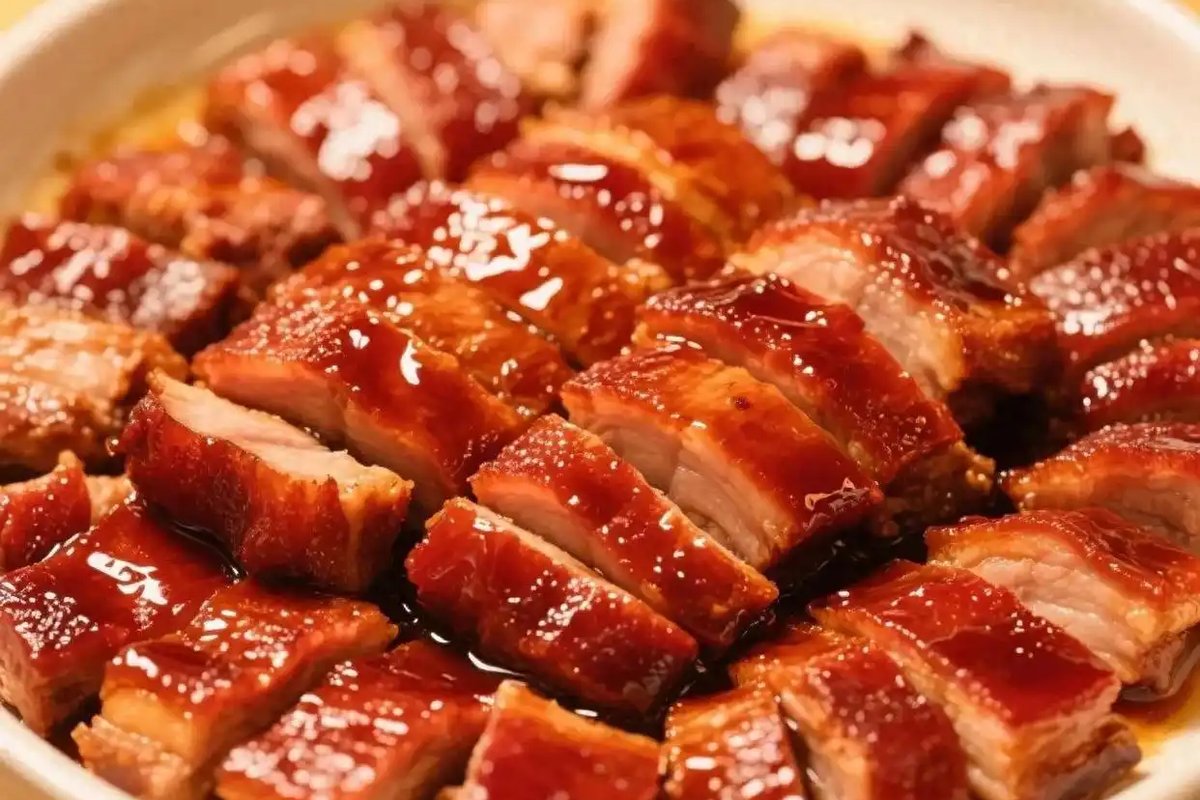
The man behind the counter pulls a strip down, lays it on a wooden block thick as a butcher’s bible, and brings the cleaver down in quick, angled strokes. Thok thok thok. The pieces fall away glistening, a thin stripe of charred edge framing each slice’s pinkish core.
He hands you a piece on the flat of the blade. You eat it standing. The maltose glaze cracks first, then the meat gives way — tender but with chew, sweet and salty and smoky and faintly floral from the five-spice, and there’s a thread of fat that dissolves on your tongue like butter left in the sun.
You order half a catty. You were not planning to buy pork today.
This is Char Siu (叉烧, chāshāo). The name means “fork-roasted” — from the long two-pronged forks (chā, 叉) that suspend the meat over fire. The rest of the world calls it Chinese BBQ pork. Neither name prepares you for the reality.
The Architecture of a Bite
I spent thirteen years optimizing compute pipelines. There’s a thing in GPU architecture called the memory wall — the point where processing speed outstrips your ability to feed it data. Char Siu solved its own memory wall six hundred years ago with a two-stage cooking system that’s so elegant I still think about it while waiting for CUDA kernels to compile.
The bite comes in layers. First, the glaze — maltose syrup (麦芽糖, màiyá táng) caramelized under direct flame until it forms a hard candy shell. It shatters when your teeth hit it, releasing a rush of sweetness cut with fermented red bean curd (南乳, nánrǔ) — that’s where the signature red comes from, not food coloring. The bean curd adds a cheese-like funk that takes the maltose’s simple sugar and pushes it somewhere savory and complicated.
Then the char. The strips are hung so the edges catch the fire directly. These blackened bits deliver smoke and bitterness, the counterweight that keeps the sweetness from tipping into dessert territory. Without char, you’re eating candy pork. With it, you’re eating architecture.
The meat itself is pork collar (猪颈肉, zhū jǐng ròu) or belly — cuts with intramuscular fat that bastes the meat from the inside. The marinade penetrates for a minimum of four hours: hoisin, soy sauce, Shaoxing wine, five-spice powder (五香粉, wǔxiāng fěn), garlic, and that crucial fermented bean curd. During roasting, the fat renders, the exterior dehydrates, the sugars caramelize in stages. What lands on your tongue is pork that reads as sweet first, savory second, and then — just as you’re about to form an opinion — smoky, with a clean mineral finish from the Shaoxing wine.
You chew. The meat resists just enough to remind you it’s meat, not pâté. Then the fat thread melts and everything goes silky. You swallow. You reach for another piece before the first one’s fully gone.
Good char siu makes you greedy. That’s the test.
Fire Worship
Char siu belongs to siu mei (烧味) — the Cantonese roast-meat tradition alongside roast duck, roast goose, and crispy pork belly. Its origins trace back to ancient Chinese open-fire roasting, but the specific form — long strips, sweet-savory glaze, fork-suspended over flame — crystallized in Guangdong.
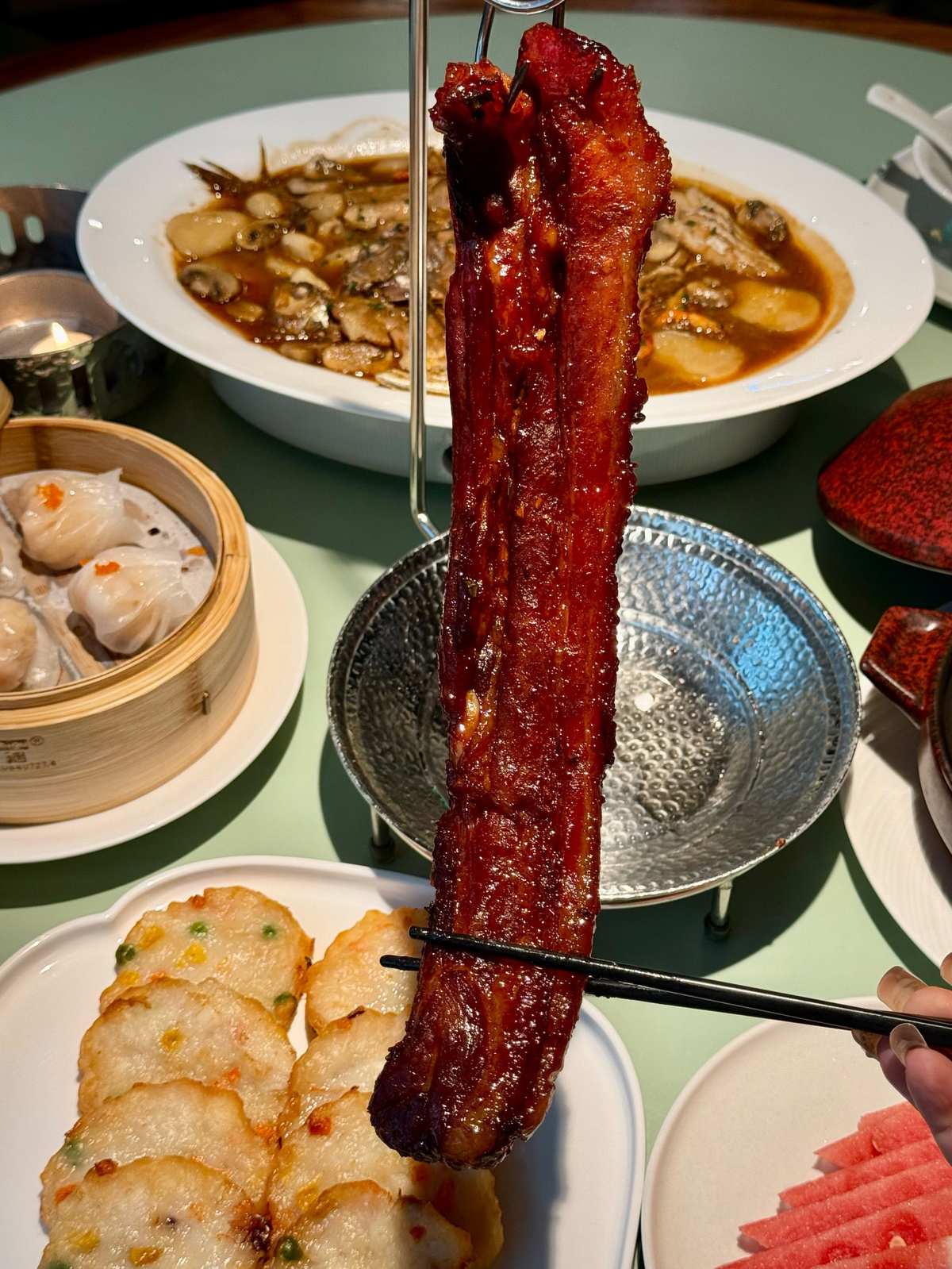
A 19th-century Guangzhou chef discovered that maltose, basted repeatedly during roasting, created a lacquer finish that sealed in juices and produced a shattering exterior. The technique spread across Cantonese kitchens and never left. Today, every siu mei shop in Hong Kong, Guangzhou, and every Chinatown from Vancouver to Melbourne hangs pork by hooks in a window facing the street. The window isn’t a display case. It’s advertising.
The Enemies of Char Siu
Char siu has one fatal vulnerability: people think the color is the point. It’s not.
Walk into a suburban dim sum parlor where the char siu glows neon-red like a traffic cone. That’s food coloring — usually red dye No. 3 mixed into a sugar-water glaze — substituting for the fermented bean curd that gives real char siu its deeper, more natural mahogany. The dye version tastes like sugar and regret. The meat underneath is usually pork loin, which has the fat content of a dish towel and dries out the instant it sees heat.
Other tells: char siu that never saw fire. Some kitchens roast it in an oven with zero direct heat and call the slightly browned edges “char.” It’s not char. Char is black. Char is carbon. Char is the difference between a sunset and a fog bank. If your pork has no blackened edge anywhere on it, you are eating ham with a tan.
Sauce that’s been poured on after cooking, forming a gummy layer that slides off the meat in one piece when you bite. Real char siu’s glaze is basted on during roasting in three or four passes so it reduces, caramelizes, and bonds to the meat at a molecular level. It shouldn’t slide. It should shatter.
And the saddest version: pre-sliced, pre-packaged, refrigerated char siu from an Asian grocery chain, sweating in a plastic tray. You can microwave it. You can call it dinner. You cannot call it char siu.
Real char siu is:
- Pork collar or belly, never loin. You need fat striations that render and baste.
- Fermented red bean curd (南乳) in the marinade — the color, the funk, the salt. This is the ingredient that separates Cantonese char siu from every other sweet roast pork on Earth.
- Maltose syrup (麦芽糖), basted in multiple layers during roasting, never after. Maltose is thicker than honey, less sweet than sugar syrup, and it sets into a hard gloss instead of a sticky coating.
- Five-spice powder: star anise, cloves, Chinese cinnamon, Sichuan peppercorn, fennel seed. A whisper, not a shout. You should sense florals and warmth, not a potpourri bomb.
- Direct flame. Gas broiler, charcoal, or the back wall of a blazing oven. The char is earned, not painted on.
- The window. A proper siu mei shop hangs the meat where you can see it. If you can’t see the hooks, you’re in the wrong place.
How to Eat It
Char siu has three correct destinations.
One: over rice. The simplest. White rice, sliced char siu laid across the top so the residual heat from the grains warms the glaze just enough to release another wave of aroma. Drizzle a spoonful of the drippings — the caramelized juices that collect at the bottom of the roasting pan — over the rice. This is char siu fan (叉烧饭) and it is the lunch of Hong Kong construction workers and stockbrokers alike, eaten from a styrofoam box with plastic chopsticks in under five minutes.
Two: in soup noodles. Char siu dropped into a bowl of wonton mein or lo mein where the broth softens the glaze just slightly and the pork’s sweetness leaches into the soup. The charred edge stays crisp if they add it at the last second. If they add it early, find a new noodle shop.
Three: straight. Standing at the counter. The shopkeeper hands you a piece on the cleaver flat and you eat it with your fingers because you are a mammal and some things do not require utensils. The first piece is always the best. The third piece is when you order half a catty to take home.
My grandmother, who grew up in Guangzhou’s Liwan district, used to say you can judge a roast-meat shop by its window. If the char siu is the first thing you see, it’s a good shop. If the roast duck is in front and the char siu is hidden in the back, the shop is ashamed of its pork. She never explained how she knew this. I have never found a counterexample.
Try our Peking Duck feature for another roast masterpiece. Or our Dan Dan Noodles — different province, same level of obsession.
💬 Comments