Chaoshan Beef Hot Pot: A Cow Cut Into Twenty Names
The cow arrives before the customers do.
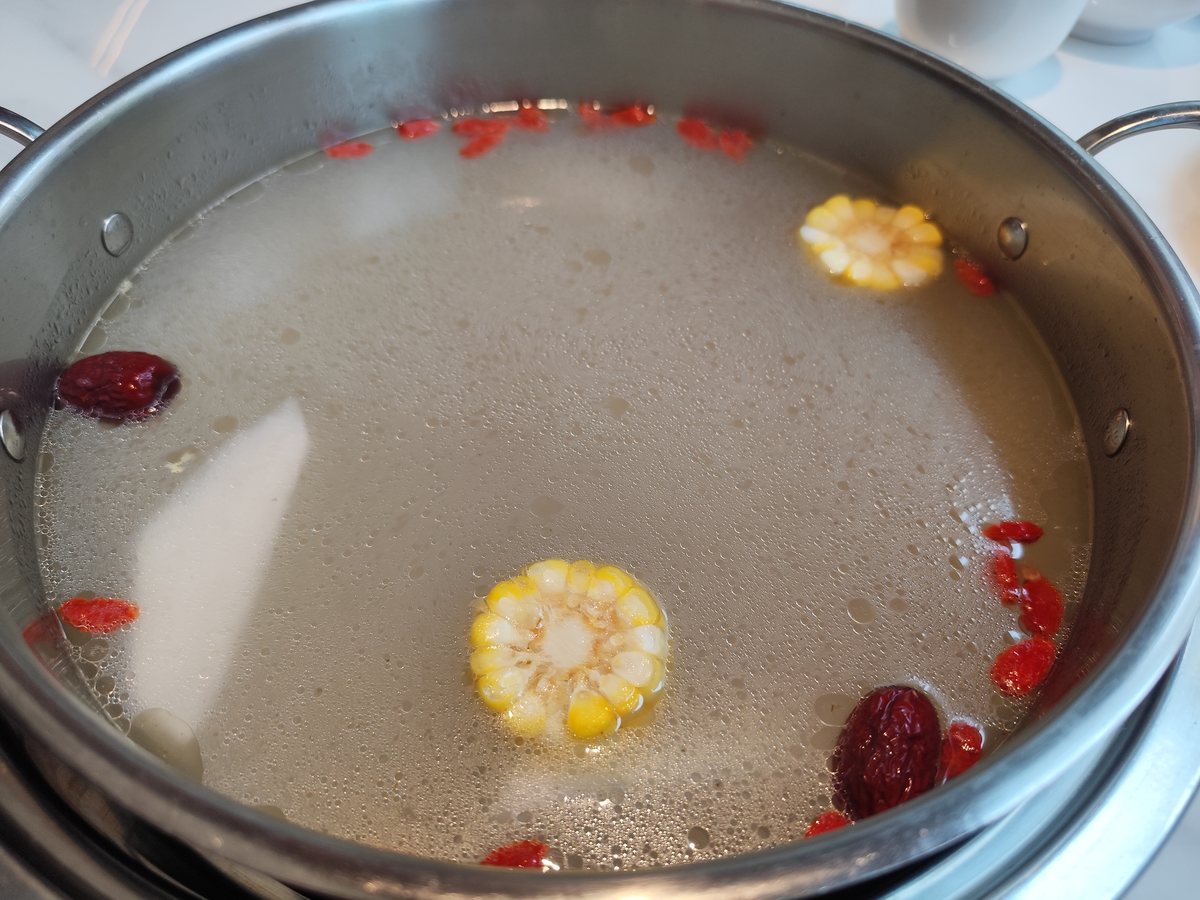
Six in the morning, back door propped open, a hindquarter on a steel trolley and two men steering it down a corridor barely wide enough. By eleven the corridor smells of bone and the front room is full. The broth has been at a bare simmer since dawn and contains nothing you could name from the taste: salt, a few coins of 南姜 (nánjiāng, galangal), daikon. That is the whole recipe.
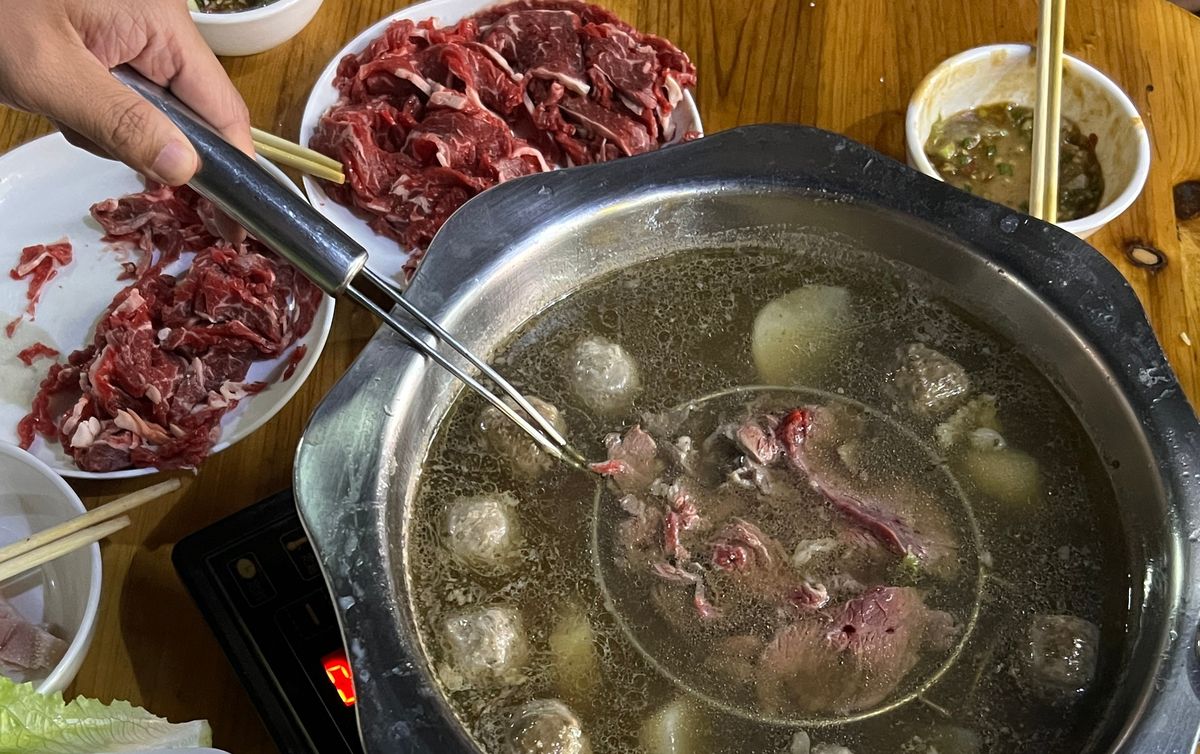
You sit. Someone puts a plate down: beef, raw, fanned in a spiral, thin enough that the pattern of the plate shows through. Someone tells you what it is. You will not remember. Then the water comes to a boil, a pair of chopsticks goes in, and the table goes quiet for a second — because the next eight seconds decide the meal.
The man with two cleavers
Behind the counter is a man who has been cutting this same animal for thirty years, and he is the restaurant. Not the broth. Not the sauce. Him.
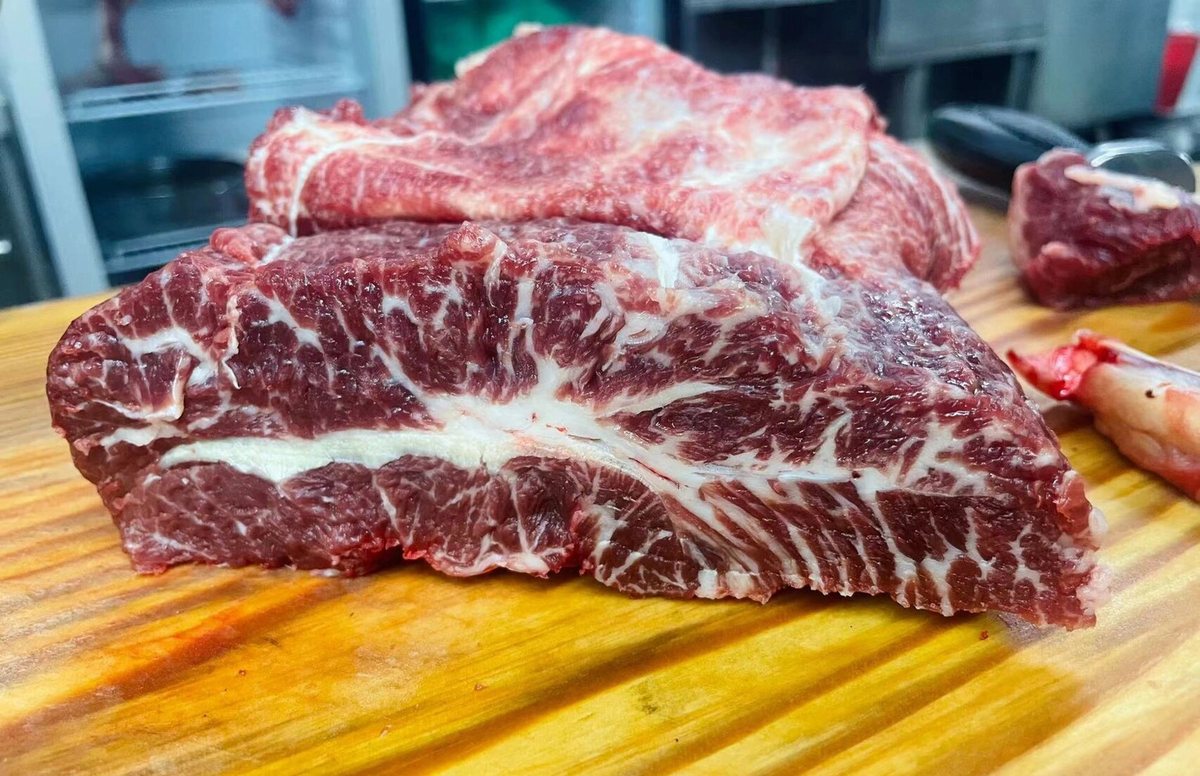
A Chaoshan shop works through one cow a day, and that cow comes apart into ten or twenty cuts, each with a name, each name describing a muscle and what that muscle does for a living. 吊龙 (diàolóng) is the strip along the sirloin: soft, faintly sweet, ten seconds. 匙柄 (chíbǐng) is the shoulder blade with a tendon running through the middle like a vein of ice — ten seconds, and the tendon is the point. 五花趾 (wǔhuāzhǐ) comes off the hind shank, all connective tissue, and it goes in for fifteen and comes out with a crunch you can hear across the table. 胸口朥 (xiōngkǒuláo), the fat cap over the brisket, needs two full minutes, after which it is not greasy at all. It is springy, closer to tendon than fat, and it tastes like the idea of beef rather than beef.
None of that is decorative. Cut thick, a shank slice is rubber. Cut thin, it is a different food. The man at the counter is deciding, plate by plate, how long your dinner takes, and he is doing it with a blade that looks like it came off a car spring.
Nothing gets thrown out either. The trimmings, the odd shapes that will not fan out on a plate — those become 牛肉丸 (niúròuwán), beef ball, and the ball is pounded with a mallet rather than ground, long enough for the protein to turn sticky and elastic. A good one squeaks against your teeth. That is why the two things are sold in the same shop: the ball is what the cow does with its leftovers.
Eight seconds
The water is not a soup. It is a clock.
Chaoshan cooks talk about 三吊水 (sān diào shuǐ) — three dips. Lower the meat, lift it, lower it, lift it, lower it. The first dip sets the outside. The second carries heat to the center. The third finishes it. Seven up, eight down, if you count the way the old men do. It sounds like folklore until you get it wrong once: leave a slice of 吊龙 in for fifteen seconds and it goes pink, then grey, then pencil eraser.
The first time anyone explained this to me was at a table in Shantou, in a shop off a side street, with a colleague whose family is from there. He would not let me touch the chopsticks for the first three plates. He cooked them himself, dropped them in my bowl, watched my face. When I finally got the tongs I overcooked four slices in a row, and he took them back without a word and ate them himself, which was worse than a lecture.
The other half of the trick is the beef itself. Chaoshan shops want meat that is hours old, not days. The animal is slaughtered locally, usually overnight, and it is on the table the same morning, before rigor has fully set in. That is why the slices look wet and cling to each other. It is also why this is one of the few Chinese meals that is genuinely hard to reproduce far from its source. You cannot ship that.
The broth that refuses to help
Every other hot pot in China is trying to add something. Chongqing throws beef tallow and chilies at you until your lips go numb. Beijing wants copper, charcoal, lamb. Chaoshan goes the other way: the broth stays plain on purpose, so a flaw in the beef has nowhere to hide.
Which makes the bad versions easy to spot. If the meat shows up in a plastic tray, frozen, machine-shaved into identical curls, that is 肥牛卷 (féiniújuǎn), supermarket beef roll, and it will taste of freezer and leak grey foam the second it hits the water. If the broth is spicy, somebody is hiding something. If the beef is wagyu, you are in the wrong restaurant; that fat melts to grease in boiling water and leaves nothing to chew. And if the plate has been out long enough for the edges to brown, send it back. Sliced beef oxidizes fast, and oxidized beef tastes like the inside of a fridge.
The order of operations
Start lean, finish fat. 嫩肉 (nènròu) and 吊龙 first, while your palate is still paying attention. Then the tendon cuts, 匙柄 and 五花趾, so the crunch has somewhere to land. 胸口朥 last, because after two minutes in the pot it coats your whole mouth and everything afterwards tastes of it.
The dip is 沙茶酱 (shāchá jiàng), Chaoshan's peanut-and-dried-shrimp sauce, sweeter and nuttier than the satay it is related to. Some shops put out 普宁豆酱 (pǔníng dòujiàng) beside it. Use a little. The beef is the argument; the sauce is punctuation.
And when the plates are empty, do not leave. Take the rice noodles — 粿条 (guǒtiáo), wide and slippery, the same ones you would get in a bowl of beef noodles down the street — and drop them into the broth that has been collecting everything all night. Thirty seconds. A spoon of shacha on top. That bowl is the real last course, and half the tables around you came for it.
At the counter the cleaver hits the block again. Somebody else just sat down. Eight seconds, and the plate is empty.
No recipe this time. Making this at home starts with finding beef that was walking yesterday, and that is a sourcing problem, not a cooking one. If enough of you ask, I will write up the shacha sauce — that part you can actually make.
💬 Comments