Century Egg Tofu: Shanghai's Answer to August
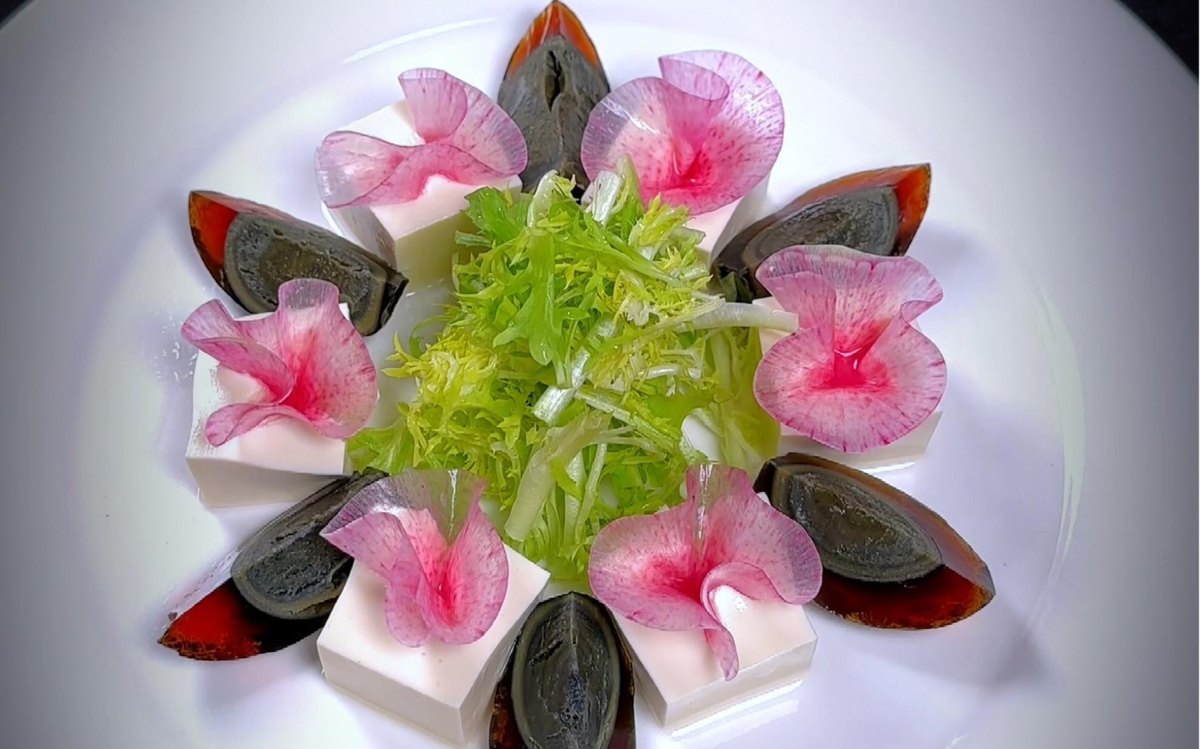
It is nine at night and the thermometer outside the kitchen window still reads 38. The air in the stairwell is thick enough to chew. You have given up on dinner, because it is too hot to want anything, and then someone sets a plate down in front of you: a white block of tofu, cold enough to fog the enamel, dark wedges of century egg laid against it like roof tiles, a spill of soy and sesame oil, a fistful of chopped scallion going limp in the heat.
You take one spoon and something in your chest unclenches. That is the entire job of this dish. Century Egg Tofu (皮蛋豆腐, pídàn dòufu) is not a dish that impresses anybody. It is a dish that rescues you.
I grew up with it as August food. My grandmother kept a block of silken tofu on the bottom shelf of the fridge the way other people keep milk, and when the city got unbearable she would pull it out, drain it, slice two eggs over the top with a paring knife, and dress it in under a minute. No cooking. The stove never got turned on. In a Shanghai summer that is not laziness, it is survival strategy.
Two temperatures on one plate
The Chinese name for the feeling is bīnghuǒ liǎngtiān (冰火两重天) — ice and fire, two heavens in one bite. Here it is literal and it is the whole architecture of the dish.
The tofu comes straight from the fridge, four degrees, bland and cold and slightly sweet. The egg sits at room temperature, dense and creamy, with a low sulfur warmth that blooms across your tongue. The chili oil, if you use it, is the fire. Eat them in one spoon and the temperature gap does something no single ingredient can do alone: the cold tofu scrubs your palate, the warm yolk coats it, and the next bite tastes as sharp as the first. Skip the temperature contrast and you have a plate of grey mush with soy on it. Which, unfortunately, is what most restaurants serve.
The tofu has to be the soft kind. In Shanghai that means the boxed silken curd sold as nèizhǐ dòufu (内酯豆腐), set with glucono delta lactone, so soft it barely holds a cube. You drain it for ten minutes, because water is the enemy — a wet block dilutes the dressing into a puddle of brown tea. You do not press it. Pressing crushes the curd and squeezes out the very water you were trying to move; gravity and time do the work. Then you cut it in the box, invert it onto the plate in one motion, and pray it lands in one piece. It usually does.
Firm tofu — the northern běidòufu (北豆腐) — is the wrong tool. It is built for frying and braising, and here it turns the dish into gravel. If that is all your supermarket has, make mapo tofu instead. This dish has no forgiveness for the wrong curd.
The egg is the sauce
Two century eggs per block of tofu, cut with a wet knife so the yolk does not drag. The yolk should be dark green-black at the edge and soft, almost jammy, at the center. The white should be amber and translucent, with the pale pine-flower crystals that tell you the egg was cured properly — alkaline ash, salt, quicklime, tea, a few weeks of patience. None of that is rot. It is chemistry, and the result is closer to a ripe cheese than to anything egg-shaped.
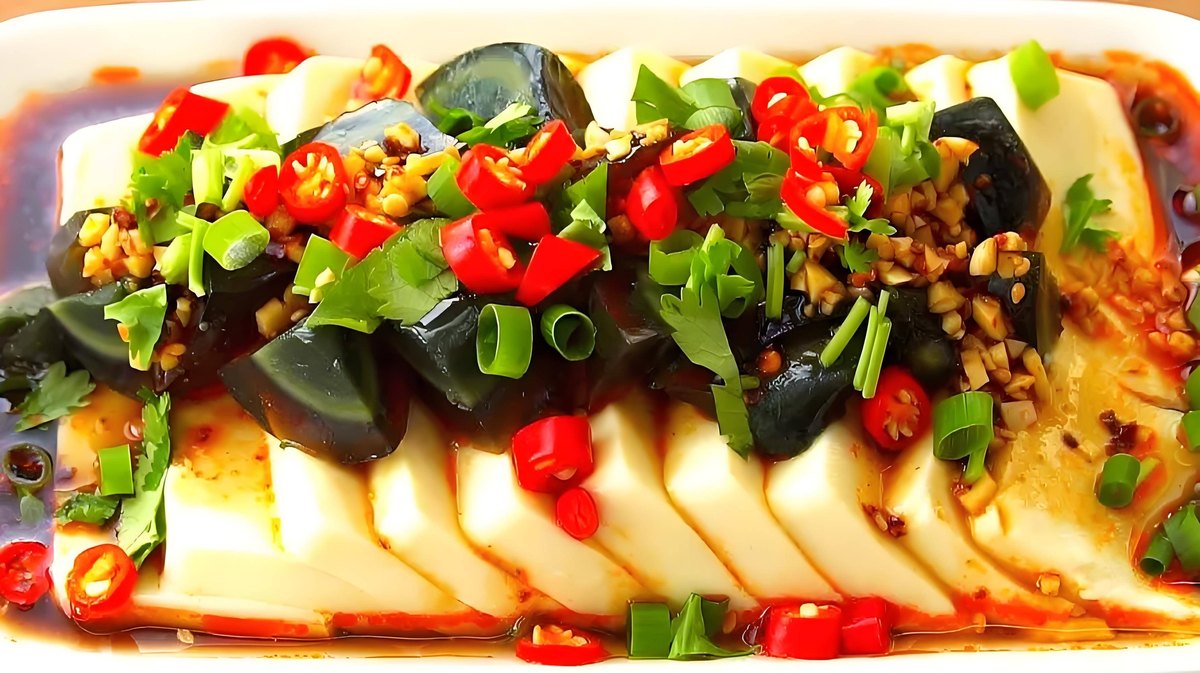
A good century egg tastes of cream and iron and a faint whiff of pond. A bad one tastes of ammonia and apology. There is no dressing in the world that fixes a bad egg, so buy from someone who sells a lot of them.
There is a small war about how the egg meets the tofu. Some households mash the two together with a fork into a rough grey paste, all in, one texture, sauce and solid at once. Others — my grandmother included — keep the wedges whole and let you assemble each bite yourself. The mash is faster and more consistent. The wedges are better, because the point is the contrast, and you cannot contrast what you have already stirred.
Dress it with light soy, a teaspoon of sesame oil, a pinch of sugar to round the salt, chili oil if the night calls for it. Scallion, coriander, maybe a little pickled ginger, maybe a scatter of pork floss. No vinegar. Vinegar is what people reach for when the egg is not good enough, and it flattens the creaminess into sourness. No raw garlic either. Garlic wins every argument on the plate, and this is not its argument.
The dish itself is a household habit rather than a restaurant invention — the century egg goes back to the Ming, and pairing it with cold tofu is what Jiangnan families did with both when the weather turned. Nobody wrote it down. It just showed up on summer tables, in every 弄堂, in every enamel plate that was never quite clean.
What goes wrong
Hotel buffets are where this dish goes to die. Tofu cubed a day ahead and sitting in its own water. Both ingredients refrigerated to the point where the yolk goes chalky and loses its cream. A dressing made in a bucket at 10 a.m., tasting of nothing but salt and vinegar. Then a garnish of something green and decorative that nobody eats.
Home cooks have their own version of the failure: dressing the plate and then letting it sit. Soy sauce is osmotic. Give it twenty minutes and it starts pulling water out of the tofu, and the clean white block turns into a soggy sponge in a brown bath. Dress it at the table. Eat it within ten minutes. What is left on the plate afterwards — the dark, oily, egg-flecked last of the soy — is for the rice, and it is the best part, so leave room.
And if you are the kind of person who needs this dish to be "healthy", understand what you are removing. The sesame oil is not optional. The fat is what carries the sulfur and the soy across the cold curd. Take it out and you have a diet food that tastes like one.
How to eat it
One spoon, loaded in this order: a cube of tofu, then a sliver of egg pressed into it, then drag it through the pool of dressing at the base of the plate. Eat it before you talk. The cold hits first, then the yolk blooms warm, then the salt and the sesame come up behind it.
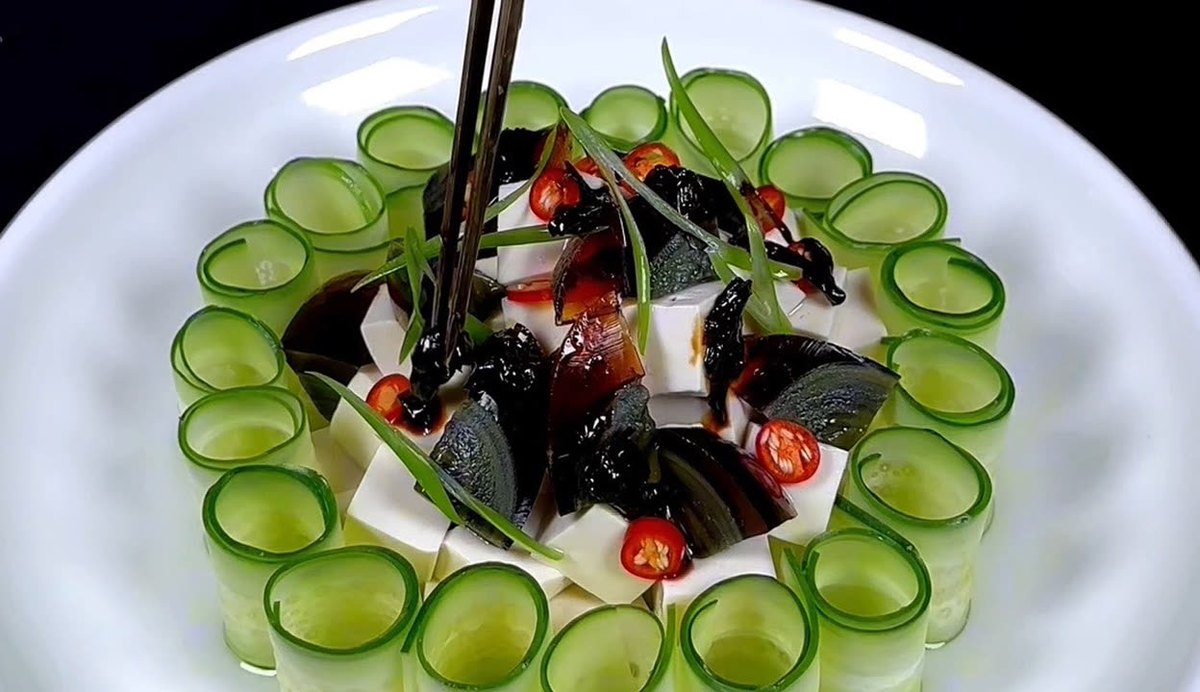
Do not stir. Do not mash. Do not put it in the fridge "to let the flavors marry" — they marry in your mouth, in four seconds, and that is the whole design.
My grandmother served it with nothing else. No rice, no second dish, just the plate and a fan and the sound of the city not cooling down. I have eaten it in restaurants with better ingredients and worse results. The dish rewards almost nothing except restraint and cold.
Out of space for today — the home-cooking version deserves its own post. The one thing that matters is draining: ten minutes, no pressing, and a plate that goes to the table dry. Get that wrong and nothing else saves it. Recipe coming soon.
Want to cook this? Here’s the step-by-step Century Egg Tofu recipe.
💬 Comments