Buddha's Delight: The Temple Dish That Fakes Meat Better Than Meat
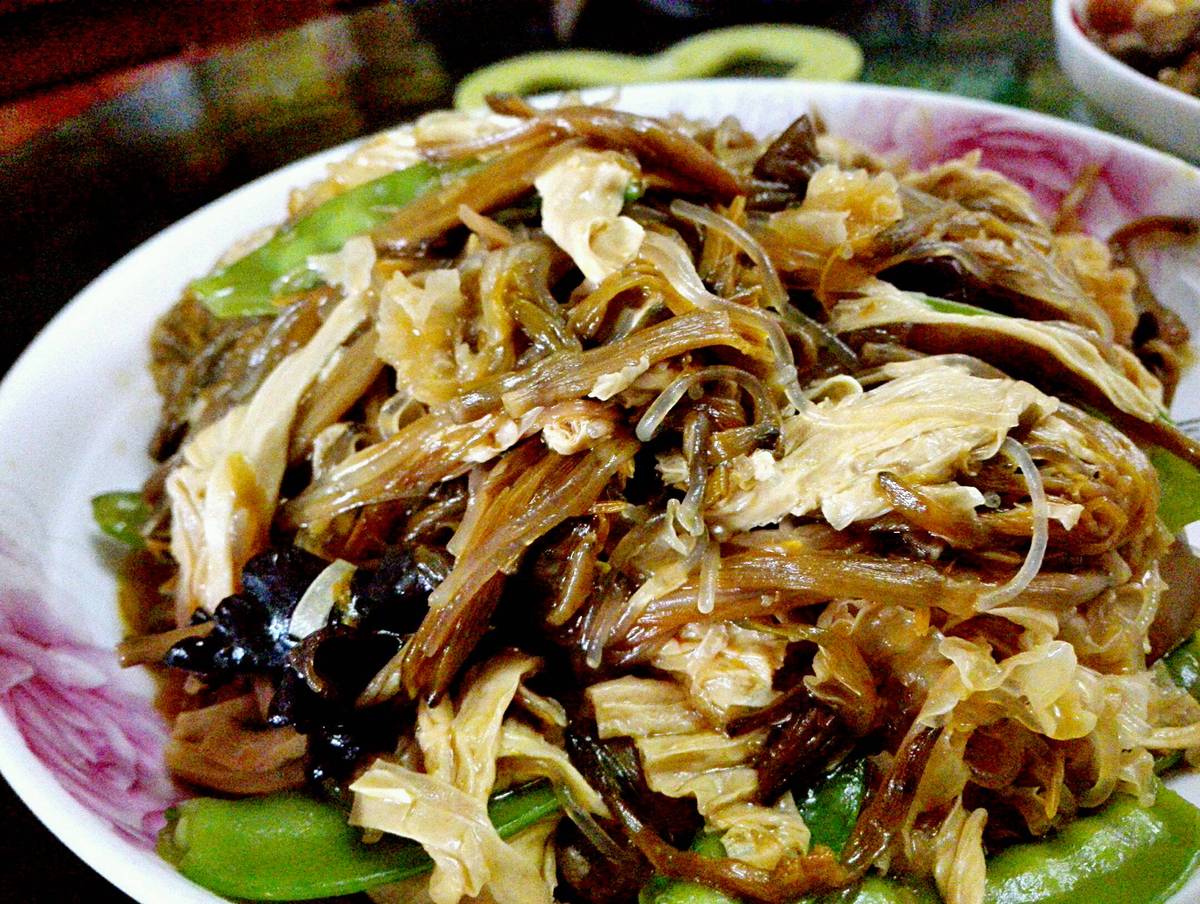
The plate lands and my uncle leans in. "That's goose," he says. "Look at the skin."
It is not goose. It has never been goose, and he knows it — we are in Göngdélín (功德林), a vegetarian house that has been faking meat since 1922, and my grandmother has been taking me here after temple visits since I was tall enough to see over the table. The room smells of sesame oil, soy, and the hot-sugar smell of gluten coming out of the fryer. The "skin" is yuba, dried tofu skin, fried and then braised until it wrinkles like a bird hanging in a Cantonese window. He chews. He goes quiet. Then he says, "Fine. It's better than goose," and reaches for more. Nobody at the table says anything. We've all seen this happen before.
This is what Buddha's Delight actually is. It is almost certainly not what you have been served.
The plate you know
If you have ordered Buddha's Delight (羅汉斋, luóhàn zhāi) in the West — sometimes printed as "Lo Han Chai" — you got broccoli, carrot coins, baby corn, canned straw mushrooms and a handful of snow peas, all tossed in a brown sauce that tastes like soy sauce and cornstarch having a quiet disagreement. It arrives as a side dish. It costs eleven dollars. Nobody at the table fights over the last piece.
I'll be fair: it's edible, and on a Wednesday it might be exactly what you want. But it has about as much to do with the real dish as a supermarket croissant has to do with one in Paris. The name survived the ocean crossing; the cooking did not.
The real thing is temple food — 斋菜 (zhāicài), the cooking of Buddhist monasteries — and in China it is not a penance, not a health kick, not the sad option for your cousin's girlfriend. It is a cuisine with knife work, with stocks, with its own repertory of imitation meats so labor-intensive that a good temple kitchen will spend two days on a single banquet. The grand version is 鼎湖上素 (Dǐnghú shàngsù), from Qingyun Temple in Zhaoqing: three kinds of mushroom, six kinds of fungus, nine kinds of bamboo shoot. It was cooked for emperors. It costs more than the duck.
Eighteen names, one wok at a time
The name is a joke that got old and then got respectable. Luóhàn are the arhats, the eighteen enlightened figures lining the walls of a temple hall; zhāi is a vegetarian meal. So the dish is "the arhats' feast," and the ingredients are supposed to number eighteen, one for each of them. Nobody counts strictly. What matters is that there are many, that they are different, and that they arrive from different directions.
The roll call runs something like this: shiitake, wood ear, cloud ear, golden needle (dried lily buds), bamboo shoot, lotus seed, ginkgo nut, fried gluten puffs, yuba, fresh tofu skin, bamboo pith, snow peas, napa cabbage, carrot, dried scallop mushroom, black moss, and whatever the cook found at the market that morning.
Here is what separates this from a stir-fry. Eighteen ingredients cannot share one cooking time. Snow peas are done in ninety seconds. Gluten needs three minutes to drink up sauce. Ginkgo is bitter and wants its own blanch. Dried lily buds must be soaked, their hard tips pinched off one by one, then braised. Bamboo shoot is bland and has to be cooked in stock before it tastes like anything at all. So the kitchen cooks each one separately — blanch, fry, braise, steam — and only at the end folds them together with a stock built from soybean, mushroom stems and kelp. The dish is an assembly, not a stir-fry. It is the most labor-intensive vegetable plate in China, and that is why a proper version costs what it costs.
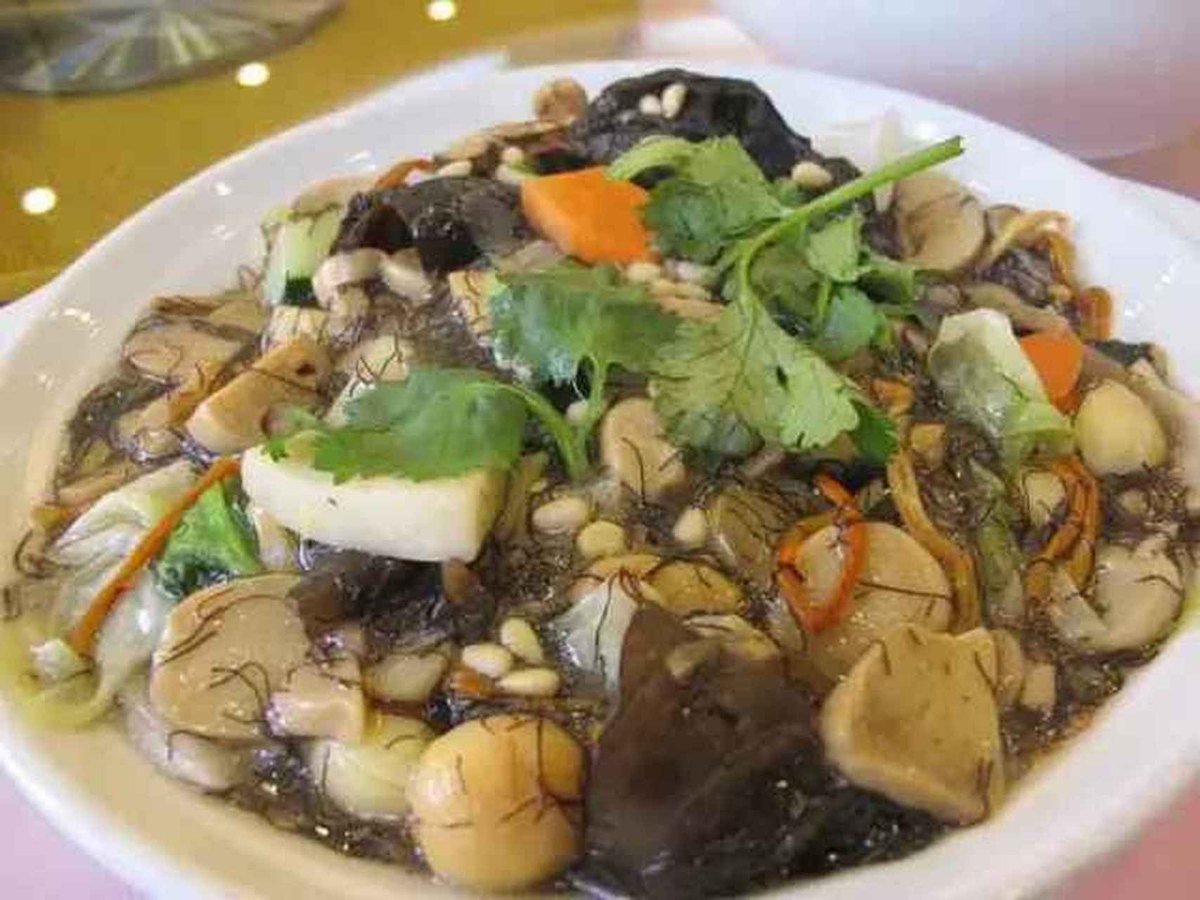
The stock is where the flavor lives. No meat, no bones, so the cook builds savoriness out of dried things: mushroom stems saved all week, seaweed, a little fermented bean paste, a spoonful of the water the lily buds soaked in. It is the same problem a Western vegetable cook faces and usually solves with butter. Chinese temple kitchens solved it with fermentation and drying, several centuries before anyone put the word umami on a menu.
The fake goose problem
Then there is the imitation meat, which is where the whole thing turns strange and wonderful. 面筋 (miànjīn), wheat gluten, is kneaded and washed until the starch rinses away and what's left is a gray, elastic mass that can be rolled, steamed, fried and braised into something that shreds along the grain exactly the way poultry does. Konjac, a root that sets into a firm translucent jelly, gets cut into "scallops." Tofu skin is folded and tied into "goose." Whole restaurants in China exist for this illusion alone, and their customers are not all vegetarians. Plenty are meat eaters who simply find the fake goose more interesting than the real one.
Which brings me back to my uncle. The point of the fake goose was never deprivation. It was craft: a test of whether the kitchen could make you forget what you were eating. When it works you don't feel cheated. You feel like somebody let you in on the trick.
What ruins it
Baby corn. It is the tell. Baby corn in a Chinese vegetarian dish means somebody opened a freezer bag and called it a tradition. Real versions use fresh bamboo shoot, and the difference in the mouth — crisp and faintly sweet versus squeaky and watery — is the whole argument in one bite.
Oyster sauce. Read the menu, then read it again. A startling number of "vegetarian" dishes in Cantonese restaurants get finished with oyster sauce, because that is what the kitchen reaches for without thinking. It is not vegetarian. It is the most common quiet lie on a Chinese menu outside China, and if you are ordering for a monk or a vegan, ask twice.
One wok, everything at once. If all eighteen ingredients hit the oil together, the snow peas go gray, the gluten collapses, and you get a wet pile with the texture of a kitchen accident. You can taste the shortcut: everything is soft in the same way.
Oil instead of stock. Cheap versions arrive swimming in a red-orange slick, because fat is the fastest way to make vegetables taste like something. A good plate is glossy, not greasy. The sauce clings. There is maybe a tablespoon left at the bottom when you finish, and you'll want it.
How to eat it
Find a temple restaurant, or a 斋菜馆 near one. Order the luóhàn zhāi and one thing you don't recognize. Eat it with plain white rice, never noodles — the sauce is the point, and rice is the only thing that carries it properly. Start with the fried gluten while the edges are still crisp, then work toward the braised mushrooms and bamboo, which improve as they sit in the sauce. Save the ginkgo for last. It is slightly bitter and slightly sweet, and it tastes like the end of a meal.
Then drink tea. Oolong, not jasmine. Jasmine is perfume; oolong clears the fat off your tongue. My grandmother's rule, and I have never found a reason to break it.
The best time to eat it is the first and fifteenth of the lunar month, when half of Shanghai goes vegetarian for a day and the temple kitchens cook for a crowd. The food is better when the room is busy. Everything is.
So next time a menu offers you Buddha's Delight, ask the kitchen how many ingredients are in it. If the answer is five, order the eggplant.
💬 Comments