Big-Plate Chicken: The Dish That Won't Fit on Your Table
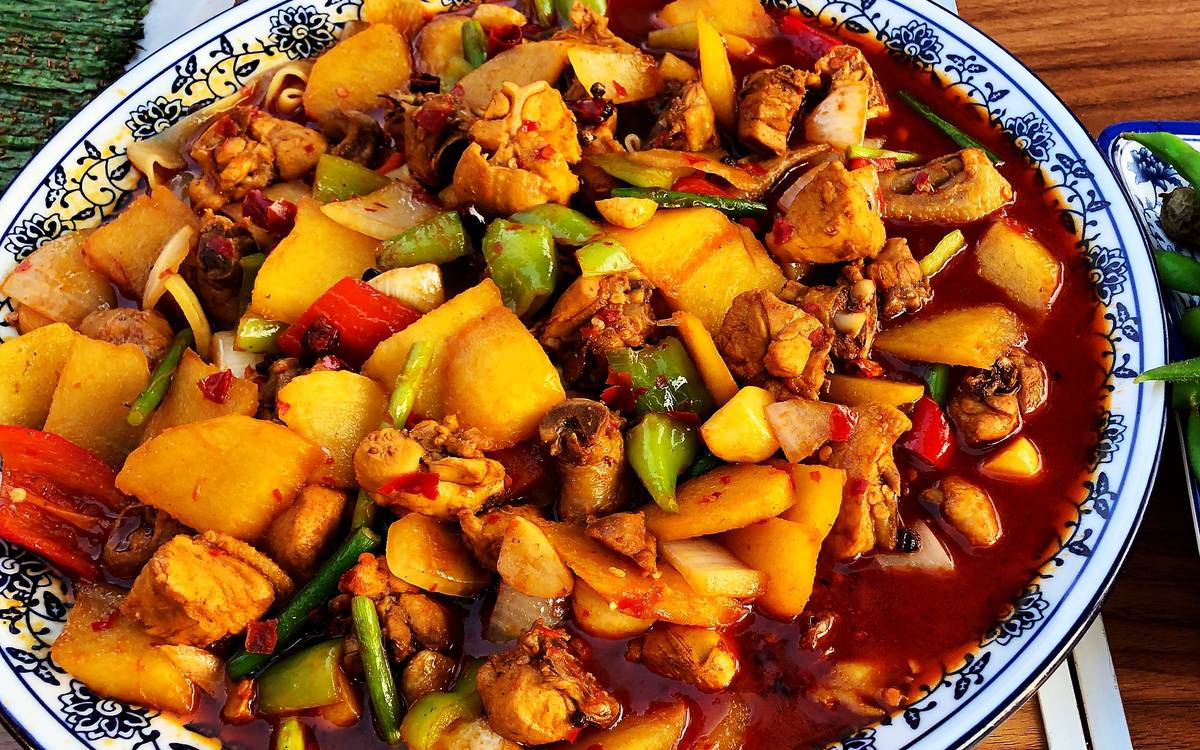
The plate arrives before the food does, because it has to. It won't fit anywhere else on the table. Two hands, a folded towel under one edge, and the waiter walks it in sideways like a door.
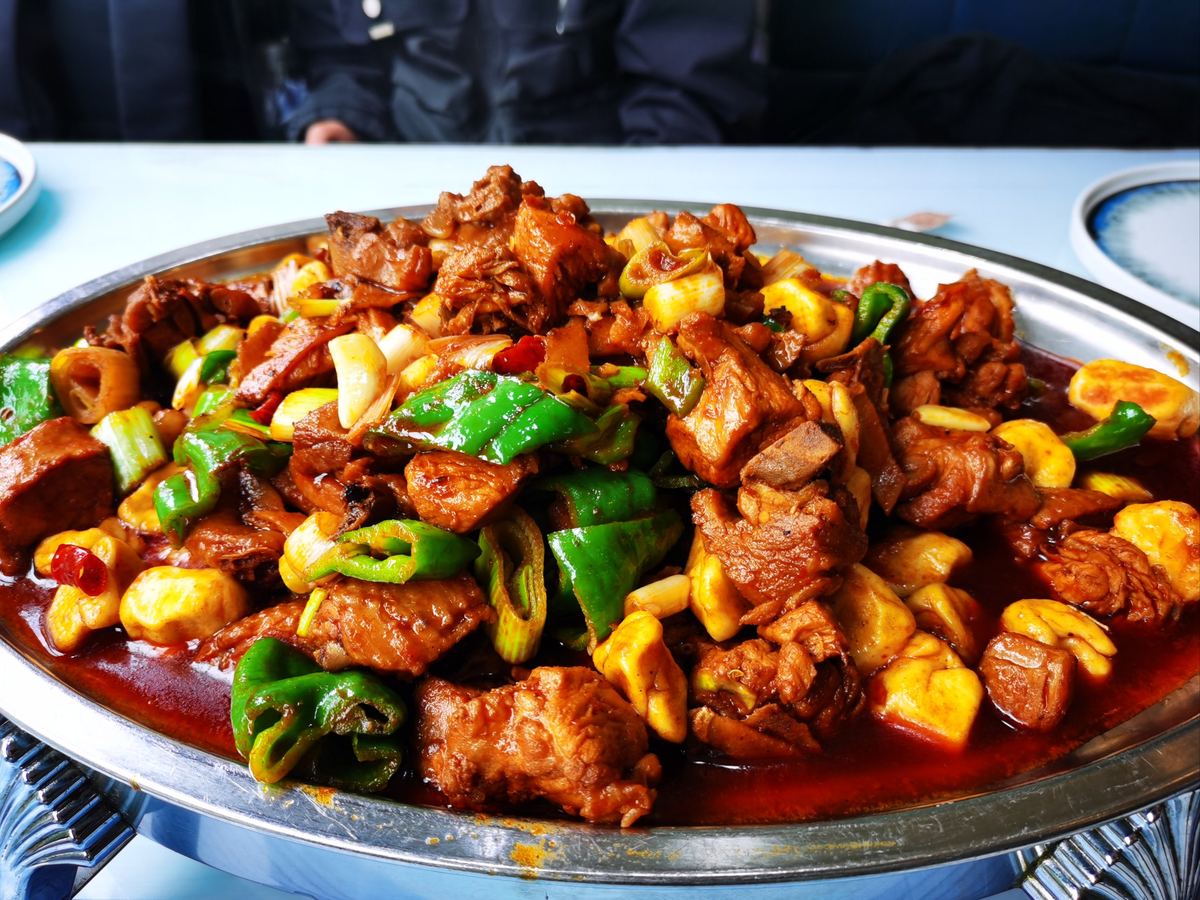
What lands is a chicken. Not a portion of chicken — a whole bird, chopped through the bone into thumb-length pieces, braised to a dark brick red in a sauce that smells of dried chili, star anise, and beer. Potato wedges slumping at the corners. Green peppers laid across the top, still hissing. Around the rim, a slick of chili oil the color of rust, and under it, if you look, the lake of sauce you are going to spend the next hour negotiating with.
A friend of mine from Urumqi spent a full year telling me every version of this dish in Shanghai was wrong. Then he took me to a basement place off Changshou Road, where the cook came from Shawan and the only decoration was a framed photograph of a truck. He ordered in Uyghur, then turned to me and said: "Now you'll see how much sauce you've been wasting."
Big-Plate Chicken (大盘鸡, dàpán jī) is the most communal thing I know how to order in a Chinese restaurant. One dish, one plate, four people, no ceremony. You do not get your own. That is the entire architecture of the meal.
The plate is the invitation
Count the bird. A proper 大盘鸡 starts with a whole chicken, somewhere between one and one and a half kilos, hacked apart with a cleaver on a wooden block. You hear it before you see it — that flat, heavy thwack from the back kitchen, bone going through, not around. If your chicken arrived already boneless, somebody made a decision on your behalf and it was the wrong one. The bone is where the collagen lives. The collagen is what makes the sauce feel like it has weight.
Then the potatoes. People treat them as filler. They are not filler, they are the thickener. Cut into rough wedges and cooked in the braise until the outside goes floury and starts to dissolve, they do what cornstarch cannot: they make the sauce cling. By the time you're halfway through, the liquid in the plate has tightened into something closer to gravy. That is not an accident. That is the potatoes doing their job.
And the chilies. Not for pure heat. Xinjiang cooks use a lot of dried red chilies, and a lot of them are there for fragrance and color — the fruit-and-smoke note you get before the burn. The heat builds slowly, from the back of the plate forward, and it never quite turns into the numbing assault of Sichuan food. This is a different register: warm, smoky, a little sweet from the onion and the beer the chicken was braised in.
The smell when the lid comes off is the part I'd bottle if I could. Chili oil, star anise, chicken fat, and underneath all of it, the flat malt smell of beer that has cooked down to almost nothing. It hits you at arm's length. It stays in your jacket for a day.
Shawan, on the 312
The dish is young, which surprises people. It comes out of Shawan County (沙湾) in Tacheng Prefecture, northern Xinjiang, in the early 1990s, on the national highway that carried trucks west. Long-haul drivers wanted one thing: a large amount of food, fast, that could sit on a table and be attacked by four tired men with cold beer. The version most cooks tell is that a restaurant ran short of small plates during a busy service, so a whole chicken went out on the biggest dish in the kitchen. That may be folklore, but the dish explains itself. It was built for a roadside table, not a dining room.
Belt noodles, and when to ask for them
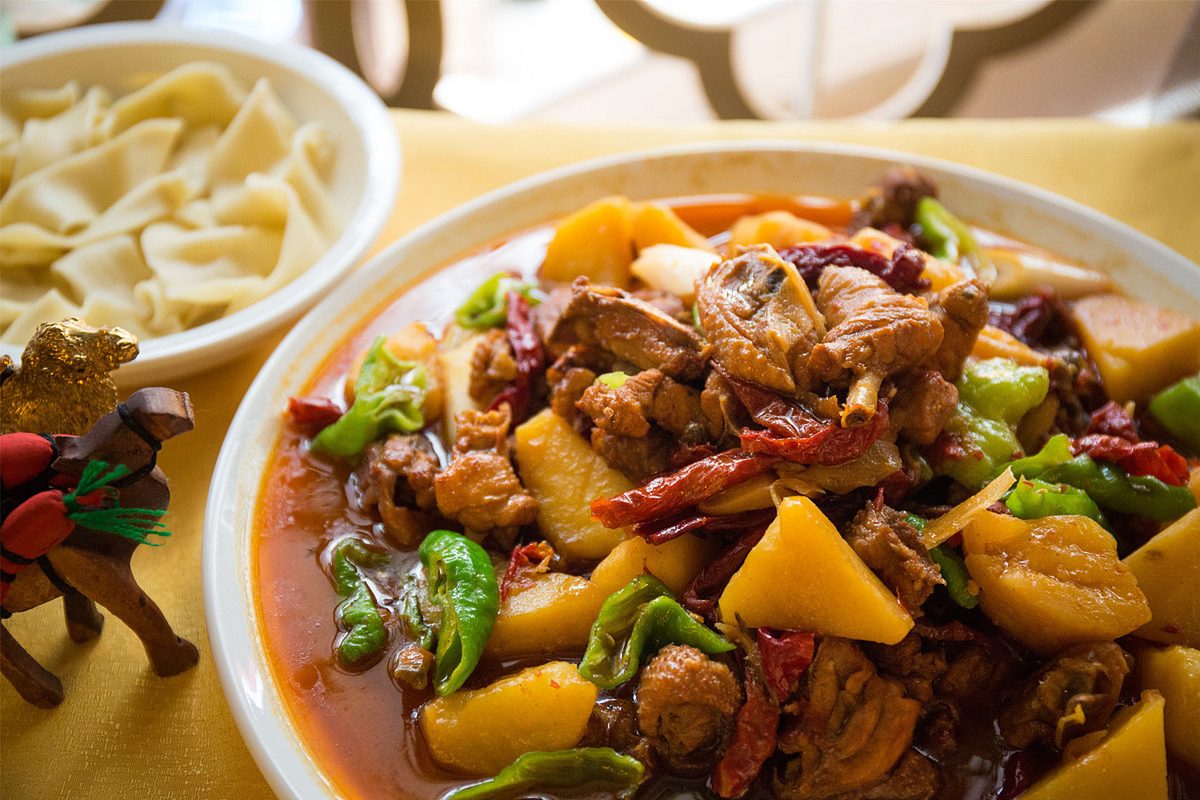
Here is the thing that separates 大盘鸡 from chicken stew: 皮带面 (pídàimiàn), belt noodles. Wide, hand-pulled, thick enough that they need to be chewed rather than slurped. The cook stretches them to order and slaps each one against the steel counter — a wet crack you can hear across the room — then drops them into boiling water and pulls them out while they still have a snap.
They do not come with the chicken. They come after. Get that timing wrong and the whole thing collapses. You eat the chicken first. You let the plate drop to maybe a third full — sauce, potatoes broken down, chili oil, a few scraps of skin. Then you ask for the noodles, and they go into that reduced, concentrated, slightly sticky liquid, and you toss them through it yourself with your chopsticks until every ribbon is dark.
Ask for them when you order, not when the plate is empty.
Where it falls apart
Restaurants outside Xinjiang ruin this dish in predictable ways, and once you know them you can spot a bad 大盘鸡 from the menu.
Chicken breast is the first crime. Boneless, skinless, lean — it cooks into something with the texture of a pencil eraser and gives the sauce nothing. If a menu advertises "boneless chicken" as a feature, it is advertising that it has removed the only ingredient doing structural work.
Ketchup is the second. Some kitchens want that bright red and reach for tomato paste or, worse, ketchup, and the sauce turns sweet and pink and one-dimensional. A proper plate is brown-red and savory, and the sweetness comes from onion and a little sugar at the end, not from a bottle.
Cumin is the third, and it annoys me the most. Cumin belongs to the skewer grill, and it's wonderful there. Sprinkling it over a big plate of chicken is a costume — a shortcut to tasting "Xinjiang" without doing the work of a real braise. If the cumin arrives before the chili, you're eating a theme, not a dish.
Then: rice. Serving 大盘鸡 with a bowl of white rice tells you the kitchen doesn't trust its own sauce to carry noodles. It's like serving a good broth with crackers.
And the last one, quieter. Undercooked potatoes. A wedge that's still firm in the middle means the braise was rushed, and if the braise was rushed, the chicken didn't get its twenty-five minutes either, and what you're eating is chicken in sauce rather than chicken of sauce.
How to eat it without wasting the point
Three people minimum, four is better. Order one plate, one cold dish to start — smashed cucumber, something vinegary — and beer. Not tea. The carbonation cuts the chili oil in a way hot tea cannot,
Go for the potatoes about ten minutes in, when they've soaked but haven't yet collapsed. Take the skin. Take the wing tips and the neck if they're in there, because those are the pieces the cook kept for himself in his imagination. Don't stir the plate constantly — let the sauce reduce at the edges.
The last bite is the one worth planning for: a single belt noodle, thick as a thumb, dredged through what's left at the bottom of the plate, glossy with chili oil and potato starch and the last of the chicken fat. Everything in the meal was, in the end, an elaborate method for getting that one noodle into your mouth.
My friend from Urumqi never did admit that the Shanghai version was any good. But he came back to that basement twice more, and the second time he was the one who asked for extra noodles.
💬 Comments