Biang Biang Noodles: The Slap You Can Hear Down the Lane
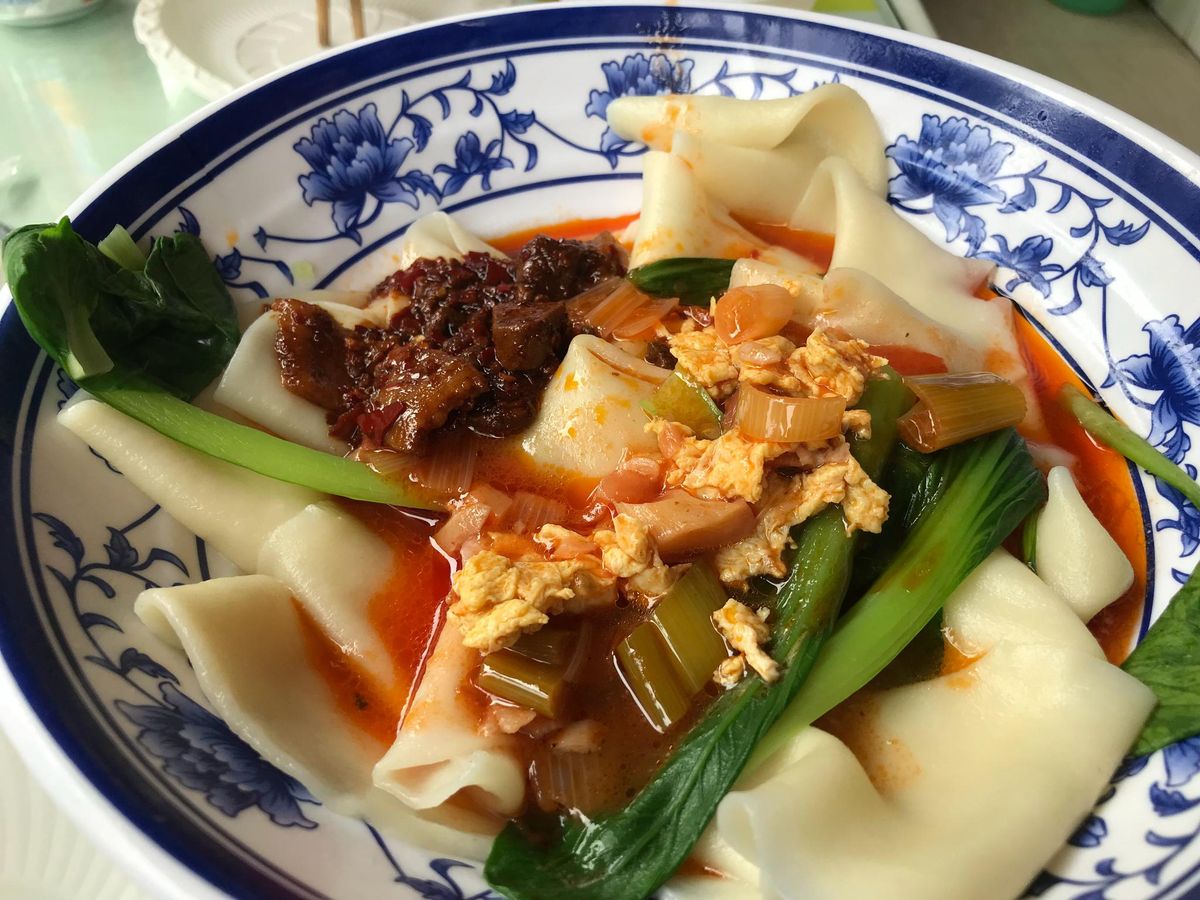
You hear it before you see the shop. A wet, flat crack against wood. Then again. Thwack. Thwack. Thwack. Steady as a metronome, loud enough to carry the whole length of the lane.
What you are hearing is a man hitting dough.
He works at a board the size of a door in the back of a stall no wider than a corridor, sleeves shoved to the elbow, flour to the wrists. Between his hands is a rope of rested dough he has been stretching for the last minute. Now he lifts it and brings it down flat on the counter, once, twice, three times, quick. Each slap pulls the rope longer. Coil, stretch, slap. By the time he is finished there is nearly a metre of pale ribbon hanging from his fists, thick at the ends, thin through the middle, and he drops it into the boiling pot while he reaches for the next piece.
That slap is the dish. The dish is named after it.
Biang Biang Noodles (裤带面, kùdài miàn) go by two names and they tell you different things. 裤带 means trouser belt, the strap that holds a man's trousers up, and one noodle comes out about that wide. The other name, 面 biángbiáng miàn, is not a word at all. It is the sound of dough hitting wood, written down.
A Character You Can't Type
Biáng is the most complicated character in everyday Chinese. Fifty-eight strokes by the common count, though you will see forty-two if someone is using the simplified version and fifty-six if they learned it off a different sign. Nobody agrees, because for most of its life the character lived on painted boards and handwritten menus and nowhere else. You could not type it. It had no key.
Structurally it is a stack of radicals that mean things on their own — a roof, speech, a horse, a long measure, a heart, a blade — but the pieces do not add up to a meaning. They add up to a scene. In 2020 a simplified version finally landed in Unicode, which means it can be typed now. Almost nobody does. The shop still paints it. Kids there learn a rhyme for writing it instead, a dozen nonsense lines long, the way children elsewhere learn the alphabet.
Flour, Water, Salt, and Nerve
What is actually in the bowl is a short list. Flour, water, salt. No egg, because egg noodles belong to Cantonese soup. No lye water, because alkaline dough is Lanzhou's business. Shaanxi's belt noodles are the plainest dough in China, and the hardest to get right, because everything depends on rest and nerve.
The dough gets mixed stiff, kneaded until it is smooth, then covered and left alone for half an hour, sometimes an hour. Then it is cut into fat strips, each one rolled into a short log and brushed with oil, and then it rests again. Only after that does it get pulled. A dough that has not rested fights you. It springs back, rips at the edges, and you end up with something ragged and ashamed.
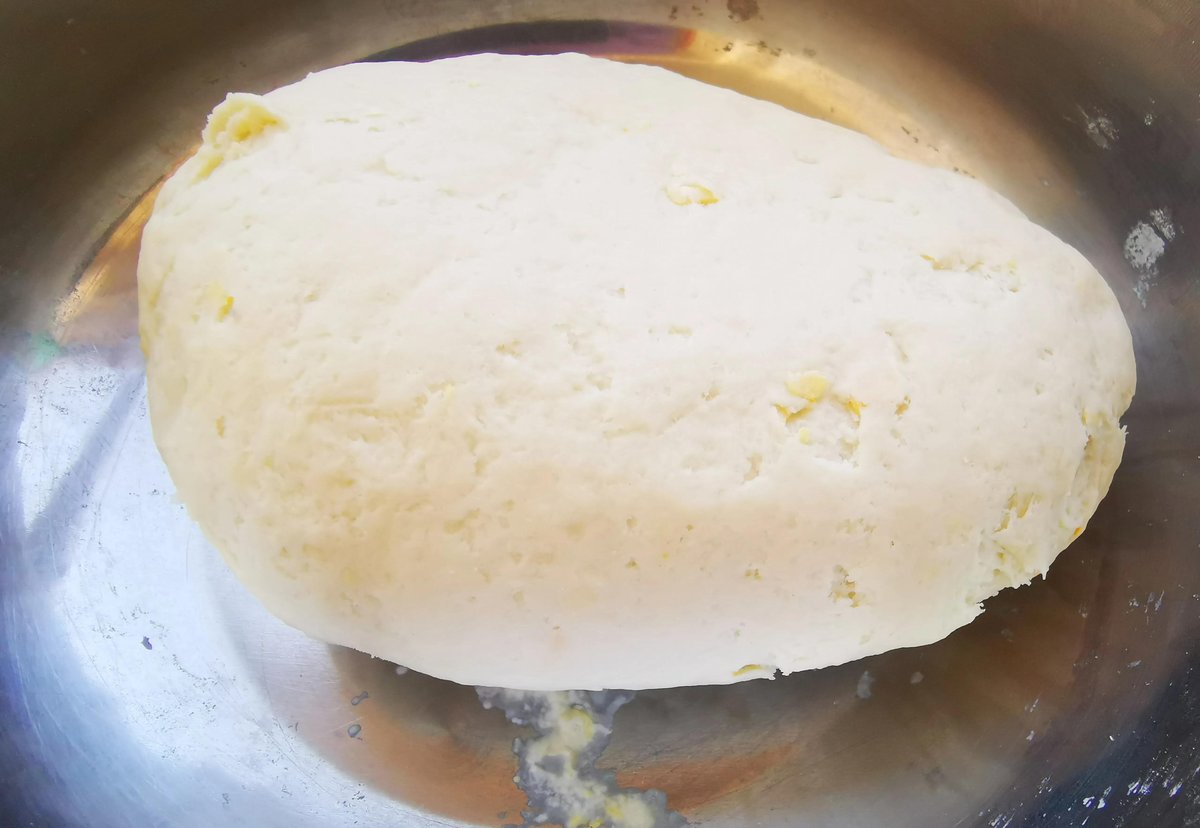
The first person who made me take this seriously was a flatmate from Baoji who moved into a two bedroom in Shanghai and immediately turned the kitchen into a workshop. He mixed dough at night, left it under a towel, and pulled it the next evening after work. He never measured anything and he was insufferable about it. The recipe is time, he said, which is the sort of thing you can only say if you come from a place where everybody already knows it.
The slap is not theatre. Bringing the strand down flat on the board does three jobs at once. It thins the middle of the noodle, it stretches the ends, and it knocks off the loose flour so the surface stays dry enough not to glue itself shut. Skip it and the belt cooks wrong, soft through the centre with ends that stay stubborn and raw.
Then the bowl gets built in about forty seconds. Onto the noodles go a handful of blanched greens, dried chili flakes by the spoonful, minced garlic, scallion, a pinch of salt. And then the oil. Rapeseed oil heated in a small pan until it just begins to shimmer and move, poured in one slow arc straight onto the chili. The sound is a hard hiss, then a crackle — and what comes off the bowl is nothing like raw chili. It is toasted, nutty, almost smoky. That oil is not cooking the noodles. It is cooking the chili, and the whole dish lives or dies inside that three second pour. Last come black vinegar and a splash of soy, and then you stir.
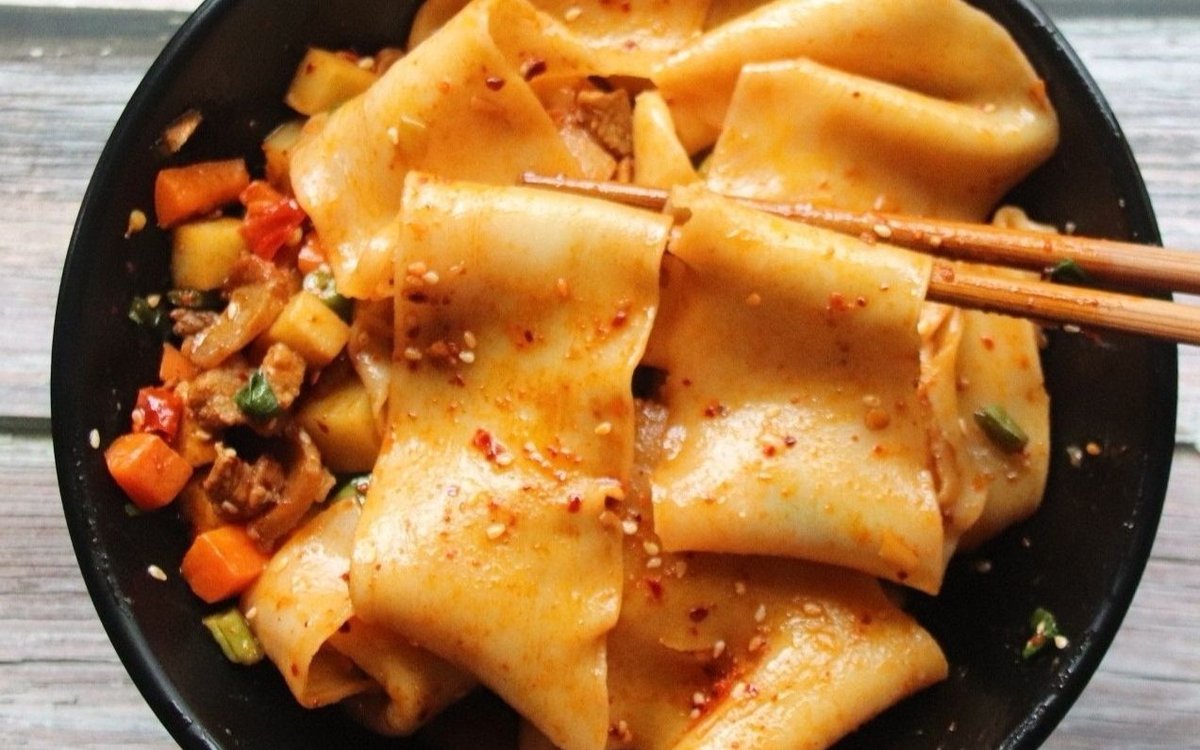
Xi'an will sell you three versions: the plain oil splash, one with tomato and egg, one with pork mince. Purists west of the city will tell you the other two are for tourists and children. They are also delicious. Order the plain one first.
How the Bowl Goes Wrong
Machine rolled imitations, first. They arrive uniform, like fettuccine that has had a hard life: the same width from end to end, faintly translucent, rubbery against the tooth. A real belt noodle is never the same width twice along its length, and it pushes back — 筋道, jīndào — the chewy resistance Shaanxi is proud of.
Second, cold oil and raw chili. If the flakes taste dusty and the oil sits on top of the bowl in an orange puddle instead of soaking into the pile, the pan was not hot enough. You get the smell of chili without the taste, which is a sad way to spend a lunch.
Third, no vinegar. This is the one people miss. Without acid the bowl turns heavy: starch, oil, chili, and nothing to cut through any of it. The right stuff is Qishan vinegar (岐山醋, qíshān cù), dark and malty, aged in jars, closer to balsamic than to the thin amber liquid on a supermarket shelf.
Fourth, the mall version. Sixty-eight yuan, served on a slate board with grilled chicken breast and a sweet tomato sauce pooled around the edge. That is not a lie about biang biang. That is a different dish wearing its clothes.
Eat It While the Oil Still Hisses
Stir from the bottom, immediately. Not a polite fold. Get underneath the noodles and turn the whole pile over, so the chili and garlic that sank come back up through the middle. The noodle is one continuous ribbon, so do not try to cut it into reasonable lengths. Lift, fold, bite. Vinegar goes in twice, a little before you mix and a splash more when you are halfway down, and the bowl changes character under you as you go.
To eat it the way it is eaten in Xi'an, peel a clove of raw garlic and bite it between mouthfuls, and order a cold bottle of bingfeng (冰峰), the orange soda that has been sold in that city since the fifties. The sweet fizz resets your mouth for the next pass. When the noodles are gone, drink the bowl of noodle water, 面汤 (miàn tāng), the cloudy liquid they were boiled in. It is not a garnish. 原汤化原食, yuán tāng huà yuán shí: the water that cooked the food helps you deal with the food. Say that to a Shaanxi grandmother and she will nod at you like you have finally said something useful.
There is no elegant way to eat it. The oil finds your chin, the belt slaps back, and you finish the bowl faster than you intended. Walking out into a cold Xi'an evening with chili on your breath is the advertisement. Not the character on the sign. The bowl.
💬 Comments