Fenjiu: The Clean One, and the Jars Buried in the Ground
The room is cold enough that nobody takes their coat off. It is early April in Fenyang, two hours' drive south of Taiyuan, and the tasting room has its radiator off because the man behind the table believes a warm room flatters bad liquor.
He pours three glasses and pushes the first across the wood. The liquid has no colour at all — not the gold of whisky, not the faint haze a young strong-aroma baijiu sometimes carries. Clear, with a hard bright line where the window hits it. I put my nose down and get almost nothing: a green pear, a little steamed sorghum, the smell of a rice bag opened that morning. Then I drink, and the alcohol arrives before the flavour does, clean and hot, and then it is gone.
Fenjiu. 汾酒. Fifty-three percent, from a village called Xinghua. If Moutai is the baijiu people argue about, Fenjiu is the one that argues a spirit should be judged by what it doesn't have.
A pit makes flavour. A jar refuses to
Walk into a strong-aroma distillery in Luzhou and the building itself smells like the inside of a compost heap that has been fed nothing but sorghum for four centuries. The pits are the point. Mud walls, a living crust of bacteria and yeast, and every batch of grain that goes down into them comes back up carrying ethyl caproate, the pineapple-and-sweat molecule that defines 浓香. Nobody sterilises a pit. Sterilising it would be like deleting the repository.
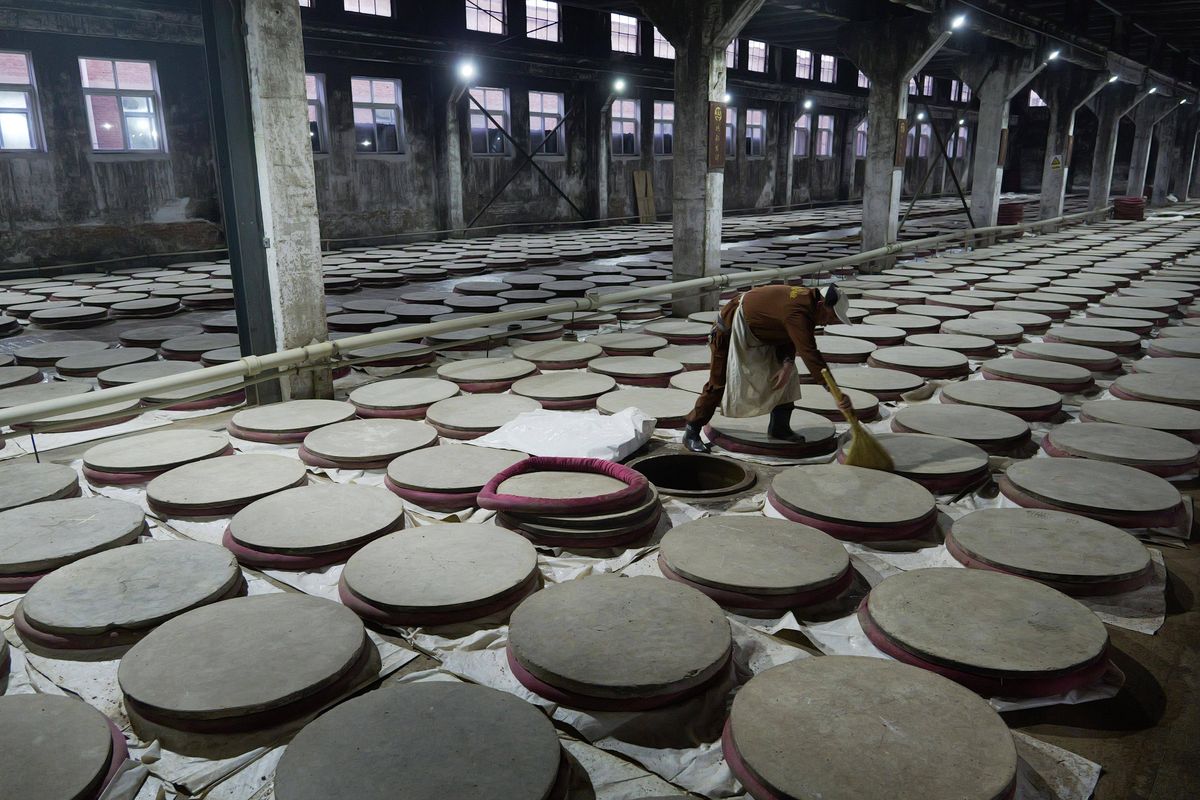
Fenjiu's answer, four hundred kilometres north and several centuries older, is to refuse the building entirely. The unglazed earthenware jars — 地缸 — are sunk into the workshop floor up to their rims, in rows, like the tops of barrels buried by someone who meant to come back for them. Grain goes into the jar. Never onto the floor, never against a wall. Between rounds the jars are scrubbed and scalded. As far as the ferment is concerned, the walls of the room are furniture.
I spent thirteen years watching build systems, and this is the difference between a build that inherits whatever happens to be installed on the machine and one that runs in a clean container. Strong aroma is a fork with four hundred years of patches nobody dares remove. Light aroma is a hermetic build, and it tastes like one.
Two rounds, not eight
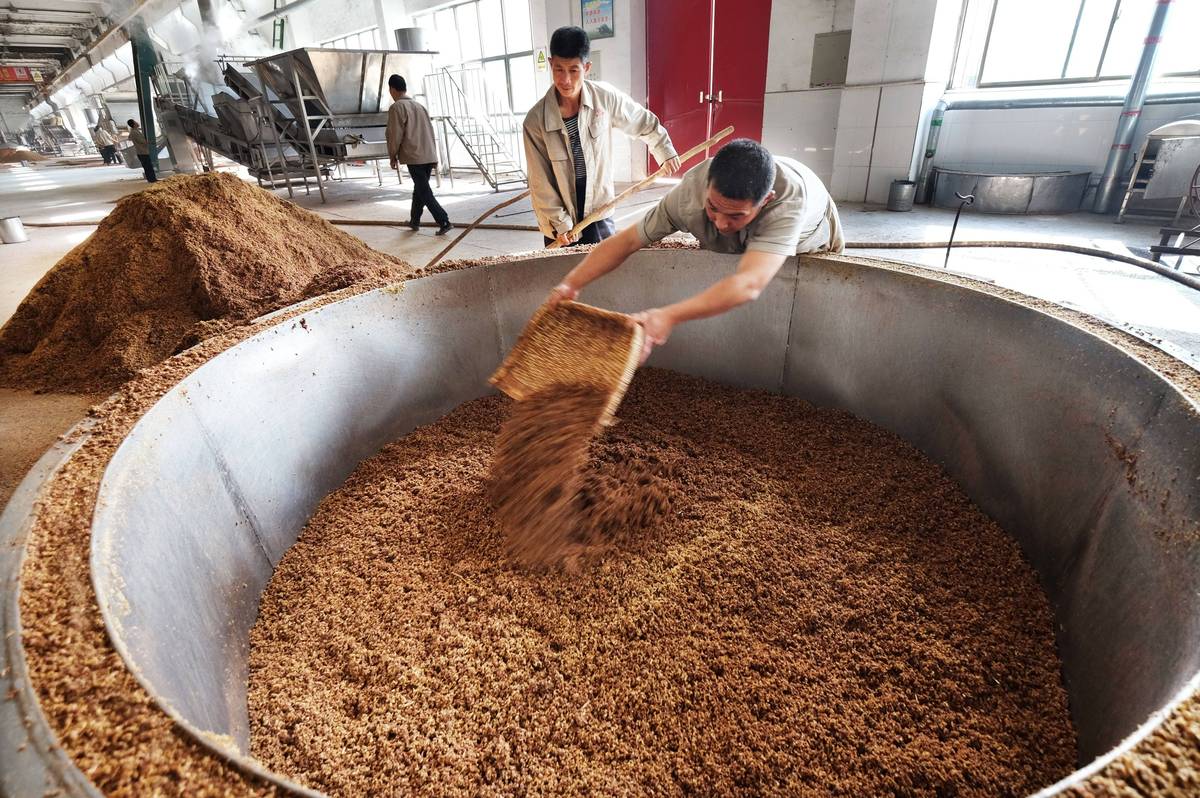
The method is called 清蒸二次清 — steam clean, twice; clear, twice. Sorghum is steamed, spread to cool, mixed with qu, packed into a jar and left for roughly four weeks. Then it is distilled. The spent grain is not thrown away: it gets steamed again, which drives off the sour, dusty notes a second fermentation would otherwise drag in, is dosed with fresh qu, and goes back for one more pass. Two rounds. That is the whole cycle.
Moutai runs eight rounds across a year; Luzhou's pits sit for sixty to ninety days a batch. Fenjiu's four weeks and two passes are why it is cheap by comparison — less grain per litre, less cellar time, less capital asleep in clay. They are also why the flavour is thin on purpose. The dominant ester is ethyl acetate, the solvent-and-pear note off a just-cut green apple. Almost none of the caproate that makes strong aroma smell like a warm bakery, none of the soy-and-clove compounds that make sauce aroma smell like fermented bean paste.
The national standard for the category, GB/T 10781.2, is unusually blunt about this. It asks for an aroma that is 清香纯正 — clear and pure, with ethyl acetate as the body of the composite aroma. It is a legal definition built mostly out of things that must not be in the glass.
Qin Hanzhang, the fermentation chemist who led a state survey of Fenjiu in 1964, is quoted in Chinese industry writing as calling it the cleanest baijiu in the country. He meant it analytically. Run a Fenjiu sample through a gas chromatograph and you get a short list. Run a Moutai sample through the same machine and you get hundreds of peaks, some of which nobody has managed to name.
Four lines, and a medal nobody can check
清明时节雨纷纷,路上行人欲断魂。
借问酒家何处有?牧童遥指杏花村。Rain, thick and fine, on the day of the dead. The traveller on the road is sick at heart. He asks: is there a tavern anywhere? The boy on the buffalo points at Xinghua Village.
That quatrain is why the village exists on the map for anyone outside Shanxi, and it is a small lesson in how Chinese cultural claims get made. The poem is attributed to Du Mu, who died in 852, but it does not appear in his collected works; the earliest text anyone has found is in a Song anthology three centuries later. Whether the Xinghua Village in the last line is this one in Fenyang, or one of a dozen others with the same name, scholars still argue. The village has settled it in its own favour: there is a statue, a museum, a distillery the size of a small city, and those four lines on the wall of every restaurant within thirty kilometres.
Two dates get recited by every guide in the building. In 1915, at the Panama-Pacific exposition in San Francisco, Fenjiu took a grand prize — the company's account, and the plaque is in the museum, though the fair's own records are less specific than the marketing. In October 1949, at the first state banquet of the new republic, the tables were set with Fenjiu, because it was what the north drank and the government had just moved to Beijing. Both stories are the kind of thing a distillery repeats until it becomes history. Both are also why the bottle looks the way it does: for most of the twentieth century light aroma was the template, and the Beijing distilleries making 二锅头 today are running this method in the capital.
How to drink something that isn't trying to impress you
Don't hunt for aroma. Swirl it like a whisky, go looking for a dozen notes, and you will find three, decide it is boring, and be wrong. Clean is the achievement. Judge the finish: good Fenjiu goes down warm, leaves no film at the back of your throat, and what stays behind is grain rather than sugar.
Serve it at whatever the room is. Northerners drink it at room temperature in cold rooms, and that combination keeps the alcohol from shouting. The fridge kills the pear; warming the glass in your hand, as you would with 黄酒, turns it into nail polish remover.
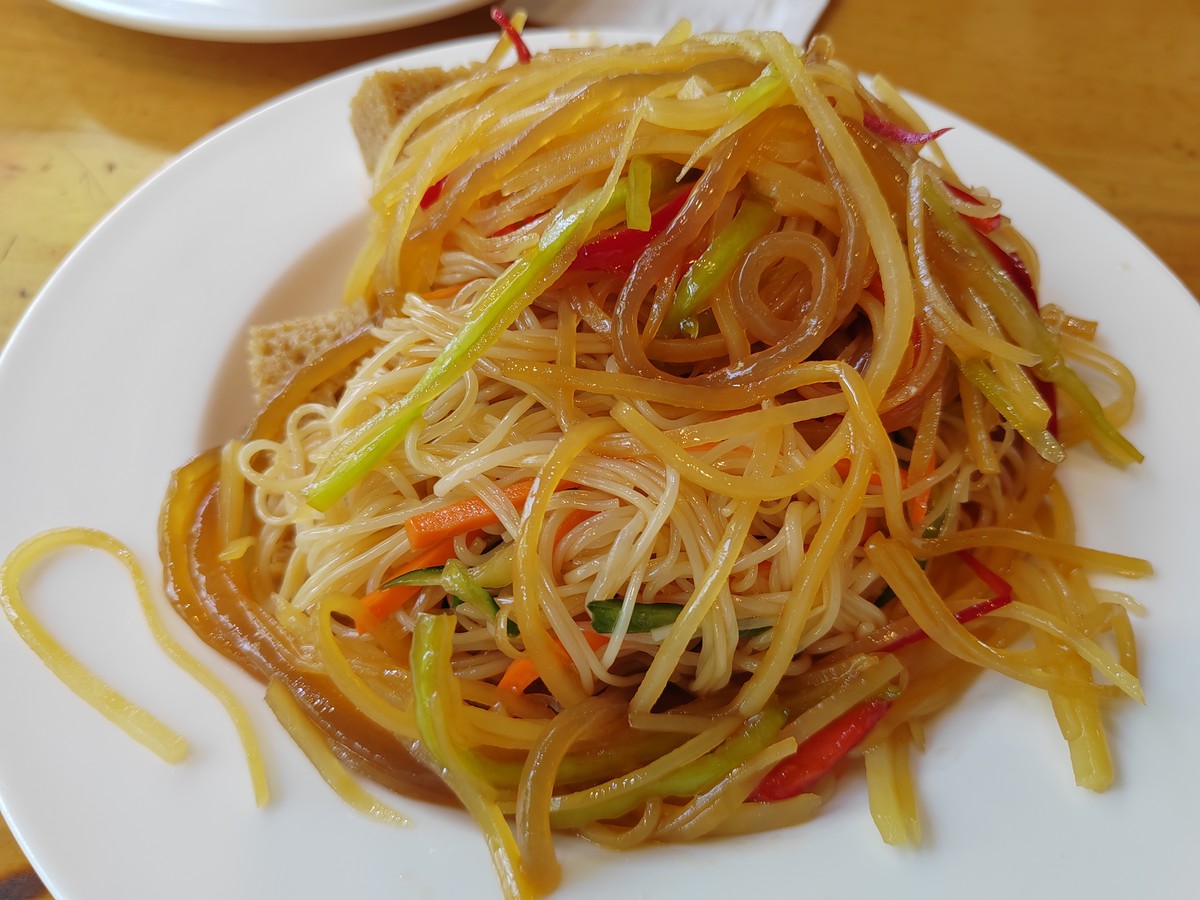
Keep the food light: cold dishes, cucumber in garlic, noodles with Shanxi's aged vinegar, boiled dumplings. A Sichuan hotpot erases it in two bites — not the spirit's fault, but a waste of the bottle.
For buying: the plain bottle with the yellow label is the honest benchmark — what people in Shanxi actually drink on a Tuesday, for less than a cocktail in most Western cities. The blue-and-white porcelain line is the same liquid with more years on it; if you want to know what the fuss is about, open that one. Skip anything sold as "aged" in a gift box. Light aroma does not deepen the way sauce aroma does, it only gets quieter. (More in After You Buy It.)
One thing took me years to accept. My first Fenjiu was at a dinner in Seattle, where an engineer from Taiyuan had carried a bottle through customs in his luggage and would not let anyone else open it. I thought someone had forgotten to flavour it. He waited, then said: now try the Moutai. The Moutai was enormous — soy, mushroom, dried fruit, the back room of a Chinese pharmacy. Then he poured me another Fenjiu, and I could taste the water in it, faintly mineral, sitting under the alcohol like a floor.
That is the trick of the clean one. It is not a smaller flavour. It is a flavour with the furniture taken out, so that you can hear the room.
Next: qu — the mouldy brick that makes every drink on this shelf possible, and why China ferments with a starter that a European brewer would throw away.